There are several types of MBA programs, but the four major formats are full-time MBA, part-time MBA, online MBA, and Executive MBA (EMBA).
You may also see programs described as one-year, two-year, hybrid, global, specialized, dual-degree, or deferred MBAs.
These labels don’t always describe the same thing. Some refer to how you study, others refer to how long you study, and others describe what you specialize in or when you apply.
Understanding these differences is important before comparing business schools.
According to MBA.com’s current MBA overview, full-time programs commonly take around one to two years, while part-time and online programs generally take longer. Executive MBA programs are usually structured for experienced professionals who continue working while studying.
Complete Guide: What is an MBA?
What Are the Main Types of MBA Programs?
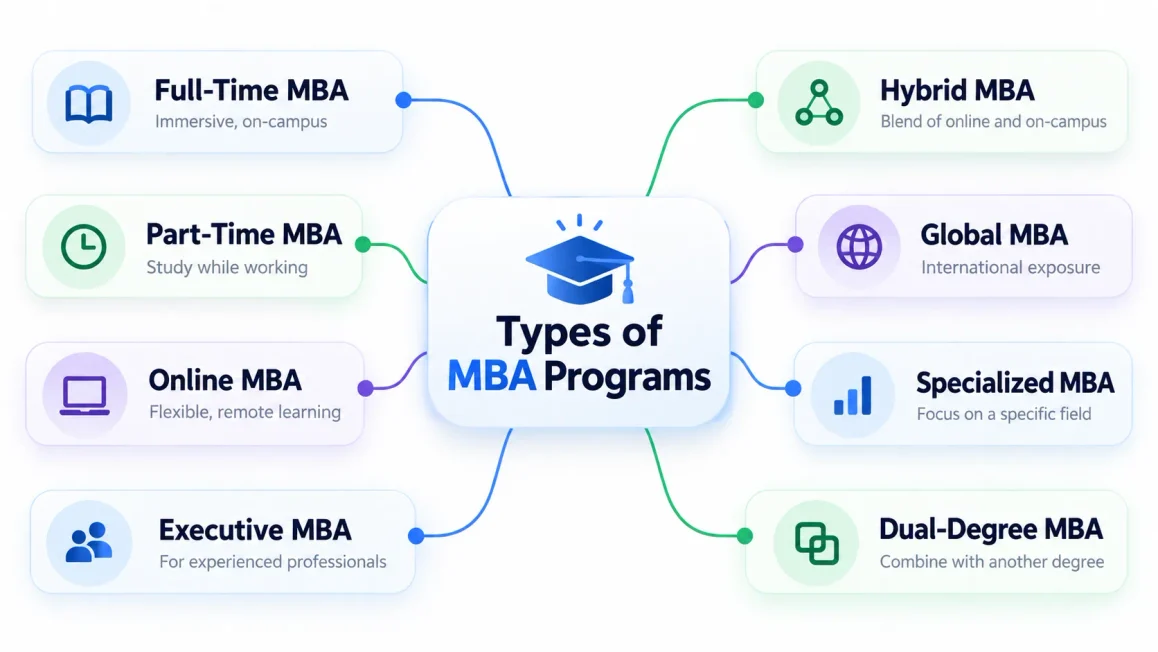
The most common MBA formats are:
- Full-Time MBA
- Part-Time MBA
- Online MBA
- Executive MBA
- Hybrid or Flexible MBA
- Global or International MBA
- Specialized MBA
- Dual or Joint-Degree MBA
You may also encounter deferred MBA programs, although deferred admission is better understood as a way of entering a future MBA program rather than a completely different MBA qualification. Harvard Business School’s current 2+2 program, for example, lets eligible students apply while still studying and then gain professional experience before starting the regular MBA program.
Before exploring each type, it helps to understand three different ways MBA programs can be classified.
| Classification | Example | What It Describes |
|---|---|---|
| Study format | Full-time, part-time, online | How you complete the MBA |
| Duration | One-year, two-year | How long the program normally takes |
| Academic focus | Finance, marketing, analytics | What you concentrate on |
| Career stage | Executive MBA | Who the program is designed for |
| Geographic focus | Global MBA | International orientation |
| Degree structure | MBA/JD, MBA/MA | Combining the MBA with another degree |
| Admission route | Deferred MBA | When you apply and enroll |
This distinction matters because one MBA can belong to several categories at once.
For example, someone could complete a two-year, full-time MBA with a finance concentration.
“Two-year,” “full-time,” and “finance” describe different aspects of the same MBA.
Quick Comparison of MBA Program Types
| MBA Type | Typical Student | Work While Studying? | Typical Format | General Duration |
|---|---|---|---|---|
| Full-Time MBA | Students focusing primarily on MBA study | Usually no | Campus-based | About 1–2 years |
| Part-Time MBA | Working professionals | Yes | Evening, weekend or blended | Usually 2+ years |
| Online MBA | Working professionals needing flexibility | Yes | Online | Often 2+ years |
| Executive MBA | Experienced managers/executives | Usually yes | Weekend, modular or blended | About 1–2 years |
| Hybrid MBA | Professionals seeking mixed delivery | Usually yes | Online + classroom | Varies |
| Global MBA | Students seeking international exposure | Depends | Campus, modular or multi-location | Varies |
| Specialized MBA | Students targeting a business field | Depends | Any MBA format | Varies |
| Dual MBA | Students wanting two qualifications | Depends | Integrated programs | Usually longer |
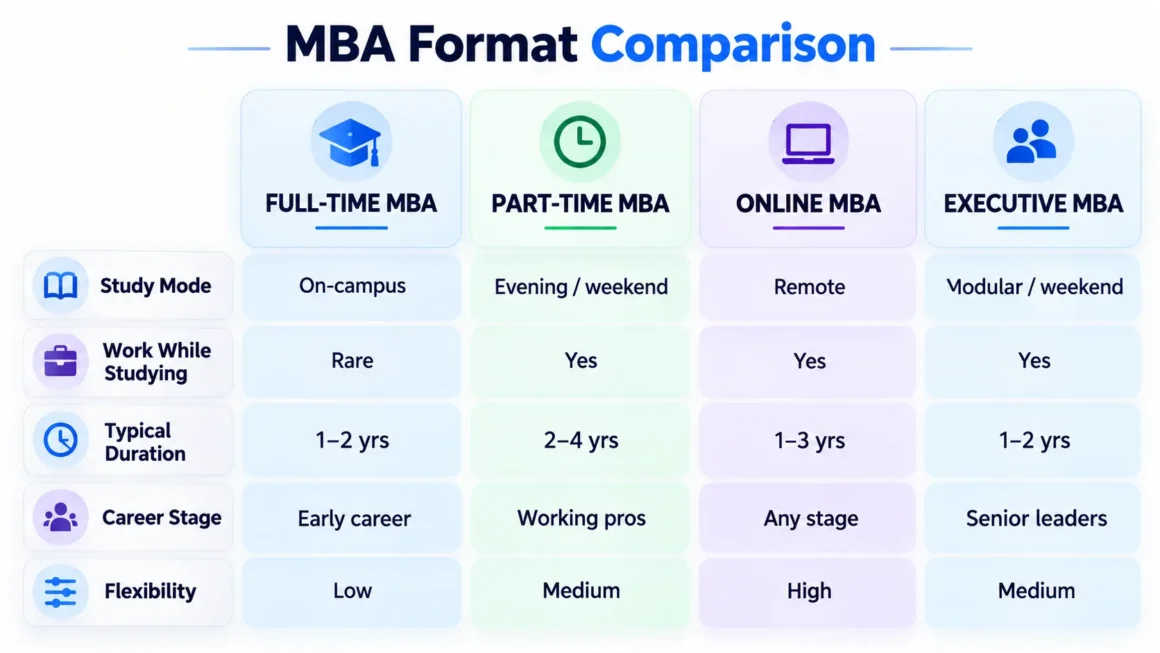
These are broad patterns rather than universal rules. Individual schools can structure programs differently. MBA.com specifically notes that MBA formats vary considerably across institutions.
1. Full-Time MBA
A full-time MBA is an immersive program in which business school becomes your primary commitment.
Students normally attend classes during the working week and generally step away from full-time employment while completing the degree.
Full-time MBA programs are especially useful for people who want:
- An immersive business-school experience
- Access to campus recruiting
- Internships
- Student clubs
- Extensive networking
- A major career transition
- Time to explore different industries or functions
MBA.com identifies one-year and two-year programs as the two major full-time MBA structures.
1.1 Two-Year Full-Time MBA
The traditional two-year MBA is particularly established in the United States.
The first year commonly provides foundations across subjects such as:
- Finance
- Accounting
- Marketing
- Economics
- Operations
- Strategy
- Leadership
Students can then have greater flexibility for electives, concentrations and advanced courses later in the program.
A major feature of many two-year MBA programs is the summer internship between the first and second academic years.
That internship can be particularly valuable for someone changing:
- Industry
- Job function
- Geography
- Career direction
MBA.com notes that two-year programs provide more time for electives, practical experiences and internships than accelerated alternatives.
Wharton’s current full-time MBA, for example, is a two-year campus-based program.
A two-year MBA may suit you if:
- You want to make a major career switch.
- You value an internship.
- You want a longer campus experience.
- You want more time for electives.
- You want extensive networking opportunities.
The disadvantage is obvious: spending two years away from full-time employment can create substantial tuition, living-expense and opportunity costs.
1.2 One-Year Full-Time MBA
A one-year MBA compresses the MBA experience into a much shorter period.
The curriculum can still cover core business disciplines, but the schedule is usually more intensive.
One-year formats are particularly common outside the traditional two-year US model. MBA.com notes that accelerated one-year MBA programs are especially common in Europe and parts of Asia.
Potential advantages include:
- Less time away from employment
- Faster graduation
- Lower living expenses in some cases
- Faster return to the workforce
Potential limitations include:
- Less time for internships
- Faster academic pace
- Less time to explore several career options
- A more compressed recruiting process
A one-year MBA can therefore make sense for someone who already understands where they want their career to go.
2. Part-Time MBA
A part-time MBA lets students complete an MBA while continuing their careers.
Instead of attending business school full time, students normally take classes:
- In the evening
- At weekends
- Online
- Through blended formats
- Through flexible modular schedules
MBA.com currently describes part-time MBAs as programs commonly designed for working professionals and typically lasting two years or longer.
The biggest advantage is that you normally do not have to leave your job.
That can mean:
- Continuing to earn a salary
- Continuing to accumulate professional experience
- Applying classroom ideas immediately at work
- Reducing the opportunity cost associated with leaving employment
However, combining a demanding job with graduate study can create a significant workload.
2.1 Evening MBA
An evening MBA schedules classes after normal working hours.
A student might work during the day and attend classes several evenings each week.
This structure can work well if:
- You live reasonably close to the school.
- Your work schedule is predictable.
- You want regular in-person interaction.
- You don’t want to leave your job.
The disadvantage is that balancing work, commuting, classes and personal commitments can become difficult.
2.2 Weekend and Flexible MBA
Some part-time MBA programs concentrate classes on:
- Fridays
- Saturdays
- Sundays
- Alternate weekends
- Intensive modules
Others combine online learning with periodic campus sessions.
MBA.com notes that part-time formats can include evening, weekend and blended delivery.
These schedules can be particularly useful for professionals who cannot attend classes several times during the working week.
3. Online MBA
An online MBA delivers most or all MBA coursework through digital learning platforms.
Students normally study without relocating and can often continue working full time.
MBA.com’s current overview describes online MBAs as flexible options for working professionals and notes that programs may be fully online or include residential components.
An online MBA may include:
- Recorded lectures
- Live virtual classes
- Online discussions
- Digital assignments
- Group projects
- Virtual presentations
- Online examinations
- Optional campus events
- Required residencies
Online MBAs are particularly attractive when geography or work commitments make regular campus attendance difficult.
But not all online programs work the same way.
3.1 Synchronous Online MBA
Synchronous learning happens at scheduled times.
For example, you may have to join a virtual finance class every Wednesday at 7 p.m.
The advantage is greater live interaction with:
- Professors
- Classmates
- Project teams
The disadvantage is reduced scheduling flexibility.
3.2 Asynchronous Online MBA
With asynchronous learning, much of the material can be completed within broader deadlines rather than at one fixed class time.
Students might watch lectures, complete readings and contribute to discussions when their schedule allows.
This format may suit:
- Professionals with irregular work schedules
- Parents
- International students across time zones
- Frequent travelers
However, it requires strong self-discipline and time-management skills.
3.3 Online MBA With Residential Components
“Online” does not always mean 100% remote.
Some programs combine online coursework with short in-person experiences.
MBA.com notes that online MBA programs may include residential periods in addition to virtual study.
These periods can be used for:
- Networking
- Leadership workshops
- Team projects
- Company visits
- Intensive classes
Always check the attendance requirements before applying, particularly if international travel would be required.
4. Executive MBA
An Executive MBA, or EMBA, is designed primarily for experienced professionals who want advanced management education while continuing their careers.
Unlike a traditional full-time MBA student, an EMBA participant is typically already well established professionally.
MBA.com describes Executive MBA programs as part-time programs aimed at experienced executive-level professionals, while Wharton describes its EMBA as a format intended for people further along in their careers who usually continue working full time.
4.1 Who Is an Executive MBA Designed For?
Executive MBA cohorts often include:
- Senior managers
- Department heads
- Directors
- Founders
- Entrepreneurs
- Executives
- Experienced professionals moving toward senior leadership
Programs may emphasize:
- Leadership
- Strategy
- Executive decision-making
- Organizational management
- Finance
- Global business
- Innovation
- Peer learning
The experience level required varies by institution.
Current MBA.com guidance notes that many EMBA participants have extensive professional experience, while individual schools establish their own requirements.
4.2 Executive MBA vs Part-Time MBA
These two formats are often confused because both can let you work while studying.
The difference is mainly the career stage and cohort profile.
| Factor | Part-Time MBA | Executive MBA |
|---|---|---|
| Typical audience | Working professionals | More experienced professionals and leaders |
| Work during program | Usually yes | Usually yes |
| Schedule | Evening, weekend, hybrid | Weekend, modular, blended |
| Career stage | Early to mid-career can participate | Generally mid-to-senior career |
| Leadership emphasis | Varies | Usually stronger |
| Peer experience | Mixed | Typically more experienced |
An Executive MBA is not necessarily academically “higher” than an MBA.
At some schools, the difference is primarily program structure and student profile. For example, Wharton states that its full-time and Executive MBA students earn the same MBA degree through different formats.
That should not be assumed for every university, however. Always verify the exact qualification awarded by a particular school.
5. Hybrid or Flexible MBA
A hybrid MBA combines online and in-person learning.
You might:
- Watch lectures online
- Complete assignments remotely
- Attend campus on selected weekends
- Participate in periodic residential sessions
“Hybrid” is therefore usually better understood as a delivery method rather than a completely separate academic qualification.
A hybrid MBA could also be:
- Part-time
- Executive
- Global
- Flexible
For example, MBA.com notes that modern MBA programs increasingly combine virtual and face-to-face learning across multiple traditional MBA categories.
Hybrid programs can offer a useful compromise between:
Campus interaction + online flexibility
They may suit professionals who want face-to-face networking but cannot commute to campus several times each week.
6. Global or International MBA
A Global MBA or International MBA usually places greater emphasis on international business.
The program may include:
- International classmates
- Global case studies
- International strategy
- Cross-cultural management
- Overseas study
- International consulting projects
- Courses at multiple campuses
- Business trips or immersion programs
MBA.com describes Global or International MBA programs as programs that retain core MBA content while placing additional emphasis on international management and global business.
However, “Global MBA” is not one standardized format.
One university’s Global MBA may be:
- Full time
while another might be:
- Online
- Executive
- Modular
- Hybrid
Read the actual curriculum instead of choosing a program because the word global appears in its name.
7. Specialized MBA
An MBA is traditionally a general management degree, but many schools allow students to build deeper expertise in a specific area.
This may be described as a:
- Specialization
- Concentration
- Major
- Track
- Pathway
7.1 Common MBA Specializations
Depending on the institution, options can include:
- Finance
- Marketing
- Business Analytics
- Entrepreneurship
- Human Resource Management
- Operations
- Supply Chain Management
- Healthcare Management
- Technology Management
- Sustainability
- International Business
- Strategy
MBA.com currently lists areas such as finance, marketing, entrepreneurship, healthcare management, business analytics and HR among MBA specialization options.
7.2 Program Format vs MBA Specialization
This distinction is important.
Full-time MBA describes how you study.
Finance MBA describes what you focus on.
A student could therefore complete:
Full-Time MBA + Finance concentration
Another could complete:
Online MBA + Business Analytics concentration
A specialization should not automatically be treated as a completely different type of degree.
When comparing programs, first decide how you want to study, then examine what you want to study.
8. Dual or Joint-Degree MBA
A dual or joint-degree MBA combines the MBA with another academic qualification.
Examples can include:
- MBA + JD
- MBA + MA
- MBA + engineering degree
- MBA + public policy degree
- MBA + healthcare-related degree
The purpose is to combine general management education with expertise in another discipline.
Wharton, for example, currently lists integrated joint-degree opportunities that combine its MBA with qualifications in areas such as international studies and law.
Dual-degree programs can be useful if your target career genuinely requires knowledge from both fields.
However, consider:
- Additional tuition
- Longer duration
- Higher workload
- Whether both qualifications are actually necessary
A second degree only adds value when it supports a clear objective.
9. Deferred MBA
A deferred MBA is usually not a different MBA curriculum.
Instead, it is an admissions pathway.
You apply before gaining the amount of professional experience normally expected for a traditional MBA, secure admission, work for a period, and then enroll later.
9.1 How Deferred MBA Admission Works
A simplified pathway looks like this:
Final year of university → Apply → Gain admission → Work for several years → Start MBA
Harvard Business School’s current 2+2 program allows eligible students to apply during their final year of college or a qualifying full-time master’s program. Successful applicants then gain between two and four years of professional experience before enrolling in the regular HBS MBA.
Stanford GSB also currently offers deferred enrollment, allowing eligible admitted students to spend between one and four years gaining professional experience before beginning the MBA.
9.2 Who Can Consider a Deferred MBA?
Deferred admission may be worth researching if:
- You are near the end of university.
- You already expect an MBA to fit your long-term plans.
- You have strong academic performance.
- You have demonstrated leadership.
- You want to gain professional experience before business school.
Eligibility differs significantly by institution, so always check the school’s current admissions rules.
10. How to Choose the Right Type of MBA
There is no single MBA format that is appropriate for everyone.
Start with your situation rather than the program’s marketing.
10.1 Consider Your Career Goal
Ask:
What exactly should change after I complete my MBA?
Possible goals include:
- Switching industries
- Moving into management
- Reaching executive leadership
- Changing job functions
- Building a company
- Learning general management
- Developing business knowledge alongside technical expertise
The clearer your goal, the easier it becomes to evaluate programs.
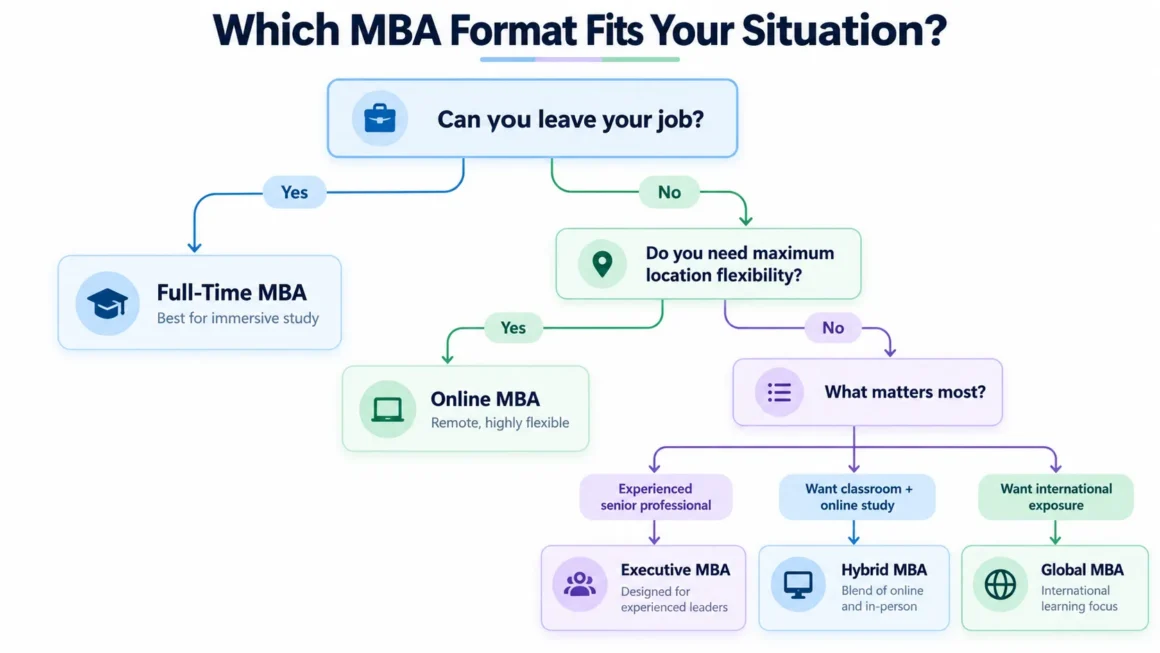
10.2 Decide Whether You Can Leave Your Job
If you can pause employment and want an immersive experience, a full-time MBA may deserve consideration.
If you need to continue working, investigate:
- Part-time MBA
- Online MBA
- Hybrid MBA
- Executive MBA
Remember to compare more than tuition.
Leaving work also creates an opportunity cost because you give up income during the program.
10.3 Consider Your Work Experience
Career stage matters.
Someone with relatively limited professional experience may be better matched to a traditional MBA cohort than an Executive MBA designed around experienced managers.
Conversely, a senior professional may prefer an EMBA cohort where classmates face similar leadership challenges.
10.4 Compare Time Commitment
Ask how many hours per week the program realistically requires.
Consider:
- Classes
- Reading
- Assignments
- Group projects
- Travel
- Exams
- Recruiting activities
- Networking
A flexible MBA can still be academically demanding.
10.5 Calculate the Total Cost
Calculate:
Tuition + Fees + Travel + Living Costs + Financing Costs + Lost Income
A shorter program is not automatically cheaper, and an online program is not automatically inexpensive.
Use the actual fees of each school you are considering.
10.6 Examine Career Support
Career services can differ dramatically between formats.
Investigate:
- Internship opportunities
- Campus recruiting
- Employer events
- Career coaching
- Alumni access
- Job boards
- Industry networking
- Career-switching support
This is particularly important if your main goal is to change careers.
10.7 Compare Curriculum and Specializations
Check whether the school teaches subjects relevant to your goal.
For example, someone targeting technology product management might value coursework in:
- Strategy
- Marketing
- Analytics
- Entrepreneurship
- Technology management
- Product development
Don’t select a program purely because it has many electives.
Choose electives that support your actual career plan.
10.8 Check Delivery Format
For online and hybrid programs, investigate:
- Live vs recorded classes
- Attendance requirements
- Campus residencies
- Time-zone requirements
- Group-project expectations
- Exam arrangements
- Networking opportunities
A program advertised as flexible may still contain mandatory scheduled sessions.
Which Type of MBA Fits Different Students?
The following table provides a simple starting point rather than a universal recommendation.
| Situation | MBA Formats to Research |
|---|---|
| Want an immersive campus experience | Full-Time MBA |
| Want a traditional internship opportunity | Two-Year Full-Time MBA |
| Want a faster full-time program | One-Year MBA |
| Need to keep working | Part-Time MBA |
| Need location flexibility | Online MBA |
| Want online learning plus campus interaction | Hybrid MBA |
| Experienced manager seeking leadership development | Executive MBA |
| Want significant international exposure | Global/International MBA |
| Want deeper expertise in one business area | MBA with specialization |
| Need management plus another professional discipline | Dual/Joint MBA |
| Final-year student planning an MBA later | Deferred MBA pathway |
The right choice depends on the specific school, your experience, and your goals—not simply the label attached to the program.
Common Mistakes When Comparing MBA Types
One common mistake is treating every MBA label as a completely different degree.
Another is choosing based only on program duration.
Avoid these mistakes:
- Assuming an online MBA is automatically easier
- Assuming an Executive MBA is simply a “better” MBA
- Confusing specialization with program format
- Ignoring lost salary when comparing costs
- Choosing a one-year program only because it is faster
- Assuming all part-time programs offer the same flexibility
- Ignoring residency requirements in an online program
- Choosing a Global MBA based only on its name
- Ignoring recruiting differences between formats
- Looking at rankings without considering career fit
A better approach is to compare format + curriculum + career support + total cost + student profile + outcomes together.
Final Thoughts
There isn’t just one way to earn an MBA.
The major types of MBA programs include full-time, part-time, online, and Executive MBA programs, while hybrid, global, specialized, and dual-degree options add further flexibility.
The most important distinction is this:
Program format tells you how you study.
Program duration tells you how long you study.
Specialization tells you what you focus on.
Career-stage labels such as Executive MBA tell you who the program is primarily designed for.
Understanding those differences makes comparing business schools much easier.
Instead of asking only, “Which MBA type is best?”, ask:
“Which MBA format best fits my career goal, experience, schedule, finances and preferred way of learning?”
That question will give you a much more useful starting point.
FAQs
1 How Many Types of MBA Programs Are There?
There is no universally fixed number because MBA programs can be classified by delivery format, duration, specialization and career stage. The major formats are full-time, part-time, online and Executive MBA programs. Other commonly used categories include hybrid, global, specialized and dual-degree MBAs.
2 What Are the Four Main Types of MBA?
The four major formats are:
- Full-time MBA
- Part-time MBA
- Online MBA
- Executive MBA
Business schools may offer additional variations within these categories.
3 What Is the Difference Between a One-Year and Two-Year MBA?
Both are generally full-time MBA formats. A one-year program compresses the curriculum into a shorter period, while a two-year MBA provides more time for electives, networking and, in many programs, a summer internship.
4 What Is the Difference Between an MBA and an Executive MBA?
A traditional full-time MBA usually requires students to focus primarily on school, while an Executive MBA is designed around experienced professionals who normally continue working. The exact degree structure and requirements vary by institution.
5 Can I Work While Completing an MBA?
Yes. Part-time, online, hybrid and Executive MBA programs are commonly designed so students can remain employed while studying.
6 Is an Online MBA the Same as a Regular MBA?
An online MBA uses online delivery, but curriculum, degree designation, faculty and in-person requirements vary between schools. Some institutions may offer a closely comparable curriculum across formats, while others design their online programs differently. Check the specific university rather than assuming all online MBAs are identical.
7 What Is a Specialized MBA?
A specialized MBA combines general management education with additional coursework in an area such as finance, marketing, analytics, healthcare or entrepreneurship.
8 Is a Global MBA a Separate Degree?
Not necessarily. “Global MBA” generally signals stronger international content or exposure, but its actual delivery format varies between schools. It may be full-time, online, hybrid or executive.
9 What Is a Deferred MBA?
A deferred MBA pathway allows eligible students to apply before gaining traditional pre-MBA work experience and enroll later after working for a specified period. Harvard’s 2+2 and Stanford’s deferred enrollment pathways are current examples.
10 Which Type of MBA Should I Choose?
Choose based on your career objective, professional experience, ability to leave work, preferred learning format, total cost and desired career support. The program label alone should not determine your decision.
Related Articles
| What Is a Full-Time MBA? |
| One-Year MBA vs Two-Year MBA |
| What Is a Part-Time MBA? |
| What Is an Online MBA? |
| What Is an Executive MBA? |
| MBA vs Executive MBA |
| Online MBA vs Traditional MBA |
| Full-Time vs Part-Time MBA |
| What Is a Global MBA? |
| What Is a Specialized MBA? |
| Best MBA Specializations Explained |
| What Is a Dual MBA Degree? |
| What Is a Deferred MBA? |
| MBA Eligibility Requirements |
| MBA Admission Requirements |
| How Long Does an MBA Take? |
| How Much Does an MBA Cost? |
| Is an MBA Worth It? |