An MBA can teach you how to read a balance sheet, build a marketing strategy, analyze a market, calculate ROI, and understand how businesses operate.
But there is another part of an MBA that is harder to measure.
Can you explain your idea clearly when five people disagree with you?
Can you lead a group project when nobody wants to take responsibility?
Can you present bad news without creating panic?
Can you negotiate without damaging a relationship?
Can you listen to feedback without becoming defensive?
These are soft skills, and they can have as much influence on your career as the technical knowledge you gain during an MBA.
That is becoming even more important as artificial intelligence handles more routine analysis and information work. GMAC’s 2026 research found that communication, problem-solving, and adaptability were among the skills employers most valued when hiring graduate business talent. Employers also continue to place substantial value on teamwork, decision-making, leadership, and emotional intelligence.
For an MBA student, therefore, the goal should not simply be to become better at finance, marketing, operations, or strategy.
The goal is to become someone who can use business knowledge effectively with other people.
This guide explains the most important soft skills for MBA students, why employers care about them, how they appear in real business situations, and how you can develop them during your MBA.
What Are Soft Skills?
Soft skills are the interpersonal, behavioral, and thinking skills that influence how you work with other people and respond to situations.
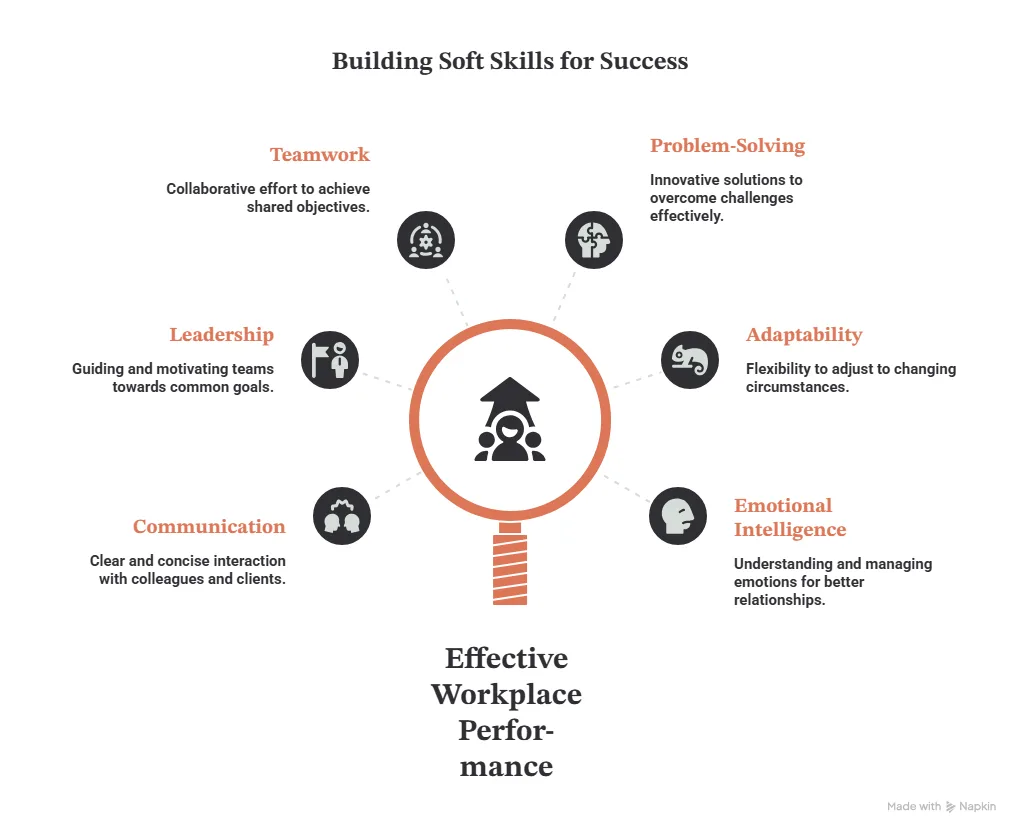
They include abilities such as:
- communication
- leadership
- teamwork
- problem-solving
- adaptability
- emotional intelligence
- negotiation
- decision-making
- time management
- conflict resolution
They are sometimes called people skills, professional skills, transferable skills, or interpersonal skills.
The word “soft” can be misleading.
There is nothing easy about leading a difficult team meeting, persuading a skeptical client, making an unpopular decision, or resolving conflict between two employees.
These skills can be difficult to develop precisely because they cannot be mastered simply by memorizing a formula.
They improve through experience, feedback, reflection, and repeated practice.
Why Soft Skills Matter for MBA Students
MBA programs prepare students for roles in which they are expected to make decisions, influence people, solve problems, and take responsibility.
That changes the type of skills you need.
An analyst may be rewarded primarily for producing accurate analysis.
A manager may need to understand that same analysis and then explain it to senior leadership, persuade colleagues to act on it, manage resistance, assign responsibilities, and make sure the plan actually gets executed.
Technical knowledge gets you part of the way.
Soft skills help you turn that knowledge into results.
LinkedIn’s 2026 skills research also points toward growing demand for areas such as team management, cross-functional collaboration, mentorship, executive communication, stakeholder communication, and public speaking.
What Employers Value in Business Graduates
GMAC’s 2026 Corporate Recruiters Survey provides a useful picture of what employers currently value when hiring graduate management education candidates.
Employer Demand for Selected Skills
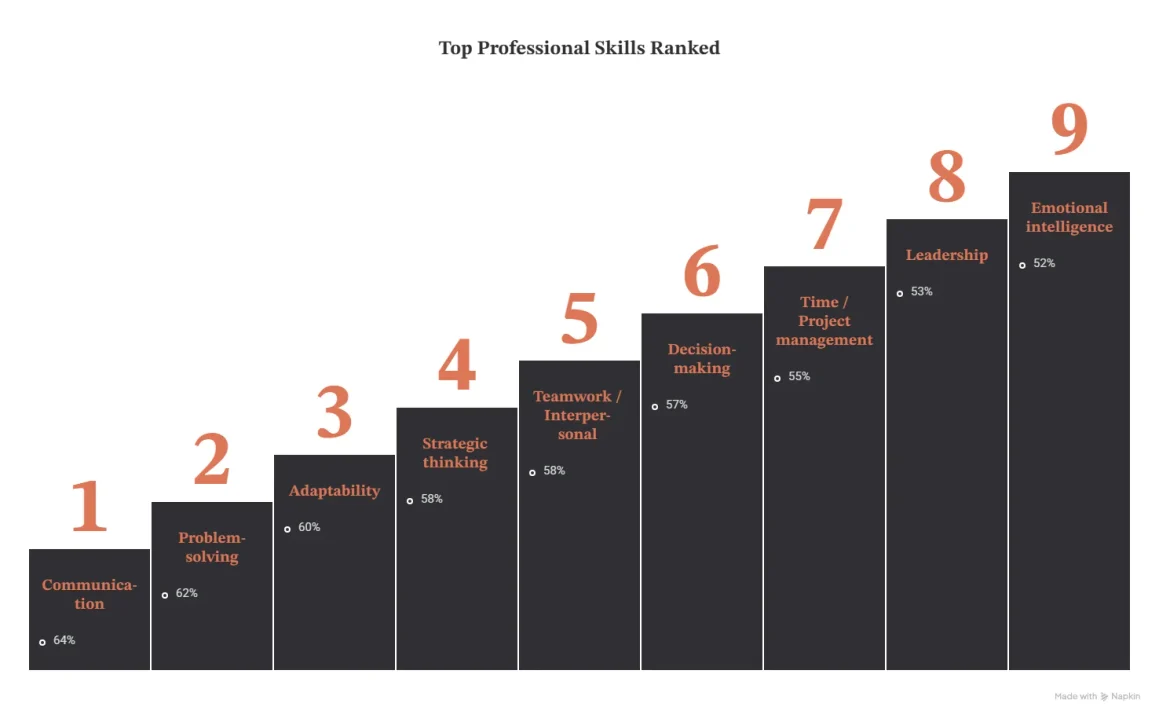
Source: GMAC Corporate Recruiters Survey 2026. Percentages represent the share of surveyed employers identifying these areas as important in hiring decisions for graduate management education talent.
The message is useful for MBA students.
Employers are not choosing between technical skills and human skills.
They increasingly want both.
15 Essential Soft Skills for MBA Students
1. Communication Skills
Communication is one of the most important skills an MBA student can develop.
Business communication is not simply about speaking fluent English or using impressive vocabulary.
Good communication means getting the right message to the right person in a way they can understand and act upon.
Imagine that your team has spent two weeks analyzing a new market.
Your analysis may be excellent.
But if your presentation is confusing, senior management may never understand why your recommendation matters.
A good communicator can take something complicated and make it clear.
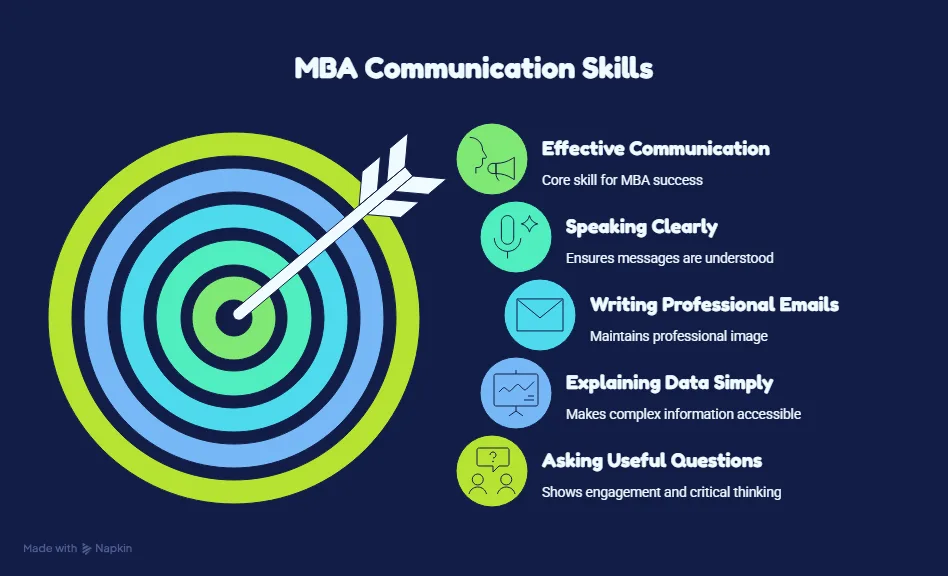
MBA students should practice:
- speaking clearly in meetings
- writing professional emails
- explaining data simply
- asking useful questions
- listening without interrupting
- giving concise updates
- adapting communication to different audiences
- writing executive summaries
- presenting recommendations
One useful rule is:
Do not try to sound intelligent. Try to make the idea easy to understand.
That distinction can dramatically improve professional communication.
2. Leadership
Leadership is often misunderstood as being the loudest person in a room.
It is not.
Leadership is the ability to help people move toward a goal.
Sometimes that requires giving direction.
Sometimes it requires listening.
Sometimes it requires making an uncomfortable decision.
And sometimes it simply means taking responsibility when everyone else is waiting for someone to act.
MBA students get many opportunities to practice leadership through group projects, student organizations, competitions, internships, consulting projects, and classroom discussions.
You do not need a management title to practice leadership.
You can demonstrate it by:
- taking ownership
- setting clear expectations
- helping a team stay focused
- resolving disagreements
- supporting weaker team members
- making decisions when information is incomplete
- admitting mistakes
- giving credit to others
Strong leaders create clarity rather than confusion.
3. Teamwork and Collaboration
Very few important business problems one person can solve.
A marketing manager may need finance approval.
Finance may need sales forecasts.
Sales may depend on product development.
Product development may depend on operations.
This is why collaboration matters.
MBA students often work with classmates from different cultures, industries, personalities, experience levels, and ways of thinking.
That can sometimes feel frustrating.
It is also excellent preparation for the workplace.
Good teamwork means learning how to contribute without dominating and disagree without becoming personal.
A strong team member:
- completes work on time
- communicates early when there is a problem
- listens to other viewpoints
- shares useful information
- accepts feedback
- supports group decisions
- gives credit fairly
- focuses on the problem rather than the person
Employers increasingly value cross-functional collaboration because modern work frequently requires coordination across teams rather than within a single department.
4. Problem-Solving
Businesses hire people to solve problems.
Revenue is falling.
Customers are leaving.
Costs are increasing.
A project is late.
Employees are disengaged.
A competitor has entered the market.
The ability to look at a messy situation and create a logical path forward is extremely valuable.
Problem-solving does not mean immediately answering.
Strong problem-solvers first understand the problem.
A simple process is:
Identify the problem
        ↓
Separate facts from assumptions
        ↓
Find the root cause
        ↓
Generate possible solutions
        ↓
Compare costs, risks and benefits
        ↓
Choose an approach
        ↓
Take action
        ↓
Measure the result
        ↓
Learn and improve
This habit is useful in almost every MBA specialization.
5. Strategic Thinking
Strategic thinking means looking beyond the immediate task and understanding the wider business impact.
Suppose sales can be increased by offering a large discount.
That sounds positive.
But what happens to profit margins?
Will customers expect the lower price in the future?
Will the discount damage the premium positioning of the brand?
Could competitors respond?
A strategic thinker considers these second-order effects.
They ask questions such as:
- What happens next?
- Why are we doing this?
- What assumptions are we making?
- What could competitors do?
- What are we giving up by choosing this option?
- Does this decision support our long-term objective?
Strategic thinking was also among the skills highly valued by employers in GMAC’s 2026 recruiter research.
6. Adaptability
Your MBA will not prepare you for every situation you will encounter during your career.
No course can.
Industries change.
Technology changes.
Organizations restructure.
Customer expectations change.
Jobs disappear, and new roles emerge.
Adaptability is the ability to adjust without losing effectiveness.
For an MBA student, that might mean learning a new technology, changing your project strategy after receiving new data, working with an unfamiliar team, or entering an industry you had never previously considered.
Being adaptable does not mean constantly changing direction.
It means being willing to change when the evidence tells you that your original approach is no longer the best one.
GMAC reported adaptability as one of the top skills employers valued in 2026.
7. Emotional Intelligence
A technically correct manager can still be a terrible manager.
Why?
Because management involves people.
Emotional intelligence is your ability to understand and manage your own emotions while recognizing how other people may be feeling.
It includes:
- self-awareness
- self-control
- empathy
- social awareness
- relationship management
Consider two managers receiving criticism.
One immediately becomes defensive.
The other asks questions, considers whether the feedback is valid, and decides what to improve.
The difference is not technical intelligence.
It is emotional management.
MBA students can develop emotional intelligence by becoming more aware of how they react during disagreement, stress, competition, failure, and uncertainty.
8. Decision-Making
Business decisions rarely come with perfect information.
Managers often have to decide while facing uncertainty.
Should a company launch now or wait?
Hire another employee or outsource?
Enter a market or stay focused on the current one?
Increase price or accept lower margins?
A good decision-maker does not simply trust instinct.
They combine information, experience, judgment, risk assessment, and business objectives.
A useful decision framework is:
| Step | Question |
|---|---|
| Define | What decision actually needs to be made? |
| Evidence | What information do we have? |
| Options | What realistic choices exist? |
| Impact | What are the likely outcomes? |
| Risk | What could go wrong? |
| Decision | Which option best supports the objective? |
| Review | Did the decision produce the expected result? |
Decision-making was identified by 57% of employers in GMAC’s 2026 survey as an important skill for current GME graduates.
9. Time Management
MBA students quickly discover that there is always more that could be done.
Classes compete with assignments.
Assignments compete with recruiting.
Recruiting competes with networking.
Networking competes with competitions, clubs, internships, and personal life.
Trying to do everything equally well is usually impossible.
Time management is therefore less about creating a perfect schedule and more about deciding what deserves your attention.
Try dividing tasks into four groups:
| Importance | Action |
|---|---|
| Important + Urgent | Do it now |
| Important + Not Urgent | Schedule it |
| Not Important + Urgent | Delegate or simplify |
| Not Important + Not Urgent | Reduce or remove |
MBA students who learn prioritization early are often better prepared for management roles where demands multiply rather than disappear.
10. Negotiation
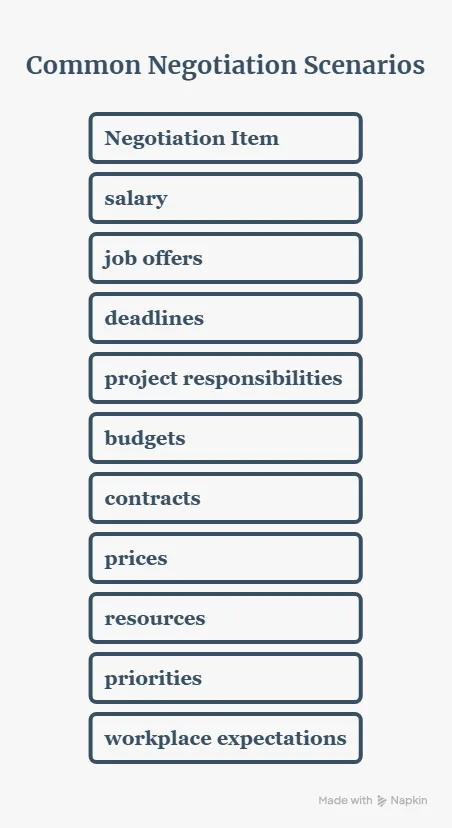
Negotiation happens far more often than most students realize.
You negotiate:
- salary
- job offers
- deadlines
- project responsibilities
- budgets
- contracts
- prices
- resources
- priorities
- workplace expectations
Good negotiation is not about defeating the other person.
The strongest agreements often create acceptable value for both sides.
Before entering an important negotiation, understand:
Your ideal outcome
What would you like to achieve?
Your minimum acceptable outcome
At what point would the agreement no longer make sense?
Your alternative
What will you do if no agreement is reached?
The other side’s interests
What are they actually trying to achieve?
The more clearly you understand these four areas, the less likely you are to negotiate emotionally.
11. Conflict Resolution
Wherever people work together, disagreement will occur.
Avoiding all conflict is unrealistic.
The useful skill is learning how to handle disagreement productively.
Poor conflict sounds like:
“You never listen.”
Useful conflict sounds like:
“We seem to disagree about the launch date. Let’s compare the assumptions behind each option.”
The second version moves attention away from personalities and toward the actual problem.
When handling conflict:
- Define the issue clearly.
- Let each person explain their position.
- Identify areas of agreement.
- Separate facts from interpretations.
- Focus on shared objectives.
- Generate possible solutions.
- Agree on specific next steps.
Conflict handled well can actually improve a decision because it forces teams to examine assumptions they might otherwise ignore.
12. Networking and Relationship Building
Networking is often treated as collecting LinkedIn connections.
That is a very limited view.
Real professional networking is relationship building.
It involves curiosity, generosity, consistency, and trust.
Instead of approaching someone with:
“What can this person do for me?”
Try:
“What can I learn from this person, and how can I build a genuine professional relationship?”
MBA programs provide unusual access to classmates, alumni, professors, recruiters, executives, entrepreneurs, and guest speakers.
Those relationships may remain useful for decades.
A simple networking cycle looks like this:
Meet
  ↓
Ask thoughtful questions
  ↓
Listen
  ↓
Find common ground
  ↓
Follow up
  ↓
Offer value when possible
  ↓
Stay in touch
  ↓
Build trust over time
The important phrase is over time.
Networking rarely works well when it begins only after you urgently need a job.
13. Presentation and Public Speaking
MBA students present constantly.
Case studies.
Group projects.
Business plans.
Research.
Pitch competitions.
Internship work.
Consulting recommendations.
Later in your career, the audience may change, but presenting remains important.
You may present to executives, employees, clients, investors, or customers.
A strong business presentation usually follows a simple structure:
Situation
What is happening?
Problem
Why does it matter?
Evidence
What does the data tell us?
Recommendation
What should we do?
Action
What happens next?
The objective is not to fill slides.
The objective is to help the audience understand and decide.
LinkedIn’s 2026 skills analysis specifically highlighted public speaking and executive/stakeholder communication among areas becoming increasingly important as work becomes more technologically complex.
14. Critical Thinking
Critical thinking means questioning information rather than automatically accepting it.
This is increasingly important because MBA students now have instant access to AI-generated answers, summaries, analysis, forecasts, and recommendations.
The ability to generate information is becoming easier.
The ability to judge whether that information is reliable remains valuable.
Ask:
- Where did this information come from?
- Is the evidence current?
- What might be missing?
- Is correlation being confused with causation?
- What assumptions support this conclusion?
- Is there another explanation?
- Who benefits if I accept this argument?
- What evidence would prove the conclusion wrong?
AI can help you think faster.
It should not replace the responsibility to think carefully.
15. Initiative and Self-Management
Managers rarely have someone standing behind them explaining every next step.
Organizations value people who can identify what needs to happen and take responsible action.
Initiative might mean:
- volunteering for a difficult project
- proposing an improvement
- researching a problem before being asked
- helping a struggling teammate
- learning a tool needed for a project
- following up without being reminded
- taking responsibility for an error
There is an important difference between initiative and impulsiveness.
Initiative still requires judgment.
The goal is not to constantly act without permission.
The goal is to become someone who can be trusted to move useful work forward.
Soft Skills vs Hard Skills for MBA Students
MBA students need both.
| Hard Skills | Soft Skills |
|---|---|
| Financial modeling | Communication |
| Accounting | Leadership |
| Data analysis | Teamwork |
| Market research | Adaptability |
| Excel | Problem-solving |
| Business analytics | Emotional intelligence |
| Valuation | Negotiation |
| Operations analysis | Conflict resolution |
| Marketing analytics | Decision-making |
| AI tools | Critical thinking |
The mistake is treating the two groups as competitors.
Imagine two MBA graduates.
Student A can build an excellent financial model but cannot explain its assumptions to executives.
Student B is a confident speaker but cannot analyze the financial consequences of a recommendation.
Neither profile is ideal.
The stronger professional combines both:
Technical ability + judgment + communication + execution
Which Soft Skills Matter Most for Different MBA Careers?
Different careers place different levels of emphasis on each skill.
| Career Area | Especially Important Soft Skills |
|---|---|
| Consulting | Problem-solving, communication, presentation, teamwork |
| Investment Banking | Time management, communication, resilience, teamwork |
| Marketing | Creativity, communication, adaptability, customer empathy |
| Product Management | Collaboration, prioritization, communication, decision-making |
| Human Resources | Emotional intelligence, communication, conflict resolution |
| Entrepreneurship | Adaptability, negotiation, leadership, resilience |
| Operations | Problem-solving, leadership, decision-making |
| Sales | Communication, negotiation, relationship building |
| Strategy | Critical thinking, strategic thinking, communication |
| General Management | Leadership, decision-making, communication, emotional intelligence |
This does not mean consultants do not need emotional intelligence or marketers do not need decision-making ability.
It simply shows where particular skills tend to become especially visible.
How MBA Students Can Develop Soft Skills
Reading about communication does not automatically make you a good communicator.
Soft skills require practice.
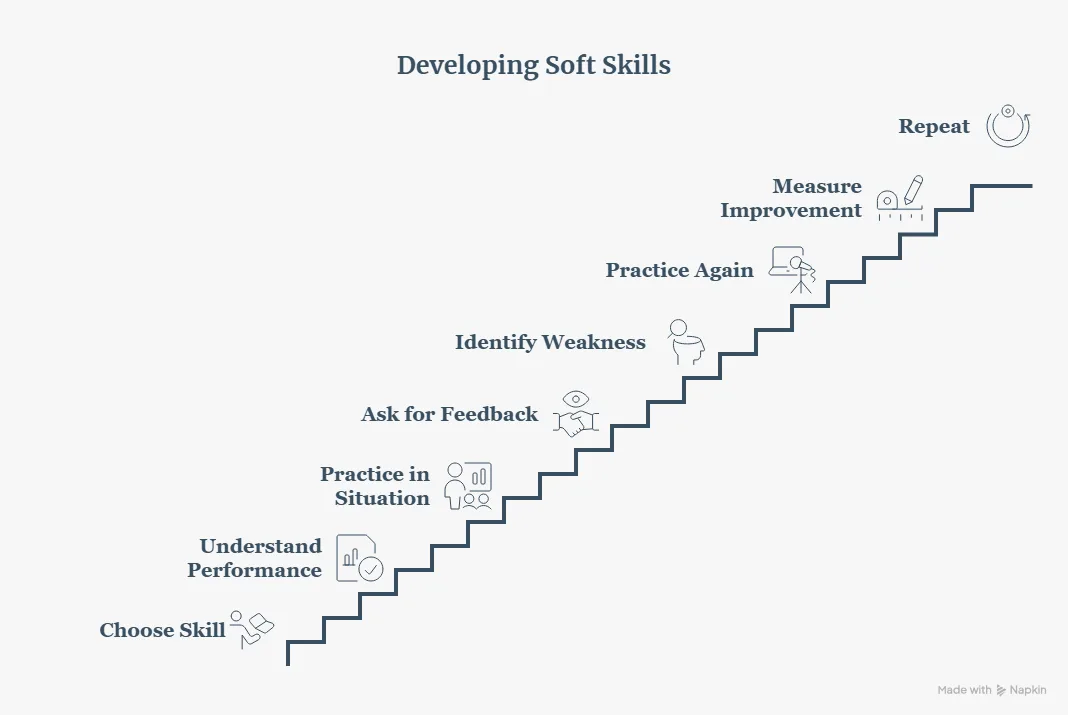
A useful development process looks like this:
Do not try to improve fifteen skills simultaneously.
Choose one or two.
For example:
Month 1: Presentation skills
Volunteer to present during group projects.
Record yourself speaking.
Reduce filler words.
Ask classmates whether your explanation was clear.
Month 2: Networking
Meet two new people each week.
Ask better questions.
Follow up after conversations.
Maintain relationships rather than collecting contacts.
Month 3: Leadership
Take responsibility for one project.
Delegate instead of doing everything yourself.
Ask teammates for feedback after the project.
Small deliberate improvements accumulate.
Soft Skills Self-Assessment for MBA Students
Rate yourself from 1 to 5.
1 = Needs significant improvement
5 = Strong and consistent skill
| Skill | Your Score |
|---|---|
| Communication | /5 |
| Leadership | /5 |
| Teamwork | /5 |
| Problem-solving | /5 |
| Strategic thinking | /5 |
| Adaptability | /5 |
| Emotional intelligence | /5 |
| Decision-making | /5 |
| Time management | /5 |
| Negotiation | /5 |
| Conflict resolution | /5 |
| Networking | /5 |
| Public speaking | /5 |
| Critical thinking | /5 |
| Initiative | /5 |
Do not worry about your total score.
Look for your two lowest areas.
Those are likely to offer more value than trying to make your strongest skill slightly better.
How to Show Soft Skills on an MBA Resume
Avoid simply writing:
Skills: Leadership, teamwork, communication, problem-solving
Almost anyone can claim these things.
Evidence is more convincing.
Instead of:
Leadership
Write something such as:
Led a six-member cross-functional team to complete a market-entry project two weeks ahead of schedule.
Instead of:
Communication skills
Show where communication created an outcome:
Presented quarterly performance recommendations to senior management, contributing to approval of a new customer-retention initiative.
Instead of:
Problem-solving
Demonstrate the problem:
Analyzed customer churn data and identified three major cancellation drivers, helping the team redesign the onboarding process.
The principle is simple:
Do not name the soft skill when you can demonstrate it.
How to Demonstrate Soft Skills in an Interview
Interviewers often evaluate soft skills through behavioral questions.
You may hear:
“Tell me about a time you disagreed with a teammate.”
“Describe a difficult decision you made.”
“Tell me about a time you failed.”
“Give me an example of when you influenced someone.”
“Tell me about a conflict you resolved.”
A useful structure is STAR:
Situation
What was happening?
Task
What responsibility did you have?
Action
What specifically did you do?
Result
What happened because of your actions?
The most important part is usually Action.
Do not spend three minutes explaining the background and ten seconds explaining what you actually did.
Soft Skills for MBA Internships and Placements
Internships are one of the best places to test whether your classroom skills transfer into real work.
During an internship, pay attention to simple behaviors.
Do you arrive prepared?
Do you take notes?
Do you ask clear questions?
Can you receive feedback?
Can colleagues depend on you?
Do you communicate problems early?
Can you explain your work?
Do you understand when to ask for help?
Do you follow through?
These behaviors may appear small compared with a sophisticated strategy project.
But managers notice them.
Reliability is a professional skill.
How AI Changes the Importance of Soft Skills
AI is changing the skill mix expected from business graduates.
That does not mean human skills are disappearing.
GMAC’s 2026 research found rapid growth in the importance of AI, data analysis, and technology capabilities, while communication, problem-solving, and adaptability continued to rank highly. Employers also expect AI-tool skills and strategic thinking to become particularly important over the next five years.
This creates a useful model for MBA students:
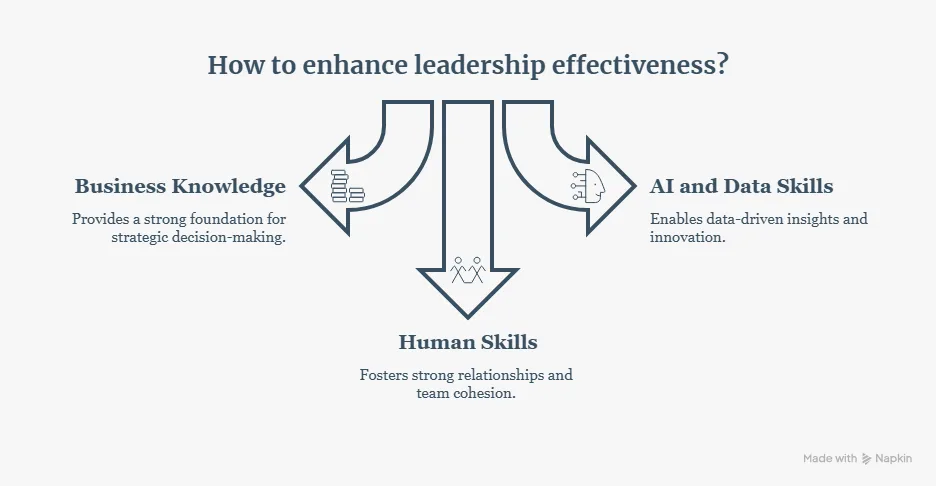
A manager may use AI to analyze thousands of customer comments.
But someone still needs to decide what the findings mean.
Someone needs to choose a response.
Someone needs to explain that response.
Someone needs to convince the organization to act.
And someone needs to take responsibility for the result.
GMAC’s September 2026 research into the future of graduate management education similarly found business schools placing greater emphasis on judgment, adaptability, communication, empathy, collaboration, conflict resolution, and complex problem framing as generative AI takes on more routine analytical work.
The future MBA graduate therefore does not need to compete against technology by trying to behave like a machine.
The stronger strategy is learning how to use technology while becoming better at the things that require human judgment and interaction.
A 30-Day Soft Skills Improvement Plan
You do not need to wait until graduation.
Try this simple plan.
| Week | Focus | Action |
|---|---|---|
| Week 1 | Communication | Speak at least once in every class or team discussion |
| Week 1 | Listening | Ask one follow-up question before giving your opinion |
| Week 2 | Presentation | Give a 3-minute presentation and record yourself |
| Week 2 | Feedback | Ask two people for one improvement suggestion |
| Week 3 | Networking | Start four meaningful professional conversations |
| Week 3 | Leadership | Take responsibility for one team task |
| Week 4 | Negotiation | Practice one mock negotiation |
| Week 4 | Reflection | Review what improved and select your next skill |
Thirty days will not make anyone a perfect leader.
It can, however, make you more intentional.
That is how soft skills usually improve.
Common Mistakes MBA Students Make With Soft Skills
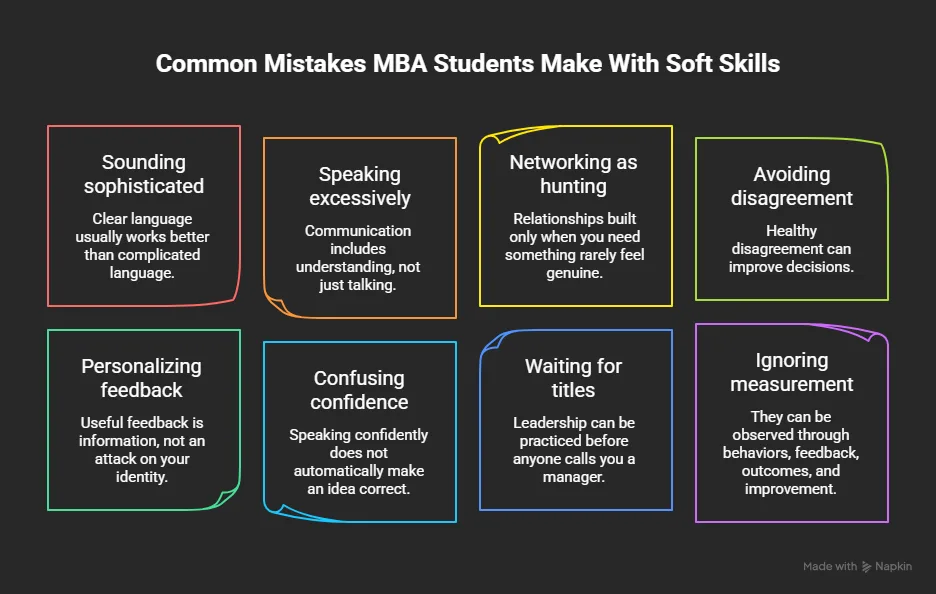
Trying to sound sophisticated
Clear language usually works better than complicated language.
Speaking more than listening
Communication includes understanding, not just talking.
Treating networking as job hunting
Relationships built only when you need something rarely feel genuine.
Avoiding disagreement
Healthy disagreement can improve decisions.
Taking feedback personally
Useful feedback is information, not an attack on your identity.
Confusing confidence with competence
Speaking confidently does not automatically make an idea correct.
Waiting for a leadership title
Leadership can be practiced before anyone calls you a manager.
Assuming soft skills cannot be measured
They can be observed through behaviors, feedback, outcomes, and improvement.
Final Opinion
Your MBA may help you understand finance, marketing, economics, operations, strategy, analytics, and organizational behavior.
But your career will require you to use that knowledge around other people.
You will need to explain.
Listen.
Negotiate.
Decide.
Adapt.
Influence.
Collaborate.
Lead.
That is why soft skills should not be treated as an optional addition to an MBA.
They are part of what makes business knowledge useful.
Technology will continue to change. AI capabilities will become more powerful. New tools will emerge, and some technical tasks that once required hours may take minutes.
But organizations will still need people who can make sound judgments, communicate clearly, work across teams, handle uncertainty, build trust, and take responsibility.
For an MBA student, that may be one of the most valuable lessons to learn before graduation.
Frequently Asked Questions
What are the most important soft skills for MBA students?
Communication, problem-solving, adaptability, teamwork, leadership, decision-making, emotional intelligence, strategic thinking, negotiation, time management, and critical thinking are among the most useful soft skills for MBA students. Employer research also consistently places several of these skills high in hiring priorities for business-school graduates.
Why are soft skills important in an MBA?
MBA graduates often move into positions requiring collaboration, decision-making, presentations, negotiation, client interaction, or leadership. Technical business knowledge is more useful when a person can communicate and apply it effectively.
Which communication skills should MBA students develop?
MBA students should practice professional speaking, active listening, business writing, email communication, presentation skills, persuasion, questioning, executive summaries, and explaining complex information simply.
How can MBA students improve leadership skills?
Take responsibility for real projects, lead group assignments, practice delegation, ask teammates for feedback, study how effective managers make decisions, and reflect on your own leadership behavior after each project.
Can soft skills be learned?
Yes. Although personality can influence how naturally certain behaviors come to someone, communication, negotiation, leadership, listening, presentation, conflict resolution, and other professional behaviors can improve through deliberate practice and feedback.
What soft skills should MBA students put on a resume?
Instead of simply listing generic terms such as leadership or teamwork, demonstrate them through achievements. Describe the team you led, problem you solved, stakeholder you influenced, conflict you handled, or result your communication helped produce.
Are soft skills more important than technical skills?
Neither should replace the other. MBA graduates generally benefit from combining technical business knowledge with communication, judgment, leadership, and interpersonal skills.
Will AI make soft skills less important?
Current employer research suggests the opposite relationship may be emerging. AI and technology skills are becoming more important, but employers continue to place considerable value on communication, adaptability, problem-solving, leadership, and other human capabilities.
What is the best way to improve soft skills during an MBA?
Choose one skill, practice it in real MBA activities, request specific feedback, identify one weakness, and repeat the process. Group projects, presentations, internships, case competitions, networking events, and student organizations all provide opportunities to practice.
What is the difference between hard skills and soft skills?
Hard skills are specific technical abilities such as financial modeling, data analysis, accounting, or market research. Soft skills describe how you think, communicate, collaborate, lead, and respond to people and situations. Most management roles require a combination of both.