Do you want to learn English speaking but feel stuck? You are not alone. Many people study grammar for years yet struggle to speak. The key is to change your approach. Spoken English is a skill, not just a subject. You must practice it actively.
This guide offers 70 practical ways to improve. We will move from simple first steps to advanced techniques. These tips will build your confidence, fluency, and clarity. Let’s begin your journey to fluent spoken English.
Your attitude is the first step to success. A positive mindset makes learning easier and more fun.
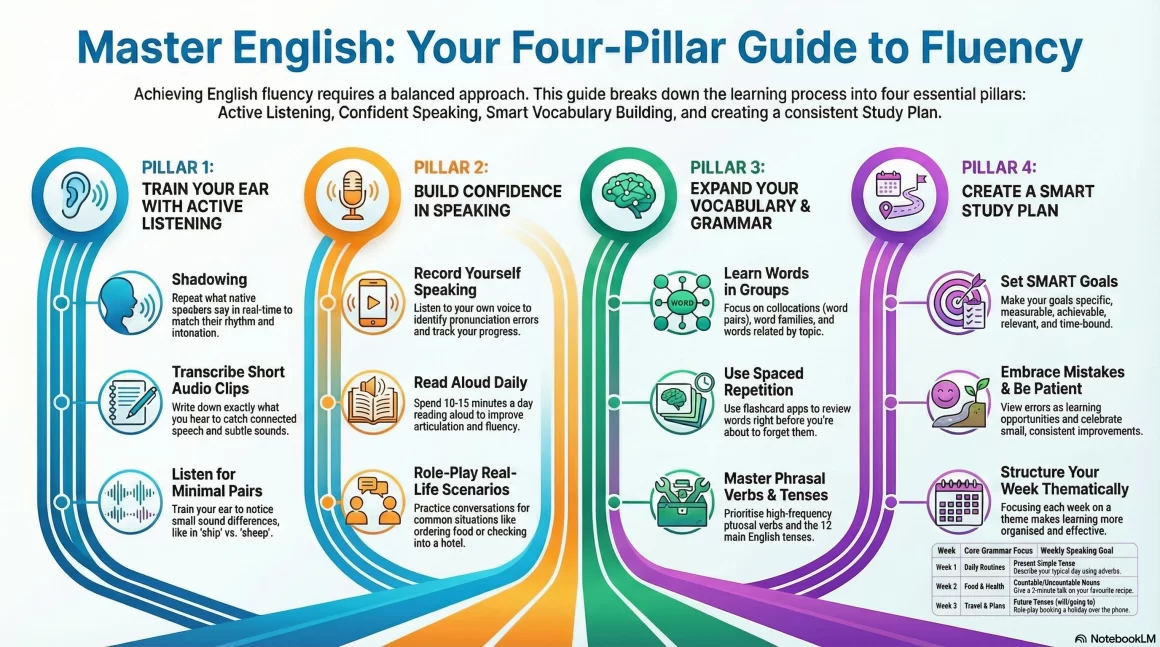
70 Ways of Spoken English
| # | Technique | Description |
| 1 | Active Listening | Focus intently on the speaker’s tone, stress, and pace, not just the words. |
| 2 | Listen to Podcasts | Choose topics you enjoy and listen to native speakers at a natural speed. |
| 3 | Watch English Movies | Start with subtitles, then try watching without them. |
| 4 | Use YouTube | Follow channels designed for English learners (e.g., VOA Learning English). |
| 5 | Shadowing | Repeat words/sentences immediately after a native speaker in a video or audio. |
| 6 | Listen to English Music | Read the lyrics and sing along to practice rhythm and pronunciation. |
| 7 | Listen to Audiobooks | Listen while reading the physical book to link sound and spelling. |
| 8 | Transcribe Audio | Write down exactly what you hear in short audio clips. |
| 9 | Analyze Intonation | Pay attention to how the voice rises (questions) and falls (statements). |
| 10 | Listen to News | Follow global English news outlets (BBC, CNN) for formal, clear speech. |
| 11 | Differentiate Minimal Pairs | Practice recognizing subtle differences between sounds (e.g., ‘ship’ vs. ‘sheep’). |
| 12 | Listen to Different Accents | Expose yourself to American, British, Australian, etc., accents. |
| 13 | Use a Language Exchange App | Listen to your partner’s natural way of speaking. |
| 14 | Summarize What You Hear | After listening, summarize the main points out loud in your own words. |
| 15 | Focus on Connected Speech | Notice how words link together (e.g., “”cup of tea”” often sounds like “”cuppa tea””). |
| 16 | Think in English | Narrate your day internally in English instead of your native language. |
| 17 | Find a Speaking Partner | Schedule regular conversation sessions (online or in person). |
| 18 | Speak Slowly | Don’t rush; focus on clarity and correct structure over speed. |
| 19 | Join a Club | Participate in an English Book Club, Debate Club, or Toastmasters. |
| 20 | Describe Pictures | Practice spontaneous speech by describing a photo or scene in detail. |
| 21 | Use Vowel and Consonant Charts | Learn the placement of your tongue and lips for different sounds. |
| 22 | Prepare Mini-Speeches | Give a 2-minute speech on a new topic every day. |
| 23 | Self-Correction | Get in the habit of catching and fixing your own mistakes mid-sentence. |
| 24 | Keep a Spoken Journal | Instead of writing, record your daily thoughts and experiences. |
| 25 | Practice Pausing | Use pauses naturally for breath and emphasis, rather than rushing. |
| 26 | Use a Mirror | Practice speaking while watching your mouth movements. |
| 27 | Record Yourself | Listen back to identify errors and areas for improvement. |
| 28 | Master the Schwa Sound | Practice the common, unstressed /∂/ sound (e.g., ‘about’, ‘teacher’). |
| 29 | Read Aloud Daily | Read any English text out loud for 10-15 minutes. |
| 30 | Role-Play Scenarios | Practice dialogues for situations like ordering food or checking in at a hotel. |
| 31 | Focus on Stress | Learn which syllable is stressed in common multi-syllable words. |
| 32 | Use Filler Words Naturally | Learn appropriate English fillers like “”Well,”” “”You know,”” “”I mean””. |
| 33 | Answer Open-Ended Questions | Practice giving long, detailed answers, not just “”Yes/No””. |
| 34 | Memorize Useful Phrases | Learn common greetings, farewells, and conversational connectors. |
| 35 | Ask for Feedback | Ask native speakers to gently correct your errors. |
| 36 | Learn Collocations | Study words that naturally go together (e.g., ‘make a mistake,’ not ‘do a mistake’). |
| 37 | Use Flashcards (Spaced Repetition) | Use apps like Anki or Quizlet to review vocabulary. |
| 38 | Learn Words in Context | Never learn an isolated word; learn it within a full sentence. |
| 39 | Focus on High-Frequency Words | Master the top 3,000 most common English words. |
| 40 | Group Words by Topic | Learn all related vocabulary together (e.g., words for travel, business). |
| 41 | Focus on Tenses | Practice using the 12 main tenses accurately when describing events. |
| 42 | Keep a Vocabulary Notebook | Write down new words, their definitions, and example sentences. |
| 43 | Review Old Words | Revisit your vocabulary notes weekly to reinforce memory. |
| 44 | Read English Articles Daily | Find one article on a general interest topic every day. |
| 45 | Use a Monolingual Dictionary | Look up definitions in English to build stronger associations. |
| 46 | Study Idioms/Slang | Learn 2-3 new idioms each week and try to use them. |
| 47 | Master Phrasal Verbs | Focus on common ones like ‘look up,’ ‘put off,’ ‘get along’. |
| 48 | Read a Variety of Genres | Expose yourself to vocabulary from different fields (tech, arts, science). |
| 49 | Start Simple, Then Elaborate | Practice saying a simple sentence, then add two more clauses. |
| 50 | Use a Thesaurus | Learn synonyms and antonyms to vary your speech. |
| 51 | Study Common Prepositions | Practice using ‘in,’ ‘on,’ ‘at,’ ‘for’ correctly in different contexts. |
| 52 | Practice Relative Clauses | Use ‘who,’ ‘which,’ ‘that’ to create more complex sentences. |
| 53 | Learn Word Families | Study the noun, verb, adjective, and adverb forms of a single root word. |
| 54 | Avoid Direct Translation | Try to form sentences in English naturally, bypassing your native language. |
| 55 | Focus on Functional Language | Learn how to agree, disagree, interrupt, and express opinions politely. |
| 56 | Set SMART Goals | Set specific, measurable, achievable, relevant, and time-bound goals (e.g., “”I will use 5 new phrasal verbs this week””). |
| 57 | Embrace Mistakes | See mistakes as learning opportunities, not failures. |
| 58 | Be Patient | Fluency is a journey; celebrate small improvements. |
| 59 | Create an English Environment | Change your phone, social media, and computer language to English. |
| 60 | Find a Role Model | Choose a speaker (podcaster, actor) whose style you admire and try to emulate their speech. |
| 61 | Don’t Be Shy | The biggest barrier is fear of judgment; speak up whenever you have a chance. |
| 62 | Use the 5-Minute Rule | If you don’t feel like studying, commit to just 5 minutes—you’ll often do more. |
| 63 | Incorporate English into Hobbies | Play video games in English, read English sports news, watch English cooking shows. |
| 64 | Find an Accountability Partner | Someone who ensures you stick to your study plan. |
| 65 | Test Yourself Regularly | Use online quizzes to check your vocabulary and grammar. |
| 66 | Take Breaks | Study in focused, short bursts (e.g., 25-minute Pomodoro sessions). |
| 67 | Review Your Daily Output | At the end of the day, mentally review the English you spoke or wrote. |
| 68 | Imagine Future Scenarios | Mentally practice dialogues for anticipated future situations (job interview, travel). |
| 69 | Mix Up Your Routine | Prevent burnout by changing your study activities weekly. |
| 70 | Reward Yourself | Acknowledge your progress when you hit a major milestone. |
Start with Your Mindset
- Set clear, achievable goals. Say “I will learn to introduce myself this week.” This is better than a vague goal like “I want to be fluent.”
- Embrace mistakes. They are not failures. They are vital lessons. Every mistake corrects your path.
- Celebrate small wins. Did you order coffee in English? That’s a victory! Celebrate it.
- Be patient with yourself. Learning a language is a marathon, not a sprint. Progress takes time.
- Find your “why.” Remember why you want to learn English. Is it for a job, travel, or education? This reason will motivate you.
Build Your Core Vocabulary: Words You Will Actually Use
Your attitude is the first step to success. A positive mindset makes learning easier and more fun.
- Set clear, achievable goals. Say “I will learn to introduce myself this week.” This is better than a vague goal like “I want to be fluent.”
- Embrace mistakes. They are not failures. They are vital lessons. Every mistake corrects your path.
- Celebrate small wins. Did you order coffee in English? That’s a victory! Celebrate it.
- Be patient with yourself. Learning a language is a marathon, not a sprint. Progress takes time.
- Find your “why.” Remember why you want to learn English. Is it for a job, travel, or education? This reason will motivate you.
Master the Sounds: Pronunciation and Listening
- Listen actively every day. Use podcasts, music, or news. Even 15 minutes daily helps.
- Shadow speaking. Repeat exactly what you hear from a video or audio. Match the speed and tone.
- Record yourself. Listen back to catch pronunciation errors. Compare your recording to a native speaker.
- Learn the phonetic alphabet. It helps you understand dictionary pronunciations.
- Focus on problem sounds. Many learners struggle with “th,” “v,” and “w.” Practice them separately.
- Use pronunciation dictionaries. Websites like Forvo let you hear words spoken by natives.
- Pay attention to word stress. Stressing the wrong syllable (like DE-sert vs des-SERT) can confuse listeners.
- Notice sentence rhythm. English has a musical rhythm. Listen for which words are stressed in a sentence.
- Watch mouth movements. Observe how native speakers shape their lips and tongue on YouTube.
- Sing along to English songs. It’s a fun way to practice rhythm and fluency.
Grammar for Speaking: Keep It Simple
You do not need perfect grammar to start speaking. Use what you know.
- Learn sentence frames. “I like to…”, “I think that…”, “Can you help me with…?” These are ready to use.
- Master the past, present, and future of 10 common verbs. Go, eat, do, have, see, come, read, work, talk, want.
- Use contractions. Say “I’m,” “don’t,” and “can’t.” This makes your spoken English sound natural.
- Do not overthink. In conversation, it’s better to speak with small errors than not to speak at all.
- Practice question forms. Conversations are built on questions. Practice “What do you think?” and “How was your day?”
Practice Alone: Your Personal Spoken English Lab
You can practice spoken English even when no one is around. These solo exercises are powerful.
- Think in English. Describe your actions in your head. “I am making tea. Now I am opening my laptop.”
- Talk to yourself. Describe what you see. Plan your day out loud in English.
- Read aloud. Read news articles, books, or even social media posts. This connects your brain and mouth.
- Narrate your life. As you cook or drive, explain what you are doing like a TV host.
- Use a mirror. Talk to your reflection. Watch your facial expressions and mouth movement.
- Retell a story. After watching a show, explain the plot to yourself in simple English.
- Use voice assistants. Set your phone’s Siri or Google Assistant to English. Ask it questions.
Find Your Community: Practice with Others
Speaking is a social activity. You must eventually practice with people.
- Join a language exchange. Websites like Tandem or HelloTalk connect you with learners worldwide.
- Find a conversation partner. Even 30 minutes a week talking to a patient friend helps immensely.
- Participate in online forums. Join Reddit groups or Facebook groups about learning English.
- Take an online class. Platforms like iTalki or Preply offer affordable tutors.
- Attend local meetups. Search for “English conversation practice” in your city.
- Play online games. Multiplayer games often have voice chats where you can practice.
- Comment on YouTube videos. Write comments in English to practice expressing opinions.
Use Technology Wisely: Apps and Tools to Learn English
Your smartphone is a powerful tool for learning spoken English.
- Try language learning apps. Duolingo, Babbel, and Rosetta Stone offer structured speaking exercises.
- Use speech recognition. Google Translate’s microphone feature can check if it understands your pronunciation.
- Watch videos on slow speed. YouTube lets you slow down videos to hear each sound clearly.
- Subscribe to English YouTube channels. Find channels about your hobbies. You will learn relevant vocabulary.
- Listen to podcasts for learners. “Learn English with BBC” or “6 Minute English” are excellent choices.
Immerse Yourself Daily: Live in English
Create an English environment around you. This speeds up learning.
- Change your device language. Set your phone, computer, and social media to English.
- Watch movies and TV shows. Use English subtitles, not subtitles in your native language.
- Follow English news. Choose one news app like BBC or CNN to check daily.
- Listen to English radio. Background listening trains your brain to process the language.
- Read something every day. It can be a short article, a comic strip, or a recipe.
Advanced Fluency Techniques: Speaking Like a Native
Once you are comfortable, these tips will polish your spoken English.
- Learn idioms and phrasal verbs. “Hit the books” (study) or “figure out” (understand) are very common.
- Understand slang (carefully). Learn common slang from shows, but use it only in casual settings.
- Practice linking sounds. Notice how natives connect words: “Whaddaya think?” (What do you think?).
- Use filler words naturally. “Well,” “actually,” and “I mean” can make you sound more fluid.
- Vary your intonation. Do not speak in a flat tone. Let your voice go up and down to show interest.
- Learn conversation connectors. Use phrases like “On the other hand,” or “Speaking of which,” to link ideas.
Conquer Your Fears: Building Confidence for Spoken English
Fear is the biggest blocker. You must manage it to speak freely.
- Start small. Order food, ask for directions, or give a compliment. Small successes build confidence.
- Prepare go-to phrases. Have a few standard sentences ready for common situations.
- Do not apologize for your level. Simply say, “I am learning English.” Most people will be supportive.
- Focus on communication, not perfection. Your goal is to share an idea, not to speak flawless English.
- Visualize success. Before a conversation, imagine yourself speaking calmly and being understood.
Specialized Practice: English for Work and Travel
Tailor your spoken English practice to your specific goals.
- Role-play job interviews. Practice common questions and answers with a partner.
- Learn industry-specific terms. If you are a programmer, learn tech terms. If you are a chef, learn cooking terms.
- Practice travel scenarios. Act out checking into a hotel, asking for help, or buying tickets.
- Watch business presentations. Observe how professionals structure their talks on YouTube.
Consistency is Key: Making It a Habit
Learning English speaking requires regular practice.
- Create a routine. Dedicate a specific, short time each day to speaking practice.
- Mix it up. Do not do the same activity every day. Alternate between apps, videos, and conversations.
- Track your progress. Look back at your old recordings. You will see how much you have improved.
- Join a challenge. A 30-day speaking challenge can keep you motivated.
Final Essential Tips
These last pieces of advice will hold everything together.
- Be a good listener. Paying attention helps you respond better and learn new phrases.
- Have fun! When you enjoy the process, you will stick with it longer and learn faster.
Your Path to Fluent Spoken English Starts Now
Learning to speak English fluently is an exciting journey. You have 70 different paths to try. You do not need to use them all. Start with the ones that seem easiest or most fun.
First, work on your mindset and core vocabulary. Next, blend solo practice with real conversations. Finally, immerse yourself and refine your skills.
The most important step is to begin. Pick one tip from this list and try it today. Open your mouth and make a sound. Each word you speak brings you closer to your goal. Your voice in English is waiting to be heard. Start speaking now.