Email remains one of the most powerful and widely used communication tools in professional and personal settings. Whether you’re applying for a job, communicating with clients, collaborating with coworkers, or reaching out to a professor, proper email etiquette plays a crucial role in how your message is received.
Poorly written emails can create confusion, damage credibility, and even harm professional relationships. On the other hand, emails that follow proper etiquette reflect professionalism, respect, and clarity.
In this detailed guide, we’ll explore examples of proper email etiquette, explain why it matters, and show you how to write emails that are polite, effective, and professional.
What Is Email Etiquette?
Email etiquette refers to the set of guidelines and best practices used when writing and responding to emails. These rules help ensure your message is clear, respectful, and appropriate for the situation.
Proper email etiquette covers:
- Tone and language
- Formatting and structure
- Subject lines
- Greetings and closings
- Response time
- Professional behavior
Mastering these basics can significantly improve your communication skills and professional image.
Why Proper Email Etiquette Is Important
Using proper email etiquette is more than just good manners—it’s a professional necessity.
Key Benefits of Proper Email Etiquette
- Builds trust and credibility
- Prevents misunderstandings
- Saves time for both sender and recipient
- Enhances your professional reputation
- Improves workplace communication
Emails often serve as written records, so mistakes or unprofessional behavior can have long-lasting consequences.
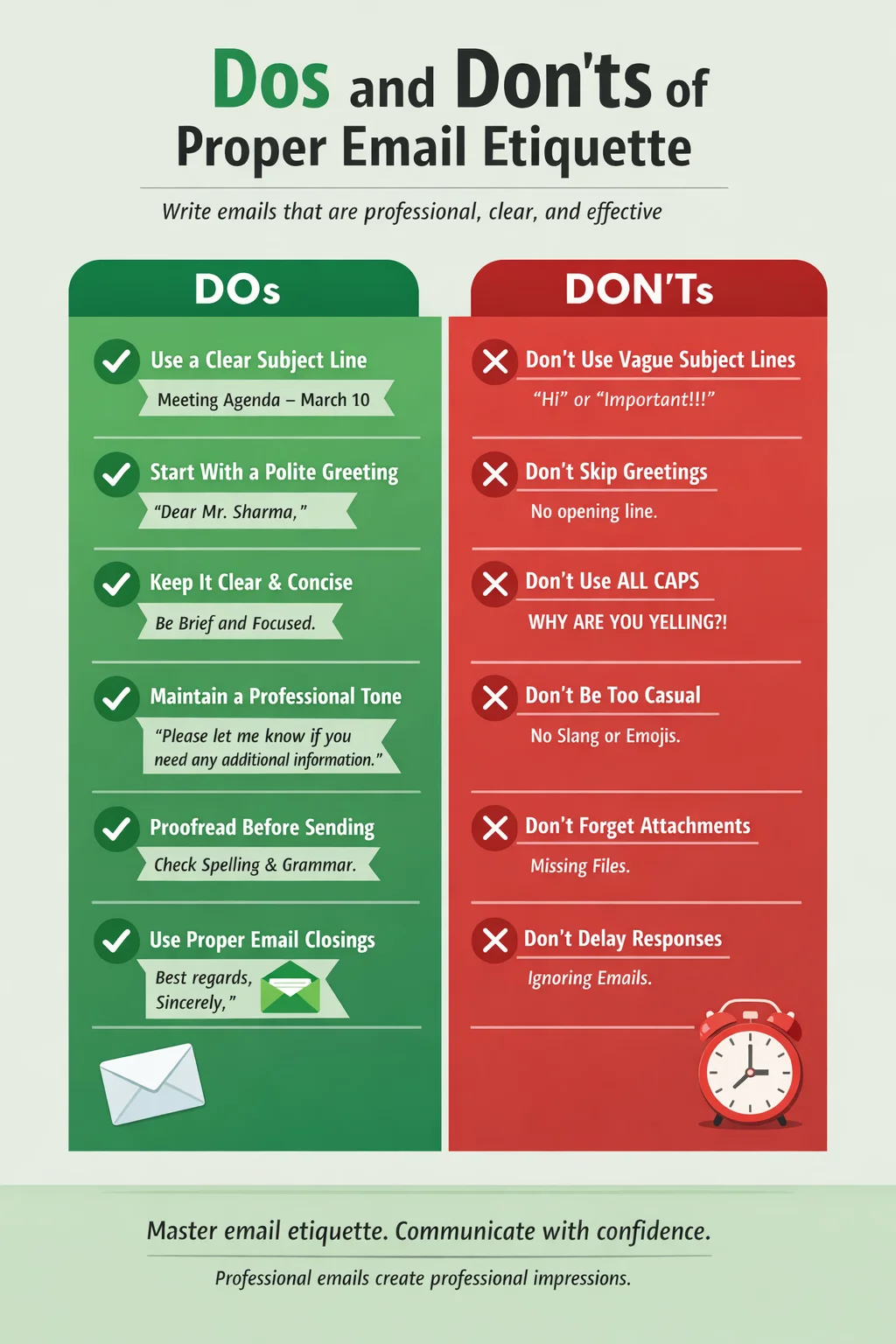
Dos and Don’ts of Proper Email Etiquette
| Dos | Don’ts |
|---|---|
| Use a clear and specific subject line that reflects the purpose of the email. | Do not leave the subject line blank or use vague words like “Hi” or “Important”. |
| Start your email with a polite and appropriate greeting. | Do not begin emails abruptly without a greeting. |
| Keep your email concise, focused, and easy to read. | Do not write long, unstructured paragraphs that confuse the reader. |
| Maintain a professional and respectful tone throughout the message. | Do not use rude, aggressive, or sarcastic language. |
| Proofread your email for grammar and spelling errors before sending. | Do not send emails with typos, poor grammar, or unclear sentences. |
| Use proper formatting, such as short paragraphs and bullet points when needed. | Do not use excessive fonts, colors, or decorative formatting. |
| Respond to professional emails within a reasonable timeframe. | Do not ignore emails or delay responses without acknowledgment. |
| Use CC and BCC appropriately and only when necessary. | Do not include unnecessary recipients in email threads. |
| Clearly mention and attach files with appropriate file names. | Do not forget attachments or send large files without notice. |
| End emails with a professional closing and signature. | Do not use overly casual or informal sign-offs in professional emails. |
| Be polite when making requests or asking questions. | Do not sound demanding or impatient. |
| Re-read the email to ensure clarity and correctness before sending. | Do not send emails in anger or without reviewing the content. |
1. Writing Clear and Relevant Subject Lines
The subject line is the first thing the recipient sees. A vague or misleading subject line can cause your email to be ignored or misunderstood.
Examples of Proper Subject Lines
- “Meeting Agenda for March 10”
- “Follow-Up on Project Proposal”
- “Request for Leave on April 15”
- “Invoice Submission – February 2026”
What to Avoid
- “Hi”
- “Important!!!”
- “Quick Question”
- Leaving the subject line blank
A clear subject line sets expectations and increases the chance your email will be opened promptly.
2. Using Appropriate Greetings
Starting your email with a polite greeting shows respect and professionalism.
Professional Greeting Examples
- “Dear Mr. Sharma,”
- “Hello Ms. Williams,”
- “Hi John,” (acceptable in casual or internal emails)
When You Don’t Know the Recipient’s Name
- “Dear Hiring Manager,”
- “Hello Team,”
- “Dear Customer Support Team,”
Avoid informal greetings like “Hey,” or skipping the greeting entirely, especially in professional communication.
3. Maintaining a Professional and Polite Tone
Tone is one of the most important aspects of email etiquette. Since emails lack body language and facial expressions, your words must clearly convey respect and professionalism.
Examples of Polite Language
- “Please let me know if you need any additional information.”
- “I would appreciate your feedback.”
- “Thank you for your time and consideration.”
What to Avoid
- ALL CAPS (sounds like shouting)
- Excessive exclamation marks
- Sarcasm or jokes that could be misinterpreted
- Aggressive or demanding language
A calm, courteous tone helps maintain positive relationships.
4. Keeping Emails Concise and Well-Structured
Long, cluttered emails can overwhelm readers. Proper email etiquette encourages clarity and brevity.
Best Practices
- Stick to one main topic per email
- Use short paragraphs
- Break information into bullet points when necessary
- Avoid unnecessary details
Example
Instead of writing one long paragraph, structure your message like this:
- Purpose of the email
- Key details
- Required action
- Deadline or next steps
This makes your email easy to read and respond to.
5. Using Proper Grammar, Spelling, and Formatting
Errors in grammar and spelling can make your email appear careless or unprofessional.
Proper Formatting Tips
- Use standard fonts (Arial, Calibri, Times New Roman)
- Avoid decorative fonts or bright colors
- Use correct punctuation
- Proofread before sending
Example of Professional Writing
❌ “Pls send me the doc asap.”
✅ “Could you please send the document at your earliest convenience?”
Taking a few seconds to proofread can make a big difference.
6. Being Mindful of Email Timing and Response Etiquette
Knowing when to send and respond to emails is a key part of proper email etiquette.
Response Time Guidelines
- Business emails: Respond within 24 hours
- Urgent emails: Acknowledge as soon as possible
- If more time is needed, send a brief acknowledgment
Example Response
“Thank you for your email. I’ve received your request and will get back to you by tomorrow.”
Avoid sending non-urgent emails late at night or during weekends unless necessary.
7. Using CC and BCC Correctly
Misusing CC (carbon copy) and BCC (blind carbon copy) can lead to confusion or privacy issues.
Proper Use of CC
- When others need to be informed
- When transparency is required
Proper Use of BCC
- When emailing a large group
- To protect recipients’ privacy
Avoid adding unnecessary people to email threads, as it wastes time and can cause frustration.
8. Including Professional Email Closings
A proper closing leaves a positive final impression.
Professional Closing Examples
- “Kind regards,”
- “Sincerely,”
- “Best regards,”
- “Thank you,”
Follow your closing with your full name and, if appropriate, your job title and contact information.
Example Email Signature
Best regards,
Krish Patel
Marketing Executive
Company Name
Phone | Email
Avoid casual sign-offs like “Cheers” or “Thanks a lot” in formal emails.
9. Attaching Files Correctly and Responsibly
Forgetting attachments or sending large, unnecessary files is a common email mistake.
Proper Attachment Etiquette
- Mention attachments in the email body
- Use clear file names (e.g., “Project_Report_March.pdf”)
- Compress large files or use cloud links
- Double-check attachments before sending
Example Sentence
“Please find the attached project report for your review.”
10. Knowing When Not to Use Email
Good email etiquette also means knowing when email is not the best communication method.
Avoid Email When:
- The issue is highly emotional
- Immediate clarification is needed
- Sensitive or confidential matters are involved
In such cases, a phone call or face-to-face conversation is often more appropriate.
Common Examples of Proper Email Etiquette in Action
Example 1: Professional Request Email
“Dear Ms. Brown,
I hope this email finds you well. I am writing to request additional details regarding the upcoming training session. Please let me know a convenient time to discuss this further.
Thank you for your assistance.”
Example 2: Follow-Up Email
“Hello John,
I’m following up on my previous email regarding the proposal sent last week. I would appreciate any updates when convenient.
Kind regards,”
Example 3: Apology Email
“Dear Team,
I apologize for the delayed response. Thank you for your patience, and I appreciate your understanding.”
Final Thoughts on Proper Email Etiquette
Proper email etiquette is an essential skill in today’s digital world. From writing clear subject lines to using polite language and professional formatting, every detail contributes to effective communication.
By following the examples of proper email etiquette discussed in this guide, you can:
- Communicate more clearly
- Avoid misunderstandings
- Build stronger professional relationships
- Present yourself with confidence and professionalism
No matter your industry or role, mastering email etiquette will always be a valuable asset.