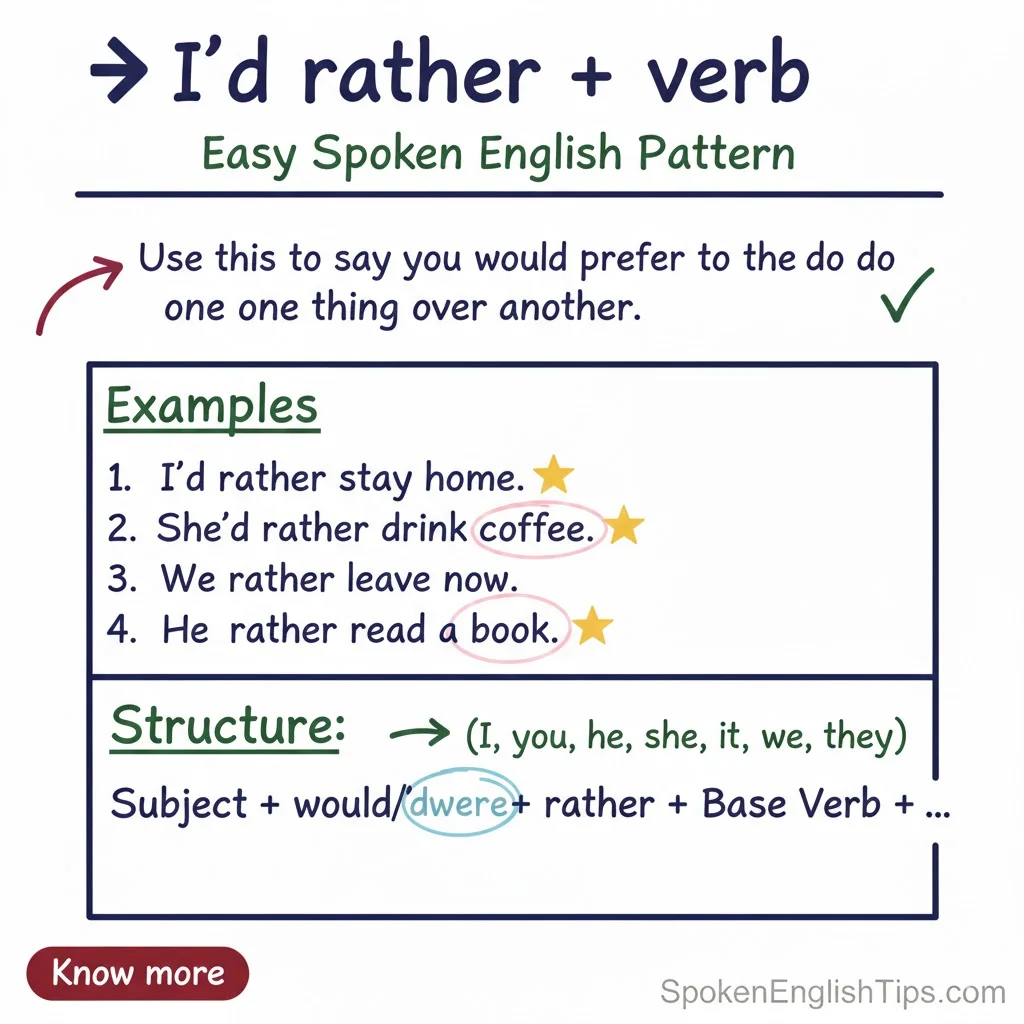
“I’d rather” is a very common expression in spoken English. We use it to talk about preferences — what we prefer to do in a situation. It sounds more natural and polite than simply saying “I want.”
For example, imagine your friend asks, “Do you want tea or coffee?”
You can say, “I’d rather have tea.”
You can also use it when choosing between two actions:
“I’d rather stay home than go out tonight.”
Native speakers use “I’d rather” in daily conversations at home, in the office, and with friends. Learning this structure will make your English sound more fluent and confident.
◎ Important Points
- “I’d” is the short form of “I would.”
- Use the base form of the verb after “rather.”
- Do NOT use “to” after “rather.”
- You can use it to compare two choices.
- It is more polite than saying “I want.”
- You can use it in negative sentences.
- It is very common in spoken English.
➤Key Concept
✅ Sentence Structure: Subject + would rather + base verb
Example:
I would rather stay home.
Main idea:
We use “would rather” to talk about what we prefer to do.
💡 Speaking Tip:
In fast speaking, say it naturally: “I’d rather” (not “I would rather” every time).
➤ Common Mistakes To Avoid
| Common Mistake | Wrong Example | Correct Example |
|---|---|---|
| Using “to” after rather | I’d rather to go. | I’d rather go. |
| Using -ing form | I’d rather going home. | I’d rather go home. |
| Forgetting subject | Rather go now. | I’d rather go now. |
| Wrong verb form | I’d rather went home. | I’d rather go home. |
| Using “more” with rather | I’d more rather stay. | I’d rather stay. |
➤ Examples
- I’d rather cook at home tonight.
- I’d rather take a taxi than walk.
- I’d rather talk to you in person.
- I’d rather finish this work now.
- I’d rather not discuss this topic.
- I’d rather sit near the window.
- I’d rather save money than spend it.
- I’d rather call her later.
- I’d rather work from home today.
- I’d rather watch a movie than scroll on my phone.
➤ Practice Examples
A. Fill in the blanks
- I’d rather ______ (stay) at home.
- She’d rather ______ (eat) pizza.
- We’d rather ______ (leave) early.
- I’d rather not ______ (argue).
- He’d rather ______ (drive) himself.
B. Correct the sentences
- I’d rather to sleep now.
- I’d rather going by bus.
- I rather stay here.
- I’d rather went home.
- She’d rather to talk later.
C. Speak Aloud Practice
Say these sentences slowly and clearly:
- I’d rather stay home tonight.
- I’d rather work in the morning.
- I’d rather not waste time.
- I’d rather travel by train.
- I’d rather focus on my goals.
Repeat each sentence 3 times. Focus on smooth pronunciation of “I’d rather.”