A genuine apology is more than just saying “I’m sorry.” It is a bridge back to intimacy, a demonstration of respect, and a commitment to growth. However, a poorly executed apology—one that is defensive, dismissive, or conditional—can deepen the wound and erode trust.
This guide provides a detailed, step-by-step roadmap to crafting an apology that is not only heard but felt. If you are ready to move past the silent treatment, the cold shoulders, and the lingering tension, read on to learn how to sincerely apologize to your girlfriend and lay the foundation for a stronger relationship.
Step 1: Understand Why “I’m Sorry” Isn’t Enough
Before you utter a single word, you must understand the psychology of why apologies fail. Most men approach an apology as a tool to end an argument—a verbal band-aid to stop the tension. However, your girlfriend likely views the apology as the beginning of emotional reconnection.
When a woman is hurt, she needs to feel heard and safe. A generic apology fails because it dismisses her experience. If you say, “I’m sorry you feel that way,” you aren’t apologizing for your actions; you are subtly criticizing her emotional reaction. If you say, “I’m sorry, okay? Can we just move on?” you are prioritizing your comfort over her healing.
To apologize sincerely, you must shift your mindset from defending yourself to understanding her pain.
Step 2: The Pre-Apology Preparation (Timing is Everything)
Timing can make or break your sincerity. Apologizing in the heat of the moment, when adrenaline is spiking and voices are raised, rarely works. At that stage, the brain is in “fight or flight” mode, and neither party is capable of genuine listening.
Do not apologize:
- While she is walking out the door.
- When you are both exhausted late at night.
- In public, unless the argument started there.
- While you are distracted (e.g., driving, watching a game).
Do this instead:
Create a moment of intentional space. You might say, “I can see we are both really upset right now. I want to fix this, but I don’t want to say the wrong thing. Can we take 20 minutes to cool down and come back to talk?”
Use that time not to rehearse your defense, but to reflect on her perspective. When you reconvene, ensure you are in a private, quiet space where you can sit face-to-face without distractions. Put your phone on silent. Turn off the TV. Eye contact is non-negotiable here; it signals that she is your priority.
Step 3: The Anatomy of a Sincere Apology
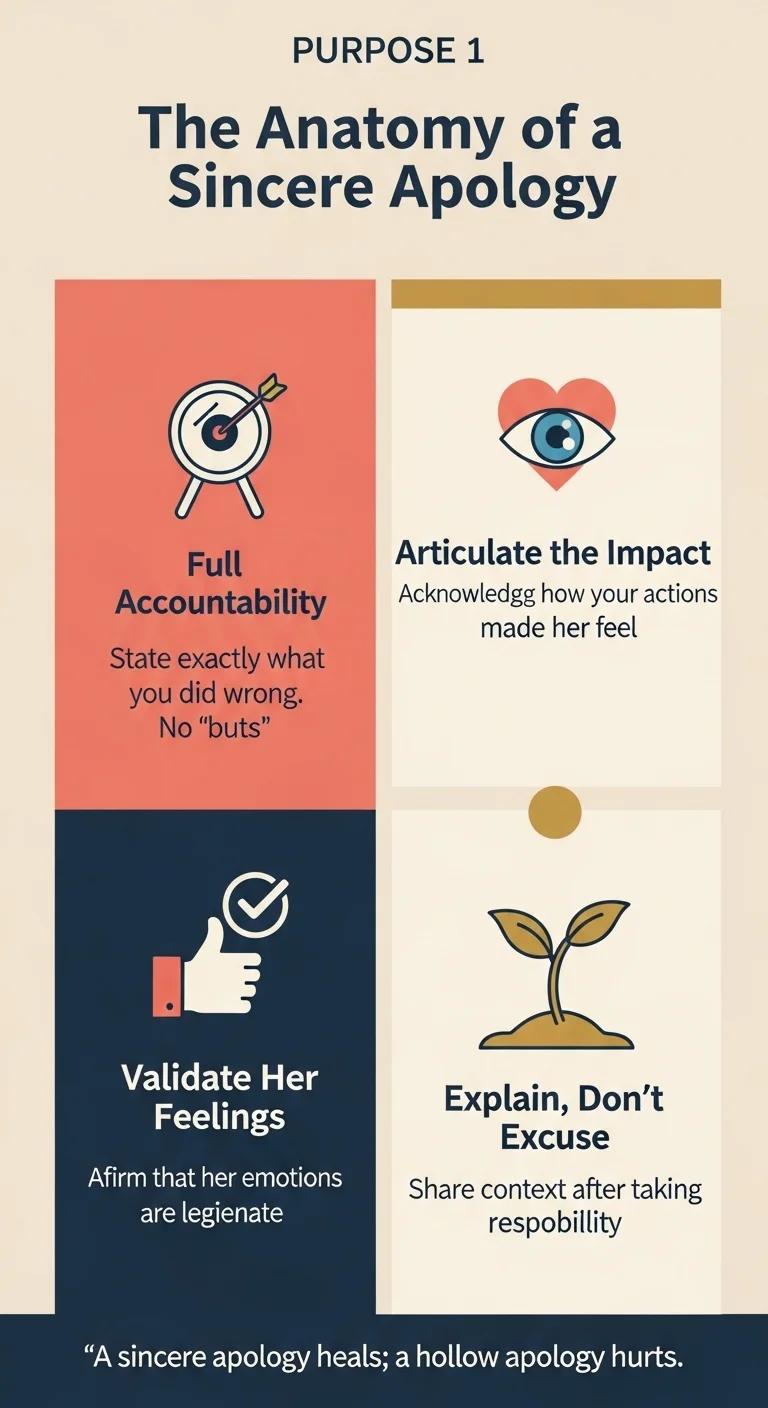
A sincere apology is composed of four distinct parts. Missing any one of them makes the apology feel hollow.
1. Full Accountability (No “Buts”)
This is the hardest part for most men. The word “but” is the enemy of an apology. When you say, “I’m sorry, but I was stressed at work,” you are telling her that her feelings are secondary to your excuses. You are justifying your behavior.
Instead, use a mirroring technique. State exactly what you did wrong without minimizing it.
- Wrong: “I’m sorry if I came off rude.”
- Right: “I raised my voice at you in the kitchen, and that was disrespectful.”
2. Articulate the Impact
You must prove that you understand why it hurt. This requires empathy. Look beyond the action and acknowledge the emotion it caused.
- Example: “When I raised my voice, I imagine it made you feel unsafe and disrespected. It probably felt like I care more about being right than I care about you. I hate that I made you feel that way.”
When you articulate the impact, you validate her reality. You are showing her that you see her, which is often the deepest desire behind the anger.
3. Validate Her Feelings
After acknowledging the impact, affirm that her feelings are legitimate. Even if you didn’t intend to hurt her, the impact is real.
- Example: “Your anger is completely justified. You have every right to be upset with me. I would be devastated if you spoke to me that way.”
4. Explain, Don’t Excuse
There is a fine line between explaining your state of mind and excusing your behavior. An explanation helps her understand the context, but it must come after you have taken full responsibility.
- Excuse: “I yelled because you were nagging me.”
- Explanation: “I want to be honest about why I reacted that way. I felt overwhelmed and insecure about the situation, but that doesn’t make it okay. I should have used my words to tell you I was struggling instead of attacking you.”
Step 4: The Art of Active Listening
After you deliver your apology, stop talking. This is the most critical phase. You have offered your olive branch; now she needs to process it.
Often, when a woman is hurt, she needs to vent her feelings before she can accept the apology. If you interrupt her, defend yourself, or try to explain again, you reset the argument back to zero.
How to listen:
- Validate while listening: As she speaks, use soft affirmations. Say things like, “I hear you,” “That makes sense,” or “I understand why you’d feel that way.”
- Do not get defensive: If she says something that feels unfair, resist the urge to correct her. If you need to clarify a point, wait until she is completely finished. Often, she just needs to feel the catharsis of being heard.
- Repeat back: To show you were truly listening, summarize her point. “If I’m hearing you right, it’s not just about the party I missed; it’s that I made you feel like a low priority. Is that right?”
Step 5: Making Amends and Changing Behavior
Words are cheap. A sincere apology is eventually measured by the actions that follow. If you apologize for being glued to your phone but remain on it the next day, your future apologies will sound like lies.
After the emotional dust has settled, you need to propose a concrete plan for change.
- Vague: “I’ll try to be better.”
- Specific: “Going forward, I will put my phone in the drawer when we have dinner together so I can be fully present. If I feel overwhelmed in an argument, I will tell you I need a 10-minute break instead of shutting down.”
This step shows her that you have not only recognized the mistake but are actively working to ensure it doesn’t happen again. Consistency is key here. You need to do this for weeks and months, not just for a day or two.
Step 6: What If She Doesn’t Accept It Immediately?
One of the biggest mistakes men make is expecting immediate forgiveness. They apologize, and when their girlfriend is still sad or distant an hour later, they get frustrated and say, “What more do you want? I said I was sorry!”
You must respect her timeline. Trust is like a broken glass; you can glue it back together, but it takes time for the bond to hold. If she needs space, give it to her without resentment. Let her know, “I know you need some time to process this. I am here whenever you’re ready to talk, and I am committed to making this right.”
Sample Sincere Apology Script
To help you visualize how these elements come together, here is a cohesive script. Remember, this must be in your own words to feel authentic.
(Sit facing her, maintain eye contact, speak calmly)
You: “I’ve been thinking about what happened earlier, and I need to apologize properly. I was disrespectful when I dismissed your idea in front of our friends. I made you feel small, and I am so sorry for that.
I want you to know that I realize it wasn’t just a joke that landed wrong. It was me being insecure and trying to look smart at your expense. That was selfish and hurtful. You deserve to feel supported by me, especially around other people.
I know that probably made you feel embarrassed and unsupported. Your feelings are completely valid.
I don’t want to make excuses, but I want to be honest that I was feeling anxious about the conversation. However, that is my issue to manage, and I should never take it out on you. Going forward, I promise to be your teammate. If I disagree with you, I will bring it up privately, not publicly. I want to earn your trust back. Can we talk about how you’re feeling?”