Date & Time Calculator
Date & Time Calculator
A Date & Time Calculator is a versatile tool that helps users calculate the difference between two dates or times, add or subtract specific durations, determine future or past dates, and convert time units accurately. Whether you're planning a project, calculating an employee's service period, finding someone's age, scheduling events, or estimating deadlines, a Date & Time Calculator eliminates manual calculations and provides precise results within seconds.
Dates and time are fundamental to everyday life and business operations. Companies use date calculations for payroll processing, contract management, project scheduling, inventory planning, and compliance reporting. Individuals rely on date calculations for travel planning, countdowns, anniversaries, loan maturity dates, subscription renewals, and retirement planning. Since calendars contain varying month lengths and leap years, manually calculating dates can easily lead to mistakes. A Date & Time Calculator automatically accounts for these complexities, ensuring reliable and consistent results.
One of the most common functions is calculating the difference between two dates. The tool can display the result in years, months, weeks, days, hours, minutes, or seconds. It is also useful for determining the number of working days between two dates when weekends or holidays are excluded.
Common Date & Time Calculations
| Calculation | Purpose |
|---|---|
| Date Difference | Find days between two dates |
| Time Difference | Calculate hours and minutes |
| Add Duration | Add days, weeks, months, or years |
| Subtract Duration | Find a past date |
| Countdown | Days remaining until an event |
| Age Calculation | Determine exact age |
| Working Days | Exclude weekends and holidays |
| Timestamp Conversion | Convert Unix timestamps |
| Time Zone Difference | Compare time across regions |
| Duration Conversion | Convert between time units |
Mathematical Formulas
Date Difference
Number of Days =
End Date − Start Date
Time Difference
Duration =
End Time − Start Time
Future Date
Future Date =
Current Date + Number of Days
Past Date
Past Date =
Current Date − Number of Days
Convert Hours to Minutes
Minutes = Hours × 60Convert Minutes to Seconds
Seconds = Minutes × 60Convert Days to Hours
Hours = Days × 24Convert Weeks to Days
Days = Weeks × 7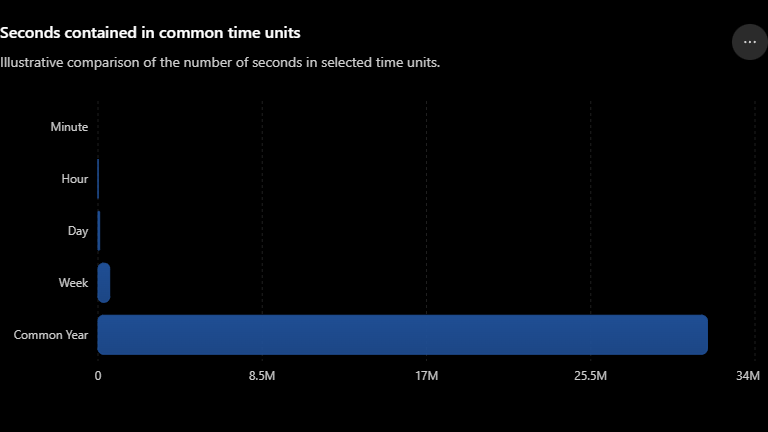
Time Unit Conversion Table
| Unit | Equivalent |
|---|---|
| 1 Minute | 60 Seconds |
| 1 Hour | 60 Minutes |
| 1 Day | 24 Hours |
| 1 Week | 7 Days |
| 1 Fortnight | 14 Days |
| 1 Month (Average) | 30.44 Days |
| 1 Quarter | 3 Months |
| 1 Year (Common) | 365 Days |
| 1 Leap Year | 366 Days |
| 1 Decade | 10 Years |
| 1 Century | 100 Years |
| 1 Millennium | 1,000 Years |
Time Conversion Reference
| From | Multiply By | Result |
|---|---|---|
| Seconds | 60 | Minutes |
| Minutes | 60 | Hours |
| Hours | 24 | Days |
| Days | 7 | Weeks |
| Weeks | 52.14 | Years (Approx.) |
| Months | 12 | Years |
Calendar Measurements
| Measurement | Value |
|---|---|
| Days in Week | 7 |
| Months in Year | 12 |
| Quarters in Year | 4 |
| Hours in Day | 24 |
| Minutes in Hour | 60 |
| Seconds in Minute | 60 |
| Seconds in Hour | 3,600 |
| Seconds in Day | 86,400 |
| Minutes in Day | 1,440 |
| Hours in Week | 168 |
| Hours in Year | 8,760 (Common Year) |
Example Calculation
Suppose a project starts on January 1 and ends on March 15.
- Total Duration = 73 Days
- Equivalent Weeks = 10 Weeks + 3 Days
- Equivalent Hours = 1,752 Hours
- Equivalent Minutes = 105,120 Minutes
- Equivalent Seconds = 6,307,200 Seconds
This illustrates how one date range can be represented in multiple time units, making planning and reporting more flexible.
Popular Uses
- Employee payroll calculations
- Project timeline management
- Construction scheduling
- Retirement planning
- Age calculations
- Loan maturity tracking
- Subscription renewals
- Academic calendars
- Event countdowns
- Travel itinerary planning
- Legal contract duration
- Manufacturing schedules
- Medical appointments
- Software license expiry tracking
- Financial reporting periods
