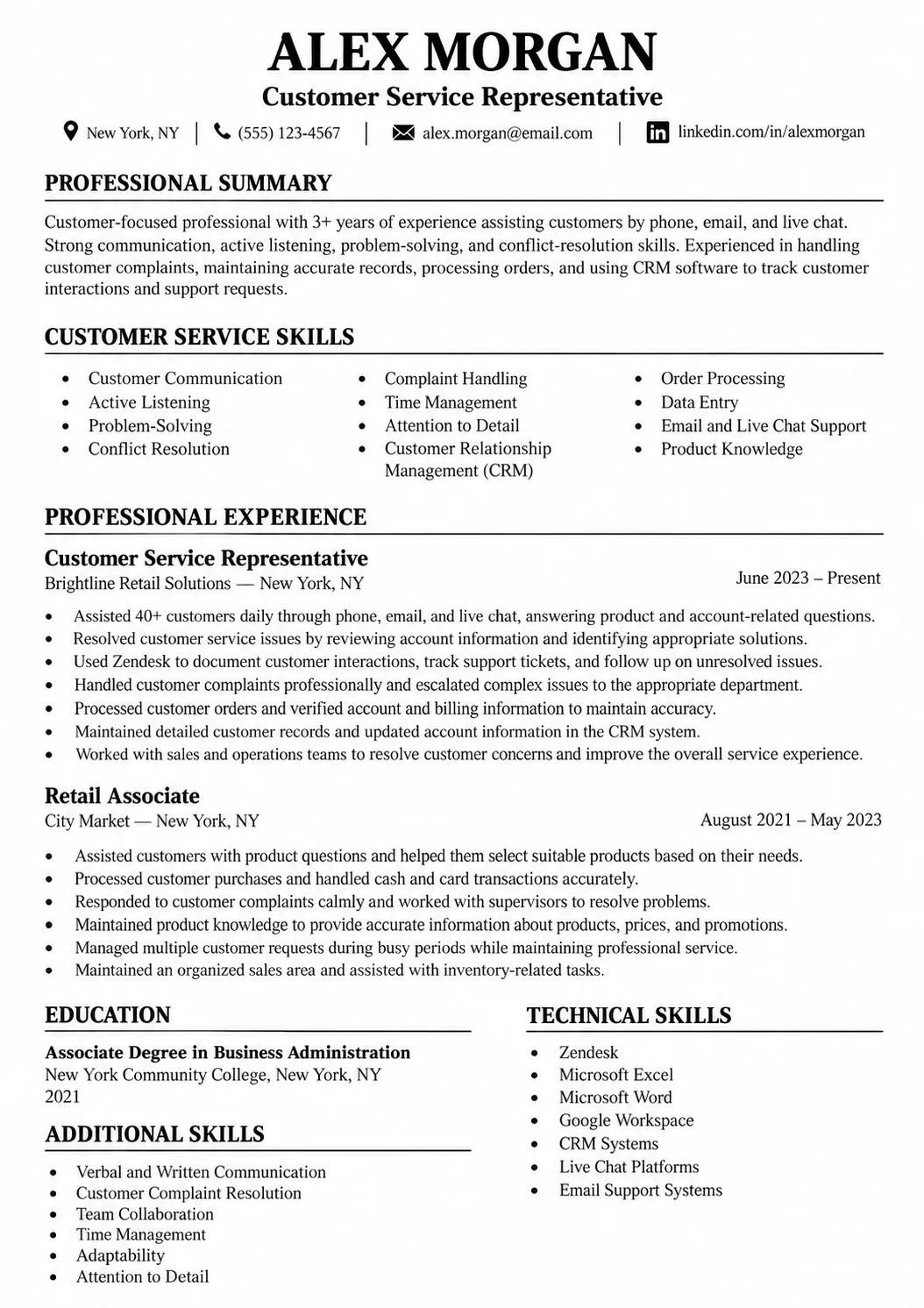


Customer service skills are the abilities you use to communicate with customers, understand their needs, solve problems, and provide helpful support. These skills are important on a resume because employers want people who can handle customer questions professionally and create a positive experience.
Customer service skills can be divided into soft skills and hard skills. Soft skills include communication, active listening, empathy, patience, and problem-solving. Hard skills include using CRM software, handling support tickets, processing orders, and working with customer service tools.
However, simply writing a list of skills on your resume is not always enough. Employers also want to see how you have used those skills in real situations. For example, instead of writing “good communication skills,” you can say that you assisted customers by phone, email, and live chat to resolve questions and service issues. This guide explains the most useful customer service skills and shows you how to present them effectively on your resume.
What Are Customer Service Skills?
Customer service skills are the abilities you use to communicate with customers, understand their needs, answer questions, solve problems, and provide a positive experience. These skills are important in many jobs, including customer service, retail, call center, sales, hospitality, and technical support.
Customer service skills can generally be divided into two groups: soft skills and hard skills.
Soft skills are personal and interpersonal abilities that help you work effectively with customers and coworkers. Common examples include communication, active listening, empathy, patience, problem-solving, conflict resolution, and time management.
Hard skills are practical or technical abilities that can be learned and demonstrated through specific tasks or tools. Examples include using CRM software, managing support tickets, entering customer data, processing orders, understanding products, and providing technical troubleshooting.
A strong customer service resume should include a combination of both. However, you do not need to list every skill you have. Choose skills that match the job description and that you can support with examples from your experience.
10+ Good Customer Service Skills for a Resume
The right customer service skills can help employers quickly understand what you can bring to a role. Below are 12 useful skills to consider, along with examples of how you can show them on your resume.
1. Communication
Good communication is one of the most important customer service skills. Customer service employees need to explain information clearly, ask the right questions, and communicate professionally with different types of customers.
Communication can include both verbal and written communication. You may use it when speaking with customers on the phone, responding to emails, answering live-chat messages, or explaining a product or service.
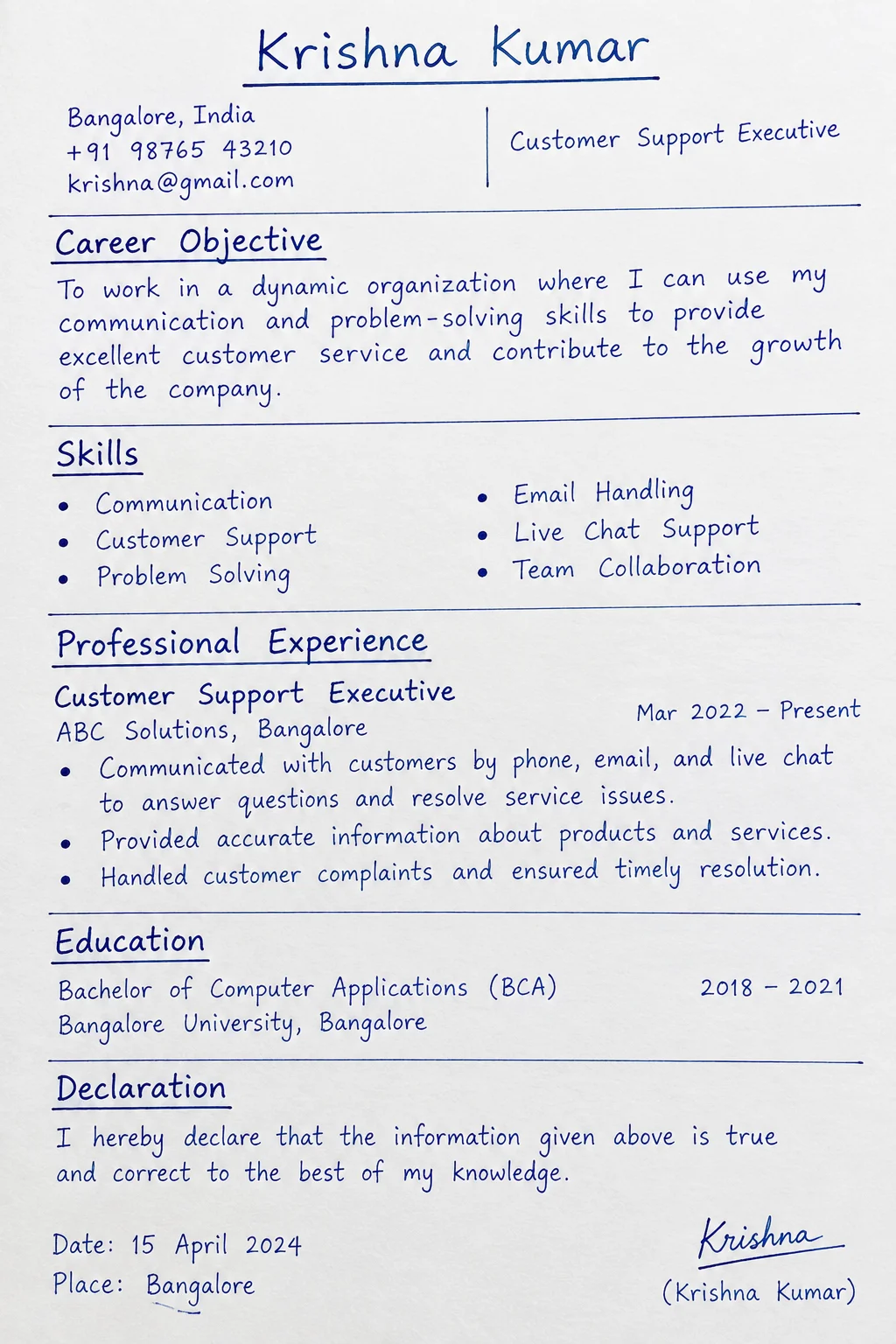
Resume example:
2. Active Listening
Active listening means paying close attention to what a customer is saying and making an effort to understand the actual problem before offering a solution.
Customers may not always explain their problem clearly. A good customer service professional listens carefully, asks relevant questions, and confirms the issue before responding.
3. Problem-Solving
Customer service often involves finding solutions to unexpected problems. You may need to investigate an issue, understand what went wrong, and determine the best way to help the customer.
Strong problem-solving skills show employers that you can think through a situation instead of simply passing every problem to someone else.
4. Empathy
Empathy means understanding a customer’s feelings and responding with patience and respect. It is especially important when customers are frustrated, confused, or unhappy with a product or service.
Showing empathy does not mean agreeing with every customer. It means listening to their concerns, acknowledging their experience, and communicating in a helpful and respectful way.
5. Conflict Resolution
Customer service professionals sometimes deal with complaints, disagreements, and difficult situations. Conflict resolution skills help you remain professional while working toward a practical solution.
This skill can include:
- Handling customer complaints
- Remaining calm during difficult conversations
- Understanding the customer’s concerns
- Finding an acceptable solution
- Escalating an issue when necessary
6. Patience
Patience is particularly valuable when customers need extra help or when an issue takes time to resolve. A patient customer service representative avoids becoming frustrated and continues to communicate respectfully.
This skill can be useful in:
- Call centers
- Technical support
- Retail
- Healthcare
- Customer support
- Entry-level customer service positions
7. Time Management
Customer service employees often have to handle several tasks at the same time. Good time management helps you prioritize requests, respond within expected timeframes, and complete important tasks without losing attention to customers.
You may use this skill when managing customer requests, responding to support tickets, following up with customers, or working during busy periods.
8. Attention to Detail
Small mistakes can create bigger problems in customer service. Incorrect account information, order details, billing information, or customer records can lead to delays and frustration.
Attention to detail helps you enter information accurately, review important details, and identify errors before they affect the customer.
9. Product Knowledge
Customers often contact support teams because they need information about a product or service. Good product knowledge allows you to answer questions accurately and recommend appropriate solutions.
This skill is particularly useful for retail, sales, technical support, and customer service positions.
Instead of simply writing “product knowledge” on your resume, mention the products, services, or systems you actually understand.
10. CRM Skills
Customer relationship management (CRM) skills involve using software to organize customer information, record interactions, track requests, and manage follow-ups.
Common CRM and customer support platforms include Salesforce, Zendesk, HubSpot, Freshdesk, and Intercom. Only list software that you have actually used or have relevant training in.
For example, instead of writing only:
CRM experience, you could mention the specific platform and what you used it for.
11. Multitasking
Customer service employees may need to manage several responsibilities during the same shift. For example, you might answer a phone call while updating customer records, respond to emails, and monitor live-chat requests.
The ability to organize these tasks without losing accuracy can be valuable in busy customer service environments.
12. Adaptability
Customer service environments can change frequently. Companies may introduce new products, software, procedures, policies, or communication channels.
Adaptability shows that you can learn new processes and adjust your approach when circumstances change.
Customer Service Skills: Soft Skills vs. Hard Skills
Understanding the difference between soft and hard skills can help you choose the right skills for your resume.
| Customer Service Skill | Type | What It Shows | Resume Example |
|---|
| Communication | Soft skill | Ability to communicate clearly and professionally | Communicated with customers through phone, email, and live chat. |
| Active listening | Soft skill | Ability to understand customer concerns | Used active listening to identify customer needs and provide solutions. |
| Problem-solving | Soft skill | Ability to identify issues and find solutions | Resolved customer issues by identifying problems and providing appropriate solutions. |
| Empathy | Soft skill | Ability to understand customer concerns | Used empathy when assisting customers with complaints and service issues. |
| Conflict resolution | Soft skill | Ability to handle difficult situations professionally | Resolved customer complaints while maintaining a professional approach. |
| Patience | Soft skill | Ability to remain calm and helpful | Patiently guided customers through product and account questions. |
| Time management | Soft skill | Ability to prioritize tasks and meet deadlines | Managed multiple customer requests while meeting service targets. |
| Attention to detail | Soft skill | Ability to maintain accuracy | Maintained accurate customer and account records. |
| Product knowledge | Hard skill | Understanding of products or services | Used product knowledge to answer customer questions and recommend solutions. |
| CRM software | Hard skill | Ability to use customer management tools | Used Zendesk to track customer support tickets and interactions. |
| Data entry | Hard skill | Ability to enter and maintain information accurately | Entered and updated customer information in company systems. |
| Order processing | Hard skill | Ability to manage customer orders | Processed customer orders and verified order information for accuracy. |
| Technical troubleshooting | Hard skill | Ability to identify and resolve technical issues | Assisted customers with basic technical troubleshooting and account issues. |
| Ticket management | Hard skill | Ability to organize and follow up on support requests | Managed customer support tickets and followed up on unresolved issues. |
How to Choose the Right Skills for Your Resume
You do not need to use all 12 skills on your resume. The best choices depend on the position you are applying for.
Start by reading the job description and identifying the skills the employer mentions. Then select the skills that genuinely match your experience.
Soft Skills vs. Hard Skills for Customer Service
Soft customer service skills
- Communication
- Active listening
- Empathy
- Patience
- Problem-solving
- Conflict resolution
- Adaptability
- Time management
- Teamwork
- Attention to detail
Hard customer service skills
- CRM software
- Ticketing systems
- Data entry
- Order processing
- POS systems
- Product knowledge
- Technical troubleshooting
- Live chat support
- Email support
- Call center software
How to Put Customer Service Skills on Your Resume
Adding customer service skills to your resume is more than creating a long list of keywords. You should place relevant skills in different sections of your resume and show how you have used those skills in real situations.
Use the following steps to make your customer service skills clear, relevant, and easy for employers to find.
| Step | Resume Section | What to Do | Example |
|---|---|---|---|
| 1 | Read the job description | Look for customer service skills and requirements mentioned by the employer. | If the job asks for communication, problem-solving, CRM, and complaint handling, consider including these skills if you genuinely have them. |
| 2 | Choose relevant skills | Select the skills that match both the job and your actual experience. Avoid copying every skill from a job description. | Communication, active listening, problem-solving, CRM software, conflict resolution |
| 3 | Add skills to the Skills section | Create a clear skills section where recruiters can quickly see your relevant abilities. | Customer Service Skills: Communication, active listening, problem-solving, conflict resolution, CRM software, data entry, time management, customer complaint handling. |
| 4 | Use important skills in your Professional Summary | Mention two or three of your strongest and most relevant skills naturally in your opening summary. | Customer-focused professional with strong communication, problem-solving, and complaint-resolution skills. Experienced in assisting customers by phone and email while maintaining accurate records and providing timely solutions. |
| 5 | Show skills in your Work Experience | Instead of simply naming a skill, explain how you used it in your previous job. | Assisted 40+ customers daily through phone and email while maintaining accurate account information. |
| 6 | Start bullet points with action verbs | Use strong verbs to show what you actually did. | Resolved customer complaints, assisted customers with account issues, and processed customer orders. |
| 7 | Add numbers when possible | Use genuine numbers to show the scale or results of your work. Never invent statistics. | Assisted 40+ customers daily and maintained accurate customer records. |
| 8 | Mention relevant tools | If you have used CRM or customer service software, include the specific platform rather than only writing “computer skills.” | Used Zendesk to track support tickets and document customer interactions. |
| 9 | Connect skills to results | Show what happened because of your actions when you have a measurable result. | Resolved customer issues efficiently while helping maintain a 95% customer satisfaction rating. |
| 10 | Check your resume for relevance | Remove skills that are unrelated to the position or that you cannot support with experience. | For a call center job, prioritize communication, active listening, patience, problem-solving, and CRM skills. |
| 11 | Use consistent wording | Use the same professional terminology throughout your resume when it accurately describes your experience. | If the job requires “customer complaint resolution,” use that phrase naturally when it accurately reflects your experience. |
| 12 | Proofread before submitting | Check spelling, grammar, punctuation, dates, job titles, and formatting before sending your resume. | Make sure terms such as “customer service,” “CRM,” and software names are written consistently. |
Example: Turning a Skill Into a Strong Resume Statement
Simply listing a skill tells the employer that you have it, but a work experience bullet can show how you used it.
| Skill | Weak Statement | Stronger Resume Statement |
|---|---|---|
| Communication | Good communication skills | Communicated with customers by phone, email, and live chat to answer questions and resolve service issues. |
| Problem-solving | Excellent problem-solving | Resolved customer account issues by reviewing records and identifying appropriate solutions. |
| Active listening | Good listener | Used active listening to understand customer concerns and provide appropriate solutions. |
| Conflict resolution | Good at handling complaints | Handled customer complaints professionally and worked toward practical solutions. |
| Time management | Good time management | Managed multiple customer requests while meeting daily response and service targets. |
| CRM skills | CRM experience | Used Zendesk to document customer interactions, track support tickets, and follow up on unresolved issues. |
| Attention to detail | Detail-oriented | Maintained accurate customer records and reviewed account information to reduce errors. |
| Product knowledge | Product knowledge | Used product knowledge to answer customer questions and recommend suitable solutions. |