An operations director helps a business run efficiently, controls operating costs, and makes sure different departments work toward the same goals. When deliveries are delayed, expenses increase, or teams struggle to meet targets, this senior leader helps identify the problems and develop solutions.
If you enjoy solving business problems, managing people, and improving how organizations work, operations management could offer a rewarding long-term career.
But how do you become an operations director without previous senior management experience?
This guide explains how to become an operations director, including the qualifications, essential skills, career path, salary expectations, and practical steps for entering the profession.
Quick Career Overview
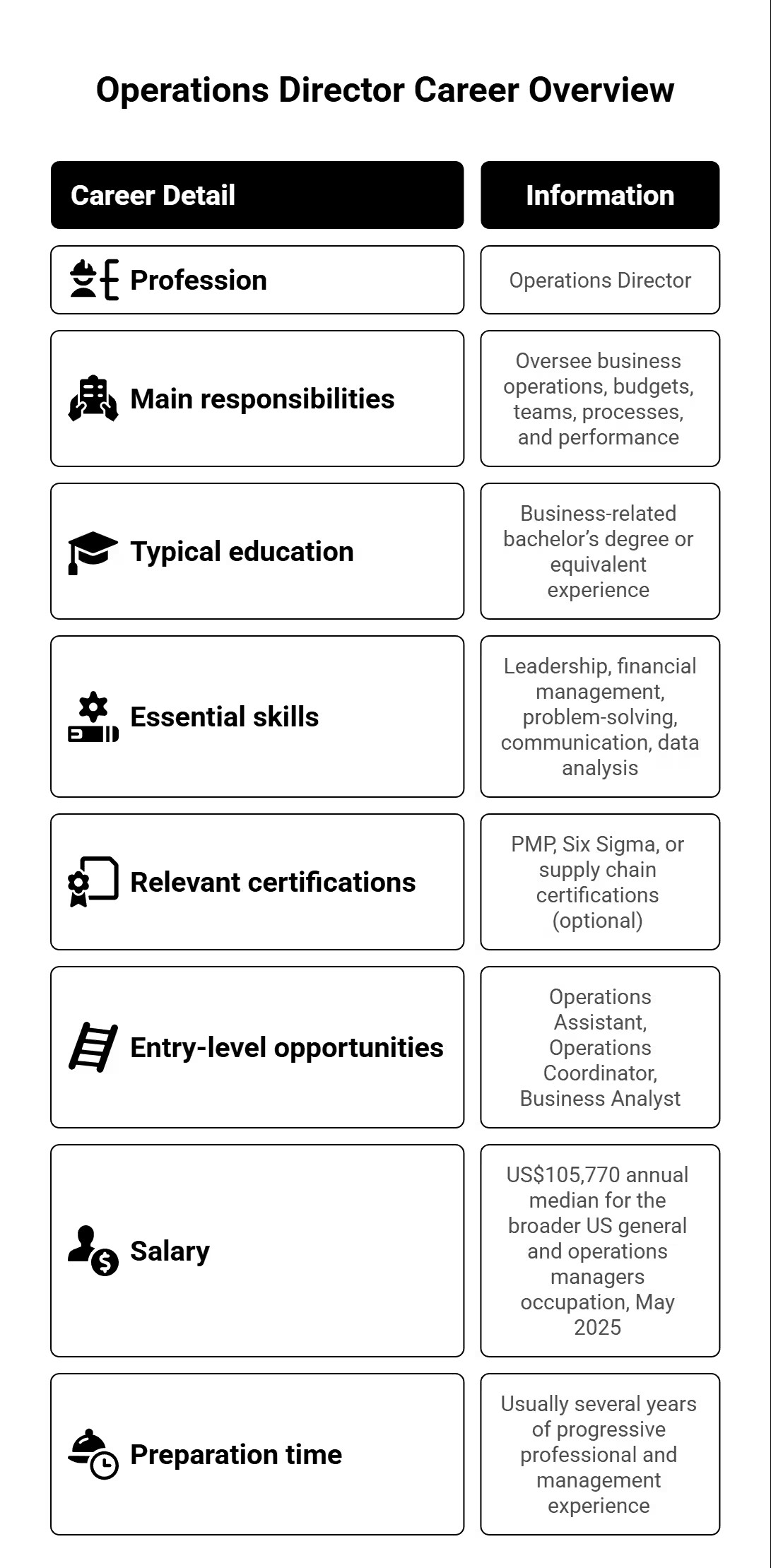
| Career Detail | Information |
|---|---|
| Profession | Operations Director |
| Main responsibilities | Oversee business operations, budgets, teams, processes, and performance |
| Typical education | Business-related bachelor’s degree or equivalent experience |
| Essential skills | Leadership, financial management, problem-solving, communication, data analysis |
| Relevant certifications | PMP, Six Sigma, or supply chain certifications (optional) |
| Entry-level opportunities | Operations Assistant, Operations Coordinator, Business Analyst |
| Salary | US$105,770 annual median for the broader US general and operations managers occupation, May 2025 |
| Preparation time | Usually several years of progressive professional and management experience |
Important: Operations director is generally a senior management position. It is not usually a job that someone enters immediately after graduation.
What Does an Operations Director Do?
An operations director manages the systems, people, and resources that allow an organization to deliver its products or services effectively.
Their responsibilities often include developing operating strategies, supervising department managers, controlling budgets, improving productivity, managing business risks, and monitoring performance.
For example, an operations director at a distribution company might discover that customer orders are regularly arriving late. They could examine warehouse processes, delivery schedules, staffing levels, and supplier performance before introducing improvements.
Operations directors work in manufacturing, healthcare, logistics, retail, technology, professional services, and other industries. Their work may involve offices, production facilities, warehouses, or multiple business locations.
Common tools include Microsoft Excel, Power BI, enterprise resource planning (ERP) systems, and project management software.
The role combines daily operational oversight with longer-term business planning.
How to Become an Operations Director: Step-by-Step Roadmap
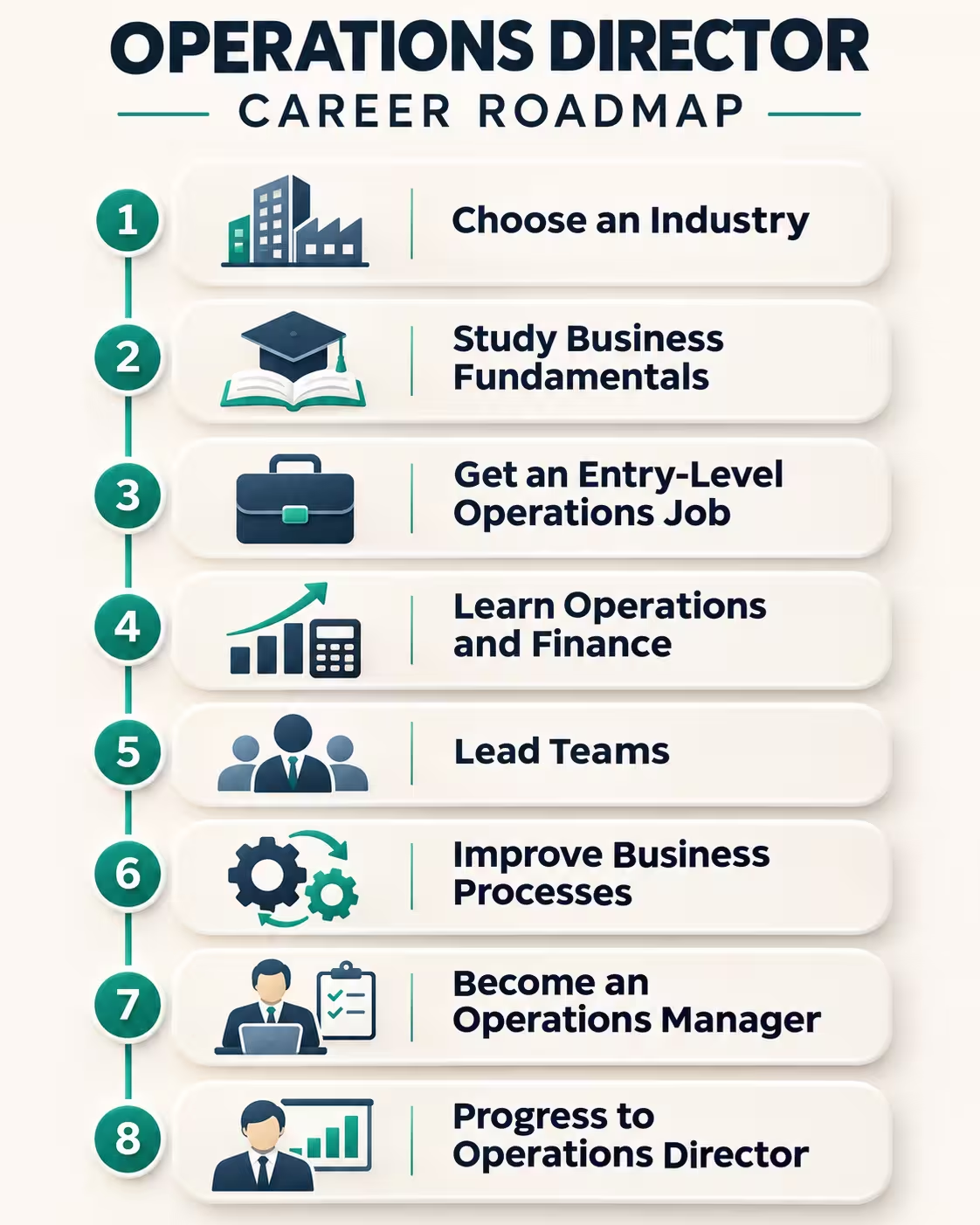
There is no single route into this profession. However, a typical operations director career path involves building business knowledge, gaining practical experience, and gradually taking responsibility for larger teams and budgets.
Step 1: Understand the Industry You Want to Work In
Operations management looks different across industries.
A manufacturing operations director may oversee production quality and equipment use, while a healthcare operations director may focus on staffing, service delivery, and regulatory compliance.
Start by reviewing job descriptions from employers in your preferred sector.
Pay attention to responsibilities involving budgets, workforce planning, quality standards, technology, and leadership.
This research will help you identify which qualifications and experiences are most useful.
Step 2: Choose a Relevant Education Pathway
A bachelor’s degree in business administration, operations management, supply chain management, finance, or a related field can provide a useful foundation.
Engineering or another specialist degree may be valuable in technical industries.
During your studies, focus on accounting, business analytics, organizational management, and project planning.
A degree is not a universal legal requirement for the job title, but many employers prefer formal education combined with substantial professional experience.
Step 3: Gain Entry-Level Operations Experience
Most future operations directors begin in junior business or operational positions.
Suitable starting roles include Operations Assistant, Operations Coordinator, Logistics Coordinator, Administrative Coordinator, and Junior Business Analyst.
These jobs help you understand scheduling, reporting, customer service, inventory, and business processes.
For example, an operations coordinator might prepare weekly staffing schedules and track missed delivery deadlines.
Such experience provides the practical foundation needed for later management responsibilities.
Step 4: Learn Operational and Financial Management
Operations directors must understand how business decisions affect efficiency, service quality, and costs.
Learn to monitor key performance indicators (KPIs), which are measurements used to track business results.
Examples include:
- Cost per order
- On-time delivery rate
- Production output
- Customer complaint rate
- Employee productivity
Develop your skills in Excel, reporting dashboards, budgeting, and forecasting.
Understanding the relationship between operating expenses and business performance is especially valuable.
Step 5: Build Leadership and Communication Skills
Technical knowledge alone is not enough to become an operations director.
You must also learn how to guide employees, communicate expectations, resolve disagreements, and make decisions under pressure.
Look for opportunities to supervise a shift, train new colleagues, coordinate a project, or lead a small team.
Ask for feedback on your communication and decision-making.
These experiences help demonstrate your ability to achieve results through other people.
Step 6: Gain Experience Improving Business Processes
An operations director is expected to improve performance, not simply maintain existing routines.
Learn process mapping, root-cause analysis, quality control, and continuous improvement.
For example, you might investigate why customer requests take too long to process.
After identifying unnecessary steps, you could introduce a revised workflow and compare processing times before and after the change.
Keep records of improvements you help deliver. Employers value evidence of measurable results.
Step 7: Progress Into Operations Management
After developing experience, look for positions such as Operations Supervisor, Operations Manager, Regional Manager, or Head of Operations.
At this stage, focus on managing larger budgets, supervising managers, improving cross-department processes, and contributing to business strategy.
You should also develop experience with supplier negotiations, performance reviews, risk management, and operational planning.
These responsibilities prepare you for the wider accountability expected of a director.
Step 8: Apply for Operations Director Positions
When you have substantial leadership experience, begin targeting director-level opportunities suited to your industry and responsibilities.
Prepare a résumé that emphasizes operational improvements, financial accountability, leadership achievements, and business results.
For example, explain how you reduced operating costs, improved service quality, or coordinated teams across several locations.
Prepare interview examples showing how you handled difficult decisions, competing priorities, and operational risks.
Your proven ability to manage complex operations will usually matter more than collecting unrelated certificates.
Education, Degrees and Certifications
There is no universal degree, certification, or professional licence required solely to hold the title of operations director.
However, employers commonly expect relevant qualifications, management experience, and strong industry knowledge.
Education Pathways
| Pathway | Career Value |
|---|---|
| Bachelor’s degree | Common foundation for business and management careers |
| MBA or relevant master’s degree | Optional preparation for broader strategic and financial responsibilities |
| Business or management diploma | Alternative route into operational roles where employers accept it |
| Work-based training | Builds practical management experience |
| Professional certification | Demonstrates knowledge in a specialist area |
Country-Specific Considerations
USA: The Bureau of Labor Statistics identifies a bachelor’s degree and considerable previous experience as typical preparation for top executives. Individual employers may accept different backgrounds.
UK: University education and work-based management development are possible routes. Skills England’s Level 5 Operations Manager apprenticeship standard remains available for privately funded new starts, but new starts have not been government funded since September 1, 2026.
Canada: Job Bank indicates that administrative services management roles usually require a related degree or college diploma and several years of professional experience.
Australia: The Australian occupational classification identifies a bachelor’s-level qualification or at least five years of relevant experience as the skill-level benchmark for general managers. Employers may impose additional requirements.
Industry-specific qualifications and regulatory responsibilities can apply, particularly in healthcare, financial services, and other regulated sectors.
Useful Professional Certifications
Three optional certifications worth considering are:
- Project Management Professional (PMP): Issued by the Project Management Institute (PMI). Suitable for experienced professionals who lead business projects and meet its eligibility requirements.
- Certified Six Sigma Green Belt (CSSGB): Issued by the American Society for Quality (ASQ). Focuses on improving processes and solving quality problems.
- Certified Supply Chain Professional (CSCP): Offered by the Association for Supply Chain Management (ASCM). Relevant to logistics, procurement, and supply chain operations.
These certifications are not mandatory for operations director jobs. Choose one based on your industry, experience, and the requirements of employers you want to work for.
Skills Needed to Become an Operations Director
Successful operations directors combine analytical abilities with practical management and leadership skills.
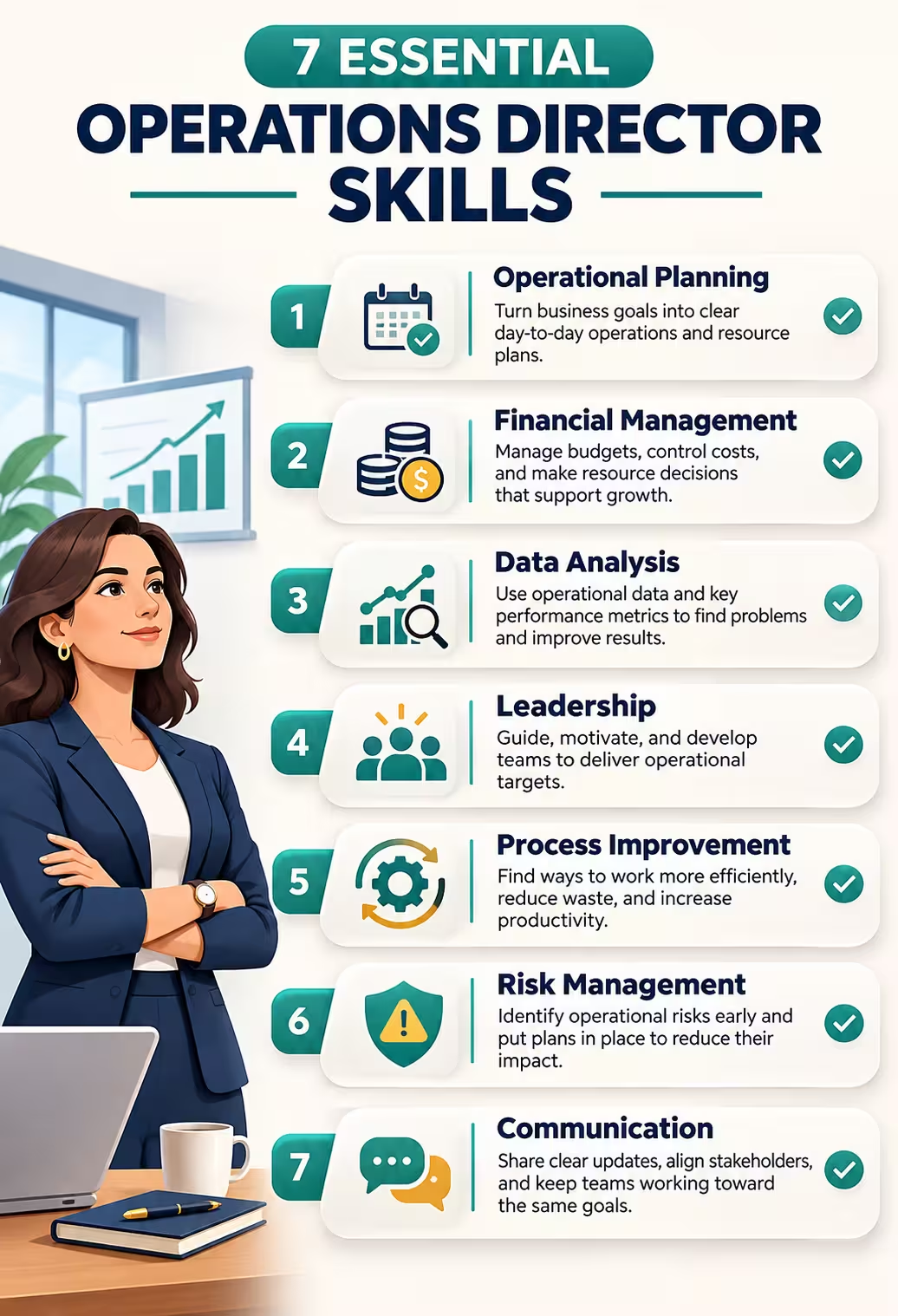
| Skill | Why It Matters | How to Learn It |
|---|---|---|
| Operational planning | Keeps teams, resources, and deadlines aligned | Manage schedules and operational plans |
| Financial management | Helps control budgets and costs | Study budgeting and financial reports |
| Data analysis | Supports evidence-based decisions | Practice Excel and Power BI |
| Leadership | Improves team performance | Supervise staff and lead projects |
| Process improvement | Reduces delays, waste, and errors | Learn Lean methods and process mapping |
| Risk management | Helps prevent operational disruptions | Study risk registers and continuity plans |
| Communication | Aligns departments and stakeholders | Present reports and lead meetings |
Learning these skills through real business assignments is especially valuable.
Operations Director Salary and Career Opportunities
Operations director salaries vary by industry, employer size, location, and level of responsibility.
Official wage statistics do not always report operations directors as a separate occupation. The following figures cover relevant management groups, so they should not be treated as directly comparable director salaries.
| Country | Salary Information | Source / Data Period |
|---|---|---|
| USA | US$105,770 median annually for general and operations managers | BLS, May 2025 |
| UK | £72,623 median annually for the broader Operations Manager occupational map | Skills England; data period not specified |
| Canada | C$50.00 median hourly for operations director – administrative services occupation group | Job Bank, 2023–2024 reference period |
| Australia | Comparable median unavailable for General Managers | Jobs and Skills Australia, May 2025 earnings data |
In the USA, employment of general and operations managers is projected to increase by 5% from 2025 to 2035, according to the Bureau of Labor Statistics. This projection covers the broader occupation rather than operations director vacancies specifically.
Operations Director Career Progression
A realistic pathway may look like this:
Operations Assistant or Coordinator → Operations Supervisor → Operations Manager → Head of Operations → Operations Director → Chief Operating Officer (COO)
Not every company uses these titles, and some professionals progress through project management, supply chain management, engineering, or other business functions.
Operations directors may eventually advance to COO, general manager, managing director, or another executive leadership position.
How to Get Your First Job in Operations
If you are a student or fresh graduate, focus on obtaining practical business experience rather than applying immediately for director positions.
Search for operations internships, graduate management programmes, operations assistant roles, and junior analyst vacancies.
Your résumé should highlight relevant coursework, spreadsheet skills, teamwork, internships, and examples of solving practical problems.
Prepare for interview questions about organizing tasks, dealing with delays, and communicating with different team members.
Beginner project idea: Create a simple operations dashboard using sample order data.
Track delivery times, errors, workload, and completion rates in Excel. Then prepare a short report explaining which process you would improve and why.
Clearly label invented data as simulated. This project can help demonstrate analytical thinking without misrepresenting professional experience.
Common Mistakes to Avoid
| Mistake | Better Approach |
|---|---|
| Applying directly for senior roles without relevant experience | Build experience through coordinator, supervisor, and manager positions |
| Focusing only on technical software | Develop leadership, communication, and financial judgment |
| Collecting certifications without applying the knowledge | Complete relevant improvement projects and document the outcomes |
| Ignoring industry-specific requirements | Learn the safety, quality, and compliance standards of your sector |
| Describing job duties instead of achievements | Explain the results of projects and responsibilities using evidence |
Practical Career Action Plan
Becoming an operations director is normally a long-term goal. The following stages are illustrative, not guaranteed promotion timelines.
| Career Stage | Recommended Actions |
|---|---|
| First 3 months | Research industries, identify skills gaps, and learn spreadsheet reporting |
| Months 3–12 | Apply for internships or junior operations jobs; complete a practical project |
| Years 1–3 | Build experience in operational reporting, team coordination, and process improvement |
| Years 3–5 and beyond | Seek supervisory and management responsibilities involving budgets and staff |
| Later career | Pursue broader management accountability and director-level opportunities when qualified |
If you already have management experience in another field, you may be able to move into operations management through a more direct route.
Frequently Asked Questions
1. Can I become an operations director without a degree?
Yes, it is possible in some organizations, but it can be challenging. Many employers prefer a relevant bachelor’s degree alongside significant management experience. Professionals without degrees may progress through operational roles, employer training, and demonstrated leadership achievements. Requirements depend on the industry, employer, and country.
2. How long does it take to become an operations director?
There is no fixed timeline. The US Bureau of Labor Statistics identifies five years or more of related experience as typical for the broader top-executive category. Operations directors often need additional experience managing teams, budgets, and complex business functions. Progression depends on responsibilities and employer expectations.
3. Is an MBA necessary to become an operations director?
An MBA is not generally mandatory. It can be useful for professionals who want to strengthen their financial, strategic, and organizational management knowledge. However, an MBA does not replace practical leadership experience. Review target job descriptions before investing in postgraduate education.
4. What is the difference between an operations manager and an operations director?
An operations manager typically supervises a department, location, or operational function. An operations director usually has wider responsibility for strategy, multiple teams, larger budgets, or several business locations. The distinction varies between organizations, particularly smaller companies where responsibilities can overlap.
5. Can I switch careers and become an operations director?
Yes. Professionals with backgrounds in engineering, logistics, finance, project management, hospitality, or business administration may have transferable skills. Start by identifying your experience with planning, budgets, teams, and performance improvement. You may need an intermediate operations management position before applying for director roles.
6. Is an operations director the same as a COO?
Not necessarily. A Chief Operating Officer is generally an executive responsible for organization-wide operations and strategy. An operations director may oversee a division, region, or particular operational area and report to the COO or another senior executive. In smaller businesses, responsibilities and titles sometimes overlap.
Final Thoughts
Learning how to become an operations director starts with understanding how businesses work and building the experience needed to lead their operations.
A relevant education can help, but practical experience, financial judgment, people management, and measurable operational improvements are central to the career path.
Begin by choosing an industry, developing your analytical skills, and pursuing opportunities that increase your responsibility.
As your career develops, focus on managing larger teams, budgets, and business challenges. Those achievements provide the foundation for moving into senior operations leadership.