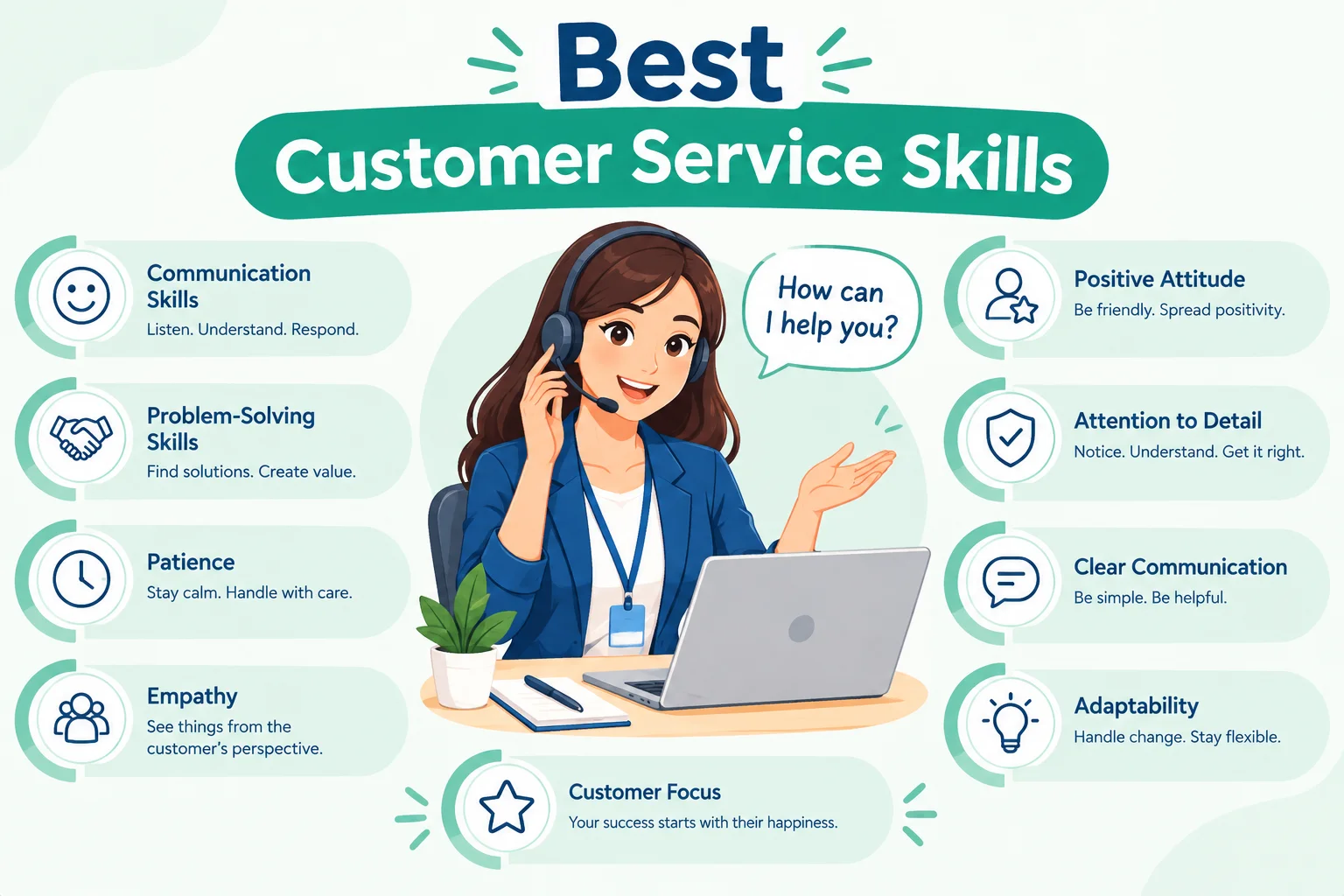
Customer service is more than answering questions or responding to complaints. It involves understanding people, communicating clearly, solving problems, handling difficult situations, and making sure customers receive accurate and useful information.
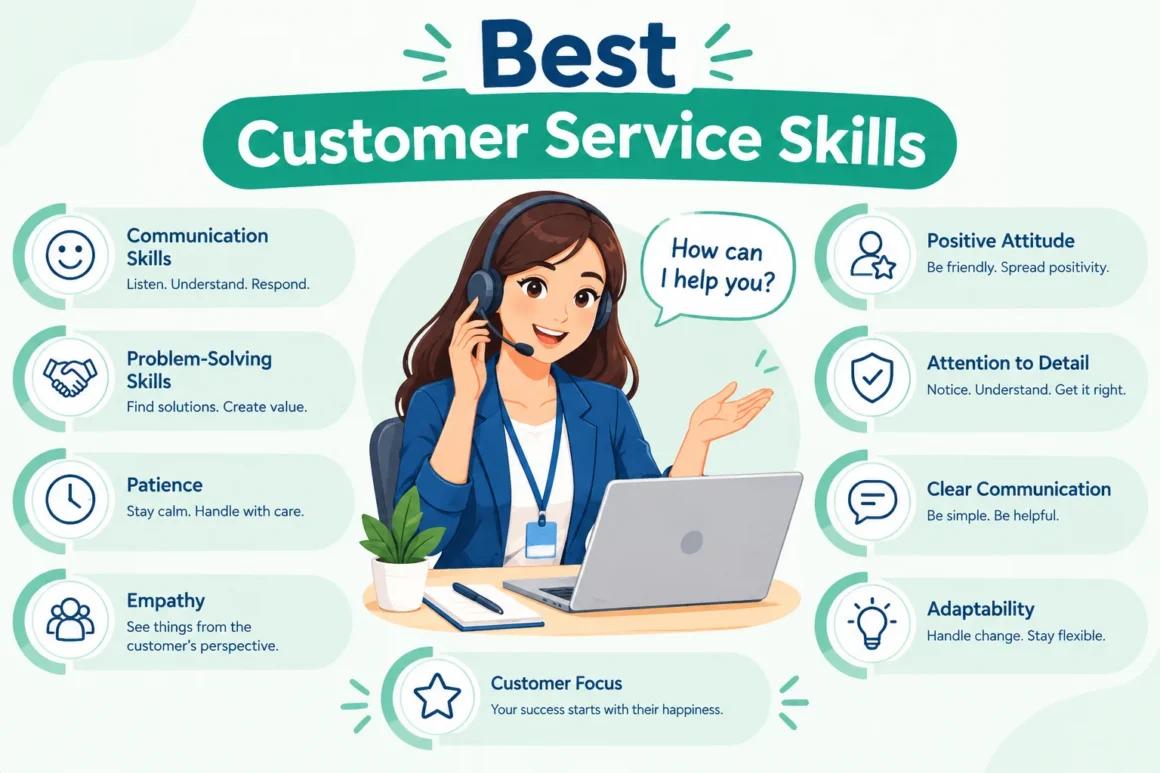
The best customer service skills combine communication abilities, emotional intelligence, problem-solving, technical knowledge, and professional behavior. Some skills are especially important for call center employees, while others are useful for retail workers, receptionists, sales professionals, technical support agents, and online support teams.
Below are 51 customer service skills that can help you perform your job more effectively and communicate with customers professionally.
1. Active Listening
Active listening means giving your full attention to what a customer is saying instead of thinking about your response while they are speaking. A good customer service representative listens for the actual problem, important details, and the customer’s expectations. Repeating or summarizing the issue can also confirm that you understood it correctly and prevent unnecessary misunderstandings.
2. Clear Communication
Clear communication helps customers understand information without confusion. Customer service professionals should explain solutions, policies, instructions, and next steps using simple and direct language. Avoiding unnecessary technical terms is especially helpful when customers are unfamiliar with a product or service. A clear explanation can make even a complicated problem easier for the customer to understand.
3. Empathy
Empathy means understanding a customer’s feelings and responding in a considerate way. Customers may contact support because they are frustrated, confused, worried, or disappointed. Showing empathy does not mean agreeing with every complaint. It means recognizing the customer’s experience and responding respectfully. Phrases such as “I understand why that would be frustrating” can help create a more constructive conversation.
4. Patience
Patience is essential when customers need extra explanations, repeat information, or struggle to describe their problem. A customer service employee should avoid sounding irritated or rushing the conversation unnecessarily. Patience is particularly useful when handling elderly customers, technical issues, language difficulties, or complicated complaints. Remaining calm can make the interaction more comfortable for both sides.
5. Problem-Solving
Problem-solving involves understanding the customer’s situation, identifying possible causes, and finding an appropriate solution. A customer may not always explain the real problem clearly, so the representative needs to ask useful questions and examine the available information. Strong problem-solving skills help employees move beyond simply answering questions and actually resolve customer concerns.
6. Product Knowledge
Product knowledge means understanding the products or services a company provides. Customer service representatives should know important features, limitations, pricing information, basic troubleshooting procedures, and relevant policies. Good product knowledge allows employees to provide accurate answers instead of guessing. It also helps them explain options more confidently when customers are deciding what to purchase or use.
7. Positive Attitude
A positive attitude means remaining helpful, respectful, and professional during customer interactions. It does not require pretending that every situation is easy. Instead, it means focusing on what can be done rather than responding negatively to a problem. A calm and constructive attitude can make conversations more productive, particularly when a customer begins the interaction feeling frustrated.
8. Time Management
Customer service employees often need to manage several requests during a busy workday. Time management helps them organize tasks, prioritize urgent issues, and avoid spending unnecessary time on simple requests. However, speed should not come at the expense of accuracy. Good time management means working efficiently while still giving customers enough attention to understand and resolve their concerns.
9. Adaptability
Every customer communicates differently. Some people want detailed explanations, while others prefer short and direct answers. Adaptability allows customer service professionals to adjust their communication style according to the situation. It is also useful when companies introduce new products, software, policies, or procedures. Employees who adapt quickly can continue providing effective service when circumstances change.
10. Conflict Resolution
Conflict resolution involves managing disagreements and finding a practical way forward. Customers may disagree with a decision, policy, charge, or previous response. Instead of arguing, a skilled representative listens carefully, identifies the main issue, explains the available options, and remains respectful. The goal is to handle the disagreement professionally without making the situation more difficult.
11. Emotional Intelligence
Emotional intelligence involves recognizing emotions and understanding how they influence communication. A customer service representative needs to recognize when a customer is becoming frustrated and adjust their approach accordingly. It is also important to control personal reactions. Staying calm when someone is angry or critical helps prevent emotional responses from making an already difficult conversation worse.
12. Attention to Detail
Small mistakes can create major customer service problems. Attention to detail helps employees correctly record names, order numbers, dates, account information, addresses, and other important details. It also helps when reading customer messages or reviewing previous interactions. Carefully checking information before taking action can reduce errors and prevent customers from having to contact the company repeatedly.
13. Critical Thinking
Critical thinking helps customer service employees examine information before deciding what to do. A customer’s explanation may not contain all the necessary details, and the first apparent solution may not always be appropriate. Critical thinking encourages employees to compare information, identify possible causes, consider company policies, and choose a response based on the available evidence.
14. Decision-Making
Customer service professionals often need to make decisions quickly. They may need to determine whether an issue can be solved immediately, requires escalation, or needs additional information. Good decision-making involves understanding company policies, considering the customer’s situation, and choosing a reasonable course of action. Clear decision-making can prevent unnecessary delays and improve the overall service process.
15. Professionalism
Professionalism means behaving appropriately and respectfully regardless of the situation. This includes using suitable language, maintaining a calm tone, respecting customer privacy, following workplace procedures, and taking responsibilities seriously. Professionalism is particularly important when dealing with complaints. Even when a customer is upset or communication becomes difficult, the employee should continue to represent the company appropriately.
16. Responsibility
Taking responsibility means owning the part of the customer service process that belongs to you. Instead of immediately transferring every difficult issue to another employee, a responsible representative first tries to understand what can be done. If another department must handle the issue, the representative should provide the necessary information and explain the next step clearly.
17. Follow-Up
Follow-up means checking whether a customer issue has actually been resolved after the initial interaction. This can be especially useful for technical problems, complaints, delayed orders, or cases involving another department. A simple follow-up message can confirm that the customer received the expected solution. It also helps prevent unresolved problems from being forgotten.
18. Persuasion
Persuasion is useful when explaining why a particular product, service, or solution may suit a customer’s needs. Effective persuasion is based on relevant information rather than pressure. For example, a representative can explain how a particular feature addresses the customer’s stated requirement. Good customer service persuasion helps customers make informed decisions instead of simply trying to increase a sale.
19. Negotiation
Negotiation becomes useful when a customer’s expectations and company policies do not completely match. A representative may need to explore available alternatives, explain limitations, or find a solution that is acceptable within company guidelines. Good negotiation requires patience, clear communication, and an understanding of what can realistically be offered. It should remain professional rather than becoming argumentative.
20. Teamwork
Customer service often involves cooperation between multiple employees or departments. A support representative may need information from billing, technical support, shipping, sales, or management. Teamwork helps employees share relevant information and coordinate solutions efficiently. Good teamwork also means communicating clearly with colleagues and avoiding unnecessary blame when a customer’s problem involves more than one department.
21. Multitasking
Multitasking involves managing several responsibilities without losing track of important details. Customer service employees may need to speak with a customer while checking an account, reviewing information, recording notes, or monitoring another task. Multitasking should not mean doing everything carelessly. The goal is to manage multiple responsibilities while maintaining reasonable accuracy and attention.
22. Stress Management
Customer service can become stressful during busy periods, large product launches, service interruptions, or difficult customer interactions. Stress management helps employees remain calm and focused instead of allowing pressure to affect their communication. Taking a moment to organize thoughts, following established procedures, and maintaining professional habits can help employees handle demanding situations more effectively.
23. Quick Learning
Companies frequently introduce new products, software, procedures, and policies. Customer service employees therefore need to learn new information quickly. Strong learning skills help representatives understand changes and apply them correctly during customer interactions. Someone who learns efficiently can become comfortable with new systems and processes without repeatedly depending on colleagues for basic information.
24. Customer-Focused Thinking
Customer-focused thinking means considering the customer’s needs while still following company policies and practical limitations. It involves asking what information the customer needs, what problem they are trying to solve, and what outcome would be useful. This approach helps employees avoid treating every interaction as a simple transaction and instead focus on providing relevant assistance.
25. Telephone Etiquette
Telephone etiquette includes speaking clearly, greeting customers professionally, listening without unnecessary interruptions, and ending calls appropriately. Tone is especially important because customers cannot see facial expressions or body language during a phone conversation. A professional telephone manner also includes avoiding excessive background noise, explaining when you need to place someone on hold, and confirming important information.
26. Email Communication
Customer service emails should be clear, polite, organized, and reasonably concise. Employees need to understand the customer’s question before writing a response and make sure every important point is addressed. A useful email usually explains the solution, provides necessary instructions, and states what the customer should do next. Proofreading is also important because unclear writing can create additional questions.
27. Chat Support Skills
Live chat requires employees to communicate quickly while maintaining accuracy. Customers often expect relatively fast responses, but speed should not lead to incomplete or confusing answers. Chat support professionals should use short paragraphs, clear wording, and appropriate greetings. They also need to read the customer’s previous messages carefully so they do not repeatedly ask for information already provided.
28. Written Communication
Written communication is important for emails, chat messages, support tickets, social media responses, and internal notes. Good writing should be grammatically correct and organized logically. Customer service employees should avoid unnecessary jargon and confusing sentences. They should also consider tone because written messages do not include voice or facial expressions to clarify the intended meaning.
29. Verbal Communication
Verbal communication involves expressing information clearly when speaking with customers. Good verbal communication includes appropriate vocabulary, understandable pronunciation, suitable pacing, and a professional tone. Employees should avoid speaking too quickly or using complicated explanations when a simpler option is available. The aim is to make the customer understand the information without making the conversation unnecessarily long.
30. Questioning Skills
Good questioning skills help customer service employees discover what the customer actually needs. Instead of immediately suggesting a solution, a representative can ask specific questions about what happened, when it happened, and what the customer has already tried. Open questions can encourage customers to explain the situation, while specific questions can help confirm important details.
31. De-Escalation
De-escalation means reducing tension during a difficult customer interaction. When someone is angry, responding defensively can make the conversation worse. A better approach is to remain calm, listen carefully, acknowledge the concern, and explain what can realistically be done. The employee should avoid arguing about emotions and instead guide the conversation toward facts, options, and practical next steps.
32. Complaint Handling
Complaint handling requires more than simply listening to negative feedback. The employee should understand what went wrong, determine what can be corrected, and communicate the available solution clearly. It is also useful to record important complaint details when company procedures require it. A professional response can turn a difficult conversation into a structured problem-solving process.
33. Technical Troubleshooting
Technical troubleshooting involves following a logical process to identify and resolve technical problems. The employee may need to ask the customer about error messages, recent changes, device settings, or steps already attempted. Rather than randomly suggesting solutions, a skilled representative works through the likely causes systematically. Clear instructions are especially important when the customer has limited technical knowledge.
34. Computer Skills
Most modern customer service roles require basic computer skills. Employees may need to use email, web applications, customer databases, internal communication tools, spreadsheets, or ticketing systems. Good computer skills allow representatives to switch between tasks efficiently and locate information without unnecessary delays. The exact software varies by employer, but comfort with digital tools is broadly useful.
35. CRM Knowledge
Customer relationship management, commonly called CRM, involves systems used to store and manage customer information and interactions. Employees may use CRM software to review previous conversations, update customer records, create tasks, or document problems. Understanding how to use these systems accurately helps maintain organized customer information and allows other employees to understand what has already happened.
36. Data Entry Accuracy
Customer service employees frequently enter information into digital systems. This might include customer names, contact information, order details, case notes, or service requests. Accurate data entry helps prevent mistakes later in the process. Employees should carefully check important information before saving or submitting it, especially when an error could affect billing, delivery, communication, or account access.
37. Organization
Organization helps customer service professionals keep track of conversations, tasks, follow-ups, documents, and deadlines. Without good organization, even a helpful employee can accidentally overlook an important request. Using appropriate notes, task lists, ticket systems, and reminders can make customer work easier to manage. Organized employees can also provide clearer information when another colleague needs to take over a case.
38. Research Skills
Customer service employees will sometimes encounter questions they cannot answer immediately. Research skills help them find reliable information using company documentation, product manuals, internal knowledge bases, or other approved resources. It is better to verify information than to guess. When research is necessary, employees should also explain to customers when they need additional time to confirm an answer.
39. Resourcefulness
Resourcefulness means knowing how to use available resources to solve a problem. A customer service employee may need to check documentation, consult another department, review previous cases, or use a troubleshooting guide. Resourcefulness does not mean ignoring company procedures. Instead, it means making sensible use of the tools and information available while staying within appropriate policies.
40. Cultural Awareness
Customers may come from different countries, cultures, age groups, and communication backgrounds. Cultural awareness helps employees avoid unnecessary assumptions and communicate respectfully. It can also improve understanding when customers use different communication styles or expressions. The goal is not to memorize every cultural difference but to remain open-minded, respectful, and willing to clarify information when misunderstandings occur.
41. Language Skills
Strong language skills can make customer communication easier, particularly when employees serve customers from different regions. Good grammar, vocabulary, pronunciation, and listening ability can reduce misunderstandings. Knowing an additional language may also be useful for certain customer service roles. However, employees should communicate only within their actual language ability and seek appropriate support when accurate translation is necessary.
42. Confidence
Confidence allows customer service representatives to explain information clearly and professionally. Customers can become uncertain when an employee sounds extremely hesitant or provides an unclear answer. Confidence does not mean pretending to know everything. A professional can confidently say that they need to verify something before providing the correct information. This is more useful than giving an uncertain or inaccurate answer.
43. Honesty
Honesty is essential in customer service because customers depend on employees for accurate information. Representatives should not promise refunds, delivery dates, features, or exceptions that they are not authorized to provide. If something cannot be done, it is better to explain the limitation clearly and discuss available alternatives. Honest communication helps prevent additional disappointment later.
44. Reliability
Reliability means consistently doing what you have agreed to do. If a representative tells a customer that they will provide an update, submit a request, or follow up on a case, they should complete that responsibility within the expected timeframe. Reliable employees help customers feel that their concerns are being handled rather than forgotten or passed around unnecessarily.
45. Respectfulness
Respectfulness means treating customers politely regardless of their background, communication style, or level of knowledge. A representative should avoid sarcasm, insulting language, unnecessary arguments, or dismissive responses. Respect does not require accepting inappropriate behavior from customers. Employees can maintain professional boundaries while still communicating courteously and focusing on the issue that needs to be resolved.
46. Flexibility
Flexibility helps employees respond appropriately when circumstances change. A company may update its procedures, introduce new software, change a product, or experience an unexpected service problem. Customers may also have different needs from those originally expected. Flexible employees can adjust their approach while still following the correct policies. This skill is particularly useful in fast-changing customer service environments.
47. Self-Control
Self-control helps employees manage their own reactions during difficult conversations. A customer may speak angrily, criticize the company, or repeatedly challenge an explanation. Responding emotionally can quickly damage the interaction. A professional representative should pause when necessary, maintain a controlled tone, and focus on the facts and available solutions instead of reacting personally.
48. Goal Orientation
Goal orientation means working toward clear service objectives while maintaining appropriate quality. Customer service goals may involve response times, case resolution, customer satisfaction measures, sales targets, or other workplace expectations. Employees should understand their goals without allowing numerical targets to encourage careless communication. A good balance involves working efficiently while still giving customers accurate and useful assistance.
49. Feedback Acceptance
Feedback helps customer service employees identify areas that need improvement. Feedback may come from customers, supervisors, quality reviews, or colleagues. Instead of treating every criticism as a personal attack, employees can examine whether there is a useful lesson in it. Being willing to improve communication, product knowledge, or work habits can gradually strengthen overall customer service performance.
50. Service Recovery
Service recovery involves responding appropriately after a customer has experienced a problem, mistake, delay, or poor service. Depending on company policy, recovery may involve correcting the error, explaining what happened, providing an appropriate alternative, or following up later. The representative should avoid making promises outside their authority. The focus should be on resolving the situation honestly and professionally.
51. Upselling Awareness
Upselling awareness means recognizing when an additional product or service may genuinely meet a customer’s needs. It should not involve pushing irrelevant products simply to increase a sale. For example, if a customer explains that their current service lacks a feature they need, a representative can explain an available option that includes it. Relevant recommendations can be useful when presented honestly and clearly.
Why Customer Service Skills Matter
Customer service employees often represent a company directly. A customer may never meet a manager or visit a company’s office, but they may interact with a support representative several times.
Strong customer service skills help employees handle these interactions more effectively. Active listening helps identify what the customer actually needs, while problem-solving helps determine what can be done about the issue.
Communication is equally important. Even a correct solution can create frustration if it is explained poorly. Customers should understand what will happen next, what information is required, and whether there are any limitations.
These skills are useful beyond traditional call-center jobs. They can benefit receptionists, sales representatives, technical support agents, account managers, retail employees, hospitality workers, and many other professionals who communicate with customers.
The Most Important Skills for Handling Difficult Customers
Not every customer interaction will be easy. A customer may be angry because of a delayed order, unexpected charge, technical problem, or previous experience with a company.
Several skills become particularly useful in these situations:
- Listen without interrupting.
- Acknowledge the customer’s concern.
- Ask questions to understand the problem.
- Avoid arguing or blaming the customer.
- Explain what you can realistically do.
- Give clear next steps.
- Follow up when appropriate.
For example, instead of saying, “That is not our fault,” a professional response could be, “I understand why that would be frustrating. Let me check what happened and explain the options available.”
The goal is not to agree with every complaint. It is to handle the conversation respectfully while working toward an appropriate solution.
How to Improve Your Customer Service Skills
Customer service skills can be developed through regular practice. You do not need to master all 51 skills at once.
Start with communication. Practice listening carefully and summarizing a customer’s concern before suggesting a solution. This simple habit can prevent misunderstandings.
Next, improve your product or service knowledge. Read company documentation, learn common customer problems, and understand the policies that affect your work.
You can also practice difficult conversations. Think about how you would respond to an angry customer, a confused customer, or someone asking for something outside company policy.
After customer interactions, review what happened. Ask yourself:
- Did I understand the customer’s actual concern?
- Was my explanation clear?
- Did I remain professional?
- Could I have solved the problem more efficiently?
- Did I explain the next step clearly?
Feedback is another useful way to improve. A supervisor or experienced colleague may notice communication habits that are difficult to recognize yourself.
How to Put Customer Service Skills on a Resume
Do not simply list every skill you have. Choose skills that match the job description and support them with evidence when possible.
For example, instead of writing only “Communication skills,” you could describe how you used communication to handle customer inquiries, explain services, or resolve complaints.
Useful resume skills may include:
- Active listening
- Customer relationship management
- Complaint resolution
- Problem-solving
- Written and verbal communication
- Conflict resolution
- Technical troubleshooting
- Time management
- Teamwork
- Product knowledge
- CRM software
- Customer retention
The strongest resumes connect skills with actual responsibilities or achievements. Keep the wording accurate and avoid claiming experience with tools or responsibilities you have not actually handled.
Customer Service Skills for Interviews
Customer service interviews often include practical or behavioral questions. Employers may ask how you would handle an angry customer, prioritize several requests, or respond when you do not know an answer.
Prepare specific examples from your experience if you have them. Explain the situation, what you did, and what happened afterward.
If you are new to customer service, examples from school, volunteering, retail, internships, or other work can demonstrate relevant abilities. For instance, helping someone understand a complicated process can show communication and patience, even if the situation was not formally called customer service.
During the interview, your behavior also demonstrates your skills. Listen carefully to the question, answer directly, and communicate respectfully.
Final Thoughts
The best customer service skills are not limited to being friendly. Strong customer service requires listening, clear communication, patience, problem-solving, product knowledge, emotional control, and the ability to take appropriate action.
You do not need to master every skill on this list immediately. Focus first on the abilities that are most relevant to your role, practice them consistently, and use feedback to improve. Over time, these skills can help you handle customer interactions more confidently and professionally.