It’s 2026. Building a successful startup is no longer just about having a brilliant product idea. The landscape is crowded, capital is discerning, and the difference between scaling and stalling often comes down to one thing: discipline.
Every day, founders fall into the trap of “tool chaos.” A sales team uses one CRM, marketing experiments with three different analytics platforms, and finance is running spreadsheets that never quite sync with the rest of the business. Before you know it, you’re drowning in subscriptions, dealing with fragmented data, and spending more time switching between tabs than actually building your business.
But what if you stopped treating tools like random apps to install when something breaks? What if you started treating them as a structured system?
This is the essence of Growth Navigate Startup Tools. It’s not a list of software; it’s a strategy. It’s a framework that helps founders move from idea to scale with clarity, measurable progress, and controlled risk. Here is how to design that system properly and build a stack that supports revenue growth instead of distracting your team.
What Are “Growth Navigate” Tools?
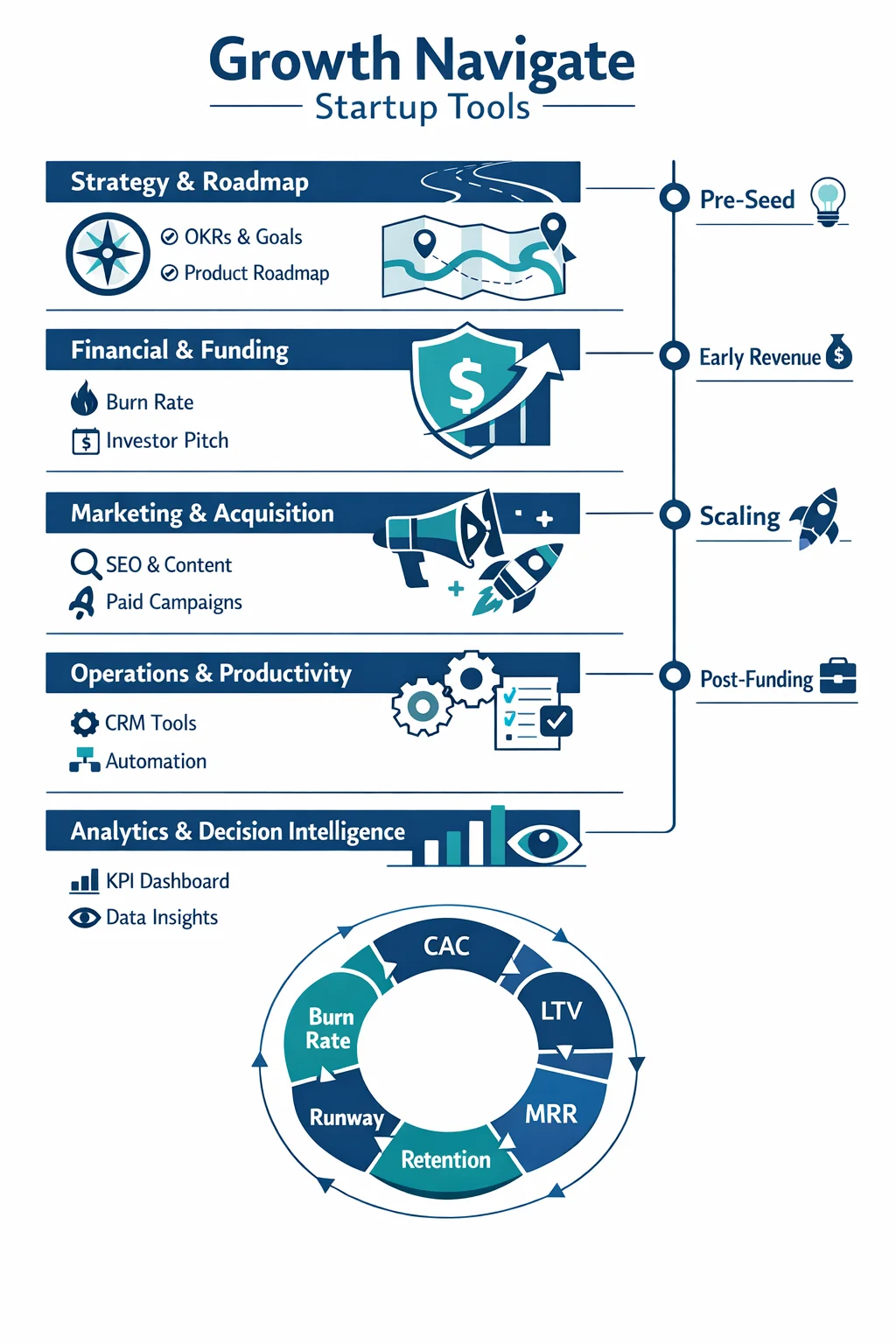
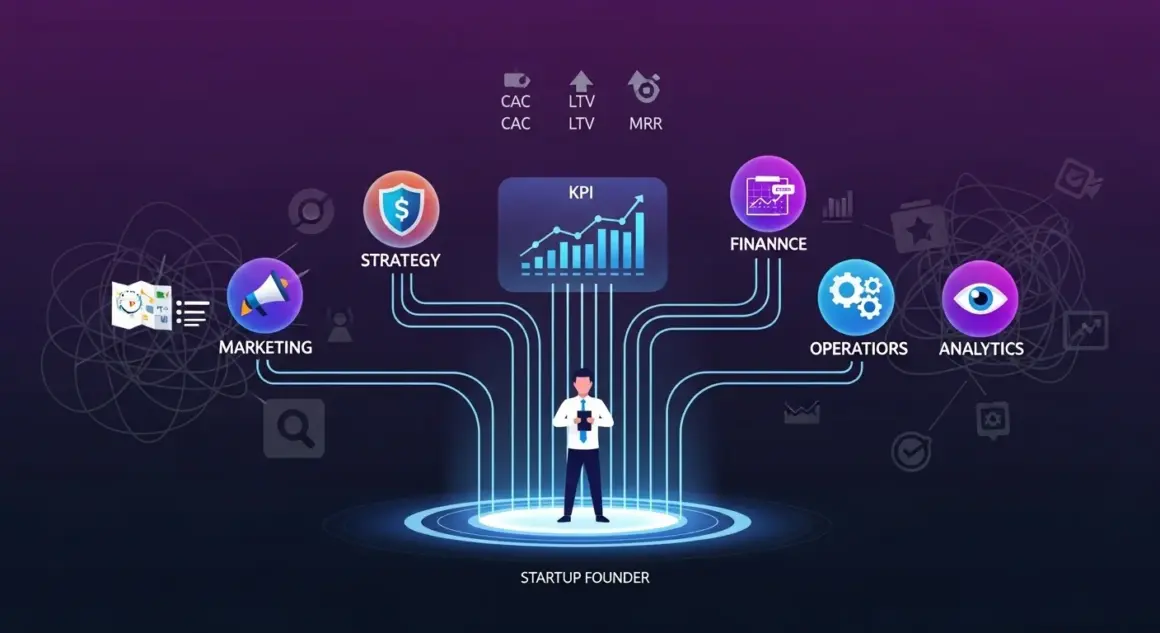
In simple terms, a growth navigate tool stack is the structured combination of platforms, systems, and software that help founders do five things:
- Plan growth intentionally.
- Track performance with real data.
- Manage teams and operations.
- Control cash flow.
- Support funding decisions.
Think of the difference between “growth” and “navigation”:
- Growth tools focus on acquisition and expansion (marketing automation, CRM, sales outreach).
- Navigation tools focus on clarity and direction (analytics dashboards, KPI systems, financial forecasting).
Without structure, tools become noise. With structure, tools become your growth engine.
The Cost of Random Adoption
Many startups install tools reactively. Someone says, “We need a CRM,” or “Let’s try this trending AI tool.” This random adoption leads to:
- Tool Overload: Too many platforms with overlapping features.
- Data Silos: Marketing data in one system, sales in another, finance in spreadsheets. No single source of truth.
- Founder Burnout: Manually checking metrics across eight dashboards daily.
- Poor KPI Visibility: No clear view of Customer Acquisition Cost (CAC), Lifetime Value (LTV), or burn rate.
When growth becomes guesswork, startups fail.
The 5 Pillars of a Strategic Tool Stack
To navigate growth effectively, your tools must fit into five distinct categories. If you have a tool that doesn’t fit into one of these pillars, you probably don’t need it.
1. Strategy & Roadmap
You need clarity before you scale.
- Tools: OKR systems (Objectives and Key Results), roadmap planners, growth modeling frameworks.
- Goal: Align teams around measurable goals.
2. Financial & Funding
Cash flow determines survival.
- Tools: Forecasting software, budget tracking, and burn rate calculators.
- Goal: Track runway monthly, not quarterly, and maintain clean books for investors.
3. Marketing & Customer Acquisition
Acquisition drives revenue.
- Tools: SEO platforms, paid ads managers, and email automation.
- Goal: Choose based on your stage, not trends.
4. Operations & Productivity
Teams scale faster with structure.
- Tools: Project management, collaboration platforms, workflow automation.
- Goal: Reduce execution friction and communication overhead.
5. Analytics & Decision Intelligence
Without clean data, the strategy fails.
- Tools: KPI dashboards, funnel tracking, and cohort analysis.
- Goal: Centralize your data to see CAC, LTV, and conversion trends in one place.
Matching Tools to Your Stage
The tools you need at the pre-seed stage are vastly different from what you need when scaling. Here is a quick guide:
- Pre-Seed (Idea to MVP):
- Focus: Lean validation, roadmap planning, basic financial tracking.
- Rule: Keep costs minimal. Use free or freemium tools to test hypotheses.
- Early Revenue:
- Focus: CRM, marketing automation, KPI dashboards.
- Rule: Revenue tracking becomes critical. This is when you invest in a system that shows you exactly where your money is coming from.
- Scaling (Post-Funding):
- Focus: Advanced analytics, automation workflows, HR systems.
- Rule: Operational efficiency matters more than experimentation. Integrate your systems to prevent manual work.
How to Build Your Stack: A Step-by-Step Blueprint
Ready to fix your tool chaos? Follow this blueprint:
- Define Your Growth Goal: Are you chasing revenue targets, user acquisition, or market expansion? Your goal dictates your tool requirements.
- Map Required Functions: List out what you need to track—marketing, sales, finance, operations.
- Select One Tool Per Function: Avoid duplication. If two tools do the same thing, pick one and drop the other.
- Integrate & Automate: Use APIs (Application Programming Interfaces) to connect your systems. Your CRM should talk to your analytics platform.
- Review Quarterly: Set a recurring calendar invite to review your subscriptions. Remove unused tools, renegotiate contracts, and optimize costs.
Metrics That Matter
Using these tools is pointless if you aren’t tracking the right metrics. Every founder must have a clear view of these numbers weekly:
- CAC (Customer Acquisition Cost): How much you spend to get a customer.
- LTV (Lifetime Value): How much revenue a customer generates over their lifetime.
- Burn Rate: How quickly you are spending capital.
- Runway: How many months until you run out of cash.
- MRR (Monthly Recurring Revenue): The lifeblood of a SaaS (Software as a Service) or subscription business.
- Retention Rate: Are your customers sticking around?
The Future is Structured, Integrated, and AI-Driven
As we move toward 2030, the landscape of growth tools is evolving. We are moving away from disconnected point solutions and toward unified founder dashboards.
- AI-First Analytics: Systems will predict churn and revenue trends before they happen.
- Embedded Financial Intelligence: Real-time burn tracking will be built into your operational tools.
- Predictive Scaling: Your tools will eventually suggest when to hire or expand based on data patterns.
AI should enhance your decision-making, but it should never replace strategic thinking. The goal remains the same: to build a system that supports revenue growth, not distracts your team.
Conclusion
Building a startup is hard enough without the burden of tool chaos. By shifting your mindset from “random adoption” to a disciplined “growth navigate” system, you regain control over your data, your cash flow, and your time.
Stop installing apps to fix immediate pain points. Start building a structured system that navigates you toward sustainable growth.