Listing your master’s degree after your name might seem like a small detail, but it carries significant professional weight. Whether you’re updating your resume, signing emails, publishing academic work, or creating a LinkedIn profile, using the correct degree order and format signals credibility, education level, and attention to detail.
Yet many people get it wrong.
Should you include periods?
Do certifications come before degrees?
What if you have more than one master’s degree?
Is it okay to use it in everyday emails?
This comprehensive guide answers all of those questions—and more. By the end, you’ll know exactly how to list your master’s degree after your name, when to do it, and when to leave it off.
Why Listing Your Master’s Degree Correctly Matters
Your name is your professional brand. Adding a master’s degree to it can:
- Establish academic authority
- Increase credibility in specialized fields
- Clarify your expertise instantly
- Strengthen professional and academic communication
However, incorrect formatting can do the opposite—making you appear careless or uninformed. That’s why understanding the right order and conventions is essential.
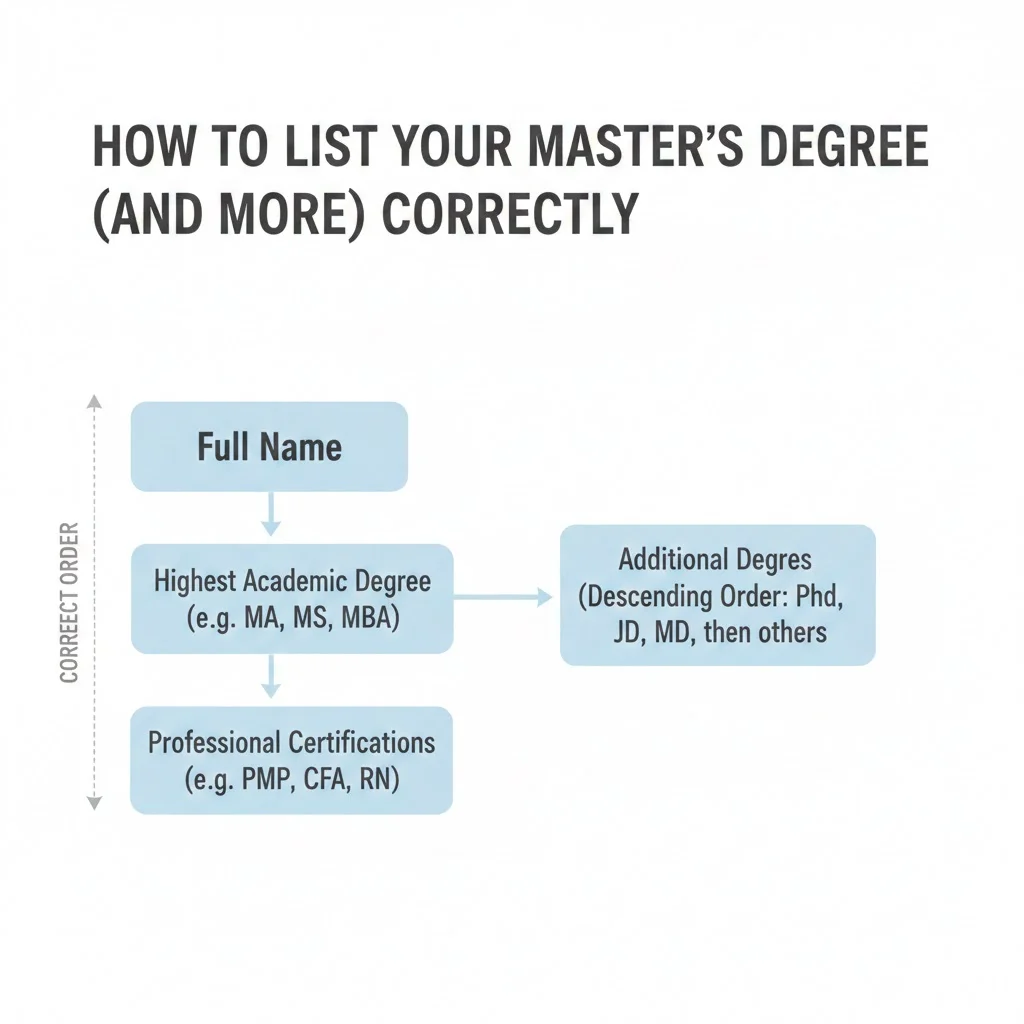
The General Rule for Listing Degrees After Your Name
The most important rule is simple:
List only your highest earned degree, unless a lower degree is relevant for a specific reason.
Degrees should be written in descending order of academic level, not in the order you earned them.
Correct Order (Highest to Lowest)
- Doctoral degrees (PhD, EdD, MD, JD)
- Master’s degrees (MA, MS, MBA, MEd, etc.)
- Bachelor’s degrees (BA, BS)
In most cases, you should stop at your highest degree.
How to Write a Master’s Degree After Your Name
Basic Format
Full Name, Degree Abbreviation
Example:
Anita Sharma, MA
or
Rahul Verma, MSc
That’s it—simple and professional.
Common Master’s Degree Abbreviations
Here are some of the most widely used and accepted master’s degree abbreviations:
| Degree Name | Abbreviation |
|---|---|
| Master of Arts | MA |
| Master of Science | MS or MSc |
| Master of Business Administration | MBA |
| Master of Education | MEd |
| Master of Engineering | MEng |
| Master of Fine Arts | MFA |
| Master of Public Administration | MPA |
| Master of Social Work | MSW |
✔ Use the abbreviation provided by your university if there’s a variation.
Should You Use Periods in Degree Abbreviations?
Both styles are acceptable, but consistency matters.
- With periods: M.A., M.S., M.B.A.
- Without periods (modern standard): MA, MS, MBA
👉 Best practice: Avoid periods unless your organization or publication style guide requires them.
How to List Multiple Master’s Degrees After Your Name
If you hold more than one master’s degree, list them in order of relevance or academic importance—not alphabetically.
Example:
Neha Kapoor, MBA, MSc
✔ Use commas between degrees
✔ Do not repeat the word “Master”
✔ Avoid listing more than two unless absolutely necessary
Pro tip: In resumes and bios, it’s often better to explain multiple degrees in the education section instead of stacking them after your name.
Degree vs. Certification: What Comes First?
Degrees and professional certifications follow different hierarchies.
Correct Order:
- Academic degrees
- Professional licenses
- Certifications
Example:
Vikram Singh, MBA, PMP
❌ Incorrect:
Vikram Singh, PMP, MBA
Degrees always come first because they represent formal academic achievement.
Should You Include Your Bachelor’s Degree?
Usually, no.
If you have a master’s degree, your bachelor’s degree is assumed and does not need to be listed after your name.
Don’t do this:
Amit Patel, BA, MA
Do this instead:
Amit Patel, MA
Exception: Academic or ceremonial contexts where full credentials are required.
How to List a Master’s Degree in Email Signatures
Your email signature is one of the most common places to display your degree—but only if it’s relevant.
Professional Email Signature Example
Riya Mehta, MBA
Marketing Manager
ABC Solutions
When to Include It
- Academic roles
- Consulting or advisory positions
- Healthcare, education, or research
- Formal business correspondence
When to Skip It
- Casual internal emails
- Creative industries where credentials are less emphasized
- Informal communication
How to Use a Master’s Degree on LinkedIn
On LinkedIn, you don’t need to add your degree after your name, although you can.
Best Practice:
- Add your master’s degree in the Education section
- Mention it in your headline only if it’s central to your expertise
Optional Name Format:
Anuj Malhotra, MS
Use this sparingly—overuse can look cluttered or overly formal.
How to List a Master’s Degree on a Resume
Unlike signatures, resumes do not include degrees after your name.
❌ Avoid:
Karan Joshi, MBA
✔ Correct:
Karan Joshi
Master of Business Administration – XYZ University
Your education belongs in the Education section, not in the name header.
Academic and Research Writing Rules
In academic publications, degree usage is highly specific.
- Authors usually do not list degrees after their names
- Degrees appear in author bios or footnotes
- Journals follow strict style guides (APA, MLA, Chicago)
Always follow the journal’s formatting requirements.
Common Mistakes to Avoid
Let’s save you from the most frequent errors.
❌ Overloading Credentials
Rohit Kumar, BA, MA, MBA, PMP, Six Sigma
Too much information reduces clarity.
❌ Using the Wrong Abbreviation
Master of Science in Economics → MEc (Incorrect)
Always verify the official abbreviation.
❌ Including Incomplete Degrees
Never list a degree you haven’t earned yet.
❌ “MBA (Candidate)” after your name
✔ Mention it in your bio or education section instead
Cultural and Regional Differences
Degree formatting can vary slightly by country.
- US/UK: MA, MS, MBA
- India: MA, MSc, MTech
- Europe: MSc often preferred
Despite variations, the order and logic remain the same globally.
Should You List Your Master’s Degree in Everyday Use?
Ask yourself one question:
Does it add value in this context?
If yes—use it confidently.
If no—leave it out.
Professionalism is about relevance, not repetition.
Quick Reference: The Right Way to List a Master’s Degree
✔ Highest degree only
✔ Correct abbreviation
✔ No unnecessary periods
✔ Degree before certifications
✔ Context-appropriate usage
Perfect Example:
Sneha Iyer, MSc
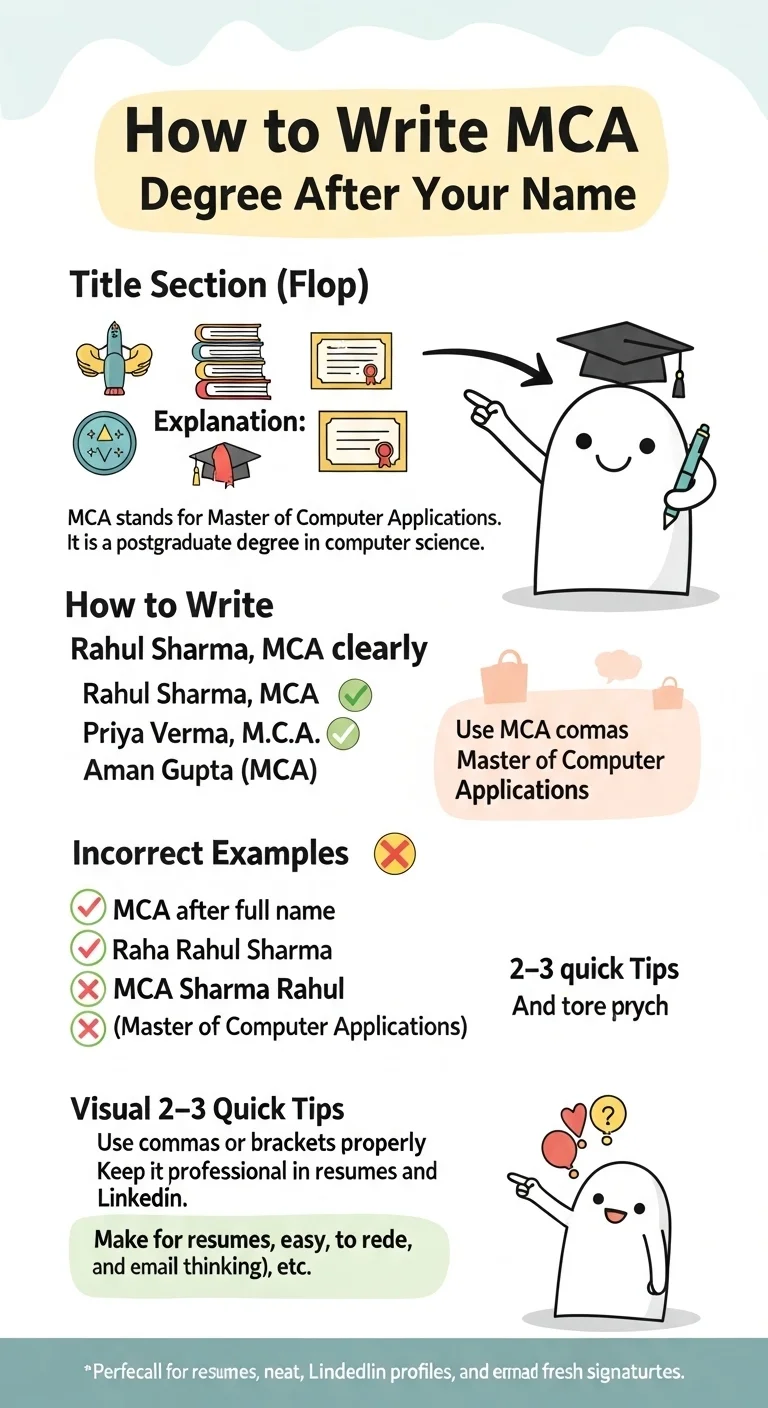
How to Write MCA Degree After Name
Final Thoughts
Knowing how to list your master’s degree after your name correctly is a small skill with a big impact. When done right, it enhances credibility, communicates expertise, and reflects professionalism. When done wrong, it can distract or even undermine your authority.
Stick to the rules, keep it clean, and always prioritize clarity over clutter.
Your name deserves to look as professional as your achievements.