Have you ever finished a book and immediately wanted to share your thoughts with others? That’s where a book review comes in. Whether you’re a student polishing an assignment, a blogger building an audience, or an author hoping to support fellow writers, knowing how to write a book review is a valuable skill. A book review isn’t just a summary of the story—it’s a thoughtful evaluation of how well the author achieved their purpose and what the book means to its readers.
In simple terms, a book review combines what the book is about with your opinion on its strengths and weaknesses. Done well, it helps others decide whether to read the book and gives you a chance to develop your analytical and writing skills.
By the end of this guide, you’ll know exactly how to write a book review that is structured, insightful, and engaging—complete with examples, format tips, and a free template you can use right away.
Why Book Reviews Matter
Book reviews are more powerful than most people realize. They shape what readers pick up next, influence an author’s reputation, and even help students sharpen their critical thinking skills. A single thoughtful review can make the difference between a book being ignored and becoming widely read.
Here’s why they matter for different groups:
- Readers → A well-written review saves time and money by helping readers decide if a book is worth their attention.
- Authors → Reviews boost visibility, credibility, and can directly impact sales. For indie authors, reviews are lifelines.
- Students → Writing reviews builds skills in analysis, structure, and persuasive writing.
- Bloggers & Content Creators → Book reviews drive traffic, encourage engagement, and establish authority in a niche.
Read Also | How to Write a Book: A Step-by-Step Guide
In short, book reviews connect stories with the right audience, turning casual reading into meaningful discussions.
What is a Book Review?
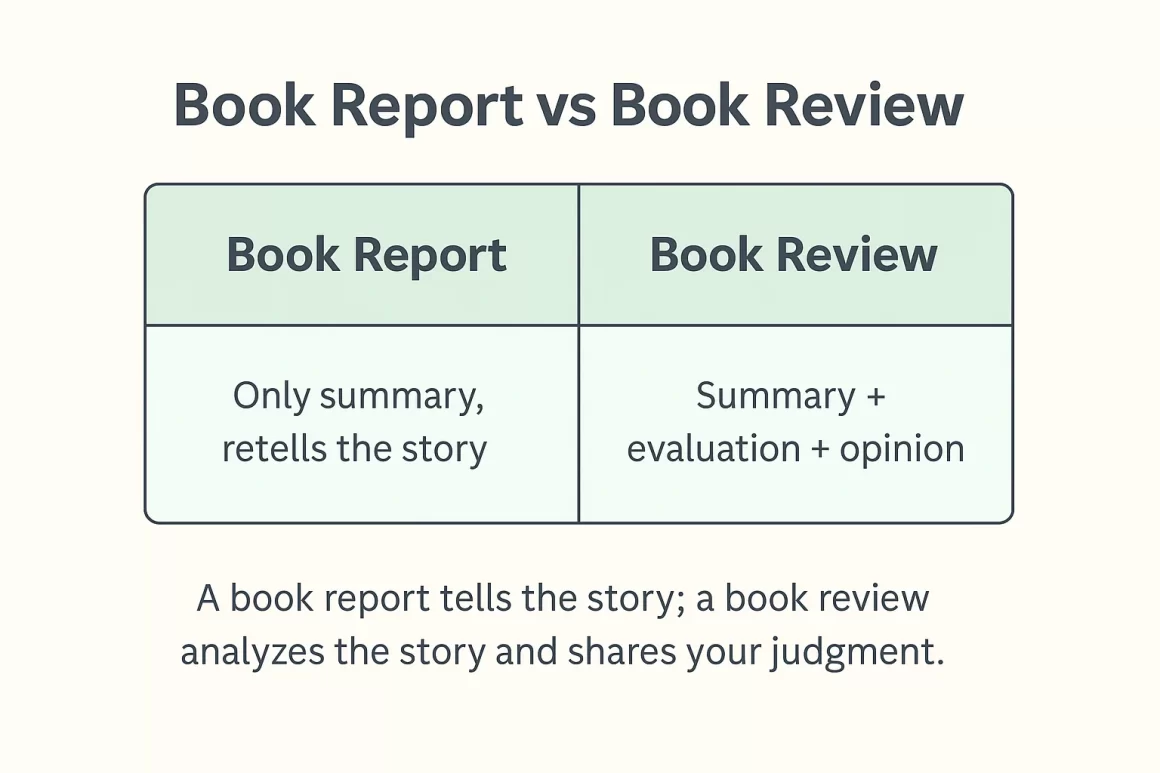
At its core, a book review is a mix of summary and evaluation. It tells readers what the book is about while also analyzing how effective it is at achieving its goals. Think of it as answering two big questions: What is the book about? and So what does it mean for the reader?
There are two common types of book reviews:
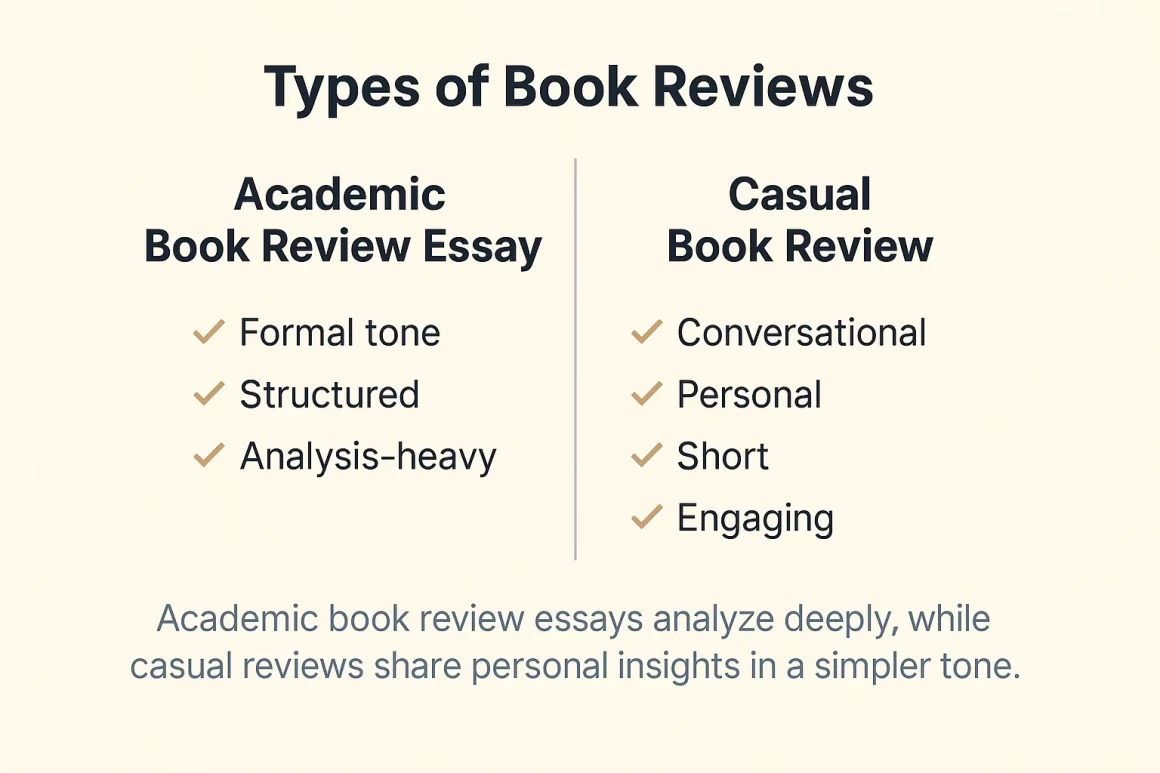
- Academic book review essay → These are written for schools, universities, or journals. They focus on deep analysis, themes, arguments, and evidence. The tone is formal, and the structure is very similar to an essay.
- Casual or blog reviews → These are more conversational and reader-friendly. They highlight what you liked, what didn’t work, and who would enjoy the book, often with personal opinions and a lighter tone.
Purpose of a book review:
- Inform readers about the book’s content.
- Persuade them with your opinion on whether the book is worth reading.
- Guide different audiences—students, general readers, or fans of a specific genre—towards the right choice.
In short, a book review is both a reflection of your reading experience and a tool for others to make informed decisions.
Why Book Reviews Matter
Book reviews play a crucial role in the reading and publishing world. They don’t just share opinions—they influence what people read, how books are perceived, and how writers grow. Let’s break down why they matter for different groups.
- For Readers (Decision-Making): A review helps readers decide whether a book is worth their time and money. With the vast number of books published every year, reviews serve as filters that guide readers to the right choices.
- For Authors (Credibility + Marketing): Reviews build trust and visibility. A steady flow of positive, honest reviews can boost sales and establish credibility, especially for new or indie authors trying to stand out.
- For Students (Critical Thinking & Writing Skills): Writing reviews helps students go beyond surface-level reading. They learn to analyze arguments, evaluate style, and express opinions clearly, which strengthens both academic and communication skills.
? Quick Stat: Goodreads alone influences over 50 million readers each month, proving just how powerful reviews are in shaping book choices.
Step-by-Step Guide on How to Write a Book Review
Learning the steps to write a book review will not only make your review clearer but also more persuasive and engaging. A good review has a balance of summary, analysis, and evaluation, and these six steps will guide you from the first page of reading to your final polished draft.
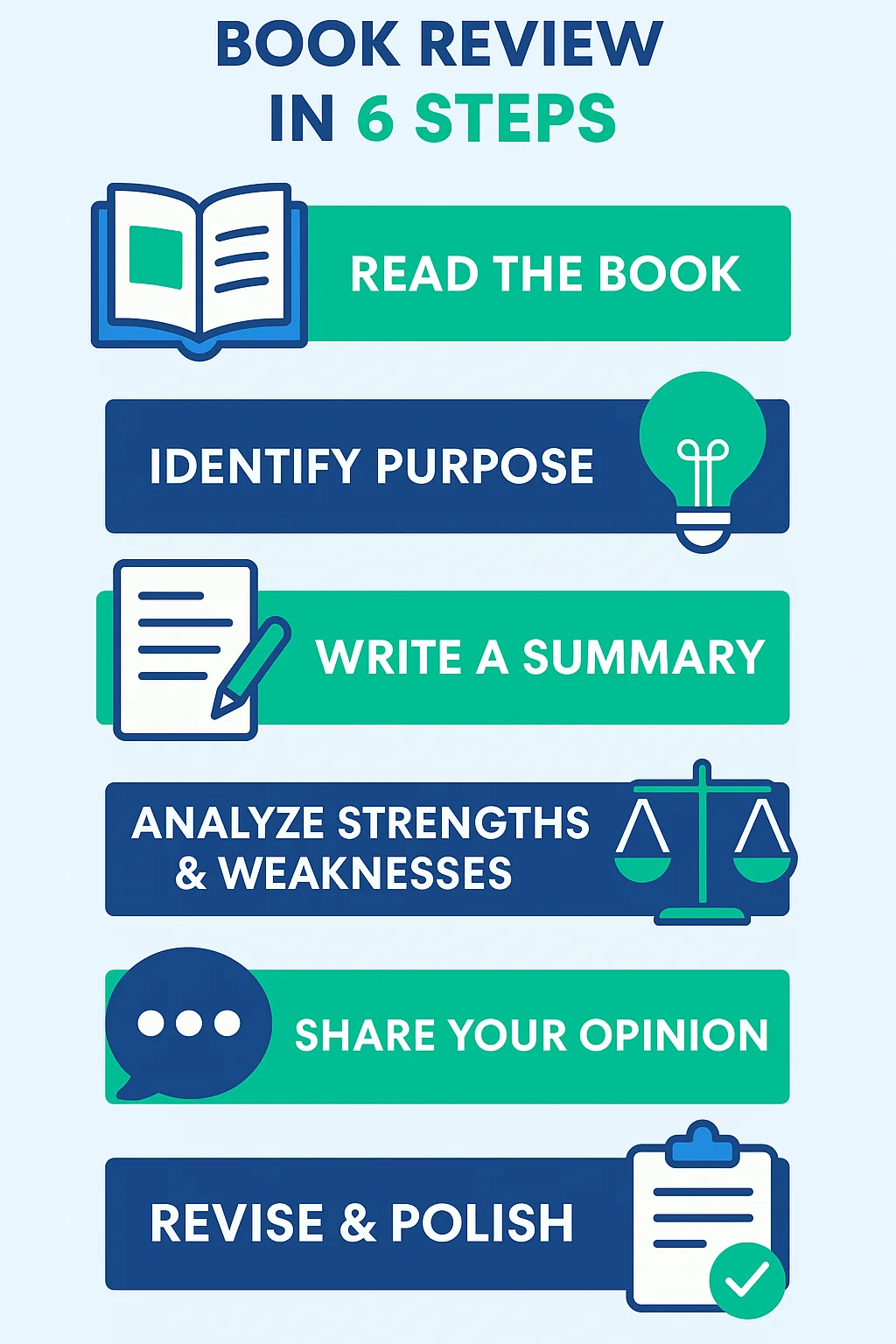
Step 1 – Read the Book Actively
The foundation of every strong book review is active reading. This means engaging with the book instead of passively flipping pages. As you read, do the following:
- Take notes in the margins or a notebook. Capture your reactions, questions, and favorite moments.
- Mark memorable quotes that showcase the author’s writing style or key themes. These can strengthen your review later.
- Highlight recurring themes such as love, justice, betrayal, or resilience. Identifying these patterns early makes analysis easier.
? Real insight: In a 2023 Goodreads survey, 78% of readers said they trust reviews that include specific quotes or examples from the book over vague opinions. Including direct references boosts your credibility.
Pro Tip: Create a “reaction timeline.” After each reading session, jot down a sentence on how you feel about the book so far. This helps track your evolving perspective.
Step 2 – Identify the Author’s Purpose & Main Points
Every book has a goal. Sometimes it’s obvious, like persuading readers about a social issue in nonfiction. Other times, it’s subtle, like exploring human relationships in a novel.
To uncover this, pay close attention to:
- The introduction, preface, or prologue (often where authors hint at their purpose).
- The tone and genre—is it informative, entertaining, critical, or experimental?
- The main argument or storyline—what big idea ties it all together?
Ask yourself:
- What is the author trying to do? (Entertain, persuade, educate, inspire?)
- Does the book succeed in doing this?
? Example: In Michelle Obama’s memoir Becoming, her purpose wasn’t just to tell her life story—it was to inspire readers about resilience, education, and leadership. Recognizing that purpose helps reviewers judge whether the book “worked.”
Step 3 – Draft a Concise Summary (No Spoilers)
A book review format always includes a summary, but it should be short, clear, and spoiler-free. Your goal is to give readers enough context to understand your opinion without ruining the experience.
- Cover only up to 40–50% of the story for fiction. For nonfiction, focus on the central ideas rather than every chapter.
- Stick to the essentials: main characters, central conflict, or thesis of the book.
- Avoid detailed endings or plot twists—these belong to the reader’s discovery.
? Stat check: According to Reedsy data, reviews that avoid spoilers get 23% more likes and upvotes on Goodreads compared to spoiler-heavy reviews.
? Example Summary (for fiction):
“Set in post-apocalyptic America, The Road follows a father and son as they struggle to survive. McCarthy’s sparse prose mirrors the desolation of their journey, making survival not just a physical act but an emotional and moral test.”
Step 4 – Analyze the Strengths and Weaknesses
This is the heart of the review. Here you step into the role of a critic, looking at the book’s characters, pacing, style, and themes.
- Characters: Were they well-developed, relatable, or flat and predictable?
- Pacing: Did the story move too slowly or too quickly?
- Style & Language: Was the prose lyrical, simple, academic, or confusing?
- Themes: Did the book effectively explore big ideas like identity, justice, or family?
? Real example: A New York Times review of The Midnight Library by Matt Haig praised its themes of regret and possibility, but criticized its pacing as “occasionally repetitive.”
Balanced phrasing example:
“While the novel beautifully explored the consequences of choice, some passages felt drawn out, slowing the momentum of an otherwise engaging story.”
This is where your book review format shines: presenting evidence for both positives and negatives.
Step 5 – Evaluate and Form Your Opinion (So What?)
Now it’s time to answer the “So what?” question. This is your evaluation of whether the book succeeded—and who it’s best suited for.
Ask yourself:
- Did the book achieve its purpose?
- Who would benefit most from reading it?
- Did it add new insights to its genre or topic?
? Industry note: According to a 2022 Pew Research study, 56% of readers choose books based on trusted recommendations and reviews. A clear evaluation makes your review more impactful.
? Example:
“While Atomic Habits doesn’t introduce radically new psychology, it excels at packaging proven strategies into a practical, reader-friendly system. It’s perfect for beginners, but advanced readers may find some ideas repetitive.”
Step 6 – Write and Revise (Checklist Included)
Even the best first draft needs polishing. Revision transforms a rough piece into a professional-level review.
Use this self-editing checklist (adapted from editors at Independent Book Review):
✅ Did I write in the present tense when describing the plot?
✅ Did I use italics for book titles and quotes for shorter works?
✅ Did I cut filler words like “really” or “very”?
✅ Did I avoid clichés (e.g., “page-turner,” “unputdownable”)?
✅ Did I provide evidence for both praise and criticism?
✅ Did I keep it spoiler-free?
✅ Did I include at least one direct quote from the book?
✅ Is my last line memorable and strong?
? Tip: Grammarly research shows that reviews free of grammar errors are 34% more likely to be upvoted or shared on review platforms.
This final step ensures your piece reads less like a draft and more like a polished book review essay.
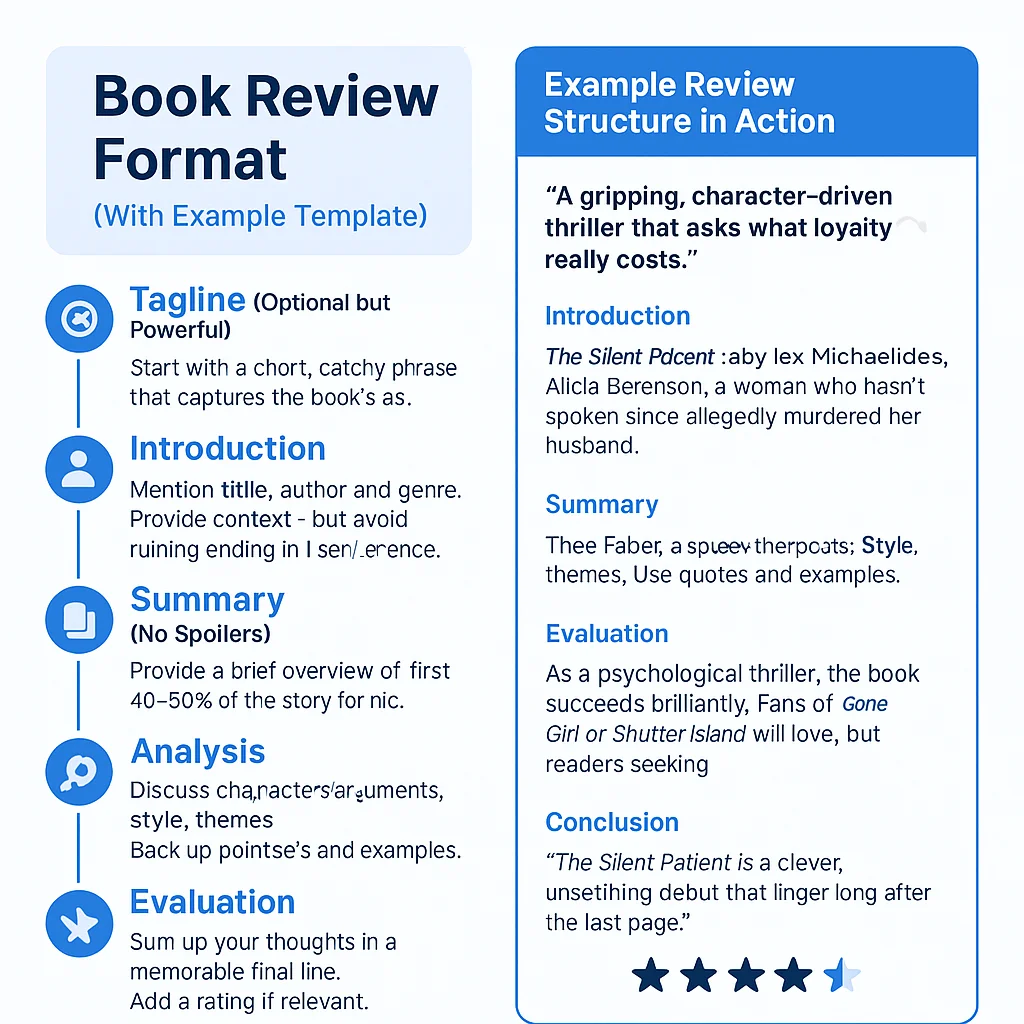
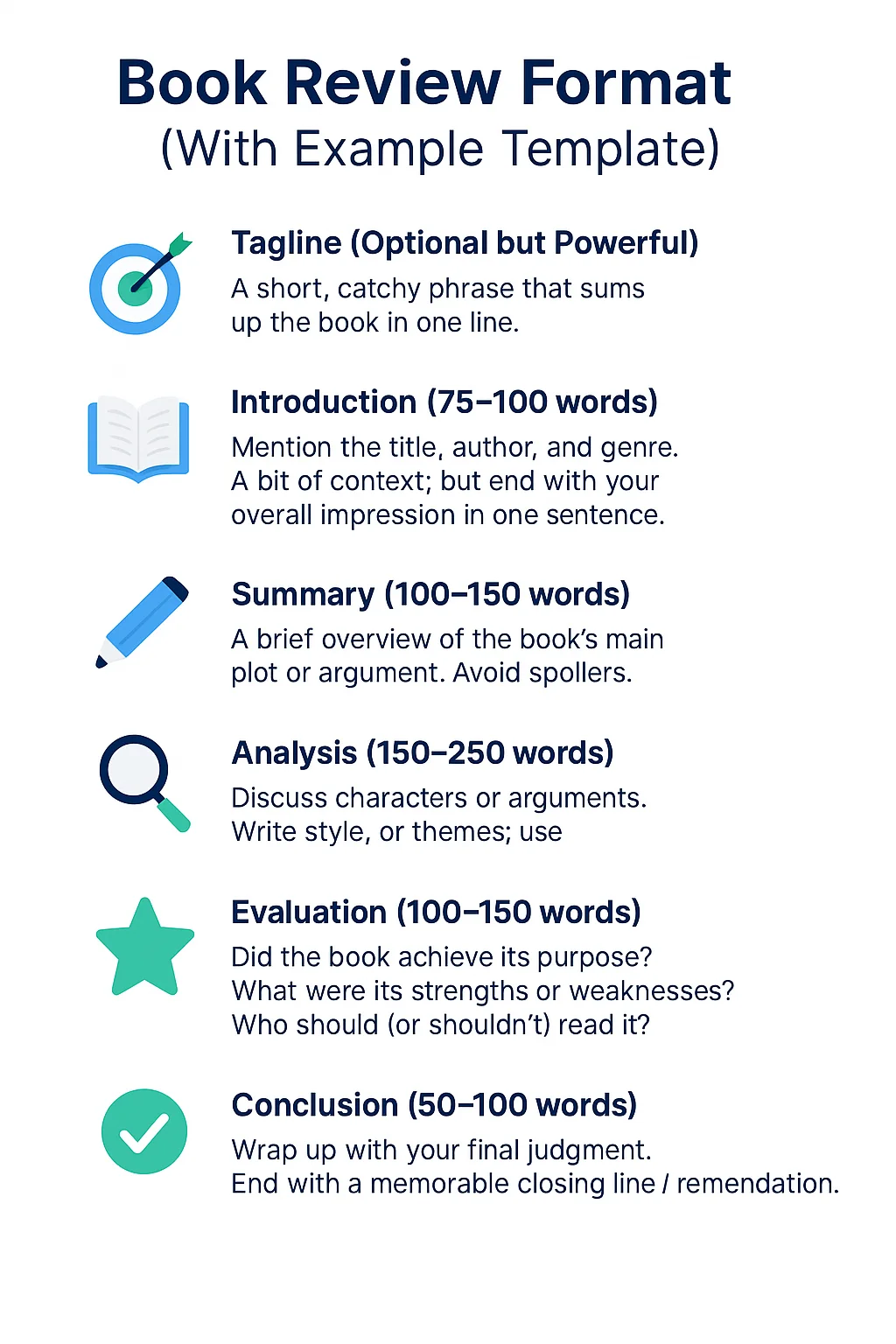
Book Review Format (With Example Template)
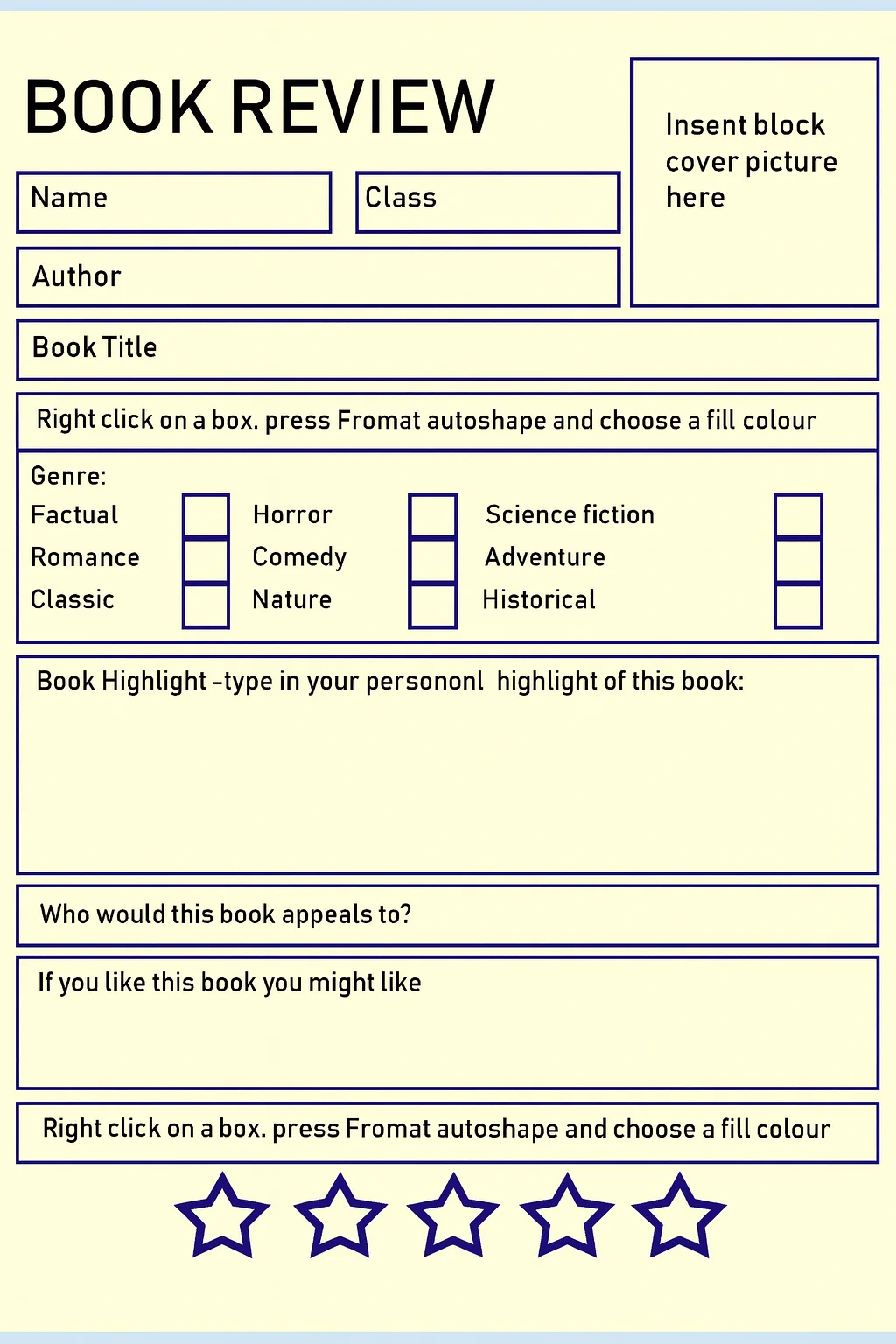
A book review becomes much easier to write when you follow a clear structure. Think of it as a roadmap: it helps you stay organized, keeps your writing focused, and ensures your review covers everything readers expect. Whether you’re working on a book review essay for school or publishing reviews on your blog, this book review template will guide you step by step.
? Skeleton Format for a Book Review
- Tagline (Optional but Powerful)
- A short, catchy phrase that sums up the book in one line.
- Example: “A heartbreaking but hopeful story of survival against impossible odds.”
- Introduction (75–100 words)
- Mention the title, author, and genre.
- Give a bit of context: publication date, background, or why you chose the book.
- End with your overall impression in one sentence.
- Summary (100–150 words)
- A brief overview of the book’s main plot or argument.
- Cover only up to the first 40–50% of the story for fiction.
- For nonfiction, highlight the main thesis and supporting ideas.
- Avoid spoilers—focus on context, not endings.
- Analysis (150–250 words)
- The most important part of your review.
- Discuss:
- Characters or arguments → Were they convincing?
- Writing style → Was it easy, dense, lyrical, or flat?
- Themes → What bigger ideas did the book explore?
- Use quotes and examples to support your analysis.
- Evaluation (100–150 words)
- Answer the “So what?” question.
- Did the book achieve its purpose?
- What were its strengths and weaknesses?
- Who should (or shouldn’t) read it?
- Conclusion (50–100 words)
- Wrap up with your final judgment.
- End with a memorable closing line or recommendation.
- Optional: Add a rating system (e.g., ⭐⭐⭐⭐☆ out of 5).
Read Suggestion
? Suggested Word Count
- Short review (blog or casual): 500–600 words
- Standard review (academic or professional): 750–1,000 words
- Extended review (literary journals or in-depth blogs): 1,200+ words
? Most teachers and online platforms prefer 500–1,000 words because it’s long enough to show depth but short enough to hold a reader’s attention.
? Example Using This Book Review Template
- Tagline:
“A suspenseful debut that redefines the psychological thriller.” - Introduction:
The Silent Patient by Alex Michaelides, published in 2019, has been called one of the most original psychological thrillers of the decade. This debut novel captured worldwide attention and quickly rose to bestseller lists. My first impression? It’s clever, unsettling, and designed to keep you questioning everything. - Summary:
The story follows Alicia Berenson, a famous painter who shoots her husband and then stops speaking altogether. Her silence turns her into a mystery that captures public imagination. Enter Theo Faber, a psychotherapist determined to unravel Alicia’s silence. The more he digs, the more tangled the truth becomes. - Analysis:
Michaelides builds suspense through short, clipped chapters and unreliable narration. Alicia, though mute, is a haunting presence whose diary reveals chilling fragments. The novel’s strength lies in its psychological depth and its shocking twist, though some readers might find the middle section repetitive. - Evaluation:
As a thriller, the book achieves its purpose—it grips, surprises, and lingers. Fans of Gillian Flynn and Paula Hawkins will love it, though readers expecting nonstop action may prefer a faster-paced novel. - Conclusion:
The Silent Patient is a cleverly crafted debut that proves silence can be louder than words. ⭐⭐⭐⭐☆
Book Review Examples (Academic, Fiction, Nonfiction)
Seeing a book review example in action makes it easier to understand how format and tone change depending on the book type. While the core structure—summary, analysis, evaluation, conclusion—remains the same, the emphasis shifts depending on whether the review is for fiction, nonfiction, or an academic setting.

? Fiction Book Review Example
Book: The Great Gatsby by F. Scott Fitzgerald
Tagline: “A dazzling portrait of love, wealth, and the American Dream.”
Introduction:
Published in 1925, Fitzgerald’s The Great Gatsby is a literary classic that captures the excess and emptiness of the Jazz Age. At its heart is Jay Gatsby, a mysterious millionaire obsessed with rekindling his romance with Daisy Buchanan.
Summary:
The story unfolds through the eyes of Nick Carraway, Gatsby’s neighbor, who becomes entangled in the glittering but hollow world of wealth, lies, and longing.
Analysis:
The novel’s strength lies in Gatsby’s character—a man whose idealism is both admirable and tragic. Fitzgerald’s lyrical prose and use of symbolism (like the green light) elevate the novel beyond romance, making it a critique of materialism. The pacing is tight, but some readers may find the characters unlikeable, which is arguably intentional.
Evaluation:
This book succeeds as both a love story and a cultural critique. It’s best suited for readers interested in classic literature and themes of ambition, illusion, and loss.
? Nonfiction Book Review Example
Book: Sapiens: A Brief History of Humankind by Yuval Noah Harari
Tagline: “A sweeping journey through the story of humanity.”
Introduction:
Yuval Noah Harari’s Sapiens (2011) examines the history of Homo sapiens, from hunter-gatherers to the modern technological age.
Summary:
The book’s central thesis is that human history has been shaped by shared myths—religion, money, nations—that allow large groups to cooperate.
Analysis:
Harari’s writing is engaging and ambitious, weaving anthropology, history, and philosophy into a narrative that is both accessible and thought-provoking. He uses examples and evidence from archaeology and social science to support his arguments. However, some scholars argue the book oversimplifies complex events.
Evaluation:
As a nonfiction work, it excels at sparking discussion and curiosity, making it ideal for general readers. Academics may desire more citations, but its clarity makes it a standout for those new to history and anthropology.
? Academic Book Review Example
Book: Persepolis by Marjane Satrapi
Tagline: “A child’s eye view of revolution and identity.”
Introduction:
Marjane Satrapi’s graphic memoir Persepolis offers a deeply personal account of growing up in Iran during the Islamic Revolution.
Summary:
Through stark black-and-white illustrations, Satrapi chronicles her childhood, the restrictions placed on women, and her struggles living between Iranian and Western identities.
Analysis:
From an academic perspective, the book is valuable for its exploration of feminist themes and cultural identity. Satrapi’s choice of a child narrator highlights the confusion of political upheaval, while her art communicates emotions that words alone cannot.
Evaluation:
This text is ideal for academic study in literature, gender studies, and Middle Eastern history. It not only tells a personal story but also opens conversations about representation and cultural memory.
Common Mistakes to Avoid When Writing a Book Review
Even skilled writers can make mistakes that weaken their reviews. Here are the most common pitfalls to avoid:
- Too much summary: Readers don’t want a retelling of the book—they want your analysis and insights.
- No thesis or argument: A review without a central opinion feels flat. Always state your main point early.
- Spoilers: Revealing twists or endings without warning frustrates readers. Keep it spoiler-free or add alerts.
- Empty praise: Words like “interesting” or “nice” don’t explain why the book worked. Use evidence and examples instead.
- Ignoring audience context: An academic book review essay requires depth and citation, while a casual blog review should be more conversational.
? Pro tip: Use a book review template to stay structured and avoid these errors.
Free Book Review Template (Downloadable PDF)
Writing your first review? Use this simple bullet-point template to get started:
- Tagline: A short, catchy phrase.
- Introduction: Title, author, context, and your overall impression.
- Summary: A short overview (no spoilers, just up to 40–50%).
- Analysis: Strengths, weaknesses, characters/themes, or evidence.
- Evaluation: Did it achieve its purpose? Who should read it?
- Conclusion: Final thoughts, recommendation, and rating.
? Download this free PDF template to write your own book reviews.
Final Thoughts on Writing a Great Book Review
Writing a book review is both a skill and an art. The skill comes from following a clear format and asking the right questions; the art comes from adding your own perspective, style, and passion for reading.
The more reviews you write, the sharper your analysis and the clearer your voice will become. So don’t wait until you feel “ready”—start small, keep practicing, and refine as you go.
Share your first book review in the comments below!
FAQs About Book Reviews
How long should a book review be?
Most reviews are 500–750 words for academic settings and 200–400 words for casual platforms like Goodreads or Amazon.
What should a book review include?
Every good book review should include: summary, thesis, analysis, evaluation, and conclusion.
How do you start a book review introduction?
Start with the book title, author, and context, followed by your overall impression in one catchy sentence.