Writing a book might seem impossible if you’ve never done it before — but it’s not. Even with zero writing background, anyone can become a published author by following a clear structure and focused mindset. In this guide, you’ll learn how to write a book with no experience through 27 proven, beginner-friendly tips that actually work.
Why You Don’t Need Experience To Write a Book
The Myth of the “Born Writer”
Many people believe great authors are born with a magical gift for words — but that’s a myth. Writing is a skill, just like cooking or playing an instrument, and anyone can learn it with practice. Every bestselling author once faced blank pages, uncertainty, and self-doubt. What separates successful writers from dreamers isn’t talent — it’s persistence.
If you’re writing for beginners or one of many first-time authors, remember: every masterpiece begins with a messy first draft. Don’t wait for inspiration; start writing consistently. Over time, your voice, confidence, and storytelling will naturally evolve. The secret? Keep showing up — your words will find their rhythm.
(Related: Read our detailed guide on How to Start Writing )
Real Examples of Authors Who Started From Scratch
You’re not alone — even world-famous writers began with no experience. J.K. Rowling wrote Harry Potter while struggling financially and facing countless rejections, yet her belief in her story changed her life. Stephen King, one of the most successful authors in history, had his first novel, Carrie, thrown in the trash until his wife encouraged him to finish it.
These authors weren’t experts when they began — they were passionate beginners who refused to give up. Their journeys prove that persistence beats perfection. You don’t need to be a “born writer”; you just need the courage to start. Each word you write moves you closer to your dream of becoming a published author.
(Must Read : How to Start Writing Your First Chapter)
27 Secret Tips on How To Write a Book With No Experience
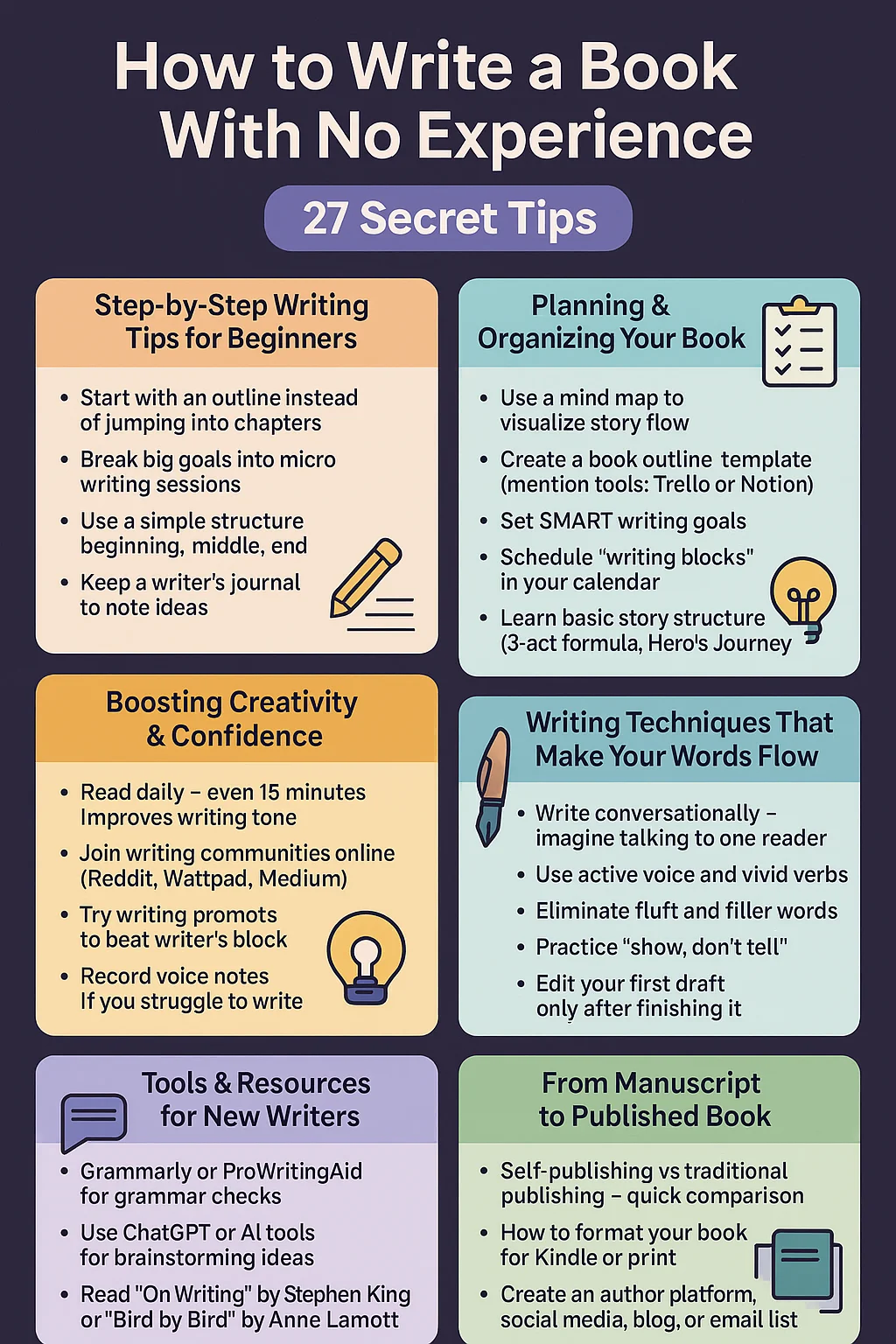
Step-by-Step Writing Tips for Beginners
- Start with an outline instead of jumping into chapters
Before you begin writing, map out your story or topic. An outline acts as your roadmap — helping you stay organized and consistent. It doesn’t need to be perfect; just list your key ideas, chapter goals, and turning points. This simple step prevents writer’s block and keeps your thoughts flowing. - Break big goals into micro writing sessions
Writing an entire book can feel overwhelming, especially for beginners. Instead of focusing on finishing a 50,000-word manuscript, aim for small, daily goals. Try writing for 25 minutes using the Pomodoro technique or complete 500 words per session. Small wins build momentum and confidence. - Use a simple structure: beginning, middle, and end
Every great story — fiction or nonfiction — follows a clear structure. Start strong by introducing your main idea or characters, develop the core message in the middle, and wrap up with a satisfying conclusion. This three-part flow helps first-time authors create a professional, cohesive book. - Keep a writer’s journal to note ideas
Inspiration can strike anywhere — during a walk, a dream, or a random conversation. Carry a small notebook or use an app like Notion to capture your thoughts instantly. Your writer’s journal becomes a treasure chest of future book ideas and creative sparks. - Don’t worry about editing while drafting
One of the biggest mistakes new writers make is trying to perfect every sentence. The first draft’s only job is to exist — not to impress. Focus on writing freely and saving editing for later. Remember, messy drafts turn into masterpieces after revision.
Planning & Organizing Your Book
- Use a mind map to visualize story flow
A mind map helps you connect ideas and chapters visually. Start with your main topic in the center, then branch out into themes, subplots, or lessons. It’s one of the best creative planning tools for beginners who want to see their book structure clearly. - Create a book outline template
Use tools like Trello, Notion, or even Google Sheets to organize chapters and scenes. Outline templates simplify your workflow and make writing less intimidating. Add checklists for each chapter — title, main point, examples, and transitions — to track your progress easily. - Set SMART writing goals
SMART stands for Specific, Measurable, Achievable, Relevant, and Time-bound. Instead of saying “I’ll write my book this year,” say “I’ll write 500 words every morning, five days a week.” This approach keeps you accountable and focused on realistic milestones. - Schedule writing blocks in your calendar
Treat writing like an appointment with yourself. Block dedicated time in your calendar and guard it fiercely. Even one uninterrupted hour a day can transform your draft into a completed book in a few months. - Learn basic story structure (3-act formula or Hero’s Journey)
Understanding storytelling frameworks helps you build emotional connection and flow. The 3-act structure—setup, confrontation, and resolution—works well for fiction, while the Hero’s Journey adds depth to character arcs. Nonfiction authors can adapt these models for storytelling-driven lessons.
- Examples of Proper Email Etiquette: A Complete Guide for Professional Communication
- How To Write A Book About Yourself
- How To Write a Book With No Experience: 27 Secret Tips
- How to Write an Ebook: Step-by-Step Guide for Beginners
- How To Write a Book Review: Step By Step Guide (Examples)
Writing Techniques That Make Your Words Flow
- Write conversationally — imagine talking to one reader
The easiest way to connect with your audience is to write as if you’re speaking directly to one person. Avoid jargon or overly formal language. A conversational tone makes your writing feel natural, relatable, and enjoyable to read — especially for beginners learning how to write a book with no experience. - Use active voice and vivid verbs
Active voice brings life to your writing. Instead of saying “The book was written by me,” write “I wrote the book.” It’s shorter, stronger, and more engaging. Pair it with vivid verbs that paint a clear picture in the reader’s mind — they help your story or message feel alive. - Eliminate fluff and filler words
New writers often add unnecessary words to sound more “writerly.” But simplicity is power. Cut out phrases like “in order to” or “very.” Every sentence should move your story forward or add clarity. Tight writing keeps readers hooked from start to finish. - Practice “show, don’t tell”
Instead of telling readers how a character feels, show it through action or dialogue. For example, don’t write “She was nervous.” Instead, write “Her hands trembled as she reached for the pen.” This simple shift transforms your writing into a vivid, immersive experience. - Edit your first draft only after finishing it
Editing while writing slows your creativity. Your first draft’s purpose is to get your ideas out, not to polish them. Once finished, step away for a day or two, then return with fresh eyes for editing. This helps you spot errors and improve flow with better perspective.
Tools & Resources for New Writers
- Grammarly or ProWritingAid for grammar checks
Even professional writers rely on editing tools. Grammarly and ProWritingAid help correct grammar, spelling, and readability issues instantly. They also provide tone and clarity suggestions — essential for anyone learning writing for beginners. - Use ChatGPT or AI tools for brainstorming ideas
AI writing assistants like ChatGPT can help you overcome writer’s block, refine ideas, or expand on plotlines. Use them as a creative partner, not a replacement. Brainstorm titles, outlines, or dialogues — but always add your unique human touch. - Read “On Writing” by Stephen King or “Bird by Bird” by Anne Lamott
These two books are must-reads for any aspiring author. Stephen King’s On Writing blends storytelling wisdom with practical advice, while Anne Lamott’s Bird by Bird teaches you how to embrace the messy, human side of creativity. - Take free online writing courses
Websites like Coursera, Reedsy Learning, and Skillshare offer free or affordable writing courses. Topics range from storytelling and character development to self-editing and publishing. Learning from professionals helps you grow faster and write with confidence.
From Manuscript to Published Book
- Self-publishing vs traditional publishing — quick comparison
If you’re a new author, self-publishing gives you creative control and faster results. Platforms like Amazon KDP or Draft2Digital allow you to publish globally with ease. Traditional publishing, on the other hand, offers credibility and professional support but takes more time and often requires a literary agent. - How to format your book for Kindle or print
Formatting is the bridge between a manuscript and a professional-looking book. Use tools like Reedsy Book Editor, Atticus, or Vellum to format your ebook and print versions. Proper formatting ensures smooth reading flow, correct margins, and attractive typography. - Create an author platform: social media, blog, or email list
Building your personal brand is just as important as writing your book. Start a blog to share writing tips, post snippets of your book on social media, or create an email list to connect with readers directly. Your author platform helps you grow a loyal audience before and after publishing.
Pro Tip: Becoming an author with no experience isn’t about talent — it’s about consistency, curiosity, and courage. With these 27 secret tips, you now have the foundation to turn your ideas into a published book that readers love.