A strong letter of recommendation can open doors. It can help a good student become a great candidate. If a medical student has asked you to write one, you might feel honored. You might also feel a bit nervous.
Getting it right is important. Residency programs read hundreds of these letters. They use them to find future doctors who are skilled, kind, and reliable. Your words have real power. You can also read How to Write a Recommendation Letter for a Student.
Do not worry. Writing a great letter is not about fancy language. It is about being clear, honest, and thorough. This guide will show you how to write a letter of recommendation for residency in eight simple steps. We will walk through the entire process together.
By the end, you will have a template you can use. You will know what to include and what to leave out. Let us help your student shine.
Why Your Letter Matters So Much
Before we start writing, let us talk about why this letter is a big deal. Residency directors look at grades and test scores. Those numbers show how smart a student is. But they do not show the full picture.
Your letter shows the person behind the grades. It tells the story of how the student acts in a real hospital. Did they comfort a scared patient? Did they stay late to help a nurse? These are things a test score cannot capture.
Programs use your letter to predict the future. They want to know: Will this person be a good team member? Can they handle stress? Your experience with the student answers these questions. A well-written letter can make a candidate memorable. It can push them to the top of the interview list.
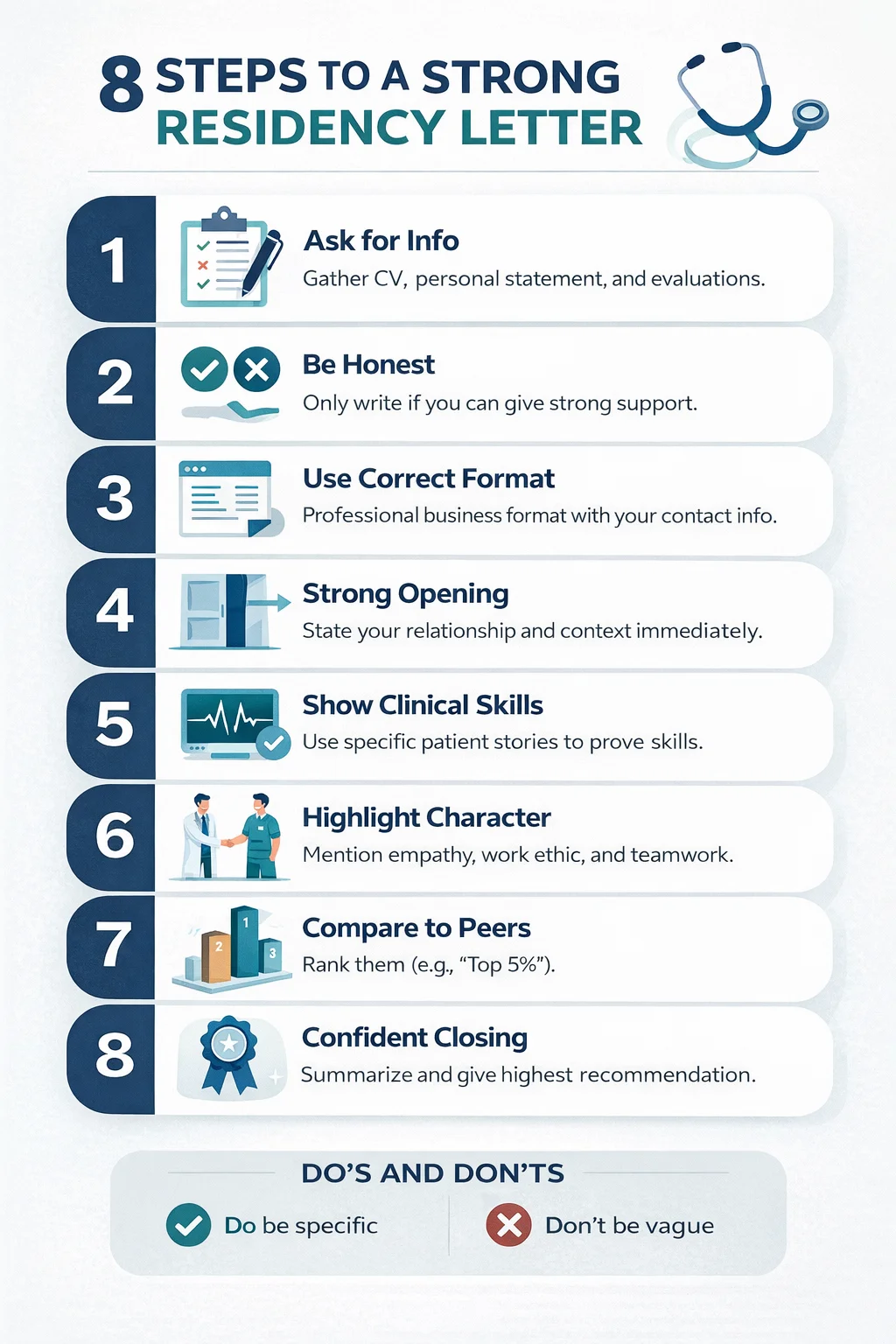
Step 1: Ask the Student for the Right Information
You cannot write a good letter in the dark. You need facts. The first step is to ask the student for a packet of information. This saves you time and makes your letter stronger.
Ask them to provide:
- Their CV or resume.
- Their personal statement.
- The list of programs they are applying to.
- A reminder of the specific rotation they did with you.
- Any feedback or evaluations you gave them at the time.
Why do you need all this? The CV helps you mention specific achievements. The personal statement shows you what matters to them. If they worked with you six months ago, the details might be fuzzy. Looking at their old evaluations jogs your memory.
How to write a letter of recommendation for residency starts with good research. When you have the facts, your letter feels personal. It does not sound like a generic template. That personal touch is what program directors want to see.
Step 2: Decide If You Can Write a Strong Letter
This step is about honesty. It is the most ethical part of the process. You must decide if you can support this student fully.
Ask yourself: Do I remember this student well? Would I want them to care for my own family? If the answer is yes, proceed. If you hesitate, you should decline.
It is better to say no than to write a weak letter. A lukewarm letter can hurt the student. Program directors can read between the lines. If your letter is short and vague, they assume you did not like the student.
If you agree to write, commit to doing it well. Tell the student you are happy to support them. Then, gather your thoughts and move to the next step. Your strong support is a gift to their future.
Step 3: Use the Correct Professional Format
Residency letters are professional documents. They must follow a standard business format. This makes them easy to read and shows respect for the process.
Here is the basic structure you need:
- Your Contact Information: At the top, include your name, title, department, hospital, and email.
- The Date: Put the date you are writing the letter.
- Program Director’s Address: Include the program name, hospital, and address. If you do not have the specific name, “To the Residency Program Director” is acceptable.
- Salutation: Use “Dear Dr. [Last Name]” if you know it. If not, use “Dear Selection Committee.”
Keep the font simple. Use Times New Roman or Arial in 11 or 12 point size. The letter should be about one to one and a half pages long. It needs to be long enough to be detailed, but short enough to hold someone’s attention.
Following this format tells the reader you are a professional. It shows you understand the medical field. It sets a good tone for everything that follows.
Step 4: Write a Strong Opening Paragraph
The opening paragraph is your hook. It needs to grab the reader’s attention immediately. Do not start with “I am writing to recommend…” Everyone starts that way. Try to be a bit different.
Start by stating your relationship to the student. How do you know them? In what setting did you work together? Be specific right away.
For example:
“It is my distinct pleasure to recommend Jane Doe for your internal medicine residency. I served as the attending physician on the general medical ward where Jane completed her eight-week clerkship in the fall of 2023. During that time, I watched her grow from a nervous student into a confident young doctor.”
See the difference? In two sentences, the reader knows who you are, who the student is, and the context. You have also used a strong word like “pleasure.” This signals to the reader that this will be a positive review.
In this section of how to write a letter of recommendation for residency, you set the stage. Make it clear, positive, and specific.
Step 5: Show Their Clinical Skills with Specific Stories
Now we get to the heart of the letter. This is where you prove your claims. Anyone can say “the student was smart.” You need to show it.
Dedicate a paragraph to clinical skills. Talk about their medical knowledge. Did they present cases well? Did they understand the diagnoses? Use a short story to illustrate this.
You might write:
“During morning rounds, John consistently impressed me. He knew the latest research on his patients’ conditions. One day, a patient with heart failure was not responding to treatment. John had reviewed the chart overnight and suggested a different diuretic. His suggestion was correct, and the patient improved. He showed judgment beyond his years.”
Next, talk about their technical skills. Are they good at procedures? Do they have good hands? Again, be specific if you can.
This section proves the student has the brains for the job. It shows they can think critically. These stories make your letter memorable. They are the evidence that backs up your praise.
Step 6: Highlight Their Character and Professionalism
Being a good doctor takes more than book smarts. It takes heart. Residency programs look for people who are kind, honest, and hardworking. Your letter must speak to their character.
Think about how the student treated others. Did they show empathy to scared families? Were they respectful to the nurses and staff? This is sometimes called “emotional intelligence.” It is vital for a doctor.
You could write:
“What truly sets Sarah apart is her compassion. I watched her sit with an elderly patient who was anxious about a procedure. She held the patient’s hand and explained everything slowly. The nurses also loved working with her. They told me she never complained and always helped clean up at the end of a long shift. She is a natural team player.”
Also, mention their work ethic. Did they arrive early? Did they stay late to finish notes? Did they volunteer to help with extra work? Residency is hard work. Programs want people who can handle the workload without burning out.
Mentioning these traits shows the student is a good person. It shows they will fit into the hospital culture. This is a huge part of how to write a letter of recommendation for residency effectively.
Step 7: Compare Them to Their Peers
Program directors love context. They want to know how this student compares to others. This helps them understand the level of your praise.
Use a simple ranking system. You do not need complex statistics. Just tell the truth about where they stand.
You could say:
- “She is in the top 5% of students I have worked with in my ten years of teaching.”
- “He ranks in the top ten of the fifty residents I have supervised this year.”
- “I would put her clinical reasoning skills in the top tier of medical students I have seen.”
This comparison is powerful. It tells the reader that this is not just another good student. It tells them this student is exceptional. It gives your words more weight.
Be honest here. Do not exaggerate. If they are good but not the absolute best, say they are in the top 25%. Honesty is always the best policy. A truthful ranking helps the program find the right fit for them.
Step 8: Write a Confident Closing and Proofread
You have made your case. Now it is time to wrap it up neatly. The closing paragraph should summarize your feelings. It should also include a clear recommendation.
Restate your support strongly. Then, leave the door open for more questions.
For example:
“In summary, I believe Michael has the intellect, the skills, and the character to be an outstanding resident. He has my highest recommendation. I am confident he will succeed in your program and become a doctor you are proud of. Please feel free to contact me if you need any further information.”
Sign off with a professional closing like “Sincerely,” or “Respectfully.” Then, leave space for your signature. Below your signature, type your full name and title.
Finally, the most important step: Proofread. Read the letter out loud. This helps you catch errors. Check for typos, grammar mistakes, or awkward sentences. Ask a colleague to look it over if you have time.
A letter with a typo looks sloppy. It reflects poorly on you and the student. A clean, perfect letter shows you care.
Key Things to Include (And What to Avoid)
Knowing how to write a letter of recommendation for residency also means knowing what to leave out. There are some things that can hurt the candidate.
Do Include:
- Specific anecdotes: Short stories about patient care.
- Comparisons: How they rank against peers.
- Non-cognitive traits: Kindness, work ethic, teamwork.
- Your contact info: Make yourself available for follow-up.
Do NOT Include:
- Vague praise: “He is a nice guy” without proof.
- Physical descriptions: Avoid mentioning race, age, or appearance. It is not relevant.
- Personal information: Do not talk about their marital status or family.
- Weak language: Do not say “I think she might be good.” Be confident.
Stick to professional and medical observations. Keep the focus on their ability to be a great doctor.
Sample Template for a Letter of Recommendation
Here is a simple template you can adapt. Fill in the brackets with your specific information.
[Your Name]
[Your Title]
[Your Department]
[Your Hospital/Institution]
[Your Email] | [Your Phone Number]
[Date]
[Program Director’s Name or “To the Residency Selection Committee”]
[Name of Residency Program]
[Hospital Name]
[Address]
Re: Recommendation for [Student Name]
Dear Dr. [Name] or Committee Members,
It is with great enthusiasm that I write to support [Student Name] for a residency position in [Specialty] at your institution. I served as [Student Name]’s attending physician during their [Length of Rotation] rotation in [Department] at [Hospital Name] in [Year].
[Student Name] immediately stood out for their clinical skills. I was particularly impressed by [his/her/their] ability to [give a specific example of clinical knowledge or a diagnosis]. For instance, I remember when [insert a 1-2 sentence story about a patient case]. This showed a level of critical thinking I usually see in more senior residents.
Beyond clinical ability, [Student Name] possesses outstanding personal qualities. [He/She/They] treated every patient with dignity and respect. I also observed [him/her/them] working seamlessly with the nursing staff, who often commented on [his/her/their] positive attitude. [He/She/They] was always the first to arrive and the last to leave, showing a dedication that will serve [him/her/them] well in residency.
Based on my experience, I would rank [Student Name] in the top [5% / 10%] of all students I have worked with in my career. [He/She/They] has the complete package of intelligence, skill, and empathy.
For these reasons, I give [Student Name] my highest and unreserved recommendation. I am confident [he/she/they] will be an asset to your program. Please do not hesitate to contact me if you require any further information.
Sincerely,
[Your Signature (if sending a hard copy)]
[Your Typed Name]
[Your Title]
[Your Department]
Final Thoughts
You now have a clear roadmap. You know how to write a letter of recommendation for residency in eight simple steps. This process takes time, but it is worth it. You are helping shape the next generation of physicians.