A recommendation letter plays a crucial role in a student’s academic and professional journey. It is more than just a formality — it serves as a personal endorsement of a student’s abilities, character, and potential. Whether written by a teacher, professor, mentor, or employer, this letter provides decision-makers with insights that grades and resumes alone cannot reveal.
Students often need recommendation letters at important milestones. These include college admissions, scholarship applications, internships, and even job opportunities. In competitive environments, where many applicants may have similar academic achievements, a well-written letter can help a student stand out. It highlights strengths, work ethic, leadership qualities, and unique attributes that make the candidate memorable.
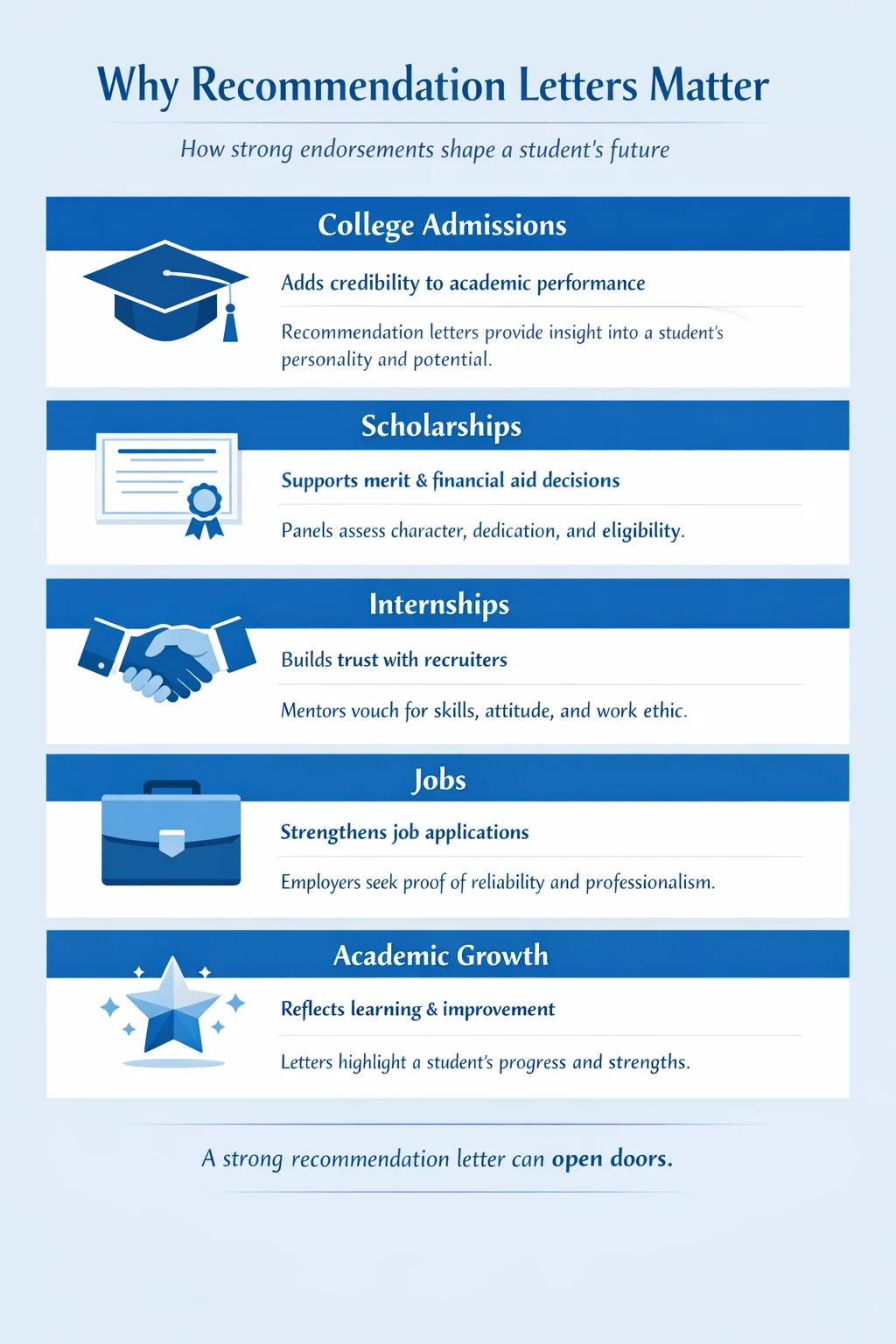
Understanding how to write a recommendation letter for a student is, therefore, essential for educators and professionals alike. A strong letter can significantly influence selection committees by building credibility and trust. It can validate a student’s accomplishments, showcase their growth, and reinforce their suitability for a particular program or role.
On the other hand, a vague or generic letter may weaken the student’s application. That is why writing a thoughtful, specific, and structured recommendation is so important. It reflects not only on the student but also on the recommender’s professionalism.
In this guide, you’ll learn practical tips, key elements, and proven strategies to craft a compelling recommendation letter that truly supports a student’s goals.
What Is a Recommendation Letter for a Student?
A recommendation letter for a student is a structured, professional document written by someone who knows the student well — typically a teacher, professor, mentor, or employer. It presents an honest evaluation of the student’s skills, achievements, behavior, and potential.
Unlike a resume or transcript, which only lists information, this letter adds human insight and credibility. It explains how the student performs in real situations: learning ability, discipline, leadership, attitude, teamwork, and character. Because it comes from a trusted authority, it plays a powerful role in selection decisions.
Purpose of a Recommendation Letter
A recommendation letter is designed to support a student’s application by:
| Purpose | Why It Matters |
|---|---|
| Validate accomplishments | Confirms achievements from a credible source |
| Highlight strengths | Shows qualities beyond grades |
| Build trust | Helps committees feel confident about the candidate |
| Add differentiation | Makes the student stand out |
| Support decisions | Influences admissions, scholarships, or hiring |
In competitive processes, a strong letter can be the deciding factor.
Types of Recommendation Letters
Not all recommendation letters serve the same function. The two most common types are:
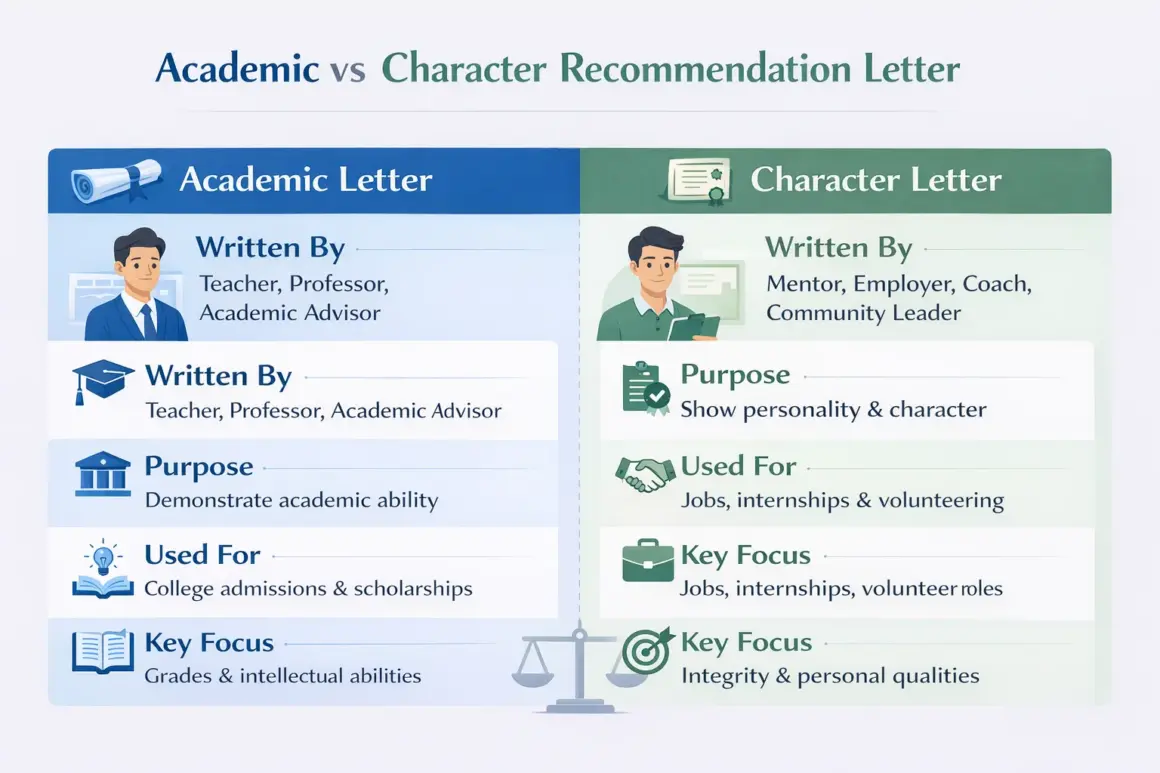
🔹 Academic Recommendation Letter
| Aspect | Details |
|---|---|
| Focus | Academic performance & intellectual abilities |
| Written By | Teacher, professor, academic advisor |
| Highlights | Grades, subject knowledge, research, participation |
| Used For | College admissions, higher studies, scholarships |
🔹Character Recommendation Letter
| Aspect | Details |
|---|---|
| Focus | Personality & personal qualities |
| Written By | Mentor, employer, coach, community leader |
| Highlights | Integrity, leadership, attitude, responsibility |
| Used For | Jobs, internships, volunteer roles |
Quick Comparison
| Feature | Academic Letter | Character Letter |
|---|---|---|
| Main Emphasis | Academic ability | Personal traits |
| Evidence Type | Grades & classroom performance | Behavior & ethics |
| Typical Writer | Educator | Mentor/Employer |
| Common Use | Education & scholarships | Jobs & internships |
Who Can Write a Recommendation Letter for a Student?
A strong recommendation letter for a student should be written by someone who has directly observed the student’s abilities, performance, and character. The credibility of the writer significantly influences how seriously the letter is considered by admission committees, scholarship panels, or employers.
👩🏫 Teachers
Teachers are among the most common and trusted recommenders. They can describe a student’s academic strengths, classroom behavior, participation, discipline, and improvement over time. Because teachers interact with students regularly, their evaluations are considered highly reliable, especially for college admissions and scholarship applications.
🏫 School Principals
Principals provide a broader institutional perspective. While they may not teach the student directly, they can comment on overall conduct, leadership roles, achievements, and reputation within the school. A principal’s letter often adds authority and formal weight.
🎓 Professors
For higher education or graduate applications, professors are ideal recommenders. They can highlight subject expertise, research skills, analytical thinking, and academic dedication. Their letters carry strong value for universities, fellowships, and advanced study programs.
💼 Internship Supervisors
Internship supervisors offer insight into a student’s practical skills, professionalism, teamwork, communication, and work ethic. These letters are especially useful for future internships and job applications, where real-world performance matters.
🏢 Employers
Employers can evaluate qualities like responsibility, punctuality, leadership, adaptability, and attitude. Even part-time job supervisors can write impactful letters if they genuinely know the student’s contributions.
Why Credibility Matters
A recommendation letter’s effectiveness depends heavily on who writes it. Decision-makers value letters from individuals who:
✔ Have worked closely with the student
✔ Can provide specific examples
✔ Hold a respected position
✔ Offer an honest, unbiased opinion

✅ Checklist: Information to Collect Before Writing a Recommendation Letter
Before you begin writing a recommendation letter for a student, it’s important to gather accurate and relevant details. A well-informed letter feels authentic, specific, and persuasive. Use this checklist to ensure you have everything you need.
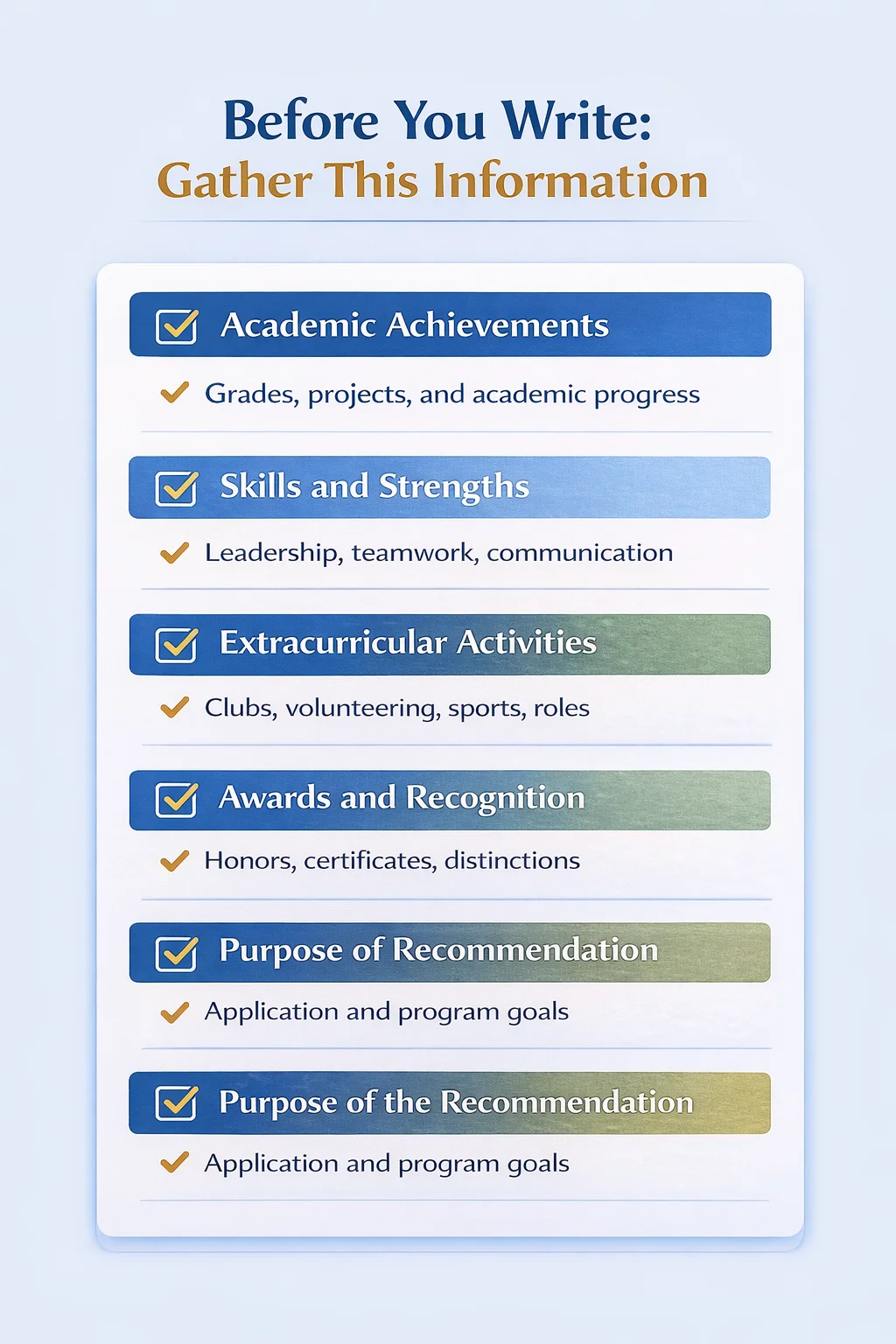
📚 Academic Achievements
✔ Recent grades or academic performance
✔ Notable projects or research work
✔ Subject-specific strengths
✔ Academic improvements or progress
✔ Class participation and attitude toward learning
Understanding academic background helps you present the student’s intellectual abilities clearly.
🌟 Skills and Strengths
✔ Leadership qualities
✔ Communication skills
✔ Critical thinking or problem-solving
✔ Teamwork and collaboration
✔ Work ethic and responsibility
Highlighting strengths makes the letter impactful and memorable.
🎭 Extracurricular Activities
✔ Clubs, sports, or organizations
✔ Volunteer work or social initiatives
✔ Competitions or events
✔ Roles and responsibilities
✔ Achievements outside academics
These details show the student’s personality and versatility.
🏆 Awards and Recognition
✔ Academic awards
✔ Scholarships or honors
✔ Certificates or achievements
✔ Special recognitions
✔ Merit-based distinctions
Awards strengthen credibility and demonstrate excellence.
🎯 Purpose of the Recommendation
✔ College admission
✔ Scholarship application
✔ Internship opportunity
✔ Job application
✔ Specific program or institution
Knowing the purpose allows you to tailor the tone, examples, and focus of the letter.
Structuring a Recommendation Letter: A Step-by-Step Guide
Crafting a persuasive recommendation letter requires more than just good intentions; it demands a professional structure that guides the reader logically. Whether you are an employer, professor, or colleague, following a standard format ensures your endorsement is taken seriously. Below is a detailed breakdown of the proper structure, from the header to the conclusion.
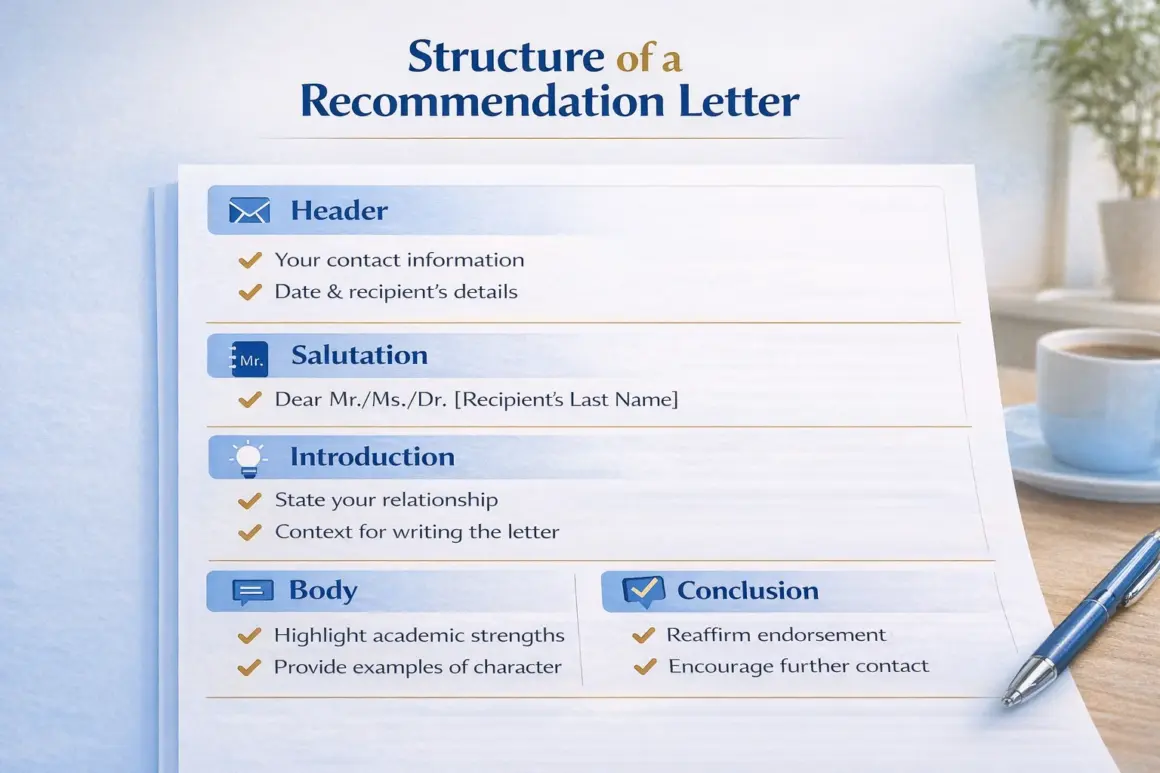
1 Header Section
The header serves as the “letterhead” of your document. It provides the essential context of who is writing, when they are writing it, and who they are writing to. This section should be aligned to the left. It must include your contact information (name, title, company, phone, email) followed by the date. After the date, include the recipient’s contact details. If the letter is general, you may omit the recipient’s specific address but keep the format balanced.
[Your Full Name]
[Your Job Title]
[Your Company/Institution]
[Your Email] | [Your Phone Number]
[Date]
[Recipient Name]
[Recipient Title]
[Recipient Company]
[Recipient Address]
2 Salutation
The salutation sets the formal tone of the correspondence. It is always best to address a specific person whenever possible. Use “Dear Mr./Ms./Dr. [Last Name]” if you know the recipient’s identity. If you are submitting the letter to a committee or an admissions board and do not have a specific name, use a gender-neutral, professional greeting. Avoid casual openings like “Hi” or “Hello.”
• Specific: “Dear Mr. Thompson,”
• Unknown Recipient: “Dear Hiring Committee,”
• Academic: “Dear Admissions Committee,”
3 Introduction Paragraph
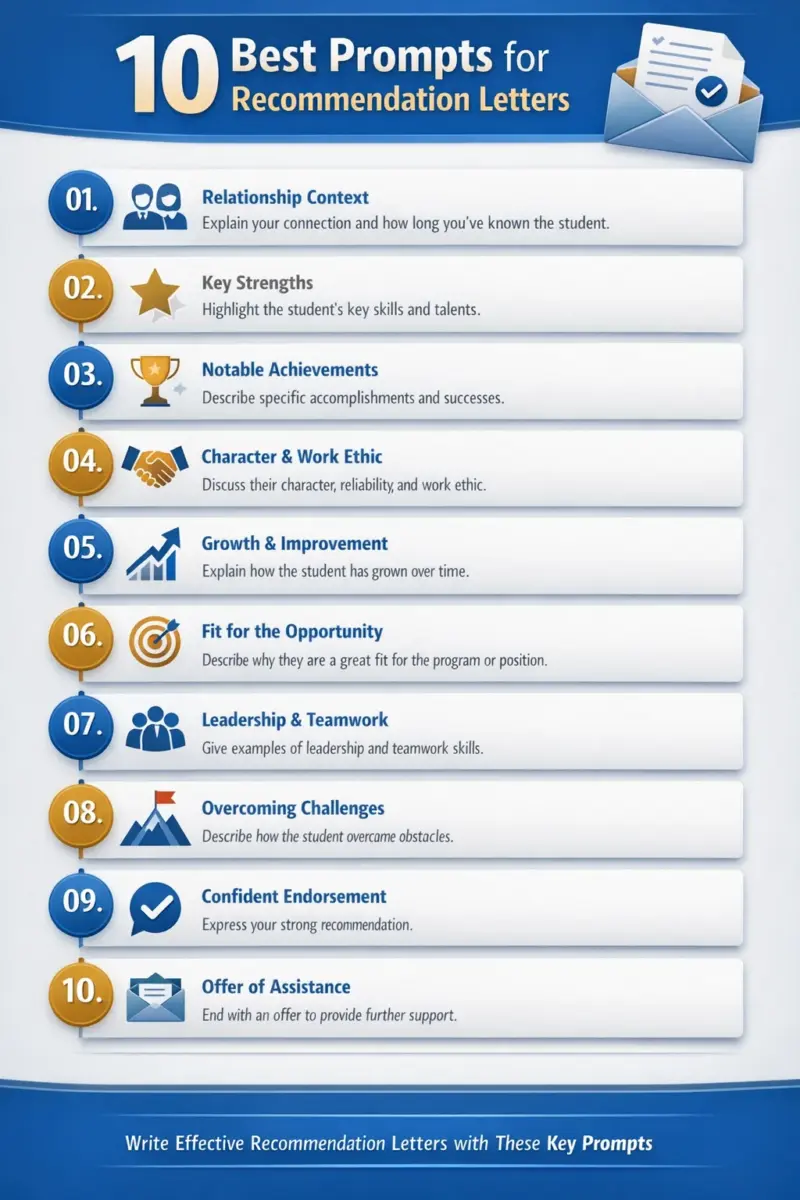
The opening paragraph is critical for establishing your credibility. You must clearly state the purpose of the letter and explicitly name the candidate you are recommending. More importantly, you must define your relationship with the candidate. Explain how long you have known them and in what capacity (e.g., “I was Jane’s direct supervisor for three years”). This context helps the reader weigh the validity of your opinion.
“I am writing to offer my enthusiastic recommendation for Michael Ross for the position of Project Manager. As Michael’s direct supervisor at Apex Logistics for the past four years, I have had the pleasure of watching him develop into a highly organized and strategic leader.”
4 Body Paragraph(s)
The body of the letter is where you provide the evidence to support your endorsement. Do not rely solely on generic adjectives like “hard-working” or “smart.” Instead, use the “Show, Don’t Tell” method. Dedicate one or two paragraphs to specific examples of the candidate’s skills. You might focus on a particular project they led, a problem they solved, or a specific technical skill they possess. Discussing their soft skills—such as teamwork, communication, and adaptability—is equally valuable.
“One of Michael’s standout qualities is his ability to manage crisis situations. Last year, during our critical software migration, he identified a potential data breach risk 48 hours before launch. His quick thinking and proactive communication saved the company significant downtime and demonstrated his unwavering reliability under pressure.”
5 Conclusion Paragraph
The conclusion serves as the final summary of your endorsement. You should reiterate your confidence in the candidate’s ability to succeed in the new role or program. It is standard practice to offer to provide further information if needed. This section should end with a formal sign-off. By inviting the recipient to contact you, you add a layer of transparency and sincerity to your recommendation.
“In summary, Michael is a dedicated professional who possesses both the technical skills and the leadership qualities necessary to thrive at your organization. I recommend him without reservation. Please feel free to contact me at (555) 123-4567 if you have any further questions regarding his candidacy.
Sincerely,
[Your Signature]
How To Write A Recommendation Letter For A Student
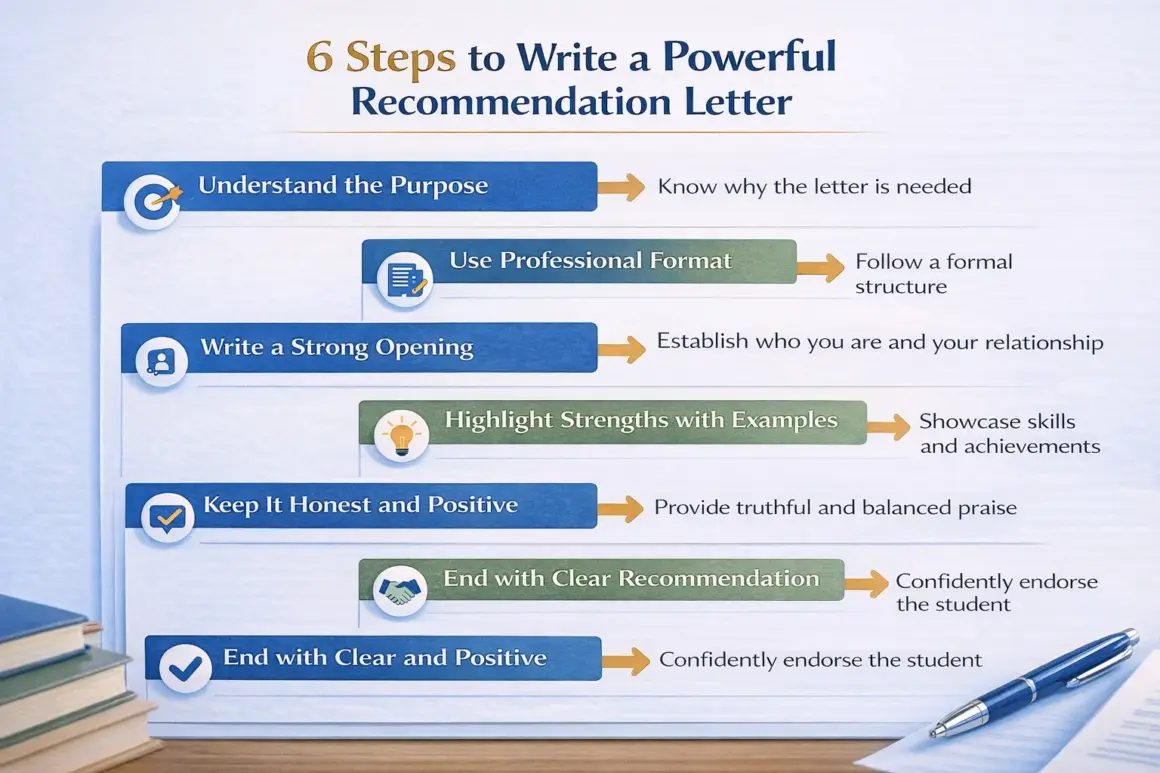
Writing a recommendation letter is a responsibility that can significantly influence a student’s academic or professional future. A thoughtful, well-structured letter can strengthen an application, while a vague one may reduce its impact. Follow this step-by-step guide to craft a compelling and credible recommendation.
1️⃣ Understand the Purpose
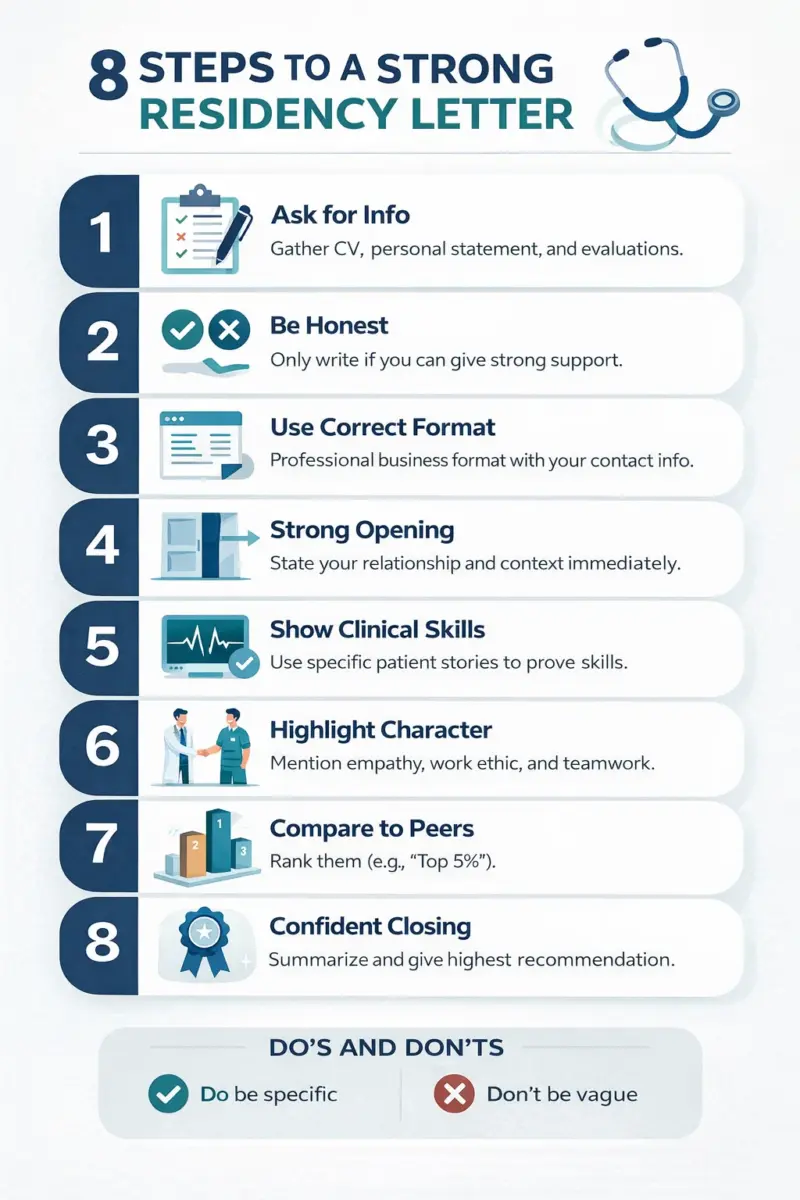
Before writing, clarify why the letter is needed. Is it for college admission, a scholarship, an internship, or a job?
Knowing the purpose helps you:
✔ Choose relevant strengths to highlight
✔ Adjust tone and emphasis
✔ Provide targeted examples
For instance, a college application may require focus on academic performance, while a job application may value work ethic and responsibility.
2️⃣ Use a Professional Format
A recommendation letter should follow a formal business structure.
Basic Format Includes:
- Header (your contact details & date)
- Salutation (Dear Sir/Madam or specific name)
- Introduction
- Body paragraphs
- Conclusion
- Signature
Maintaining a professional format shows seriousness and credibility.
3️⃣ Write a Strong Opening
The introduction should immediately establish who you are and your relationship with the student.
Include:
✔ Your position and experience
✔ How long you’ve known the student
✔ In what capacity (teacher, mentor, supervisor)
Example:
“I am pleased to recommend [Student Name], whom I have taught in [Subject/Class] for [duration].”
A strong opening builds trust with the reader.
4️⃣ Highlight Strengths with Examples
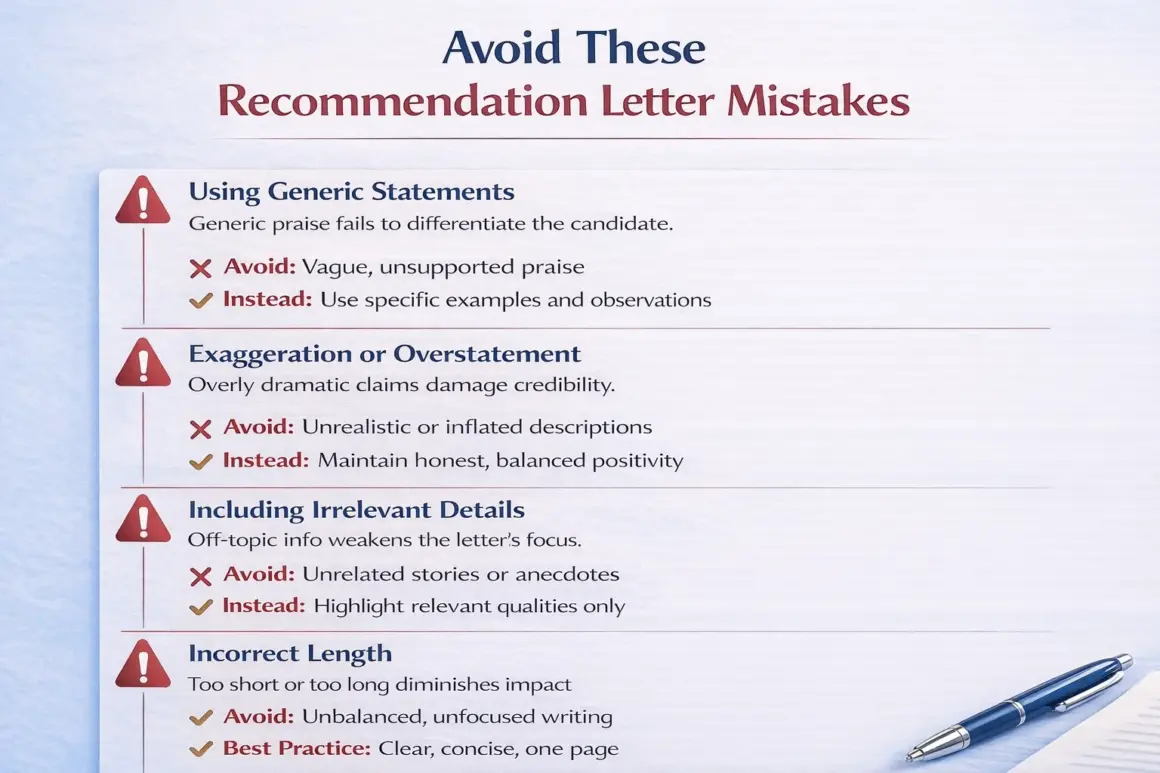
This is the most important part of the letter. Avoid generic praise.
Focus on:
✔ Academic abilities
✔ Key skills
✔ Character traits
✔ Achievements
Support with real examples:
Instead of:
“Rahul is hardworking.”
Write:
“Rahul consistently demonstrated dedication by completing complex assignments ahead of deadlines and actively participating in discussions.”
Specific examples make the letter persuasive and authentic.
5️⃣ Keep It Honest and Positive
A recommendation letter must be truthful. Over-exaggeration can damage credibility.
✔ Highlight genuine strengths
✔ Maintain a positive tone
✔ Avoid misleading claims
If you cannot write a strong endorsement, it is better to politely decline.
Balanced honesty strengthens the letter’s impact.
6️⃣ End with a Clear Recommendation
The conclusion should confidently summarize your endorsement.
Include:
✔ Strong closing statement
✔ Student’s suitability
✔ Invitation for contact
Example:
“I highly recommend [Student Name] for [program/opportunity]. Please feel free to contact me for further information.”
A clear recommendation leaves a lasting impression.
1️⃣ Full Recommendation Letter Sample (300–400 Words)
[Recommender’s Name]
[Designation / Position]
[Institution / Organization Name]
[Address]
[Email Address] | [Phone Number]
[Date]
To
[Recipient’s Name / Admissions Committee]
[Institution / Organization Name]
[Address]
Subject: Recommendation for [Student’s Full Name]
Dear [Mr./Ms./Dr. Last Name / Admissions Committee],
I am pleased to write this letter of recommendation for [Student’s Full Name], whom I have had the privilege of teaching in [Subject / Course Name] at [School / College Name] for [duration]. As a [your role, e.g., Mathematics Teacher / Professor of Economics], I have closely observed [Student’s Name]’s academic performance, work ethic, and personal development.
During this period, [Student’s Name] consistently demonstrated a strong commitment to learning. [He/She/They] displayed exceptional analytical abilities, intellectual curiosity, and a disciplined approach toward academic responsibilities. One notable example was [his/her/their] performance in [specific project, research, competition, or assignment], where [Student’s Name] exhibited originality, critical thinking, and attention to detail. The quality of work reflected both competence and dedication.
Beyond academics, [Student’s Name] has shown admirable personal qualities. [He/She/They] is responsible, respectful, and highly collaborative. [His/Her/Their] participation in [club, activity, leadership role, volunteer work] further highlighted leadership skills, teamwork, and time management. [Student’s Name] is well-regarded among peers and faculty for [positive traits such as integrity, initiative, or perseverance].
What distinguishes [Student’s Name] is [his/her/their] ability to balance academic excellence with a positive attitude and a willingness to grow. [He/She/They] approaches challenges with maturity and determination, qualities that will undoubtedly contribute to success in future academic and professional pursuits.
Based on my experience, I confidently and without reservation recommend [Student’s Full Name] for [program, scholarship, internship, or position]. I am certain that [he/she/they] will be a valuable addition to your institution/organization.
Should you require any further information, please feel free to contact me.
Sincerely,
[Signature]
[Recommender’s Name]
[Designation]
2️⃣ Short Recommendation Letter Sample (Approx. 150 Words)
Subject: Recommendation for [Student’s Name]
Dear [Recipient’s Name / Admissions Committee],
I am delighted to recommend [Student’s Full Name], whom I have taught in [Subject/Course] at [Institution Name]. During my time working with [Student’s Name], [he/she/they] consistently demonstrated strong academic abilities, dedication, and a responsible attitude toward learning.
[Student’s Name] stood out for [key strength — e.g., analytical thinking, leadership, creativity]. In [mention specific example/project/activity], [he/she/they] showed remarkable initiative and commitment. Additionally, [Student’s Name] is respectful, disciplined, and works effectively with peers.
I am confident that [Student’s Name] possesses the skills and character necessary to excel in [program/job/scholarship/internship]. I strongly recommend [him/her/them] without hesitation.
Please feel free to contact me for further details.
Sincerely,
[Name]
[Designation]
Tips for Writing a Strong Recommendation Letter
Crafting a compelling recommendation letter requires more than general praise. A strong letter should be clear, credible, and thoughtfully written. The following expert tips will help ensure your recommendation genuinely supports the student’s application.
✔ Be Specific
Specificity transforms an ordinary letter into a persuasive endorsement. Instead of using broad statements like “She is an excellent student,” include concrete examples:
- Academic accomplishments
- Notable projects
- Leadership instances
- Measurable contributions
Detailed observations provide authenticity and help the reader visualize the student’s strengths.
✔ Use Positive and Professional Language
Maintain a tone that is both encouraging and professional. Choose words that convey confidence and respect:
- “Dedicated”
- “Reliable”
- “Analytical”
- “Motivated”
- “Exceptional”
Avoid casual language or exaggerated claims. Balanced positivity builds trust.
✔ Keep It Concise
Recommendation letters are typically one page. Admissions officers and recruiters value clarity over length.
Focus on:
- Key strengths
- Relevant examples
- Direct statements
Eliminate repetition and unnecessary details. A concise letter is easier to read and more impactful.
✔ Customize for the Purpose
Tailor the letter to the specific opportunity:
- College admission → Academic ability & curiosity
- Scholarship → Merit, discipline, achievements
- Internship/job → Skills, work ethic, professionalism
Generic letters weaken applications. Personalization strengthens relevance.
✔ Proofread Carefully
Errors in grammar, spelling, or formatting can reduce credibility. Before submission:
✔ Check for typos
✔ Verify student details
✔ Ensure professional structure
✔ Confirm tone consistency
A polished letter reflects both the recommender’s professionalism and the seriousness of the endorsement.