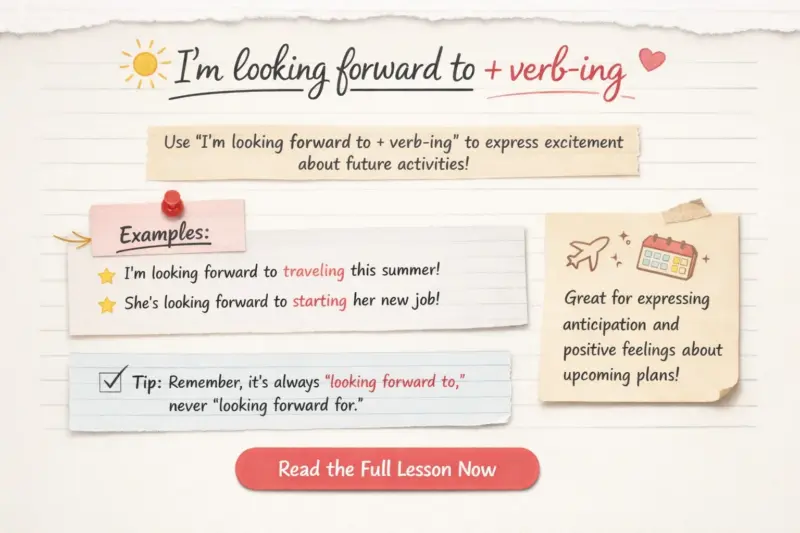
“I’m + verb-ing” is a very common English-speaking pattern. We use it to talk about actions happening right now or around this time. For example, when you say, “I’m working,” it means you are busy with work at this moment or these days.
You can use this structure in daily conversations at home, in the office, while traveling, or when chatting with friends. It helps you sound natural and active in English.
This form is very useful when you answer questions like “What are you doing?” or when you explain your current situation. Native speakers use it all the time, so learning it will quickly improve your speaking confidence.
◎ Important Points
- Use I’m for “I am”
- Add -ing to the action word
- Talk about what is happening now or these days
- Use it for temporary actions, not permanent habits
- Common in daily spoken English
- Often used in answers, not only full sentences
➤Key Concept
I’m + verb + -ing
“I’m + verb-ing” means an action happening now.
Tip: Smile and speak slowly when you use this form. It makes your English sound confident.
➤ Common Mistakes To Avoid
| Common Mistake | Wrong Example | Correct Example |
|---|---|---|
| Forgetting “am” | I working now. | I’m working now. |
| Missing “-ing” | I’m work today. | I’m working today. |
| Using past time | I’m working yesterday. | I worked yesterday. |
| Using it for habits | I’m going to office every day. | I go to office every day. |
| Wrong verb form | I’m study English. | I’m studying English. |
➤ Examples
- I’m cooking dinner right now.
- I’m learning English online.
- I’m waiting for the bus.
- I’m talking to my friend.
- I’m working from home today.
- I’m watching a movie.
- I’m traveling to Delhi this week.
- I’m feeling tired today.
- I’m writing an email at the office.
➤ Practice Examples
1. Fill in the blanks
- I’m _______ (read) a book.
- I’m _______ (wait) for you.
- I’m _______ (learn) new words.
2. Correct the sentence
- I’m eat lunch now.
- I working on my project.
- I’m go to market.
3. Speak aloud
- “I’m improving my English every day.”
- “I’m speaking English with confidence.”
Practice daily and use this pattern in real conversations.