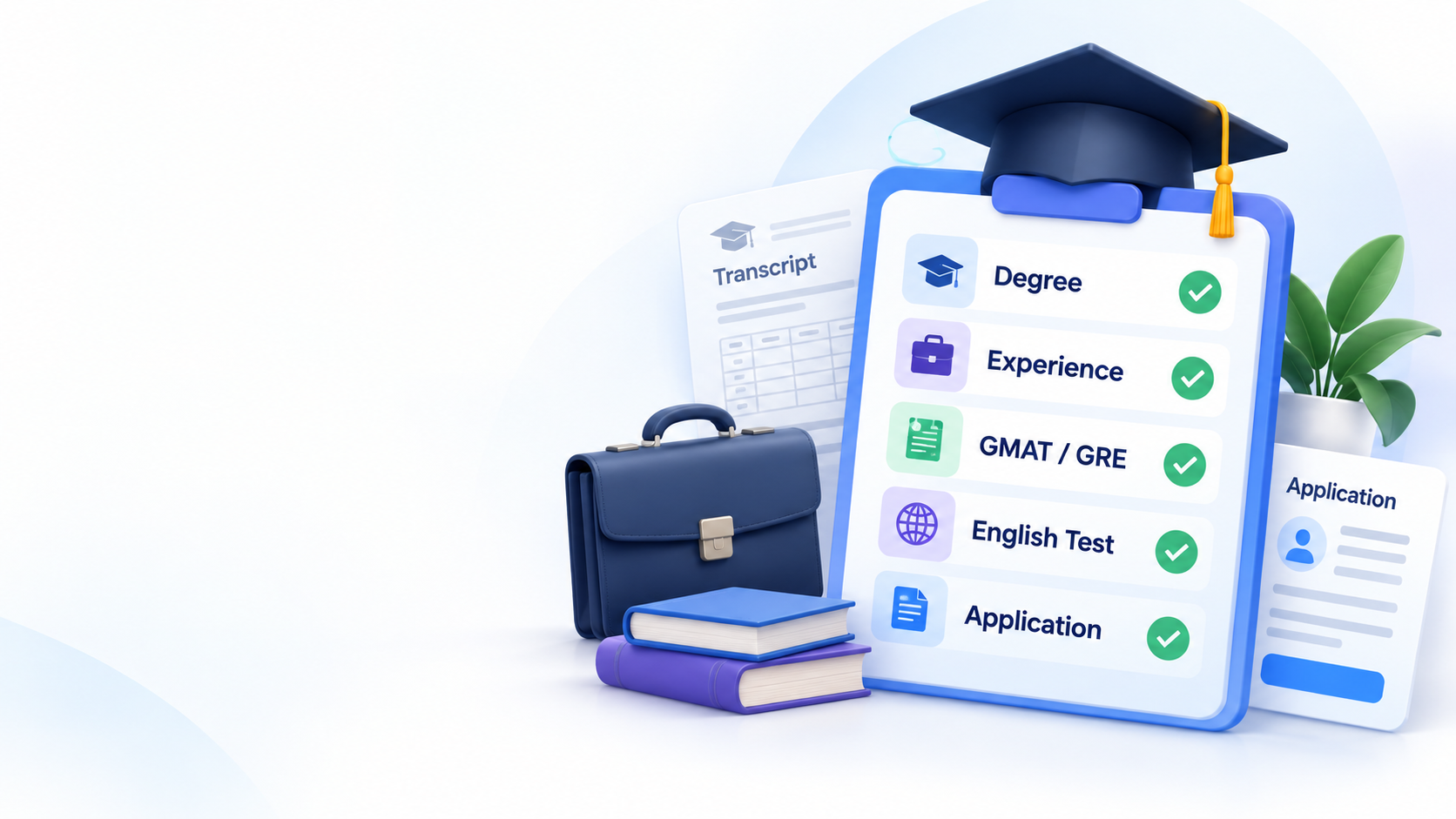
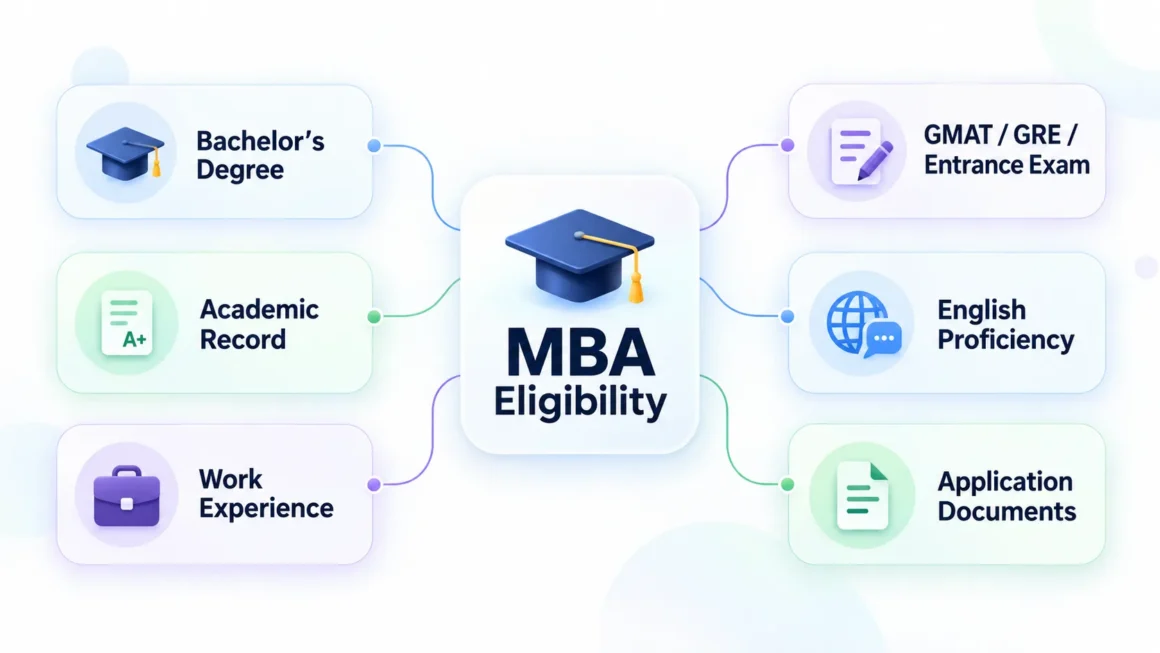
The basic MBA eligibility requirements usually include an undergraduate degree or equivalent qualification, an acceptable academic record, and the application materials required by the business school.
Depending on the program, you may also need professional work experience, GMAT or GRE scores, proof of English proficiency, essays, recommendation letters, a résumé, and an interview.
However, there is no single worldwide eligibility rule for every MBA. Learn more what is an mba?
For example, Stanford currently requires a U.S. bachelor’s degree or international equivalent and a GMAT or GRE score, while Wharton requires an undergraduate degree or equivalent and GMAT/GRE results but does not impose a minimum number of years of professional experience.
This means you should treat general MBA requirements as a starting point and always verify the current requirements of the specific business school you want to attend.
What Are the Basic MBA Eligibility Requirements?
A typical MBA applicant may need:
| Requirement | Usually Needed? |
|---|---|
| Bachelor’s degree or equivalent | Usually |
| Business undergraduate degree | Usually not |
| Academic transcripts | Usually |
| Work experience | Common, but varies |
| GMAT/GRE | Depends on school |
| English-language test | Sometimes |
| Resume/CV | Common |
| Essays | Common |
| Recommendations | Common |
| Interview | Often part of final selection |
GMAC’s current guidance similarly identifies a bachelor’s degree, work experience, standardized testing, résumé, recommendation letters, essays and English-language proof where applicable among common MBA entry requirements.
The important word is common.
Individual MBA programs can set very different rules.
MBA Eligibility vs MBA Admission Requirements
These terms are often used as though they mean exactly the same thing.
They don’t always.
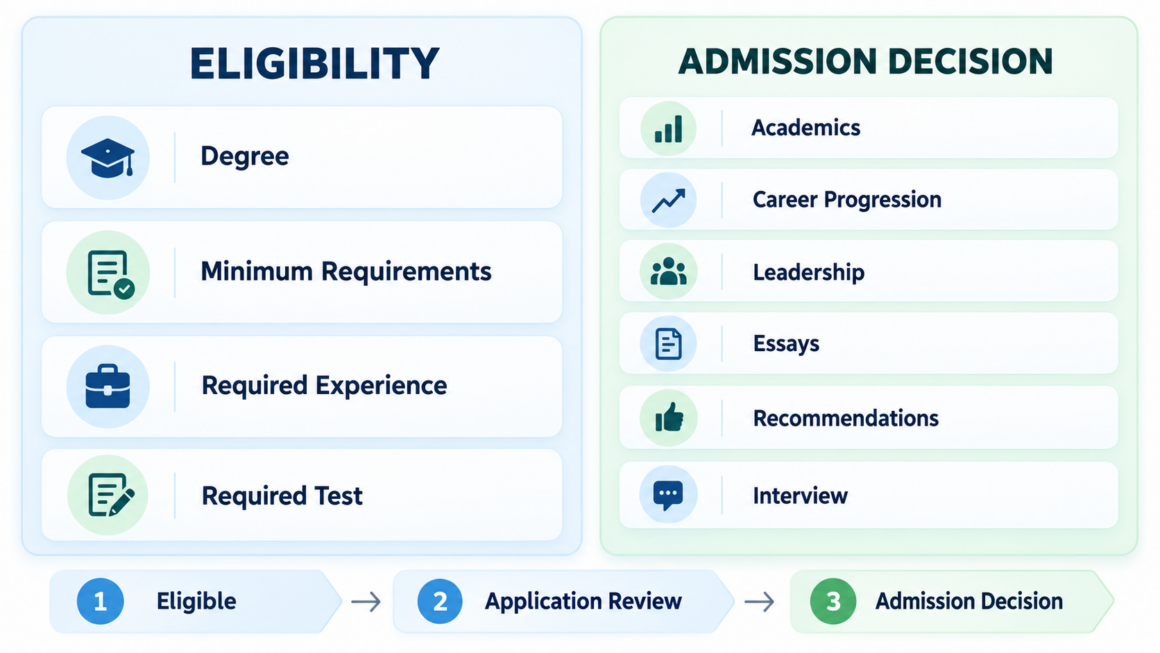
Eligibility requirements are the minimum conditions that allow you to apply.
For example:
- Holding an acceptable undergraduate degree
- Meeting a minimum experience requirement
- Completing a required entrance test
Admission requirements are broader.
They can include:
- Academic record
- Test scores
- Professional experience
- Leadership
- Essays
- Recommendations
- Interview performance
- Career goals
- Personal achievements
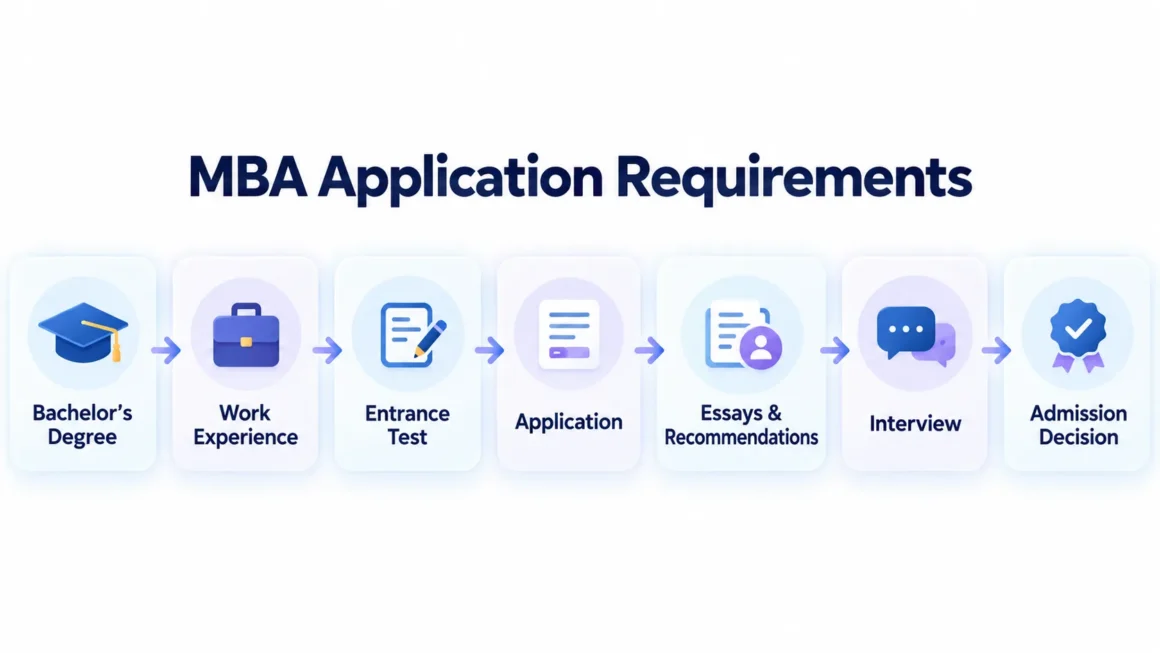
Being eligible therefore does not mean you will automatically be admitted.
A candidate may satisfy every minimum requirement but still compete against applicants with stronger overall profiles.
Business schools frequently evaluate applications holistically rather than relying on one number such as GPA or GMAT score.
1. Bachelor’s Degree Requirement
For many MBA programs, the first major academic requirement is an undergraduate degree.
This usually means:
Bachelor’s degree or recognized international equivalent
Stanford currently requires a U.S. bachelor’s degree or equivalent for its MBA, while Wharton requires completion of an accredited U.S. undergraduate program or an international equivalent.
1.1 Does Your Bachelor’s Degree Need to Be in Business?
Usually, no.
You generally do not need a BBA, commerce or finance degree before studying an MBA.
MBA classes commonly include students from backgrounds such as:
- Engineering
- Computer science
- Economics
- Finance
- Science
- Medicine
- Humanities
- Social sciences
- Technology
- Arts
Business schools often value having students from different academic and professional backgrounds.
Stanford explicitly states that it does not prefer a particular undergraduate curriculum.
Harvard Business School’s current MBA class, for example, includes students who studied engineering, economics, business, humanities, social sciences, mathematics and physical sciences.
So a student with a degree such as:
BCA, BSc, BA, BCom, BBA, BE, BTech or another recognized undergraduate qualification
may potentially apply, subject to the requirements of the individual MBA program.
1.2 Are Three-Year Bachelor’s Degrees Accepted?
Sometimes, yes.
Do not assume that every international MBA requires four years of undergraduate study.
Stanford currently states that international three-year bachelor’s degree programs can qualify as equivalent degrees for its MBA admissions process.
Harvard Business School also states that equivalent international degrees can include three-year bachelor’s degree programs.
However, degree-equivalency policies differ.
If you hold a three-year bachelor’s degree, check the school’s section for:
- International applicants
- Academic eligibility
- Degree equivalency
- Credential evaluation
Some universities may request additional documentation or credential verification.
1.3 Can Final-Year Students Apply?
Some MBA pathways allow students to apply while completing their undergraduate education.
One example is deferred MBA admission.
Harvard Business School’s current 2+2 program allows eligible students in the final year of undergraduate study—or qualifying master’s students who went directly from undergraduate study—to apply and then work before starting the MBA.
Deferred programs are different from regular MBA admission because students generally gain professional experience before enrolling.
Some regular MBA programs or entrance examinations may also permit final-year applicants, but the exact conditions vary.
Always verify when your degree must be officially completed.
2. GPA and Graduation Marks
Your undergraduate academic performance usually forms an important part of an MBA application.
Business schools may evaluate:
- Overall GPA
- Individual course grades
- Difficulty of your academic program
- Quantitative coursework
- Grade trends
- Additional courses
- Graduate study
GMAC notes that schools commonly review undergraduate transcripts and academic performance when assessing readiness for graduate business education.
2.1 Is There a Minimum GPA for an MBA?
There is no universal minimum MBA GPA.
Some universities specify a minimum.
Others don’t.
Stanford, for example, currently states that it has no minimum GPA requirement for admission to its MBA program.
That does not mean academic performance is unimportant.
Stanford still reviews:
- Transcripts
- Coursework
- Academic performance
- Quantitative preparation
- GMAT/GRE results
- Professional experience
Similarly, another institution may explicitly require a minimum academic average.
So never use one school’s GPA policy as a universal MBA rule.
2.2 Do Low Grades Make You Ineligible?
Not necessarily.
It depends on whether the school has a strict academic cutoff.
Where there is no fixed minimum, the admissions committee may evaluate your academic record alongside other evidence of your ability.
That could include:
- GMAT/GRE performance
- Professional achievements
- Additional quantitative courses
- Graduate coursework
- Career progression
- Leadership experience
However, a strong professional profile does not automatically erase an academic requirement when the school has a stated cutoff.
First determine:
Do I meet the minimum requirement?
Then ask:
Is my overall application competitive?
Those are different questions.
3. Work Experience Requirements
Work experience is one of the most misunderstood MBA eligibility requirements.
Many MBA students have several years of professional experience, but that does not mean every school requires a fixed number.
3.1 How Much Work Experience Is Usually Needed?
GMAC’s 2026 guidance says full-time MBA applicants commonly have around three to five years of professional experience, although program requirements vary significantly.
The number is better understood as a typical profile rather than a universal eligibility rule.
Consider Wharton.
Wharton currently states that it has no minimum or maximum work-experience requirement for its MBA. Its students commonly enter with around five or six years of experience, but candidates with limited experience can still apply.
Harvard Business School’s current Class of 2027 reports an average of 4.9 years of work experience, with the middle 80% having approximately three to seven years. That describes the enrolled class; it is not the same thing as a universal minimum eligibility requirement.
3.2 Can Fresh Graduates Apply for an MBA?
Yes, at some schools and through some program formats.
However, traditional full-time MBA programs are often designed for people who already have professional experience.
Wharton explicitly states that work experience is not mandatory and that it can admit early-career candidates with limited or no professional experience when they demonstrate strong potential.
In India, the situation can also differ by program.
IIM Ahmedabad’s flagship two-year PGP/MBA states that its classes include both fresh graduates and people with work experience. Domestic admission currently uses CAT as part of the selection process.
Meanwhile, an Executive MBA or MBA designed for experienced professionals normally has different expectations.
3.3 What Counts as MBA Work Experience?
Schools may consider the:
- Length of your employment
- Type of work
- Level of responsibility
- Career progression
- Leadership responsibilities
- Professional achievements
- Organizational impact
Simply accumulating years is not the only factor.
Wharton says it evaluates professional maturity and the depth and breadth of an applicant’s responsibilities rather than focusing solely on years worked.
Depending on the program, relevant experience could come from:
- Full-time employment
- Entrepreneurship
- Military service
- Nonprofit work
- Public-sector employment
- Professional projects
Internships and part-time experience may be treated differently by different schools.
4. GMAT, GRE and MBA Entrance Exams
Many MBA applicants encounter standardized admission tests.
The most internationally recognized include:
- GMAT
- GRE
Some countries and universities also use their own entrance examinations.
4.1 Is the GMAT Required for Every MBA?
No.
GMAT requirements vary.
Some schools:
- Require GMAT or GRE
- Accept either test
- Provide test waivers
- Make testing optional
- Use another entrance examination
- Do not require standardized testing
For the 2026–27 admissions cycle, Stanford requires a valid GMAT or GRE and states that it has no preference between the two.
Wharton likewise currently requires either the GMAT or GRE for its MBA application.
By contrast, other accredited university MBA programs may operate without GMAT/GRE requirements.
Therefore, the correct question is not:
“Does an MBA require GMAT?”
It is:
“Does my target MBA program require GMAT, GRE or another test?”
4.2 GMAT vs GRE
Many international business schools accept either the Graduate Management Admission Test (GMAT) or Graduate Record Examination (GRE).
Where both are accepted, check whether the school expresses a preference.
Stanford currently states that it has no preference between GMAT and GRE.
Test requirements can change between admissions cycles, so always use the school’s current admissions page.
4.3 MBA Entrance Exams in India
MBA admissions in India can involve different examinations than MBA admissions in the United States or Europe.
Common names you may encounter include:
- CAT
- XAT
- CMAT
- MAT
- NMAT
- SNAP
- GMAT
- GRE for certain programs
Requirements depend on the institution.
For example, IIM Ahmedabad’s current flagship PGP/MBA admission process uses CAT for domestic applicants, while eligible overseas Indian candidates and foreign nationals follow a GMAT-based route. Selection also considers academic performance and later assessment stages.
This is why someone researching an MBA in India should check the exact examination accepted by each institution instead of assuming that GMAT is the only MBA entrance test.
5. English Language Requirements
International students may need to demonstrate English-language proficiency.
This requirement generally depends on factors such as:
- Previous language of instruction
- University policy
- Country of previous education
- Program requirements
5.1 When Is an English Test Required?
Policies differ significantly.
Stanford currently requires applicants to demonstrate English proficiency. Students whose undergraduate education included courses taught in a language other than English generally need an approved English-language test unless they subsequently completed qualifying graduate study taught exclusively in English.
Harvard Business School currently requires an English-language test for applicants who did not attend an undergraduate institution where English was the sole language of instruction.
Wharton also has English-language testing requirements with exemptions based on previous English-medium education.
Therefore:
Being an international applicant does not automatically mean you need IELTS or TOEFL.
The determining factor can be your previous education and the specific school’s policy.
5.2 Which English Tests Are Accepted?
Commonly accepted tests can include:
- TOEFL
- IELTS Academic
- PTE Academic
Some institutions accept additional exams.
For example, Stanford currently accepts TOEFL, IELTS and PTE for MBA applicants who need English-language testing.
Harvard Business School currently also accepts the Duolingo English Test in addition to TOEFL, IELTS and PTE.
Minimum scores vary.
Never assume that one school’s IELTS or TOEFL cutoff applies to another.
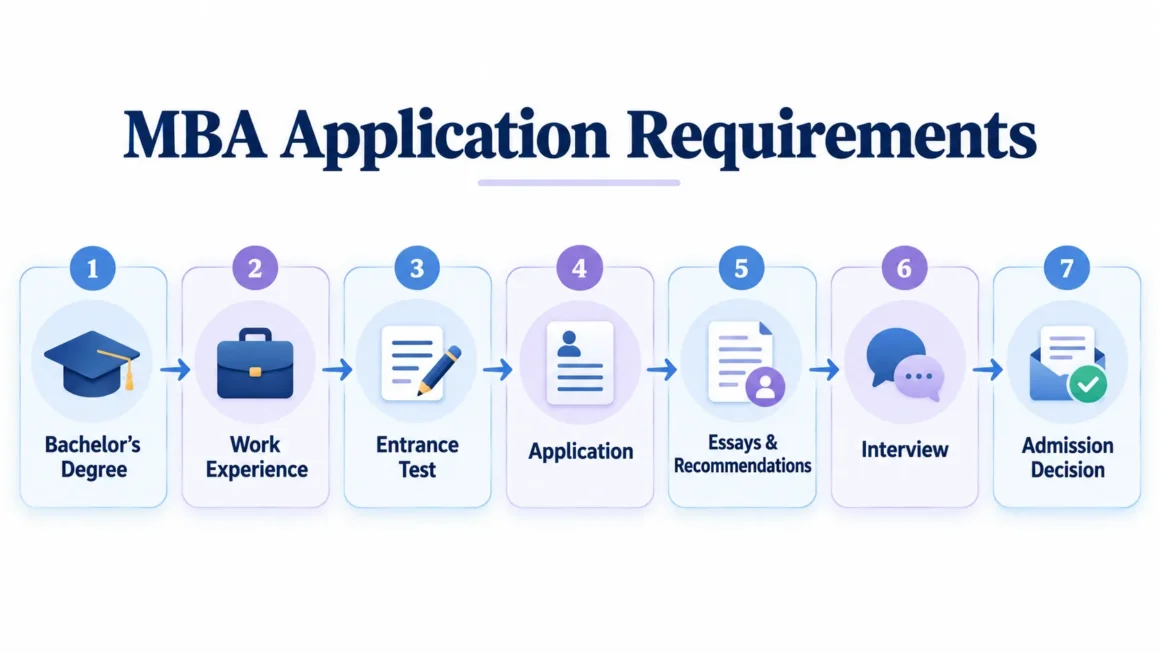
6. MBA Application Documents
Meeting the basic eligibility criteria is only the first part of applying.
MBA applications commonly require several supporting materials.
6.1 Academic Transcripts
Your transcript shows your academic history.
Schools may examine:
- Courses
- Grades
- Degree
- Academic progress
- Quantitative preparation
Stanford requires applicants to provide information about postsecondary institutions attended and upload transcripts during the application process.
International applicants may also need translations.
Wharton, for example, requires authorized English translations when academic records are not issued in English.
6.2 MBA Resume
An MBA résumé usually summarizes:
- Employment
- Promotions
- Achievements
- Responsibilities
- Leadership
- Education
- Extracurricular activities
Unlike a basic job description, a strong MBA résumé should show progression and impact.
Wharton’s current application guidance specifically encourages applicants to demonstrate growth, responsibilities, accomplishments, teamwork, leadership and measurable impact.
6.3 Recommendation Letters
Many MBA programs require one or more recommendations.
Potential recommenders can include:
- Current supervisors
- Former supervisors
- Professional mentors
- Project leaders
- Other people who know your professional contribution well
The most senior person is not automatically the best recommender.
Someone who understands your work and can provide specific examples may provide more useful evidence.
GMAC similarly recommends choosing people who can genuinely explain your abilities and professional potential.
6.4 MBA Essays
MBA essays help the admissions committee understand information that test scores and transcripts cannot fully show.
Typical themes include:
- Why you want an MBA
- Your career goals
- Why you chose the school
- Leadership experiences
- Challenges
- Professional achievements
- Personal values
A strong essay should answer the school’s actual question rather than using one generic essay for every university.
6.5 Admissions Interview
Many MBA programs interview applicants after reviewing written applications.
An interview may explore:
- Career goals
- Motivation for an MBA
- Leadership
- Professional experience
- Communication ability
- Why you selected the program
At Harvard Business School, interviews currently take place after review of the written application and are invitation-only; the interview is one part of the final evaluation rather than a guarantee of admission.
7. Executive MBA Eligibility Requirements
An Executive MBA, or EMBA, is generally designed for people further into their careers.
Its requirements can therefore be very different from those of a traditional MBA.
7.1 Work Experience for Executive MBA
Executive MBA applicants normally have more professional experience.
GMAC’s current entry-requirement guide notes that EMBA applicants are generally expected to have substantial professional experience, with program requirements often exceeding those of traditional full-time MBA programs.
At IIM Ahmedabad, for example, the current MBA-PGPX for experienced professionals requires at least four years of full-time post-graduation work experience for the 2027–28 batch.
Another Executive MBA may have a completely different minimum.
7.2 Executive MBA Academic Requirements
Executive programs commonly still expect an undergraduate degree or equivalent qualification.
However, some programs may offer exceptions based on significant professional experience.
For example, INSEAD’s Global Executive MBA states that candidates normally hold a recognized undergraduate degree or equivalent, while exceptions may apply.
Executive MBA applicants may also encounter:
- GMAT
- GRE
- Executive Assessment
- School-specific tests
Again, requirements are program-specific.
8. Online and Part-Time MBA Eligibility
An online or part-time MBA is not automatically easier to enter.
These programs may still require:
- Undergraduate qualification
- Academic transcripts
- Professional experience
- Résumé
- Essays
- Recommendations
- Entrance tests
The main difference is usually delivery format, not necessarily academic standards.
Some programs specifically target experienced working professionals, which can make work experience more important.
Before applying, check:
- Minimum employment experience
- Testing policy
- Attendance requirements
- Residential requirements
- English-language requirements
- Degree-recognition policies
9. MBA Eligibility for International Students
International applicants normally need to satisfy the same core academic standards as domestic applicants, plus additional documentation where applicable.
Common international requirements include:
- Equivalent undergraduate qualification
- Translated transcripts
- English-language proficiency
- GMAT/GRE or another test
- Passport information
- Financial documentation later in the enrollment or visa process
Harvard Business School currently states that international applicants are evaluated using the same admissions criteria as U.S. applicants, while requiring degree equivalency and English-language documentation where applicable.
International applicants should pay particular attention to degree equivalency.
A qualification accepted by one university may be evaluated differently by another.
10. MBA Eligibility in India vs International Business Schools
The basic principles overlap, but the admissions process can look different.
| Requirement | India | International MBA Programs |
|---|---|---|
| Bachelor’s degree | Commonly required | Commonly required |
| Business undergraduate degree | Usually not necessary | Usually not necessary |
| Entrance exam | CAT/XAT/CMAT/etc. may be used | GMAT/GRE commonly encountered |
| Work experience | Depends on program | Often valued; requirements vary |
| English test | Usually not relevant for domestic English-medium programs | May apply to international applicants |
| Essays | Depends on institution | Very common |
| Recommendations | Depends on institution | Common |
| Interview | Common at selective institutions | Common at selective institutions |
| Group discussion/written assessment | Used by some Indian schools | Less standardized |
These are broad patterns rather than rules.
For example, IIM Ahmedabad’s flagship PGP/MBA currently uses CAT for domestic applicants and assesses candidates using exam scores, academic performance and later evaluation stages. Its student body includes both fresh graduates and applicants with professional experience.
Meanwhile, Wharton currently requires an undergraduate qualification and GMAT/GRE but explicitly states that it has no minimum professional-experience requirement.
The lesson is simple:
Always check eligibility at the program level—not merely the country level.
11. MBA Eligibility Checklist
Before applying, use this checklist.
| Question | Check |
|---|---|
| Do I hold—or will I complete—the required undergraduate qualification? | ☐ |
| Is my degree considered equivalent by the university? | ☐ |
| Do I meet any minimum GPA or percentage requirement? | ☐ |
| Do I have the required professional experience? | ☐ |
| Is GMAT, GRE, CAT or another exam required? | ☐ |
| Is my test score still valid? | ☐ |
| Do I need IELTS, TOEFL, PTE or another English test? | ☐ |
| Do I have academic transcripts? | ☐ |
| Is my résumé ready? | ☐ |
| Do I have suitable recommenders? | ☐ |
| Have I reviewed the essay questions? | ☐ |
| Have I checked application deadlines? | ☐ |
| Do my documents need translation? | ☐ |
| Do I meet any program-specific requirements? | ☐ |
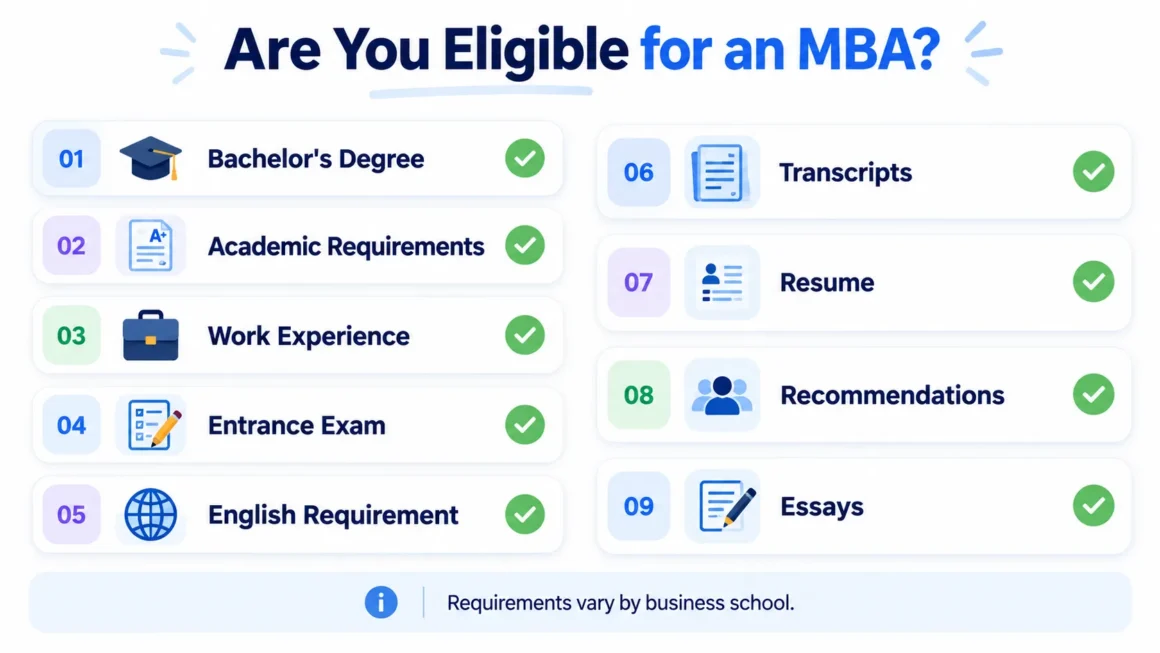
Completing every checkbox means you are more likely to have a complete application.
It does not guarantee admission.
Common MBA Eligibility Mistakes
One of the biggest mistakes is relying on generic eligibility information instead of checking the individual business school.
Avoid assuming that:
- Every MBA requires two years of experience.
- Every MBA accepts fresh graduates.
- Every school requires GMAT.
- A high GMAT guarantees admission.
- Every MBA requires a business undergraduate degree.
- Every school requires the same GPA.
- Every international student needs IELTS.
- Every three-year degree is accepted everywhere.
- Executive MBA requirements are the same as regular MBA requirements.
- Meeting minimum eligibility means you will be admitted.
A better approach is to create a spreadsheet for your target programs containing:
Degree requirement → GPA requirement → Work experience → Entrance exam → English requirement → Essays → Recommendations → Deadline.
That makes comparison much easier.
Final Thoughts
The most common MBA eligibility requirements include an undergraduate degree or equivalent qualification, an acceptable academic record and a complete application.
Depending on the business school, you may also need:
- Professional work experience
- GMAT or GRE
- CAT or another national examination
- English-language test scores
- Resume
- Essays
- Recommendation letters
- An admissions interview
But there is no universal MBA eligibility formula.
One school may require several years of work experience while another accepts early-career applicants.
One may require the GMAT or GRE while another may waive standardized testing.
One may accept a three-year bachelor’s degree automatically while another may require additional equivalency review.
So the most reliable rule is:
Check the official admissions requirements of every MBA program individually before applying.
First determine whether you’re eligible.
Then determine whether your academic record, professional experience, leadership, goals, and overall profile make you a competitive applicant.
FAQs
1 Who Is Eligible for an MBA?
MBA applicants generally need a bachelor’s degree or recognized equivalent. Depending on the program, they may also need professional experience, entrance-test scores, and English-language proficiency.
Exact requirements vary by business school.
2. Can I Do an MBA After Any Bachelor’s Degree?
Generally, you do not need an undergraduate business degree. MBA students commonly come from engineering, technology, science, humanities, economics and many other academic backgrounds. Stanford, for example, states that it does not prefer a particular undergraduate curriculum.
3. Can I Do an MBA Without Work Experience?
At some schools, yes. Wharton currently has no minimum work-experience requirement and states that early-career applicants can be considered, while other MBA programs explicitly require professional experience.
4. Is GMAT Compulsory for an MBA?
No universal rule requires the GMAT for every MBA. Some programs require GMAT or GRE, some offer waivers or alternative tests, and others do not require standardized admission tests. Stanford and Wharton currently require GMAT or GRE for their regular MBA programs.
5. What GPA Is Required for an MBA?
There is no global MBA GPA cutoff. Each university sets its own requirements. Stanford currently states that it has no minimum MBA GPA requirement, although academic performance remains part of its evaluation.
6. Can I Do an MBA With a Three-Year Degree?
Some major business schools accept recognized international three-year bachelor’s degrees. Stanford and Harvard Business School currently state that qualifying international three-year bachelor’s degrees can meet their degree requirements. Policies differ by university.
7. Is There an Age Limit for an MBA?
There is no universal MBA age limit. Individual schools, entrance examinations or specialized programs may establish their own eligibility rules. Executive and experienced-professional programs may also target applicants at particular career stages.
8. Can Final-Year Students Apply for an MBA?
Some programs allow it, particularly deferred MBA pathways. Harvard Business School’s current 2+2 program allows eligible final-year students to apply and then work for two to four years before enrolling.
9. Do International Students Need IELTS?
Not always. The requirement often depends on the language in which your previous education was taught. Stanford, Harvard, and Wharton each have specific English-language rules and exemptions, so applicants should verify the policy of their target school.
10. Can I Do an MBA After BCA, Engineering, Arts or Science?
Potentially, yes. MBA programs generally accept applicants from a range of academic disciplines rather than requiring only business graduates. You must still satisfy the individual program’s degree, academic, examination, and experience requirements.
Related Posts:
| How to Apply for an MBA |
| MBA Admission Requirements |
| Can You Do an MBA Without Work Experience? |
| How Much Work Experience Do You Need for an MBA? |
| MBA Entrance Exams Explained |
| GMAT vs GRE for MBA |
| Is GMAT Required for MBA? |
| What Is the GMAT? |
| MBA After BCA |
| MBA After Engineering |
| MBA After BSc |
| MBA After BA |
| MBA After BCom |
| MBA Without a Business Degree |
| MBA With a Low GPA |
| MBA for Freshers |
| MBA Age Limit Explained |
| IELTS Requirements for MBA |
| What Is a Deferred MBA? |
| Executive MBA Eligibility Requirements |