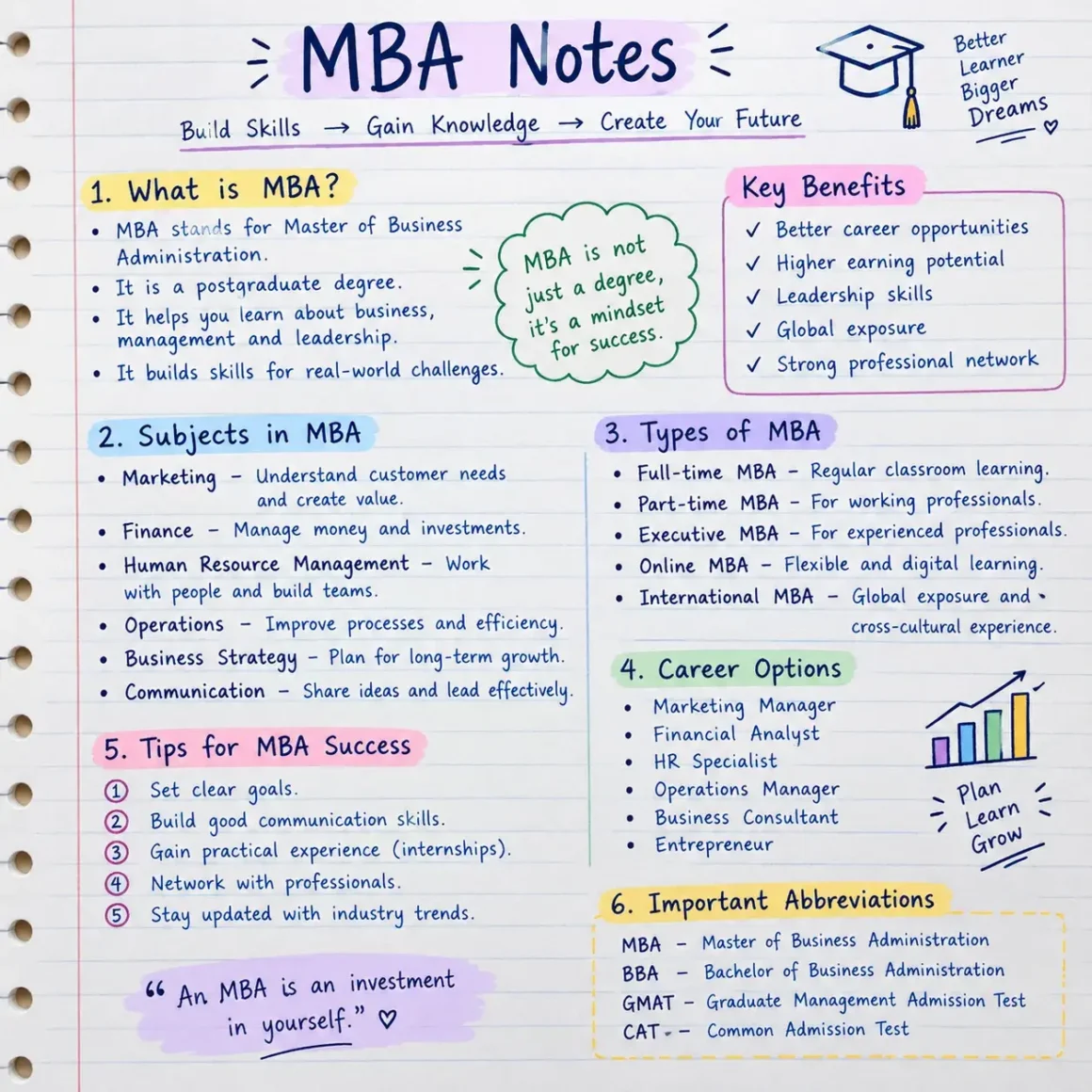
An MBA, or Master of Business Administration, is a postgraduate business degree designed to develop knowledge in management, leadership, finance, marketing, strategy, operations, and other areas involved in running an organization.
Unlike a degree focused on only one business subject, an MBA normally takes a broad view of how different parts of a business work together.
MBA programs are available in several formats, including full-time, part-time, online, and Executive MBA programs. Their length, cost, admission requirements, and curriculum vary between universities and countries.
What Does MBA Stand For?
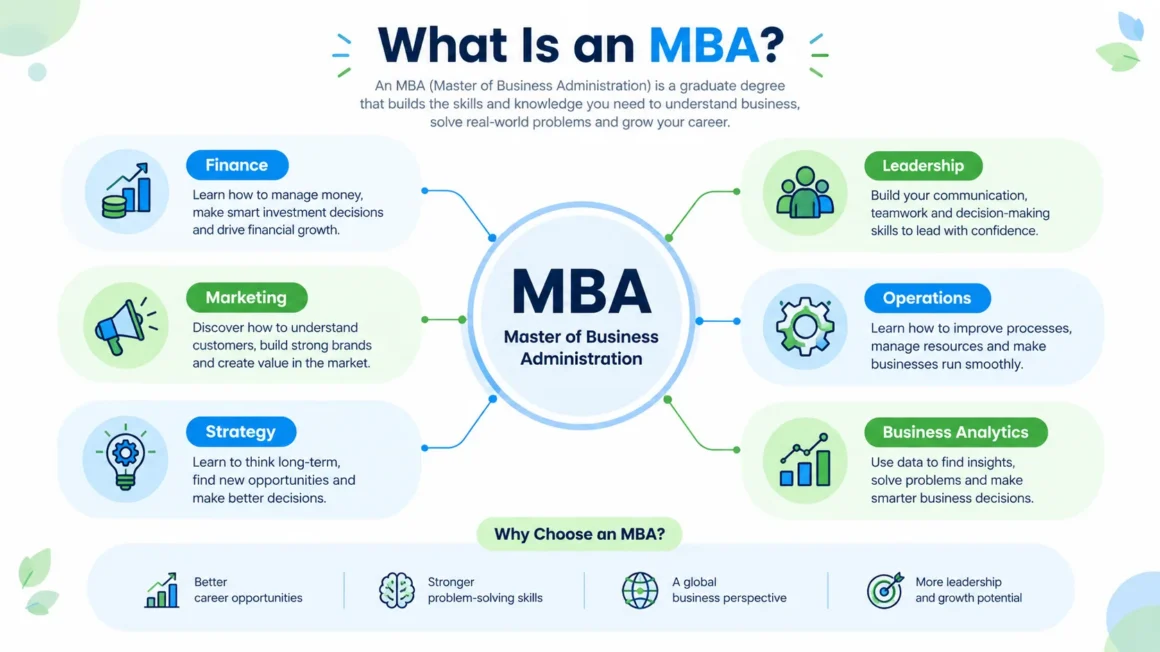
MBA stands for Master of Business Administration.
It is generally classified as a postgraduate or graduate-level degree in business and management. Cambridge defines an MBA as an advanced university degree in business.
You can think of the name in three parts:
| Term | Simple Meaning |
|---|---|
| Master | Postgraduate-level study |
| Business | How organizations operate and create value |
| Administration | Managing resources, people, decisions, and operations |
However, modern MBA programs go far beyond basic administration. Students may study leadership, analytics, entrepreneurship, technology, strategy, negotiation, finance, operations, and other management disciplines.
What Is an MBA Degree?
An MBA is primarily a general management degree.
Instead of training you for only one function, such as accounting or marketing, an MBA normally introduces you to several areas of business and teaches you how they connect.
For example, imagine that a company wants to launch a new product.
A manager may need to consider:
- How much will it cost?
- Who is the target customer?
- How should the product be marketed?
- How much inventory should be produced?
- What price should the company charge?
- How will employees manage the launch?
- What risks could affect the project?
Finance, marketing, operations, strategy, leadership, and analytics all become part of the same decision.
That cross-functional perspective is one of the main ideas behind an MBA.
MBA.com describes the MBA as a generalist qualification providing a holistic view of business across areas such as marketing, finance, and accounting while also developing management and leadership skills.
What Do You Study in an MBA?
The exact curriculum varies considerably between schools.
However, most programs combine a core curriculum with electives or specialization opportunities.
Core MBA Subjects
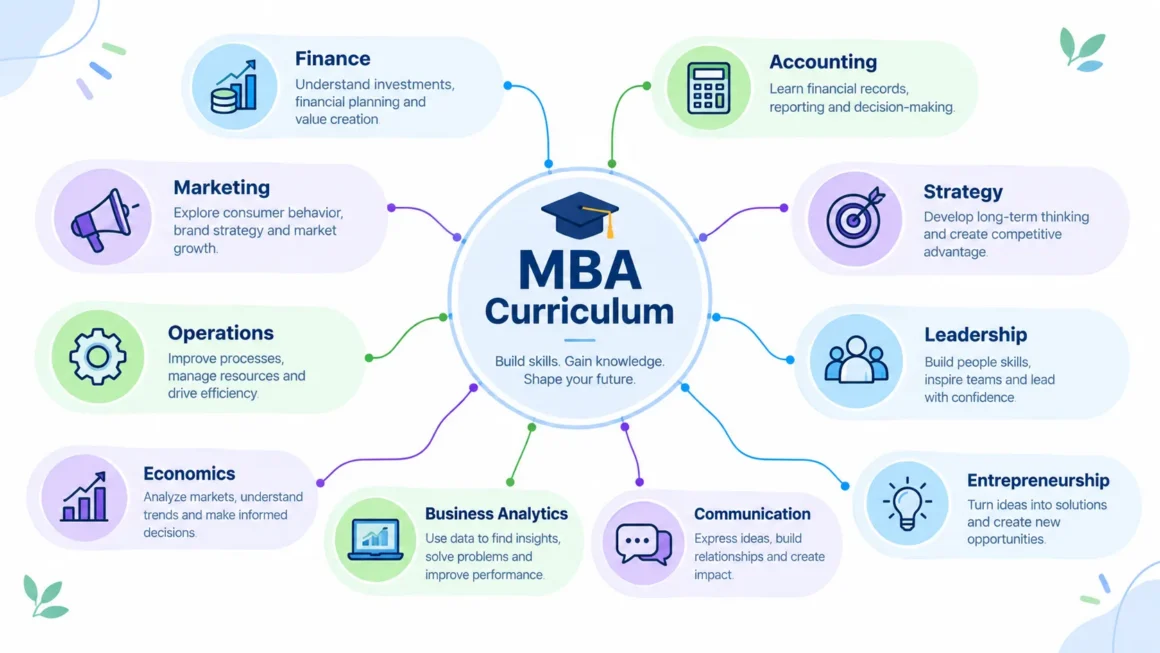
Common subjects include:
- Accounting
- Finance
- Economics
- Marketing
- Business strategy
- Operations management
- Leadership
- Organizational behavior
- Business communication
- Data analytics
- Business ethics
- Decision-making
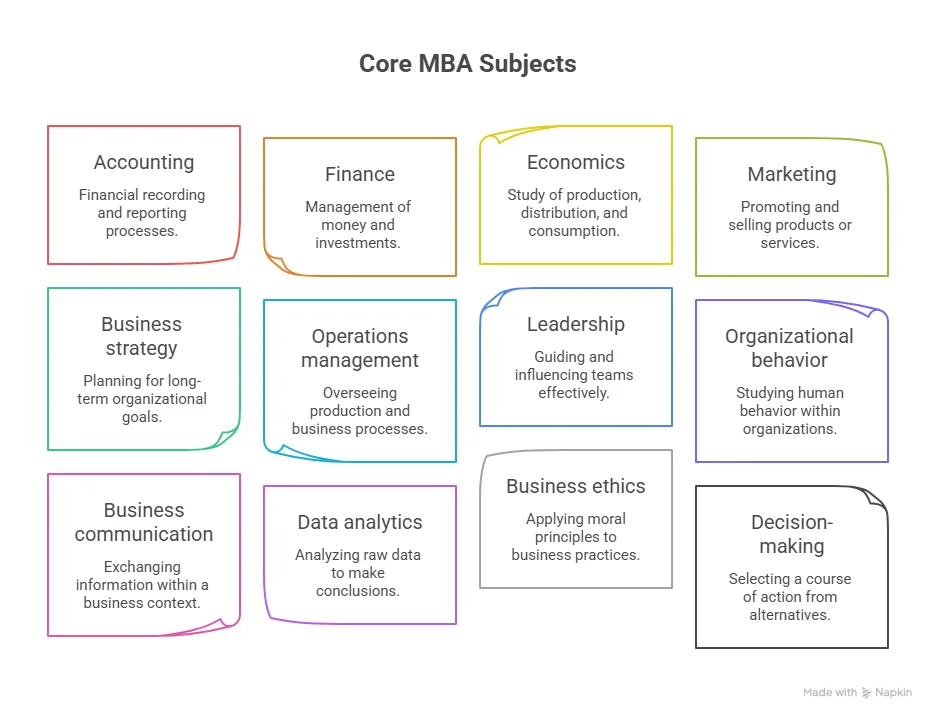
MBA.com’s current curriculum overview lists accounting, business communication, ethics, strategy, data analytics, economics, finance, leadership, marketing, and operations among common core areas.
Individual schools may structure these areas differently.
For example, Harvard Business School’s 2026–27 required curriculum includes Finance, Financial Reporting and Control, Leadership and Organizational Behavior, Marketing, Technology and Operations Management, Strategy, Data Science and AI for Leaders, and other subjects.
MBA Electives and Specializations
Once students complete core subjects, many schools allow them to choose courses related to their career interests.
Options can include:
- Entrepreneurship
- Corporate finance
- Artificial intelligence
- Business analytics
- Sustainability
- Fintech
- Advertising
- Innovation
- International business
- Supply chain management
The choices available depend entirely on the institution.
How MBA Students Learn
An MBA is not normally based only on lectures and examinations.
Programs may also use:
- Business case studies
- Group projects
- Presentations
- Business simulations
- Consulting projects
- Internships
- Capstone projects
- Company visits
- Networking events
- Classroom discussions
Harvard Business School, for example, is closely associated with case-based learning, while its MBA curriculum also incorporates practical work experience.
What Are the Different Types of MBA?
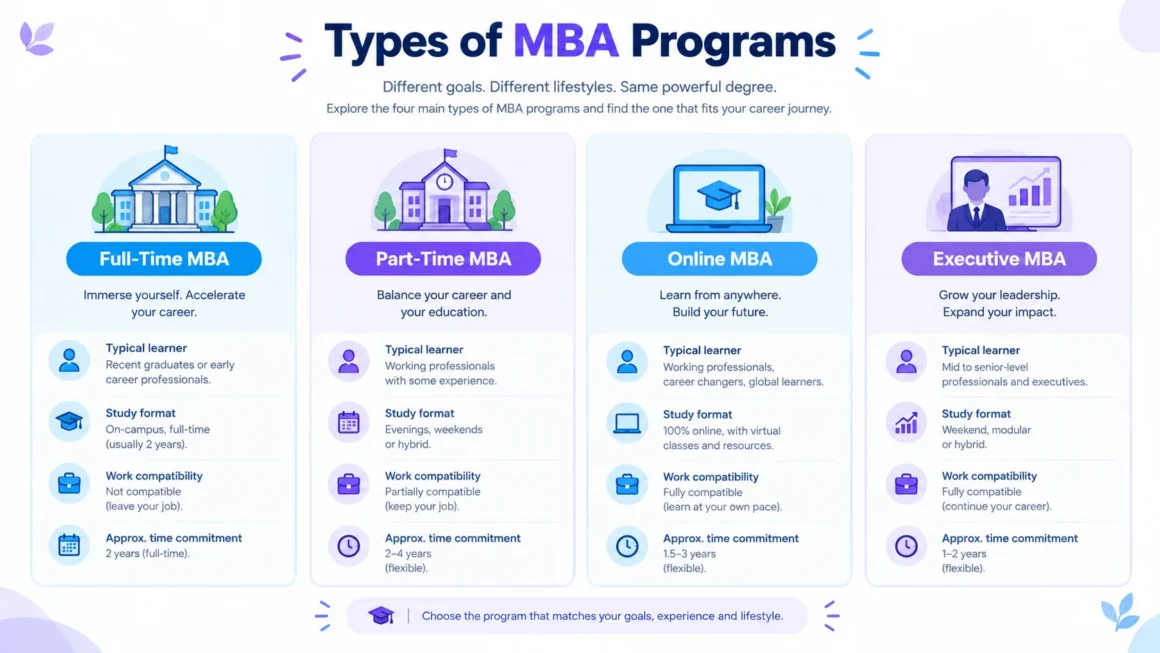
There isn’t one standard MBA format.
Modern business schools offer several formats designed for students at different career stages.
| MBA Type | Usually Suited To | Typical Structure |
|---|---|---|
| Full-Time MBA | People able to pause or reduce employment | Intensive campus-based study |
| Part-Time MBA | Working professionals | Evening, weekend, blended, or flexible study |
| Online MBA | Professionals needing location flexibility | Primarily or completely online |
| Executive MBA | Experienced managers and executives | Work-compatible executive-level program |
Program durations vary by school. MBA.com’s current overview gives roughly one to two years for many full-time and executive programs, while part-time and online formats frequently take two years or longer.
Full-Time MBA
A full-time MBA usually requires students to make the degree their primary activity.
There are both one-year and two-year versions.
Two-year programs are particularly common in the United States, while accelerated one-year programs are widely available elsewhere.
Full-time programs may provide more opportunities for:
- Internships
- Campus recruiting
- Networking
- Student clubs
- Career switching
- Experiential projects
The trade-off is that leaving full-time employment may create a significant opportunity cost.
Part-Time MBA
A part-time MBA is designed for people who want to continue working while studying.
Classes may take place:
- In the evening
- At weekends
- Online
- Through a blended schedule
The program normally takes longer than an intensive full-time MBA, but students can continue earning an income while they study.
Online MBA
An online MBA delivers most or all coursework remotely.
Depending on the program, learning may include:
- Recorded classes
- Live virtual classrooms
- Online discussions
- Group projects
- Remote presentations
- Optional or required campus sessions
Some online programs are completely remote, while others include short in-person components.
Executive MBA
An Executive MBA, or EMBA, is designed primarily for experienced professionals, managers, and executives.
Students usually continue working while completing the program.
The curriculum still covers broad business topics but often emphasizes:
- Leadership
- Strategy
- Organizational change
- Executive decision-making
- Global business
Executive MBA students generally have substantially more professional experience than traditional MBA students.
Popular MBA Specializations
Although the MBA is fundamentally a broad management degree, many schools let students concentrate on a particular area.
Common options include:
| Specialization | Main Focus |
|---|---|
| Finance | Investments, corporate finance and financial management |
| Marketing | Branding, customers and marketing strategy |
| Business Analytics | Data-driven business decision-making |
| Entrepreneurship | Building and growing businesses |
| Human Resources | People and organizational management |
| Operations | Processes, productivity and operations |
| Supply Chain | Procurement, logistics and supply networks |
| Healthcare Management | Management within healthcare organizations |
| Technology Management | Technology strategy and digital businesses |
| International Business | Management across global markets |
MBA.com currently highlights specializations including healthcare management, business analytics, entrepreneurship, finance, marketing, and HR.
A specialization can be useful, but it shouldn’t be the only reason you choose a school. The overall curriculum, employer connections, cost, teaching quality, location, and career support may matter just as much.
How Long Does an MBA Take?
There is no universal MBA duration.
A rough guide is:
- Accelerated full-time MBA: around 1 year
- Traditional full-time MBA: around 1–2 years
- Executive MBA: often around 1–2 years
- Part-time MBA: commonly 2+ years
- Online MBA: frequently 2+ years, although accelerated options exist
These are general patterns rather than rules. Individual programs can be shorter or considerably longer.
Always check the university’s official curriculum before applying.
Who Can Do an MBA?
MBA students come from many educational and professional backgrounds.
You do not necessarily need a bachelor’s degree in business.
Students may come from fields including:
- Engineering
- Computer science
- Finance
- Healthcare
- Education
- Government
- Technology
- Arts and humanities
- Nonprofit organizations
- Entrepreneurship
For example, Harvard Business School’s current class profile includes students whose undergraduate fields range across business, economics, engineering, sciences, humanities, and social sciences.
The MBA can therefore be useful for someone who wants to add business and management knowledge to an existing professional specialization.
What Are the Typical MBA Admission Requirements?
Requirements vary significantly between countries, schools, and program types.
Depending on the program, an application may include:
- A bachelor’s degree or equivalent qualification
- Academic transcripts
- Professional work experience
- A résumé or CV
- Essays or personal statements
- Recommendation letters
- An admissions interview
- GMAT or GRE scores
- English-language test results for some international applicants
MBA.com states that many business schools expect an undergraduate qualification and professional experience and may request a résumé, essays, recommendations, admissions testing, and an interview.
However, do not assume every MBA has the same rules.
For example, Harvard Business School currently requires a GMAT or GRE for its regular MBA application and strongly recommends at least two years of professional work experience before enrollment.
Other schools may have different experience or testing policies.
The correct approach is always to check the admissions page of the specific MBA program you are considering.
MBA vs Other Business Degrees
An MBA is only one option for postgraduate business education.
| Degree | General Focus | Often Suited To |
|---|---|---|
| MBA | Broad management and leadership | Professionals wanting broader management capability |
| Master in Management (MiM) | General management | Often earlier-career graduates |
| MSc Finance | Finance | Students seeking deeper finance specialization |
| MSc Marketing | Marketing | Students focusing specifically on marketing |
| MSc Business Analytics | Analytics and data | Students seeking quantitative business skills |
| BBA | Undergraduate business foundations | Students starting university-level business education |
The main distinction is breadth versus specialization.
An MBA generally teaches several business functions together, while a specialized master’s degree usually explores one discipline more deeply.
Neither approach is automatically better.
The right option depends on your current experience and career goal.
How Much Does an MBA Cost?
MBA costs vary enormously.
Instead of asking only, “What is the MBA tuition fee?”, calculate the total cost.
That can include:
Total MBA Cost = Tuition + School Fees + Books + Travel + Living Expenses + Financing Costs + Lost Earnings
The final item is particularly important for a full-time student leaving a paid job.
Some high-profile MBA programs can cost more than $200,000 in total, while programs in other universities and countries may cost far less.
Because prices differ so widely, a global “average MBA cost” can be misleading.
Before applying, compare:
- Tuition
- Scholarships
- Financial aid
- Living costs
- Loan costs
- Travel
- Expected time away from work
- Career outcomes
- Salary you may give up while studying
A less expensive program that closely matches your goals can sometimes make more financial sense than a famous but much more expensive option.
What Can You Do With an MBA?
An MBA does not train graduates for one specific job.
Instead, graduates work across many functions and industries.
Potential career areas include:
- Management consulting
- Corporate finance
- Investment banking
- Product management
- Marketing
- Operations
- Business development
- Strategy
- Project management
- Technology management
- Entrepreneurship
- General management
MBA.com identifies roles such as product manager, project manager, financial analyst, finance manager, management analyst, consultant, and marketing manager among common post-MBA possibilities.
However, earning an MBA does not guarantee a particular job, promotion, or salary.
Your results depend on factors such as:
- Previous experience
- Industry
- Location
- School
- Professional network
- Internship experience
- Job market
- Skills
- Career strategy
The degree should therefore be considered one part of a career plan rather than a guaranteed shortcut to senior management.
What Are the Benefits of an MBA?
Potential benefits include:
Broader Business Knowledge
You learn how areas such as finance, marketing, strategy, people management, and operations interact.
Leadership Development
Many MBA programs place significant emphasis on decision-making, communication, negotiation, teamwork, and leadership.
Career Switching
An MBA can provide a structured opportunity to move into another:
- Industry
- Function
- Company
- Location
This can be especially valuable in full-time programs with established recruiting systems.
Professional Network
MBA programs bring together students, alumni, faculty, recruiters, entrepreneurs, and employers.
The network can remain useful long after graduation.
Entrepreneurship Skills
Students interested in starting a business can study subjects such as:
- Finance
- Marketing
- Strategy
- Innovation
- Operations
- Entrepreneurship
Access to Recruiting
Some business schools maintain strong relationships with employers and provide dedicated career services.
The value of this benefit can vary significantly between schools.
What Are the Disadvantages of an MBA?
An MBA also has limitations.
It Can Be Expensive
Tuition and related expenses can be substantial.
You May Lose Income
Someone leaving a job for a two-year full-time MBA must consider earnings they could have received during those two years.
It Requires Significant Time
Even a part-time MBA can involve years of classes, projects, exams, and group work alongside a job.
It Does Not Guarantee Career Success
An MBA can create opportunities, but the degree alone cannot guarantee:
- Employment
- Promotion
- Executive positions
- Business success
- Higher income
You May Not Need One
If your target occupation values technical specialization, industry credentials, a portfolio, or direct experience more than a general management qualification, another path may offer better value.
Is an MBA Worth It?
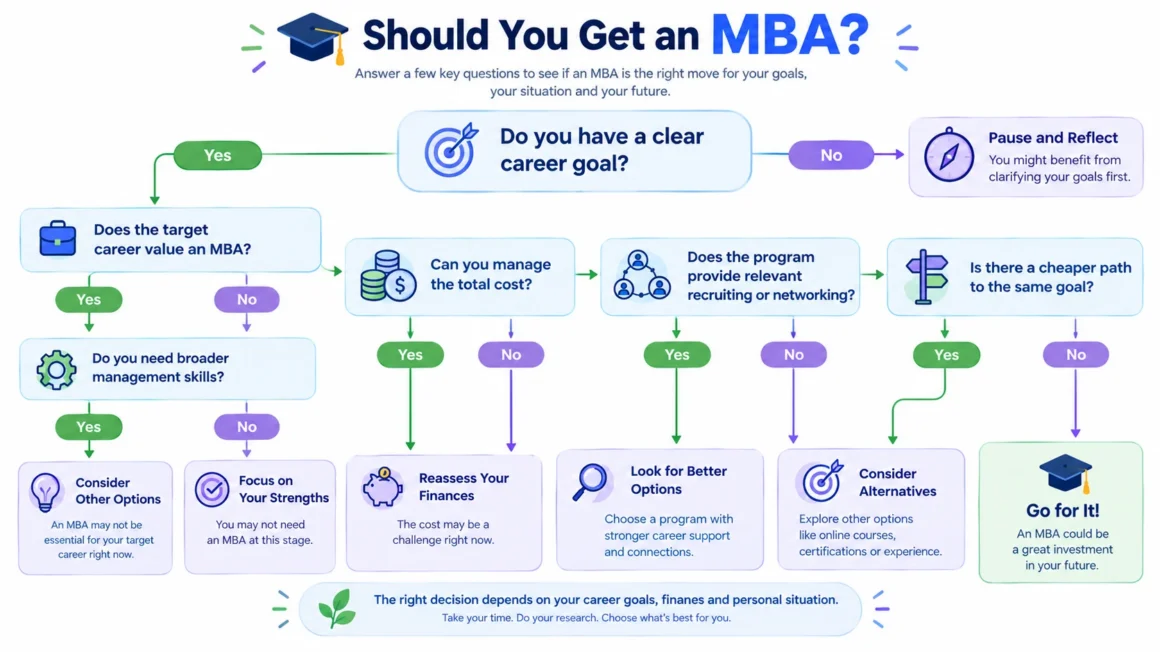
The useful question isn’t simply:
“Is an MBA worth it?”
A better question is:
“Is this specific MBA worth its total cost for the career outcome I want?”
Consider an MBA more seriously if:
- You have a clear reason for pursuing it.
- Your target career regularly recruits MBA graduates.
- You want broader management knowledge.
- You want to move into leadership.
- You want to change careers.
- You value access to a particular school’s network.
- You can finance the program responsibly.
- The expected benefits justify the total cost.
Think more carefully if:
- You don’t yet know why you want the degree.
- You are applying mainly because other people have MBAs.
- The debt would create serious financial pressure.
- Your target career does not value an MBA.
- A lower-cost qualification could provide the same skills.
- You mainly need experience rather than another academic qualification.
There is no universal answer.
The value of an MBA depends on the combination of career objective, school, cost, experience, location, network and employment opportunities.
How to Choose an MBA Program
Don’t choose an MBA using rankings alone.
Evaluate the entire program.
1. Define Your Career Goal
Write down what should change after graduation.
For example:
“I want to move from software engineering into technology product management.”
That is far more useful than:
“I want a better job.”
2. Choose the Right Format
Ask whether you can leave work.
If not, part-time, executive, or online study may be more practical.
3. Examine the Curriculum
Check whether the program offers subjects and electives relevant to your goals.
4. Study Employment Outcomes
Look for transparent information about:
- Industries
- Job functions
- Employers
- Geographic destinations
- Internship opportunities
5. Calculate the Total Cost
Include more than tuition.
6. Investigate the Network
Consider alumni presence in your target industry and location.
7. Check Accreditation and Recognition
Verify that the institution and qualification are properly recognized in the country where you intend to use the degree.
Specialized business-school accreditation can provide another quality indicator. AACSB, for example, uses a peer-review and quality-assurance process focused on areas including strategy, learner success, academic quality, and impact.
8. Speak to Students and Alumni
Marketing material tells you what a school wants you to know.
Students and alumni can help you understand what the experience is actually like.
Ask about:
- Teaching
- Recruiting
- Workload
- Career support
- Networking
- Program weaknesses
- Whether the experience matched expectations
A Brief History of the MBA
Graduate-level management education developed during the growth of large organizations in the early twentieth century.
Harvard Graduate School of Business Administration was established in 1908 and launched what Harvard identifies as the world’s first MBA program.
MBA education has since expanded internationally and developed into numerous formats, from traditional campus programs to executive and fully online degrees.
Final Thoughts
So, what is an MBA?
An MBA, or Master of Business Administration, is a postgraduate business degree designed to develop broad knowledge of management, leadership, finance, marketing, strategy, operations, analytics, and related business disciplines.
Its biggest strength is breadth.
Instead of preparing you for only one narrow business function, an MBA helps you understand how different parts of an organization connect.
But the letters MBA alone do not determine the value of the degree.
Before enrolling, compare the program’s curriculum, cost, career outcomes, format, reputation, network, accreditation, and fit with your own career goals.
A good MBA choice starts with knowing why you need the degree in the first place.
FAQs
Is an MBA a master’s degree?
Yes. MBA stands for Master of Business Administration and is a postgraduate or graduate-level business qualification.
What is the full form of MBA?
The full form of MBA is Master of Business Administration.
How many years is an MBA?
MBA duration varies. Many full-time programs take approximately one to two years, while part-time and online programs commonly take two years or longer.
Do I need a business degree before doing an MBA?
Not necessarily. MBA classes can include students from business, engineering, sciences, technology, humanities, and many other fields. Individual admission requirements vary by school.
Do you need work experience for an MBA?
Many established MBA programs prefer or require professional experience, but requirements vary. Some universities also offer deferred or early-career admission routes.
Do all MBA programs require the GMAT?
No universal rule applies to every business school. Testing policies differ by institution. For example, HBS currently requires either the GMAT or GRE for regular MBA applicants.
Can you study an MBA online?
Yes. Many universities offer online MBA programs, including completely online and hybrid formats.
What jobs can you get with an MBA?
MBA graduates work in consulting, finance, product management, strategy, marketing, operations, entrepreneurship, technology, and many other areas. The degree itself does not guarantee employment.
Is an MBA difficult?
The difficulty depends on the school, curriculum, previous experience, and format. Students may need to manage quantitative subjects, case studies, presentations, teamwork, exams, projects, and significant reading.