Writing a blog post becomes much easier when you know what to ask. Many beginners do not know how to start writing or how to create a good article. This is where prompts can help you. Prompts give clear instructions to AI tools and help you create blog ideas, outlines, and even full articles. In this guide, you will learn what prompts are and see powerful prompts that can help you write better blog posts step by step in very simple English.
What is Prompt?
A prompt is a clear instruction, question, or message that you give to an AI tool like ChatGPT, Deepseek, Gemini etc. to get a specific answer or result. It tells the AI what you want it to do, such as writing a blog, creating an outline, or explaining a topic. A good prompt is simple, clear, and detailed so the AI can understand it easily. For example, “Write a blog post on healthy habits” is a prompt. The better your prompt, the better and more useful the response will be, making your work faster and easier.
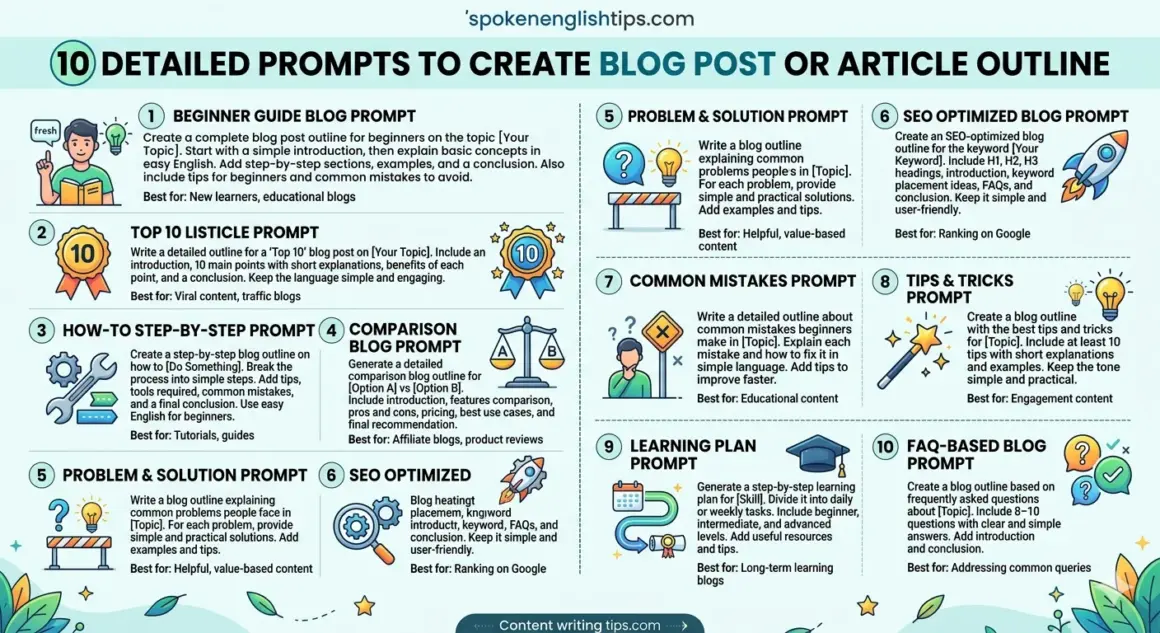
Detailed Prompts to Create Blog Post or Article Outline
Below are long, powerful, and detailed prompts you can directly copy and use 👇
1. 🔰 Beginner Guide Blog Prompt
“Create a complete blog post outline for beginners on the topic [Your Topic]. Start with a simple introduction, then explain basic concepts in easy English. Add step-by-step sections, examples, and a conclusion. Also include tips for beginners and common mistakes to avoid.”
👉 Best for: New learners, educational blogs
2. 🏆 Top 10 Listicle Prompt
“Write a detailed outline for a ‘Top 10’ blog post on [Your Topic]. Include an introduction, 10 main points with short explanations, benefits of each point, and a conclusion. Keep the language simple and engaging.”
👉 Best for: Viral content, traffic blogs
3. 🛠️ How-To Step-by-Step Prompt
“Create a step-by-step blog outline on how to [Do Something]. Break the process into simple steps. Add tips, tools required, common mistakes, and a final conclusion. Use easy English for beginners.”
👉 Best for: Tutorials, guides
4. ⚖️ Comparison Blog Prompt
“Generate a detailed comparison blog outline for [Option A] vs [Option B]. Include introduction, features comparison, pros and cons, pricing, best use cases, and final recommendation.”
👉 Best for: Affiliate blogs, product reviews
5. ❗ Problem & Solution Prompt
“Write a blog outline explaining common problems people face in [Topic]. For each problem, provide simple and practical solutions. Add examples and tips.”
👉 Best for: Helpful, value-based content
6. 🔍 SEO Optimized Blog Prompt
“Create an SEO-optimized blog outline for the keyword [Your Keyword]. Include H1, H2, H3 headings, introduction, keyword placement ideas, FAQs, and conclusion. Keep it simple and user-friendly.”
👉 Best for: Ranking on Google
7. 🚫 Common Mistakes Prompt
“Write a detailed outline about common mistakes beginners make in [Topic]. Explain each mistake and how to fix it in simple language. Add tips to improve faster.”
👉 Best for: Educational content
8. 💡 Tips & Tricks Prompt
“Create a blog outline with the best tips and tricks for [Topic]. Include at least 10 tips with short explanations and examples. Keep the tone simple and practical.”
👉 Best for: Engagement content
9. 📅 Learning Plan Prompt
“Generate a step-by-step learning plan for [Skill]. Divide it into daily or weekly tasks. Include beginner, intermediate, and advanced levels. Add useful resources and tips.”
👉 Best for: Long-term learning blogs
10. ❓ FAQ-Based Blog Prompt
“Create a blog outline based on frequently asked questions about [Topic]. Include 8–10 questions with clear and simple answers. Add introduction and conclusion.”
👉 Best for: Featured snippets & SEO
Bonus
“Write a complete SEO-friendly blog post outline on [Topic] for beginners. Use simple English (like a 10th-class student). Include introduction, headings, subheadings, examples, tips, FAQs, and a strong conclusion. Optimize for keyword [Keyword] and keep it engaging and easy to read.”