Have you ever wondered how people get such amazing results from AI tools like ChatGPT or Gemini? It feels like magic! But here is a secret: it is not magic, it is a skill called Prompt Engineering. If you want to master AI and make it work for you, you are in the right place! This guide will teach you everything you need to know about the basics of talking to AI like a pro.
What Exactly is Prompt Engineering?
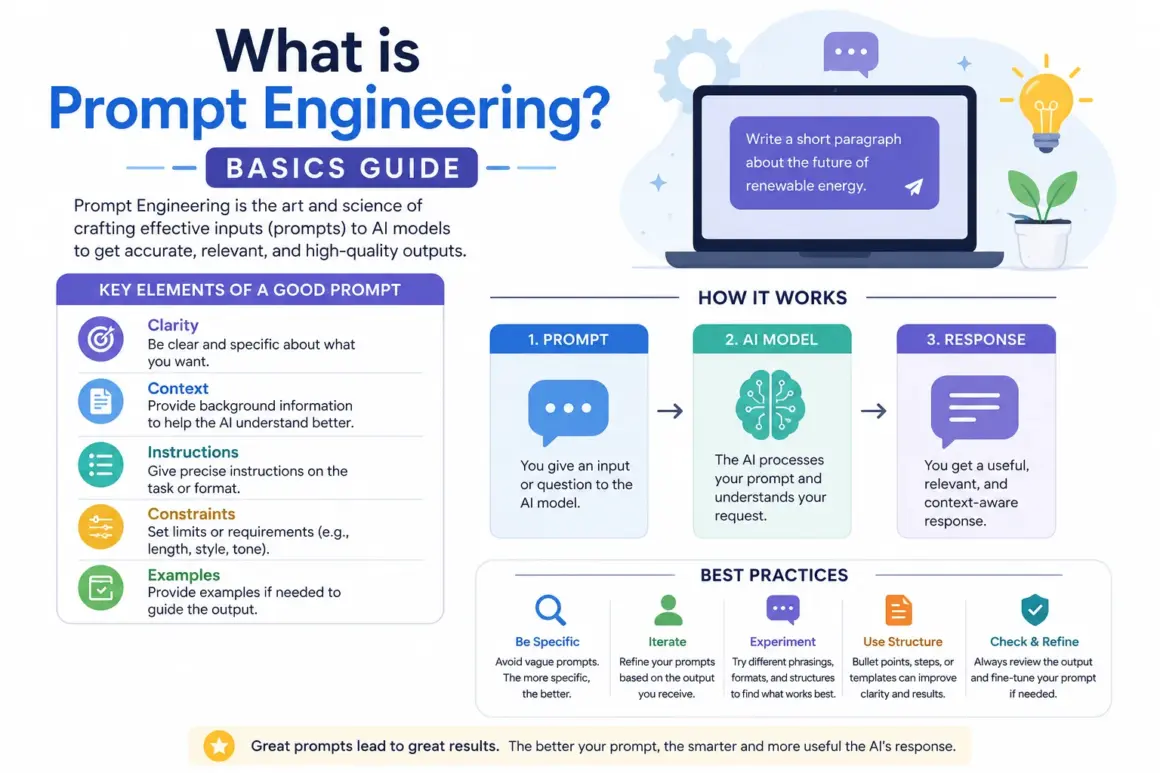
At its simplest, prompt engineering is the process of structuring natural language inputs (called “prompts”) to get the best possible results from an AI model. Think of it like giving directions to a very smart friend who has never been to your house before. If you are vague, they might get lost! But if you give clear, step-by-step instructions, they will arrive perfectly on time!
A prompt can be a simple question, a command, or even a long story that includes context and instructions. When you practice prompt engineering, you are designing and refining these instructions so the AI gives you more accurate and useful answers. It is quickly becoming one of the most important skills for the future of work!
The Four Pillars of a Perfect Prompt
To write a prompt that actually works, you should follow a simple framework. Expert prompt engineers use four key parts to build their instructions:
- Persona: Tell the AI who it should be! For example, you can say, “Act as a senior software engineer” or “You are a world-class travel blogger”. Assigning a role helps the AI understand the tone and depth it should use.
- Context: Give the AI the background story! Tell it about your current project, the specific tools you are using, or the business goals you want to reach. Without context, the AI might give you a generic answer that does not help you at all!
- Task: Be very clear about what you want the AI to do! Do you want it to write an email, review a piece of code, or summarize a long article?. State your goal clearly so the AI stays focused.
- Format: How do you want the answer to look? You can ask for bullet points, a structured table, a code snippet, or even a specific writing style like “Google-style Python docstrings”.
By using these four pillars, you turn a weak prompt into a powerful command!
Top Prompting Techniques You Need to Know
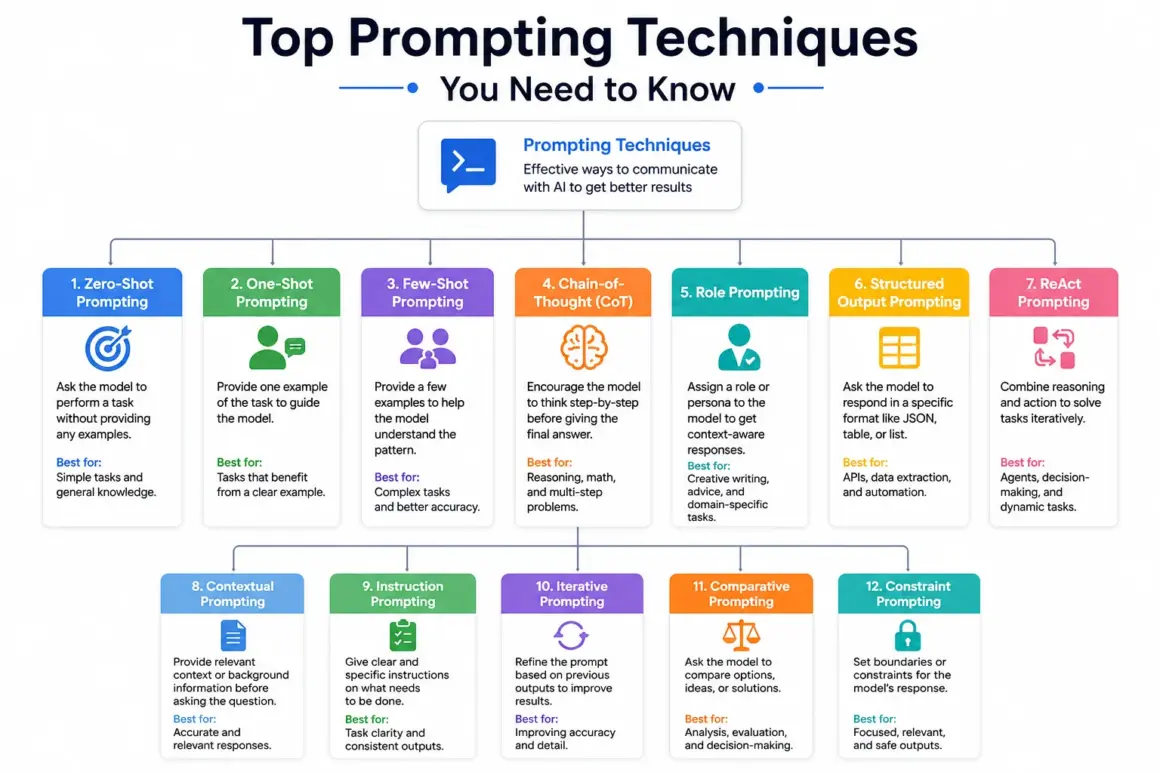
There are different ways to talk to AI depending on how hard your problem is. Here are the most popular techniques used by experts today!
1. Zero-Shot, One-Shot, and Few-Shot Prompting
This is the most basic way to think about prompts. It is all about giving examples:
- Zero-Shot Prompting: You give the AI an instruction with no examples. You just ask it to do something and hope its pre-trained knowledge is enough.
- One-Shot Prompting: You provide one single example to help the AI understand the pattern.
- Few-Shot Prompting: You give two or more examples. This is incredibly powerful for teaching the AI a specific format or a complex task. This is often called “In-Context Learning” because the AI learns from the examples you just gave it.
2. Chain-of-Thought (CoT) Prompting
Sometimes, a problem is too big for the AI to solve in one go. Chain-of-Thought prompting asks the AI to show its work! You can do this simply by adding the phrase, “Let’s think step-by-step” to your prompt. This encourages the AI to create a “train of thought” that mimics how humans reason. It has been shown to significantly improve performance on math and logic problems.
3. Least-to-Most Prompting
This technique is great for very complex tasks. The idea is to break down a hard problem into a series of smaller, easier subproblems. You solve the easiest part first, and then use that answer to help solve the next part. It helps the AI avoid getting overwhelmed by difficult logic.
4. Tree-of-Thought (ToT) Prompting
The Tree-of-Thought framework is even more advanced! Instead of just one path of reasoning, the AI explores multiple different paths at once, like branches on a tree. The AI can look ahead, evaluate which ideas are most promising, and even “backtrack” if it hits a dead end. This makes it a great general problem solver for things like creative writing or complex planning.
5. Retrieval-Augmented Generation (RAG)
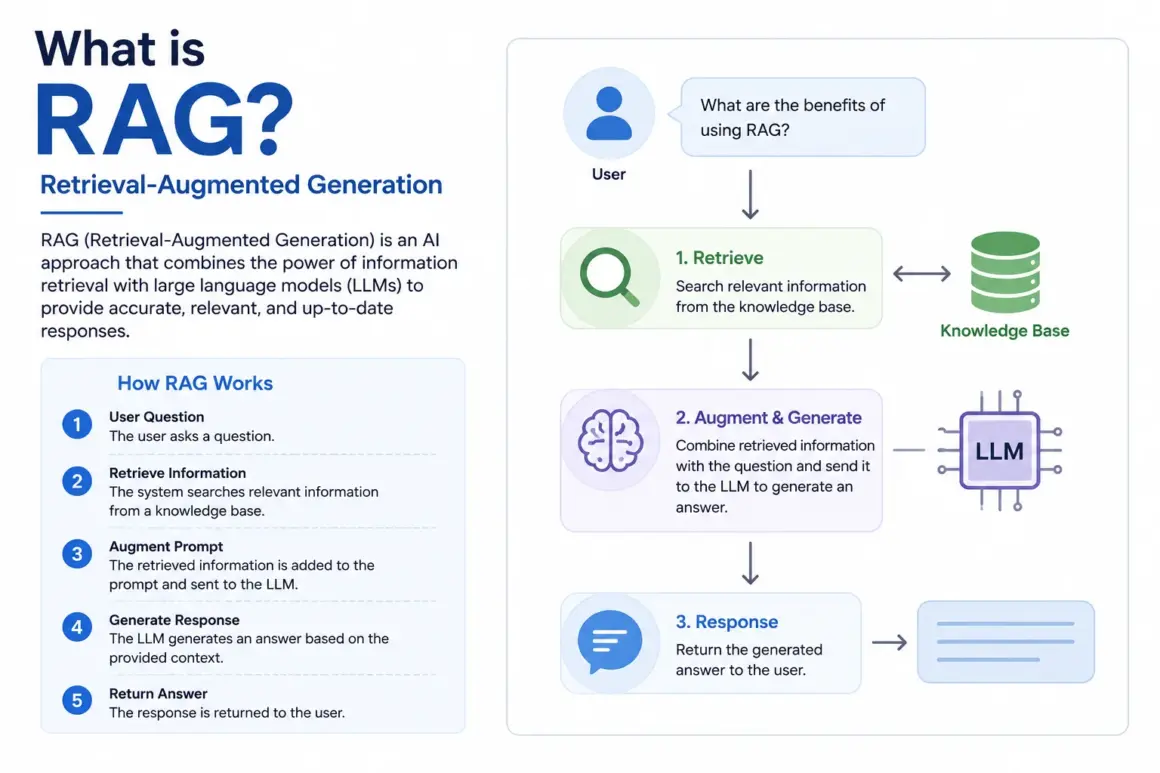
Have you ever worried that an AI might make things up? This is called a “hallucination”. RAG is a technique that lets the AI look up real information from a database or the internet before it answers you. This ensures the AI uses updated and accurate facts rather than just guessing based on its old training data.
Avoiding the “Hallucination” Trap
AI models are very confident, even when they are wrong! A hallucination happens when the AI generates nonsensical or fabricated information that looks plausible. To stop this from happening, you must be a careful prompt engineer!
- Review everything: Never trust AI output blindly. Always test and verify the results.
- Use “Human-in-the-Loop”: For important tasks, especially safety-critical ones, a human must always review the work before it is used.
- Be specific: Avoid vague requests like “make this better.” Instead, ask for “performance optimization” or “bug fixes”.
Ethics and Safety in Prompting
Being a great prompt engineer also means being a responsible one! There are important ethical rules you should follow:
- Privacy First: Never put sensitive or private information into a prompt. You do not want your personal data to become part of the AI’s memory!
- Watch for Bias: AI can sometimes repeat unfair stereotypes. It is your job to write prompts that promote fairness and reduce misinformation.
- Model Security: Do not try to “hack” the AI. A Prompt Injection is a type of attack where someone uses a malicious prompt to make the AI ignore its safety rules. This is unethical and can be dangerous.
- Copyright Laws: If you use AI to write code or stories, you might not be able to own the copyright if the AI did all the work. To protect your work, you should always add your own “human-produced original content” to what the AI generates.
Pro Tips for WordPress and Bloggers!
If you are using prompt engineering to write for a blog, remember these quick tips to keep your content high-quality:
- Split overloaded tasks: Don’t ask the AI to “write, edit, and SEO-optimize a 2000-word post” all in one prompt. Instead, ask it to write an outline first. Then ask it to write the introduction. Breaking it up leads to much better writing!
- Set the Tone: Use your persona to define your voice. If you want to sound friendly and easy to understand, tell the AI to “use simple English suitable for a 10th-grade student!”
- Define your format: Ask the AI to use specific headers (H2, H3) and bullet points to make your blog post easy for people to skim.
Common Pitfalls to Avoid
Even experts make mistakes! Here are the most common things that can ruin your prompts:
- Vague Prompts: If you are not specific, the AI will give you a generic, boring answer.
- Overloaded Tasks: Putting too many requests into one prompt confuses the AI.
- Ignoring Dependencies: Sometimes AI uses old or outdated information. If you need it to use a specific version of a tool, you must tell it!
Summary
Prompt engineering is an iterative process. This means you will rarely get the perfect answer on your first try! You have to experiment, change your wording, and try again. But as you practice, you will learn how the model “thinks,” and you will be able to unlock its full potential!
Mastering these basics is the first step to becoming an AI expert! Whether you are a student, a developer, or a blogger, these skills will help you work faster and smarter every single day! Keep practicing, stay curious, and have fun talking to the future!
Would you like me to create a set of flashcards to help you memorize these key prompt engineering techniques?