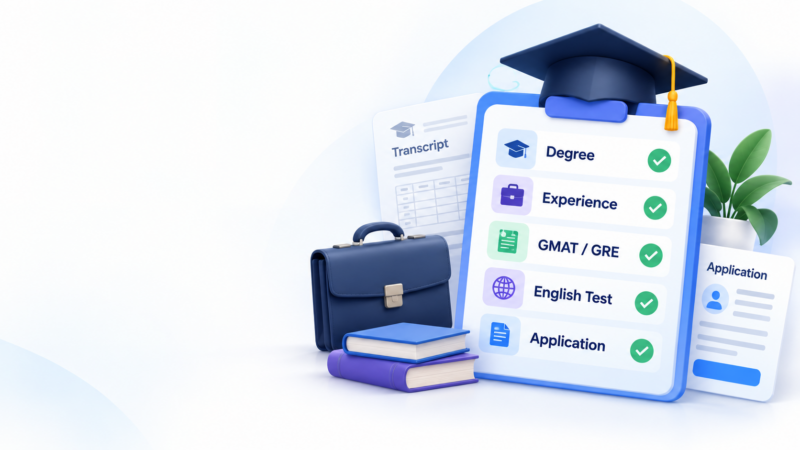
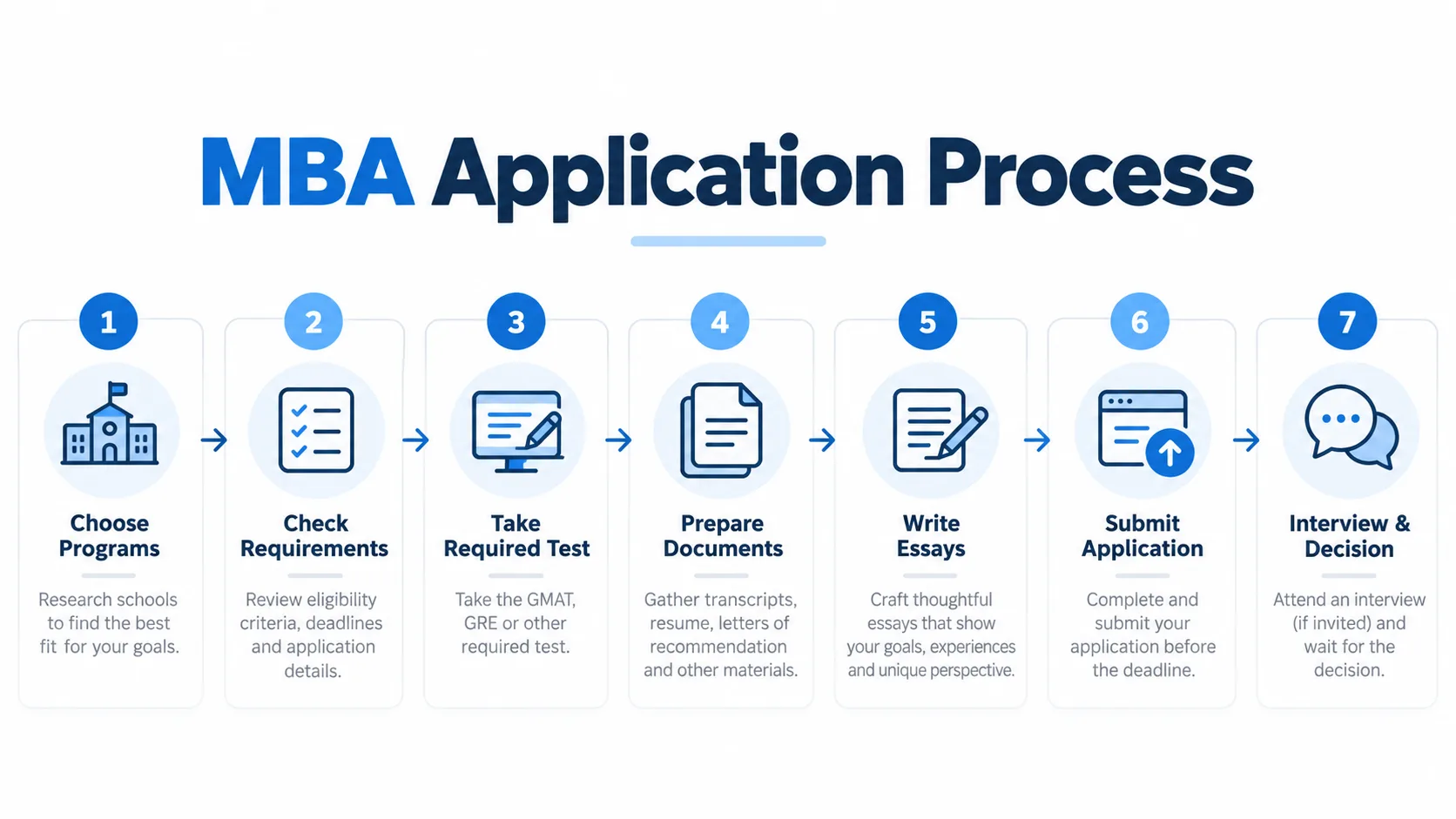
Applying for an MBA usually involves choosing the right programs, checking admission requirements, taking any required entrance tests, preparing your résumé and essays, arranging recommendations, submitting an online application, and completing an interview if invited.
The exact process differs between business schools. For example, Stanford’s current MBA application includes education history, test scores, professional experience, recommendations, essays, and an application fee. Harvard Business School similarly requires a written application with transcripts, GMAT or GRE results, essays, recommendations, and a résumé before selected applicants move to the interview stage.
The key is to prepare early and treat each MBA application as a separate application rather than sending the same material everywhere.
Understand Why You Want an MBA
Before opening an application form, be clear about why you want the degree.
1. Define your career goal
Ask yourself what you want to change after completing your MBA.
For example:
- Move from engineering into product management
- Enter management consulting
- Move into leadership
- Change industries
- Build a business
- Develop broader management knowledge
A clear career goal helps you choose appropriate programs and later makes your essays easier to write.
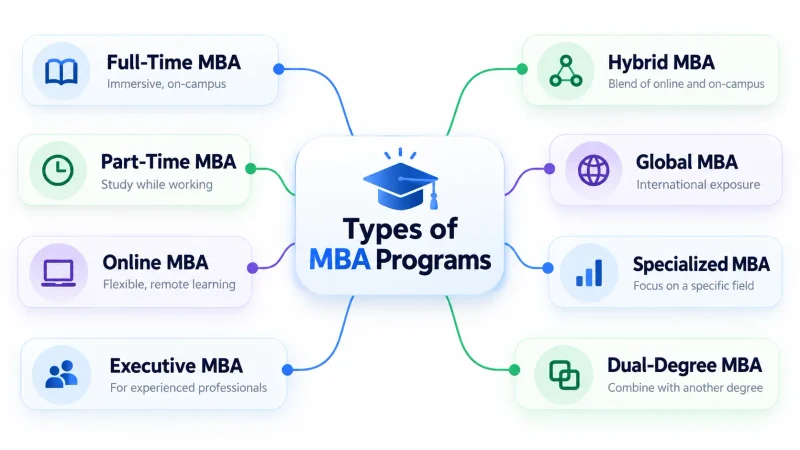
2. Decide what type of MBA fits your situation
Consider whether you want a:
- Full-time MBA
- Part-time MBA
- Online MBA
- Executive MBA
- One-year MBA
- Two-year MBA
If you need to continue working, for example, a full-time residential MBA may not be the most practical format.
3. Avoid applying simply because you want an MBA title
The degree should connect to a real career or learning objective.
Knowing what you want from the MBA also helps you judge whether the cost and time involved make sense for you.
Research and Shortlist MBA Programs
Once your goal is clear, create a manageable list of programs.
1. Compare programs based on career fit
Look at:
- Curriculum
- Electives
- Specializations
- Program duration
- Location
- Teaching format
- Internship opportunities
- Career services
- Recruiting
- Alumni network
- Tuition and total cost
Do not choose schools based only on rankings.
A program with strong connections to your target industry may be more useful for you than a higher-ranked program that does not fit your goals.
2. Check the class profile
Class profiles can help you understand the students a school normally admits.
Look at factors such as:
- Average work experience
- Academic backgrounds
- Industries represented
- International students
- Test-score ranges
Remember that an average is not necessarily an admission requirement.
3. Build a realistic shortlist
A simple spreadsheet can help.
| School | Program | Deadline | Test | Work Experience | Essays | Recommendations |
|---|---|---|---|---|---|---|
| School A | Full-Time MBA | Check | GMAT/GRE | Check | Required | Required |
| School B | Online MBA | Check | Check policy | Check | Required | Check |
| School C | MBA | Check | Check policy | Check | Required | Required |
Always fill this table using the school’s current official admissions page.
Check the MBA Admission Requirements
Do this before spending time on essays or paying for tests.
1. Confirm your academic eligibility
Most MBA programs expect an undergraduate degree or an equivalent qualification.
Your bachelor’s degree usually does not need to be in business. MBA students can come from engineering, computer science, arts, science, economics, healthcare and many other backgrounds.
International applicants should also confirm whether their degree is considered equivalent to the qualification required by the university.
2. Check the work-experience requirement
Work-experience policies vary considerably.
Some programs require professional experience. Others do not set a strict minimum.
For example, Wharton currently states that its MBA has no minimum or maximum work-experience requirement, even though professional experience remains an important part of the application.
Executive MBA programs usually expect substantially more professional experience than traditional MBA programs.
3. Check entrance-test requirements
Your target school may require:
- GMAT
- GRE
- Executive Assessment
- CAT or another national entrance exam
- A school-specific test
Some programs offer waivers or do not require standardized testing.
Do not assume that one MBA school’s policy applies to another.
For the current 2026–27 cycle, Stanford requires either the GMAT or GRE for its MBA, while Wharton also requires one of those two tests.
4. Check English-language requirements
International applicants may need an English-proficiency test such as:
- TOEFL
- IELTS
- PTE
- Another test accepted by the school
Whether you need one often depends on your previous language of instruction.
Plan Around the Application Deadlines
MBA applications are commonly divided into admission rounds.
1. Find the exact deadline for every school
Do not rely on last year’s dates.
For example, Wharton’s current 2026–27 cycle has separate Round 1, Round 2 and Round 3 deadlines, while HBS currently uses two regular MBA application rounds for its Class of 2029.
Each school sets its own calendar.
2. Work backward from your intended deadline
Give yourself enough time for:
- Entrance-test preparation
- Retakes if necessary
- School research
- Essays
- Recommendations
- Transcript collection
- Resume editing
- Proofreading
Do not leave recommendations until the final week. Your recommender has their own work and schedule.
3. Submit only when the application is ready
An earlier application is not useful if it is rushed or incomplete.
Choose an application round that gives you enough time to prepare a strong and accurate application while still meeting the school’s admissions calendar.
Take the Required MBA Entrance Test
If your target programs require a test, prepare for it early.
1. Confirm which tests the school accepts
Check the school’s admissions page before registering.
A business school might accept:
- GMAT
- GRE
- Both
- Another examination
Stanford currently accepts either GMAT or GRE for its MBA and states that it has no preference between them.
2. Give yourself time for a possible retake
Taking the test close to your application deadline creates unnecessary pressure.
An earlier test date gives you time to review your result and decide whether another attempt is worthwhile.
3. Check score validity
Schools normally require test scores to remain valid according to their stated admissions policy.
Check the acceptable testing dates for the exact application round in which you plan to apply.
Wharton’s current application guide, for example, specifies valid testing periods for each 2026–27 admissions round.
Prepare Your MBA Resume
Your MBA résumé is an important part of the application.
1. Focus on impact rather than job descriptions
Instead of writing:
Responsible for managing digital marketing campaigns.
A stronger résumé would explain the result of your work where you can support it:
Managed digital marketing campaigns across three channels and increased qualified leads by 28%.
Use real numbers only when you can verify them.
2. Show career progression
Admissions teams may want to understand how your responsibilities have developed.
Highlight:
- Promotions
- Leadership
- Major projects
- Increased responsibilities
- Team management
- Business impact
- Awards
- Important achievements
3. Keep the résumé concise
Follow the school’s instructions.
Wharton currently asks MBA applicants for a one-page résumé highlighting professional skills, experience, leadership, management ability and growth potential.
Do not automatically use the same résumé format for every program without checking its requirements.
Write Your MBA Essays
Essays allow the admissions team to understand things that cannot be fully explained through grades and test scores.
1. Answer the actual question
Do not begin with a generic MBA essay and force it into every school’s prompt.
If the question asks about leadership, write about leadership.
If it asks about your goals, explain your goals.
2. Explain your career direction clearly
A useful career-goal explanation often connects:
Past experience → Current position → MBA → Future goal
The connection should make sense.
For example:
My software-development experience introduced me to product decisions and customer problems. I now want to move into product management, and I am pursuing an MBA to strengthen my knowledge of strategy, marketing, finance and leadership.
The details should, of course, reflect your real experience.
3. Use specific examples
Instead of saying:
I am a strong leader.
Explain a situation in which you actually led people, handled a difficult decision or took responsibility for an outcome.
Specific examples are more convincing than adjectives.
4. Keep your story consistent
Your essays, résumé and application form should complement each other.
They should not look as though they describe three different versions of you.
5. Write in your own voice
Professional writing does not mean complicated writing.
Clear, specific and genuine writing is usually more useful than trying to sound impressive.
Choose Your MBA Recommenders
Many business schools request professional recommendations.
1. Choose someone who actually knows your work
A recommender should ideally be able to discuss:
- Your performance
- Leadership
- Teamwork
- Strengths
- Professional growth
- Areas for improvement
Stanford currently requires two recommendations and prefers people who have supervised the applicant’s work.
2. Do not choose someone only because of their job title
A CEO who barely knows you may be less useful than a direct manager who has worked closely with you for two years.
Follow the school’s specific recommender instructions.
3. Ask early
Give recommenders enough time to prepare thoughtful responses.
Provide useful context such as:
- Programs you are applying to
- Deadlines
- Career goals
- Projects you worked on together
- Your updated résumé
Do not write a recommendation pretending to be the recommender.
Gather Your Academic Documents
Academic records are a standard part of most MBA applications.
1. Collect your transcripts
You may need transcripts from:
- Undergraduate study
- Graduate study
- Other relevant postsecondary programs
Wharton currently requires applicants to upload transcripts covering their undergraduate and graduate academic programs. Official copies are required later if admitted.
2. Check translation requirements
If your academic documents are not in the language required by the school, you may need an authorized translation.
International applicants should read these instructions carefully because requirements differ.
3. Enter information accurately
Make sure the:
- University name
- Degree
- Dates
- Grades
- Employment details
- Test scores
match your supporting documents.
Never alter or exaggerate information.
Complete and Review the Online Application
Once your materials are ready, complete the school’s official application.
1. Fill in every required section carefully
An application commonly asks for:
- Personal information
- Education
- Employment history
- Activities
- Awards
- Test scores
- Career goals
- Essays
- Resume
- Recommendations
Stanford’s current application, for example, separately collects education, tests, professional experience, activities, recommendations, and essays.
2. Use the additional-information section carefully
Use it only when something genuinely needs explanation.
Examples might include:
- An unusual academic circumstance
- Employment gap
- Significant change in employment
- Relevant issue affecting a test or academic result
It should not become an extra essay simply because you want more space.
Stanford specifically advises applicants to use its Additional Information section for important context that is not captured elsewhere rather than as another essay.
3. Proofread everything before submitting
Check:
- Names
- Dates
- Numbers
- Employer details
- Test scores
- Grammar
- Essay questions
- Uploaded files
- Recommendation status
Also preview uploaded documents to ensure they open correctly.
4. Submit before the deadline
Avoid waiting until the final minutes.
Technical problems, payment issues or incorrect documents are easier to fix before the deadline than after it.
Prepare for the MBA Interview
Not every applicant will receive an interview.
At many selective schools, interviews are invitation-only.
1. Review your entire application
Before the interview, reread:
- Resume
- Essays
- Career goals
- Employment history
- Major achievements
You should be comfortable discussing anything you submitted.
2. Prepare for common MBA interview topics
You may be asked about:
- Why MBA?
- Why now?
- Why this school?
- Career goals
- Leadership experience
- Professional challenges
- Teamwork
- Career changes
- Strengths and weaknesses
Avoid memorizing full speeches.
Understand your examples well enough to explain them naturally.
3. Research the program properly
Be able to explain why the specific MBA program fits your goals.
Mention relevant aspects such as:
- Curriculum
- Clubs
- Career resources
- Experiential learning
- Community
- Specializations
Avoid answers that could be copied and pasted for any university.
At HBS, interviews currently occur only after the written application has been reviewed and are invitation-only. The school also makes clear that receiving an interview does not itself guarantee admission.
After You Submit the Application
Submitting the form does not always finish the process.
1. Monitor the application portal
Check whether:
- Recommendations arrived
- Test scores were received
- Documents are complete
- The school has contacted you
- An interview invitation has been issued
Also check your email and spam folder regularly.
2. Complete any required interview or follow-up
Some schools have additional requirements.
For example, HBS currently requires interviewed MBA candidates to submit a written post-interview reflection within 24 hours. That is an HBS-specific requirement, not a universal MBA application step.
3. Wait for the official decision
Possible outcomes can include:
- Admission
- Waitlist
- Denial
If admitted, carefully review:
- Enrollment deadline
- Deposit
- Financial aid
- Scholarships
- Visa requirements
- Housing
- Program start date
Do not make financial decisions based on an expected admission before receiving an official offer.
MBA Application Checklist
1. Before applying
- Define your career goal
- Research MBA formats
- Shortlist schools
- Check eligibility
- Check application deadlines
- Review total costs
2. Prepare application materials
- GMAT/GRE or required entrance exam
- English test if required
- Transcripts
- Resume
- Essays
- Recommendations
- Application information
3. Before submitting
- Proofread every section
- Check uploaded documents
- Confirm recommendation status
- Verify test scores
- Review dates and employment details
- Pay the application fee or complete an approved waiver process
- Submit before the deadline
4. After submitting
- Monitor email and application portal
- Prepare for interviews
- Complete school-specific follow-up requirements
- Wait for the official admissions decision
Common Mistakes to Avoid
1. Applying without a clear MBA goal
If you cannot explain why you need an MBA, choosing programs and writing credible essays becomes much harder.
2. Using the same essay for every school
Your core story may remain consistent, but every essay should answer the actual question asked.
3. Choosing recommenders based only on seniority
Choose people who can provide meaningful evidence about your work.
4. Waiting too long to take entrance tests
An early test gives you more flexibility if you decide to retake it.
5. Exaggerating achievements
Application information may be verified. Harvard Business School, for example, explicitly states that applicants are responsible for providing authentic and accurate information and that the school can request verification.
6. Ignoring program-specific instructions
Different schools can have different rules for:
- Resume length
- Essays
- Tests
- Recommendations
- Transcripts
- Interviews
- Deadlines
Always follow the official instructions for that application cycle.
FAQs
1. How do I apply for an MBA?
Start by defining your career goal and researching MBA programs. Then check eligibility, complete any required entrance tests, prepare your résumé, essays, recommendations, and transcripts, submit the online application, and attend an interview if invited.
2. When should I start preparing for an MBA application?
Start early enough to research programs, prepare for required tests, arrange recommendations and write thoughtful essays before your target deadline. Applicants who need significant GMAT/GRE preparation may need considerably more preparation time.
3. Do I need the GMAT to apply for an MBA?
Not for every MBA. Testing requirements vary by school. Stanford and Wharton currently require GMAT or GRE for their regular MBA programs, while other programs may have different testing or waiver policies.
4. Can I apply to an MBA without work experience?
Some MBA programs accept applicants with limited professional experience, while others require or strongly prefer experience. Executive MBA programs generally target more experienced professionals.
5. Can I apply to several MBA programs at the same time?
Yes. Applicants commonly apply to multiple business schools. However, each application should follow that school’s requirements and answer its specific essay questions.
6. Do MBA applications require recommendation letters?
Many do, but the number and type of recommendations vary. Stanford currently requires two, while other schools may have different requirements.
7. Is an MBA interview compulsory?
It depends on the school. At many selective programs, only applicants invited to interview complete this stage. At HBS, for example, the interview is invitation-only but mandatory for applicants who receive an invitation.
Final Thoughts
Learning how to apply for an MBA is mostly about preparing the right information in the right order.
Start with your career goal. Research programs carefully. Check the current admission requirements. Prepare your tests and documents early, write specific essays, choose recommenders who genuinely know your work, and review everything before submitting.
A strong MBA application does not need exaggerated achievements or complicated language.
It needs to present your real academic background, professional experience, achievements, goals and reasons for pursuing the MBA clearly and accurately.
Most importantly, always use the current official admissions page for each business school because test policies, deadlines, essay questions and other requirements can change from one application cycle to the next.