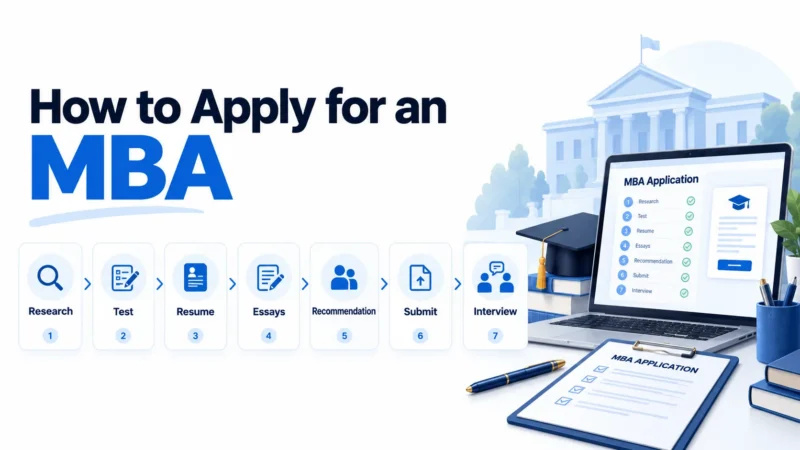
Planning to apply for an MBA? Before you start filling out applications, it helps to know exactly what business schools may ask for.
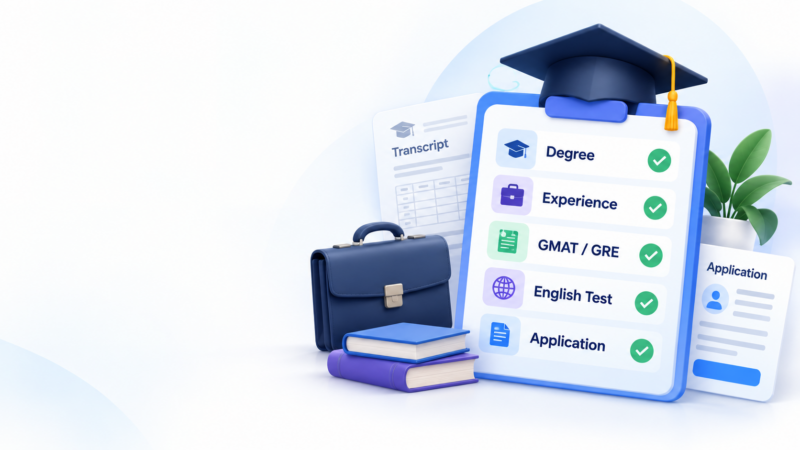
Typical MBA admission requirements include a bachelor’s degree, academic transcripts, work history, a résumé, GMAT or GRE scores (when required), essays, recommendation letters, and—at many schools—an admissions interview. International applicants may also need to prove English-language proficiency.
But here’s the important part: there isn’t one universal MBA application checklist that every school follows.
For example, Stanford currently requires a GMAT or GRE, two recommendations, essays, professional information, academic records, and an application fee. Wharton’s current 2026–27 application also asks for undergraduate credentials, transcripts, GMAT or GRE results, a résumé, essays, and references. Requirements can—and do—change between schools and admission cycles.
So, use this guide to understand the usual requirements; then check the official admissions page of every MBA program on your shortlist.
What Are the Main MBA Admission Requirements?
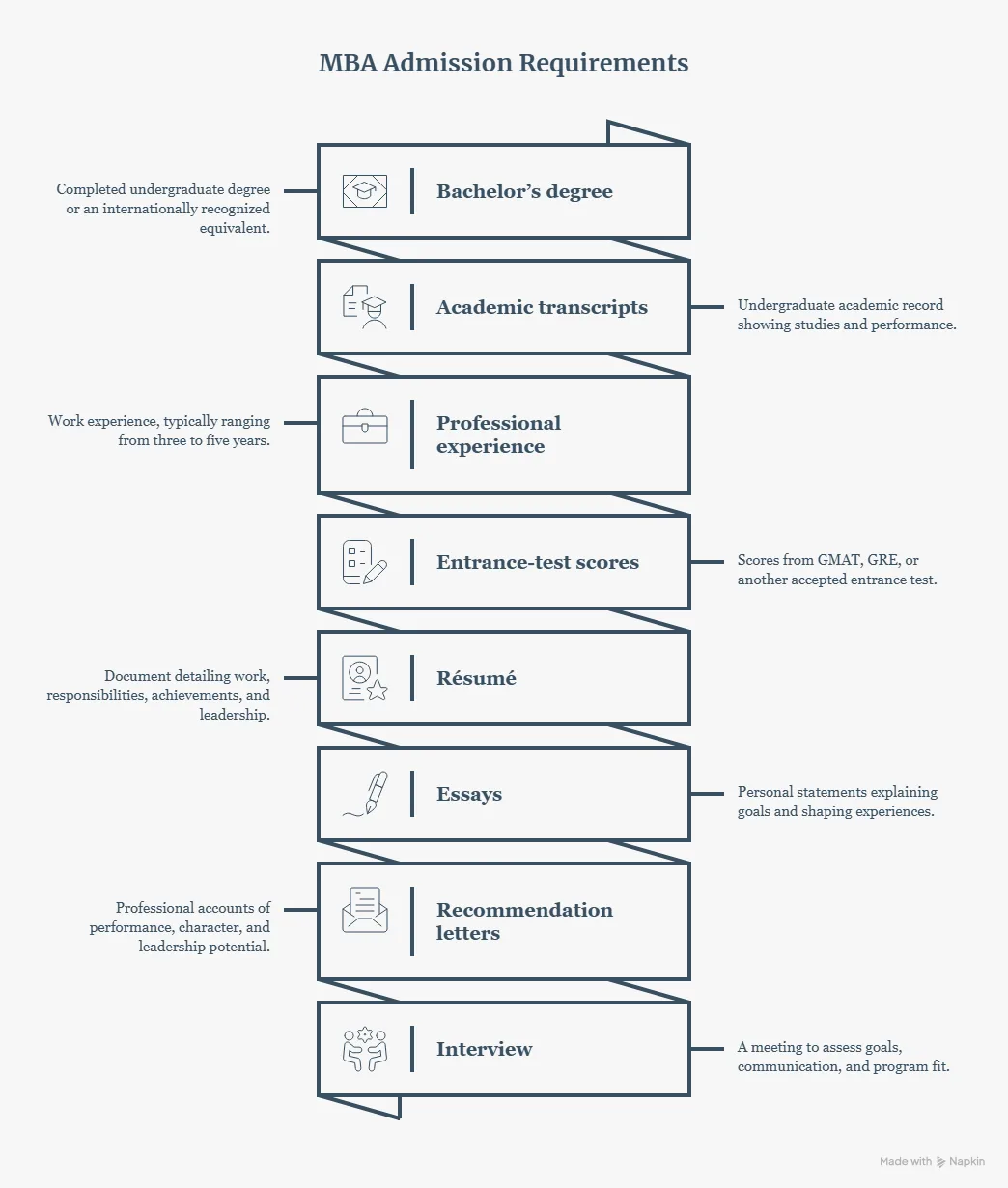
You don’t need to make this complicated. Most MBA applications are built around a few core pieces.
1. Bachelor’s degree
Most traditional MBA programs expect applicants to have completed an undergraduate degree, or an internationally recognized equivalent.
Your bachelor’s degree usually doesn’t have to be in business. Engineering, computer science, arts, science, economics, healthcare—you can find MBA students from all kinds of academic backgrounds.
2. Academic transcripts
Business schools normally want to see your undergraduate academic record.
Your transcript helps them understand what you studied, how you performed, and whether you’re academically prepared for graduate-level business study.
3. Professional experience
Work experience is common among MBA applicants, but the exact requirement varies.
GMAC’s current guidance says many full-time MBA candidates have roughly three to five years of experience; however, some programs accept people with much less experience. That’s a typical range—not a universal rule.
4. Entrance-test scores
Depending on the program, you may need:
- GMAT
- GRE
- Another accepted entrance test
Some MBA programs offer waivers, while others require testing.
Stanford currently requires either the GMAT or GRE and says it has no preference between the two.
5. Résumé
Your MBA résumé tells the admissions committee what you’ve actually been doing outside the classroom—your work, responsibilities, achievements, leadership, and professional growth.
6. Essays
MBA essays help the school understand the person behind the numbers.
Why do you want an MBA? Where are you going professionally? Why this particular school? What experiences have shaped you?
Those questions matter.
7. Recommendation letters
Many programs ask other people—usually professional supervisors—to describe your performance, character, leadership potential, and impact.
8. Interview
Some schools interview selected applicants before making a final decision.
An interview usually isn’t just a formality. It’s another opportunity for the admissions team to understand your goals, communication, experience, and fit.
Academic Requirements
Your academic history is one of the first things a business school will review.
1. You normally need an undergraduate qualification
For most MBA programs, you need a bachelor’s degree or recognized equivalent.
International applicants should pay special attention here. A degree that is standard in your home country may need to be evaluated against the university’s own equivalency rules.
2. You usually don’t need a business degree
This is a common misunderstanding.
An MBA isn’t only for BBA, BCom, finance, or economics graduates.
You may apply after studying subjects such as:
- Computer applications
- Engineering
- Science
- Arts
- Medicine
- Mathematics
- Technology
- Social sciences

What matters is whether you meet the individual program’s academic requirements.
3. Your transcript matters—but it isn’t always the whole story
Admissions committees may look at:
- Overall grades
- Difficult subjects
- Quantitative courses
- Academic improvement
- Additional qualifications
Stanford, for example, reviews transcripts, additional coursework, test scores, and professional experience when evaluating academic and quantitative readiness.
A weaker grade in one semester doesn’t automatically define your entire application.
Work Experience Requirements
This is where applicants often get confused.
“How many years of work experience do I need?”
The answer is: it depends on the MBA.
1. Many MBA students have several years of experience
GMAC’s current guidance puts the typical full-time MBA range at around three to five years.
But don’t turn that number into a rule.
Some programs welcome earlier-career applicants; others are specifically designed for experienced professionals.
2. Quality matters, not just years
Imagine two applicants.
One has worked for six years but has done almost the same work throughout.
Another has worked for three years but has already:
- Led projects
- Taken on bigger responsibilities
- Solved important problems
- Earned promotions
- Managed clients or teams
Simply counting years doesn’t tell the whole story.
Admissions committees may look at your growth, responsibilities, achievements, and impact—not just your employment dates.
3. Executive MBA requirements are different
Executive MBA programs normally target professionals further into their careers.
So, if you’re comparing a traditional MBA with an Executive MBA, don’t assume the work-experience expectations will be the same.
GMAT and GRE Requirements
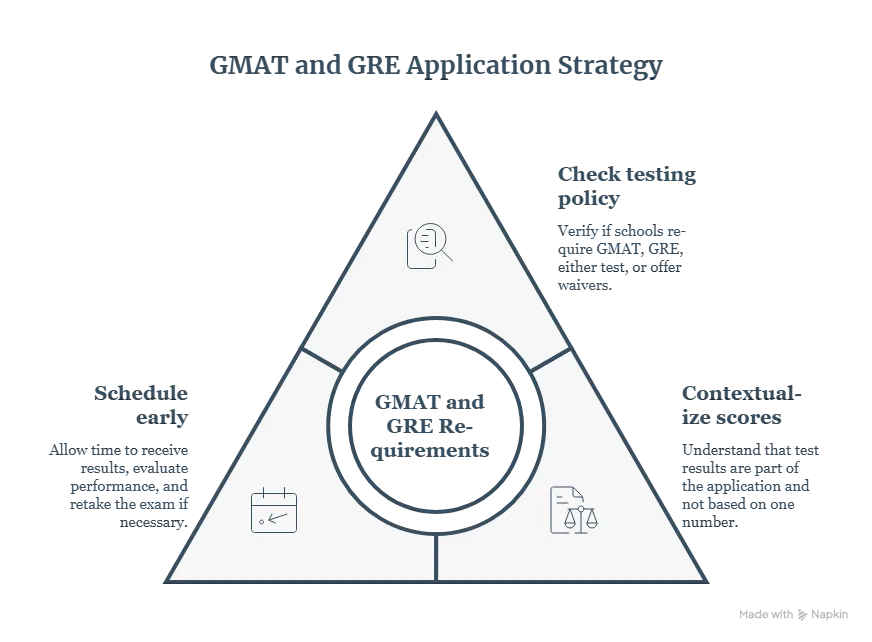
Do you need the GMAT to get into an MBA?
Sometimes—but not always.
1. Check the school’s current testing policy
Some schools require:
- GMAT
- GRE
- Either test
Others may provide waivers or operate under different testing policies.
Don’t prepare for an exam simply because someone told you, “Every MBA requires GMAT.”
Check first.
2. GMAT and GRE are only part of the application
At Stanford, either GMAT or GRE is currently required, but the school explicitly says there is no minimum score requirement and that test results are considered in context.
That doesn’t mean scores are unimportant.
It means admissions decisions aren’t necessarily based on one number.
3. Take your exam early enough
Don’t schedule your test two days before the application deadline.
Give yourself room to:
- Receive the result
- Evaluate your performance
- Prepare again
- Retake the exam, if necessary
Also check score-validity rules for your target application round.
English Language Requirements
If you’re applying internationally, you may also need to prove that you can study effectively in English.
1. You may need an English-proficiency test
Common tests include:
- TOEFL
- IELTS
- PTE
The exact requirement depends on the school and your previous education.
Stanford’s current policy, for instance, requires some applicants to submit English-proficiency results if their undergraduate education was taught partly or entirely in another language, subject to its stated exceptions.
2. Don’t automatically book IELTS
First check your target university.
If your previous degree was taught completely in English, you may qualify for an exemption at some schools.
Another school may use different rules.
That’s why the official admissions page matters.
MBA Resume Requirements

Your résumé isn’t there just to repeat your job titles.
It’s your chance to show what you’ve actually accomplished.
1. Keep it focused
An MBA résumé should make your experience easy to understand.
Include things such as:
- Job roles
- Promotions
- Major responsibilities
- Leadership
- Projects
- Achievements
- Awards
- Relevant extracurricular activities
2. Show impact
Compare these two examples:
Responsible for managing client projects.
And:
Managed six client projects across three teams and delivered each within the agreed timeline.
The second version gives the reader something concrete.
Use numbers only when they’re genuine and accurate.
3. Follow the school’s format
Don’t assume every business school wants the same résumé.
Wharton currently expects a one-page résumé highlighting skills, experience, leadership, management ability, and potential for growth.
Another program may provide different instructions.
MBA Essay Requirements
This is the part of the application where your personality, thinking, goals, and experiences can come through.
And yes—this is where generic writing can hurt you.
1. Answer the question you’re actually asked
Sounds obvious, doesn’t it?
Yet applicants sometimes write one “perfect MBA essay” and try to reshape it for five different schools.
Don’t.
If a school asks about your career goals, talk about your career goals.
If it asks about your values, don’t spend 80% of the essay describing your résumé.
2. Be specific
Instead of:
I want an MBA because I want to become a successful business leader.
Try to explain:
- Where you are now
- Where you want to go
- What’s missing
- Why an MBA can help
- Why that particular program makes sense
That’s far more useful—and believable.
3. Sound like yourself
You don’t need complicated vocabulary.
Stanford’s current essay guidance specifically asks applicants to write in their genuine voice and explain what matters to them and why Stanford fits their aspirations.
Clear, thoughtful writing is better than a paragraph packed with impressive-sounding words.
Recommendation Letter Requirements
Recommendation letters give the admissions team something your résumé can’t: another person’s view of how you actually work.
1. Choose someone who knows you well
Your recommender might be:
- Current manager
- Former manager
- Project supervisor
- Professional mentor
- Someone who supervised meaningful work outside your job
The best recommender isn’t necessarily the person with the biggest title.
2. Specific examples are valuable
A useful recommendation might explain how you:
- Led a difficult project
- Worked with others
- Responded to feedback
- Solved a problem
- Took initiative
- Developed professionally
Stanford currently requires two recommendations and emphasizes detailed examples from people who have directly supervised the applicant.
3. Give your recommender enough time
Don’t message your manager on Friday and say:
“Hi! Can you write my MBA recommendation? Deadline is Monday.”
Ask early.
Share your:
- Career goals
- MBA plans
- Updated résumé
- Application deadlines
Then let the recommender write their own recommendation.
MBA Interview Requirements
Made it to the interview stage? Good—but don’t treat it like a victory lap.
There’s still work to do.
1. Know your own application
Re-read your:
- Résumé
- Essays
- Career goals
- Work history
- Major achievements
If you wrote that you led an important project, expect to discuss it.
2. Be ready for simple questions
Many MBA interviews revolve around straightforward questions:
- Why do you want an MBA?
- Why now?
- Why this school?
- What are your career goals?
- Tell me about a leadership experience.
- Tell me about a difficult situation.
- What did you learn from a mistake?
Simple questions can still produce weak answers when someone hasn’t thought them through.
3. Don’t memorize a speech
Prepare your ideas—not every word.
A natural conversation usually sounds much better than a rehearsed five-minute answer.
What Do Business Schools Actually Look For?
MBA admissions isn’t simply:
Good GPA + High GMAT = Admission.
The process is usually more complicated than that.
1. Academic readiness
Can you handle the coursework?
Grades, transcripts, quantitative preparation, and test scores may help answer that question.
2. Professional progress
What have you done with the opportunities you’ve had?
Schools may look at your:
- Responsibilities
- Progression
- Achievements
- Initiative
- Leadership
3. Your goals
Why do you need an MBA?
If your application doesn’t explain where you’re going—or why business school makes sense now—the rest of the profile can feel disconnected.
4. Who you are beyond numbers
Stanford says its MBA evaluation considers the whole application, including background, experiences, perspectives, aspirations, values, accomplishments, academic performance, essays, tests, recommendations, work experience, and interviews. No single component determines the final decision.
That’s a useful way to think about MBA admission generally: your application should tell one clear, consistent story.
MBA Admission Requirements Checklist
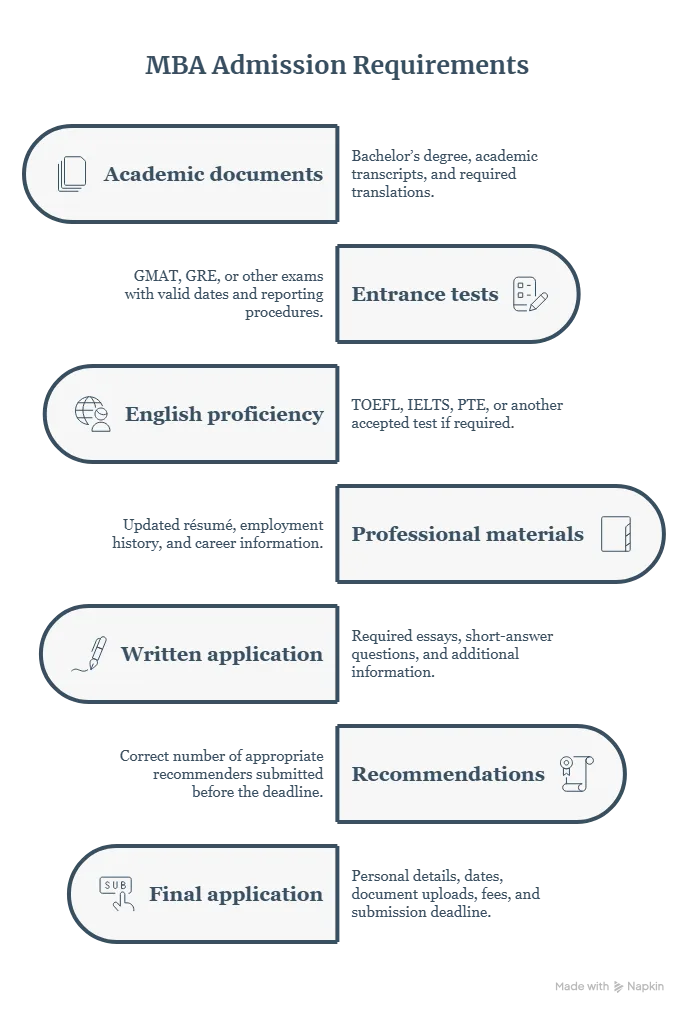
Before you press “Submit,” run through this once.
1. Academic documents
- Bachelor’s degree or equivalent
- Academic transcripts
- Required translations, if applicable
2. Entrance tests
- GMAT or GRE, if required
- Other entrance examination, if applicable
- Valid test date
- Correct score-reporting procedure
3. English proficiency
- TOEFL, IELTS, PTE, or another accepted test—if required
4. Professional materials
- Updated résumé
- Employment history
- Career information
5. Written application
- Required essays
- Short-answer questions
- Additional information, if genuinely necessary
6. Recommendations
- Correct number of recommenders
- Appropriate recommenders
- Recommendations submitted before the deadline
7. Final application
- Correct personal details
- Correct dates
- Uploaded documents open properly
- Application fee completed, if required
- Application submitted before the deadline
That’s it. No mystery—just quite a few moving parts.
Common MBA Admission Mistakes
A strong profile can still be weakened by avoidable mistakes.
1. Assuming every MBA has the same requirements
They don’t.
Always check the program itself.
2. Writing generic essays
If your essay could be sent to ten schools without changing a sentence, it’s probably too generic.
3. Choosing recommenders because they’re senior
Choose someone who can actually talk about you.
4. Exaggerating experience
Don’t inflate job titles, responsibilities, achievements, or numbers.
Accuracy matters.
5. Ignoring instructions
Word limits, résumé length, document format, test dates—small instructions still matter.
6. Waiting until the final day
A missing recommendation or upload problem is much easier to solve three days before a deadline than three minutes before it.
FAQs
1. What are the basic MBA admission requirements?
Most MBA programs ask for an undergraduate qualification, transcripts, résumé, professional information, essays, recommendations, and an application form. Some also require GMAT/GRE scores, English-proficiency testing, and an interview.
2. Is work experience required for MBA admission?
Not always. Many MBA applicants have several years of professional experience, but requirements vary by program. Some accept early-career candidates, while Executive MBA programs generally expect considerably more experience.
3. Is GMAT compulsory for MBA admission?
No universal rule applies to every MBA. Some programs require GMAT or GRE; others may offer waivers or use different testing policies. Stanford currently requires either GMAT or GRE for its MBA.
4. Do I need a business degree before an MBA?
Usually not. MBA students come from many academic backgrounds. You generally need an acceptable undergraduate qualification—not necessarily an undergraduate business degree.
5. How many recommendation letters do I need?
It depends on the school. Stanford currently requires two recommendations, but another business school may request a different number.
6. Do MBA programs require essays?
Many do. Essays help admissions teams understand your goals, experiences, values, and reasons for choosing the program. The exact questions and word limits differ between schools.
7. Does meeting all admission requirements guarantee acceptance?
No. Meeting the requirements usually means you can submit a valid application. Selective business schools may then compare your overall profile with other candidates.
Final Openion
MBA admission requirements may look like a long list—degree, transcripts, work experience, GMAT or GRE, résumé, essays, recommendations, English testing, interview—but these pieces aren’t meant to exist separately.
Together, they answer a bigger question:
Who are you, what have you done, where are you going, and why does an MBA make sense for you now?
You don’t need to make your application sound extraordinary.
Make it clear, accurate, specific, and genuinely yours.
And before applying? Check the school’s current official admissions page. Requirements change; deadlines change; essay questions change. A blog guide can show you what to expect—but the university’s current application instructions should always be your final reference.