The human body has many parts, and each part has a name and a special job. Learning human body parts in English helps us describe ourselves, understand basic science, talk about health, and improve everyday English vocabulary.
From the head and shoulders to the fingers and toes, this guide explains the names, locations, and functions of important body parts in simple English. You will find organized vocabulary tables, picture and label guides, example sentences, internal organ names, and useful facts.
Whether you are a student, teacher, parent, or English learner, this article will help you learn body parts from head to toe.
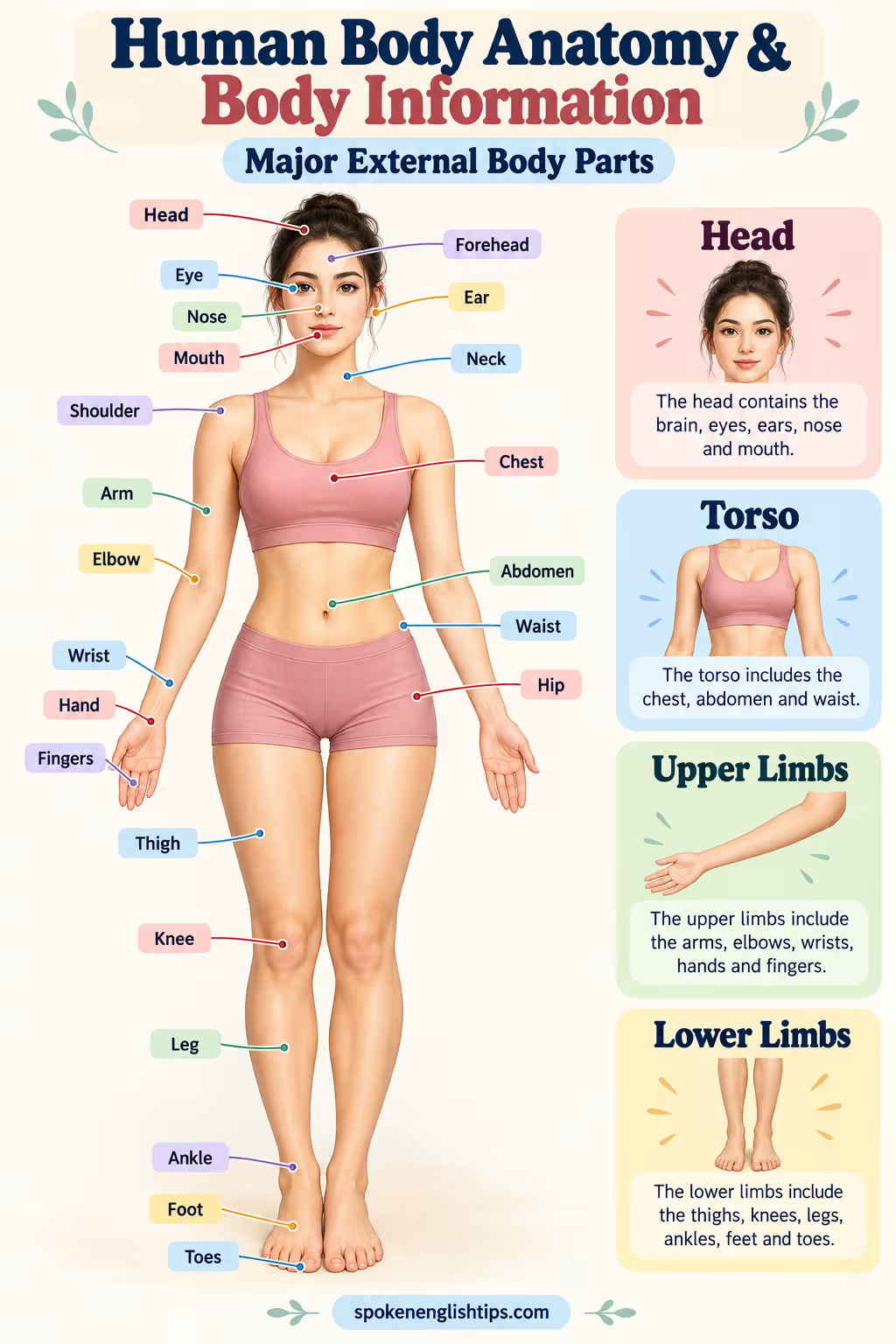
What Are Human Body Parts?
Human body parts are the different structures that make up our bodies. Some parts, such as the eyes, hands, ears, and feet, are visible from the outside. Others, such as the brain, heart, lungs, and kidneys, are found inside the body.
The following table introduces 20 common body parts that every beginner should know.
| No. | Body Part | Location or Function |
|---|---|---|
| 1 | Head | Top of the body; contains the brain |
| 2 | Face | Front part of the head |
| 3 | Neck | Connects the head to the torso |
| 4 | Shoulder | Where the arm meets the torso |
| 5 | Chest | Upper front part of the torso |
| 6 | Back | Rear part of the torso |
| 7 | Belly | Front of the abdomen |
| 8 | Waist | Narrower area between the ribs and hips |
| 9 | Hip | Area where the thigh meets the pelvis |
| 10 | Arm | Upper limb used for reaching and lifting |
| 11 | Elbow | Joint that bends the arm |
| 12 | Wrist | Connects the hand to the forearm |
| 13 | Hand | Used for holding and touching things |
| 14 | Finger | Helps with gripping and small movements |
| 15 | Leg | Lower limb used for standing and walking |
| 16 | Thigh | Upper part of the leg |
| 17 | Knee | Joint that bends the leg |
| 18 | Ankle | Joint between the leg and foot |
| 19 | Foot | Supports the body while standing |
| 20 | Toe | Helps with balance and movement |
Learning facial vocabulary helps us describe someone’s appearance, express feelings, and talk about everyday actions such as smiling, blinking, or chewing.
Head and Face Parts Names
| No. | Body Part | Simple Meaning or Function |
|---|---|---|
| 1 | Hair | Grows from the scalp |
| 2 | Scalp | Skin covering the top of the head |
| 3 | Forehead | Area above the eyebrows |
| 4 | Eyebrow | Hair above each eye |
| 5 | Eyelid | Skin that opens and closes over the eye |
| 6 | Eyelash | Small hair along the edge of the eyelid |
| 7 | Eye | Helps us see |
| 8 | Ear | Helps us hear and maintain balance |
| 9 | Nose | Helps us smell and breathe |
| 10 | Nostril | One of the two openings of the nose |
| 11 | Cheek | Soft part of the face below each eye |
| 12 | Mouth | Used for eating, speaking, and breathing |
| 13 | Lip | Soft edge of the mouth |
| 14 | Tooth | Hard structure used for biting and chewing |
| 15 | Tongue | Helps with tasting, speaking, and swallowing |
| 16 | Chin | Lowest part of the face |
| 17 | Jaw | Bony structure involved in chewing |
| 18 | Temple | Side of the head between the forehead and ear |
Examples of Head and Face Parts in Sentences
| Body Part | Example Sentence |
|---|---|
| Eyes | I close my eyes when I sleep. |
| Nose | She has a small nose. |
| Ears | We use our ears to hear sounds. |
| Mouth | Please open your mouth. |
| Teeth | I brush my teeth twice a day. |
| Tongue | The soup burned my tongue. |
| Eyebrows | He raised his eyebrows in surprise. |
| Cheeks | Her cheeks turned red in the cold. |
Interesting fact: The tongue is not just for tasting food. It also helps move food around the mouth and makes many speech sounds possible.
Parts of the Arms, Hands, and Fingers
Our arms and hands help us carry objects, write, eat, play, and perform thousands of daily movements. The hands are especially useful for activities that require careful control, such as tying shoelaces or holding a pencil.
Arm and Hand Parts Names
| No. | Body Part | Meaning or Function |
|---|---|---|
| 1 | Shoulder | Connects the arm to the torso |
| 2 | Upper arm | Area between the shoulder and elbow |
| 3 | Armpit | Area underneath the shoulder joint |
| 4 | Elbow | Joint between the upper arm and forearm |
| 5 | Forearm | Area between the elbow and wrist |
| 6 | Wrist | Joint connecting the forearm and hand |
| 7 | Hand | Used for holding, touching, and gripping |
| 8 | Palm | Inner surface of the hand |
| 9 | Thumb | Short, strong digit on the side of the hand |
| 10 | Index finger | Finger commonly used for pointing |
| 11 | Middle finger | Usually the longest finger |
| 12 | Ring finger | Finger between the middle and little fingers |
| 13 | Little finger | Smallest finger of the hand |
| 14 | Knuckle | A finger joint, especially one visible when making a fist |
| 15 | Fingernail | Hard covering on the tip of a finger |
Parts of the Chest, Stomach Area, and Back
The torso, also called the trunk, is the central part of the body. It connects the head, arms, and legs and contains many important internal organs.
The chest and abdomen form much of the front of the torso, while the back covers its rear surface.
Upper and Middle Body Parts
| Body Part | Location | Main Function or Description |
|---|---|---|
| Chest | Upper front of the torso | Protects organs such as the heart and lungs |
| Breast | Front of the chest | Contains breast tissue |
| Rib | Chest | Helps protect the heart and lungs |
| Collarbone | Between shoulder and upper chest | Connects the arm’s supporting structure to the trunk |
| Abdomen | Between chest and pelvis | Contains many digestive organs |
| Belly | Front of the abdomen | Common everyday name for the abdominal area |
| Navel | Middle of the abdomen | Mark left by the umbilical cord |
| Waist | Between ribs and hips | A common body measurement area |
| Back | Rear of the torso | Helps support posture and movement |
| Spine | Along the middle of the back | Supports the body and protects the spinal cord |
| Shoulder blade | Upper back | Helps the shoulder and arm move |
| Buttocks | Lower back of the body, behind the pelvis | Help cushion the body when sitting |
Difference Between Belly, Abdomen, and Stomach
These three words are related, but they do not have exactly the same meaning.
- Belly: An everyday word for the front of the abdomen.
- Abdomen: The body region between the chest and pelvis.
- Stomach: An internal organ that helps digest food.