
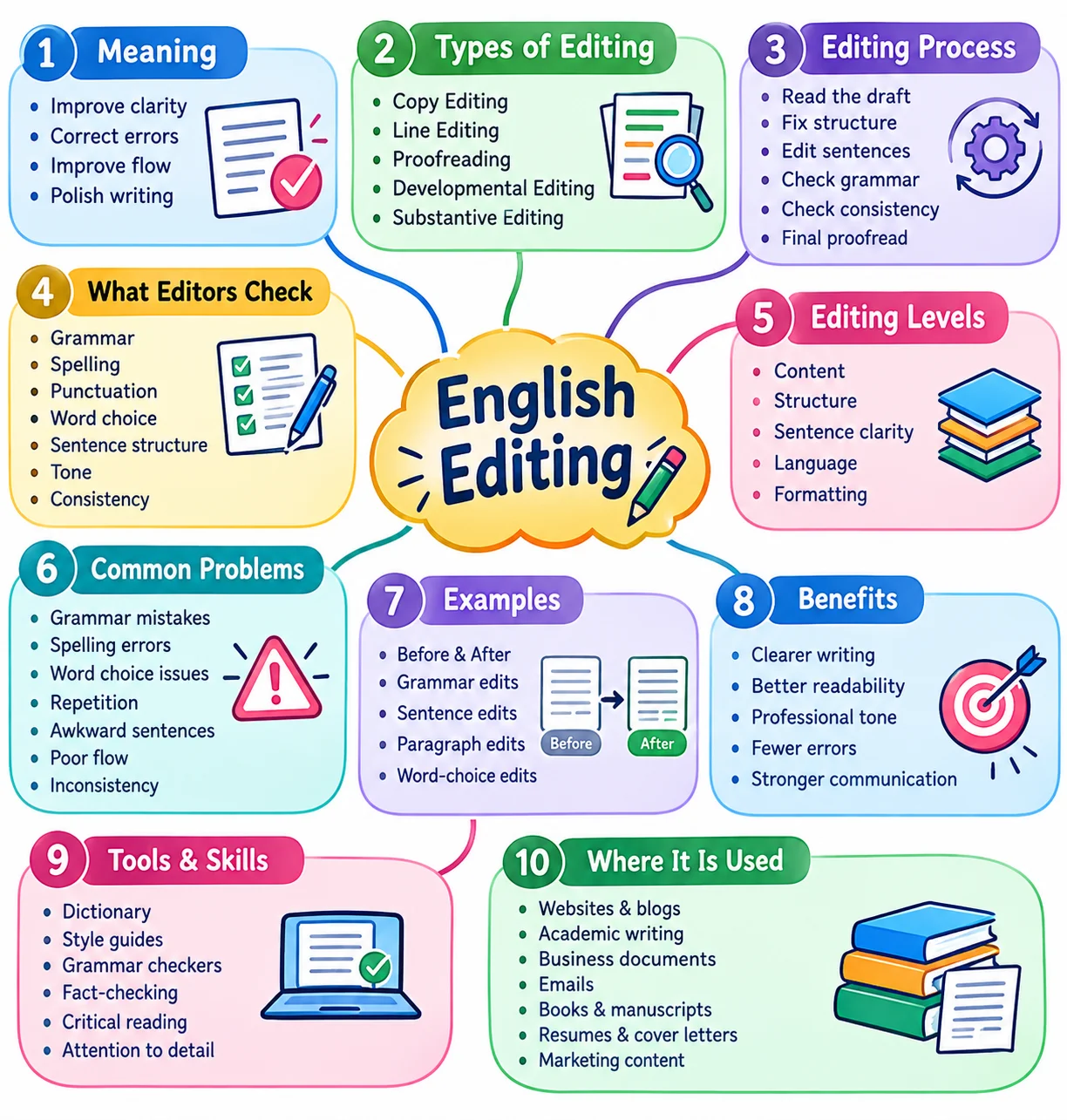
English editing is the process of reviewing and improving written English to make it clear, accurate, natural, readable, and appropriate for its intended audience. It can include correcting grammar and spelling, improving sentence structure, choosing better words, removing unnecessary repetition, and ensuring consistency in tone and style.
English editing can benefit students, bloggers, job seekers, business owners, researchers, authors, and other professionals who want to communicate their ideas more effectively.
In this guide, you will learn the meaning of English editing, the main types of editing, practical examples, the role of an English editor, the difference between editing and proofreading, and ways to improve your own editing skills.
What Is English Editing?
English editing means reviewing and improving a piece of writing so that it communicates its intended message clearly, correctly, and effectively.
Depending on the type of editing, an editor may review:
- Grammar
- Spelling
- Punctuation
- Sentence structure
- Word choice
- Clarity
- Flow and readability
- Tone and style
- Consistency
- Organization
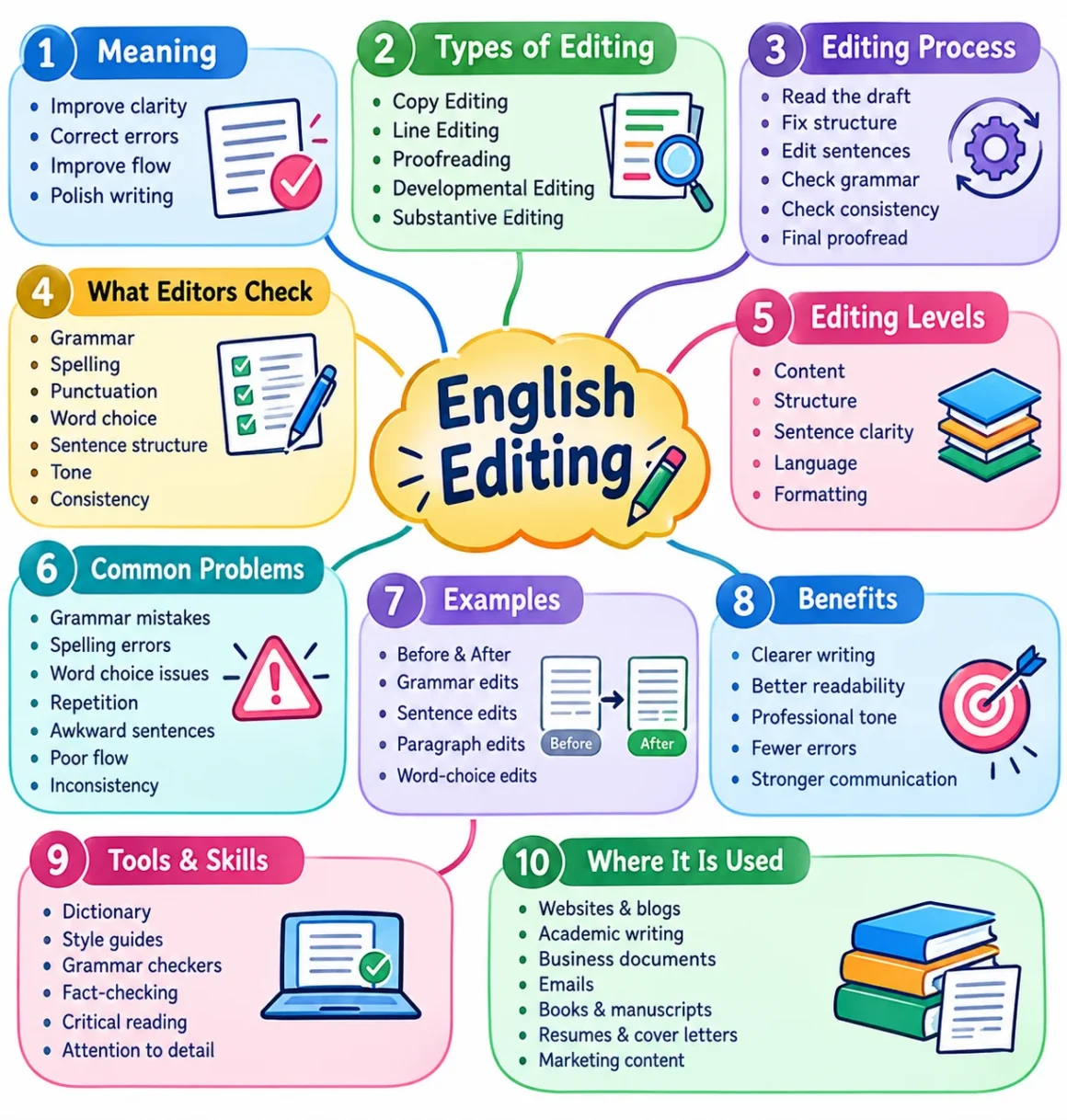
Example of English Editing
Before editing:
I am working in this company since five years and I have learned many things.
After editing:
I have been working at this company for five years, and I have learned many things.
The edited sentence uses the correct tense and preposition and sounds more natural in English.
English editing is not simply about changing every sentence. A good editor preserves the writer’s intended meaning and voice while making the writing clearer, more accurate, and easier to read.
Why Is English Editing Important?
Clear writing helps readers understand information quickly and accurately. Even a strong idea can become difficult to understand when a document contains grammatical errors, awkward sentences, unnecessary repetition, or poor organization.
English editing can help:
- Improve grammar and sentence structure
- Make writing clearer and easier to understand
- Remove unnecessary words and repetition
- Improve professional communication
- Make terminology and formatting consistent
- Strengthen tone and style
- Reduce errors before publication
- Make academic and business documents more polished
For businesses, well-edited English can also create a more professional impression in emails, websites, reports, proposals, presentations, and marketing materials.
Types of English Editing
The type of editing required depends on the purpose, length, audience, and condition of the document. The main types include copy editing, developmental editing, line editing, technical editing, and academic editing.
1. Copy Editing
Copy editing focuses on the correctness, clarity, consistency, and readability of written content.
A copy editor may check:
- Grammar
- Spelling
- Punctuation
- Word usage
- Sentence structure
- Capitalization
- Consistency
Example:
Before:
The company have launched a new products for their customer.
After:
The company has launched a new product for its customers.
Copy editing is commonly used for blog posts, websites, books, articles, newsletters, and business content.
2. Developmental Editing
Developmental editing focuses on the overall content and structure of a document rather than primarily on individual sentences.
A developmental editor may examine:
- Organization
- Structure
- Ideas and arguments
- Logical flow
- Missing information
- Repetition
- Audience suitability
For example, an article may contain useful information, but the sections may appear in an order that makes the content difficult to follow. A developmental editor can suggest reorganizing the sections to create a more logical structure.
Developmental editing is particularly useful for books, long-form articles, reports, educational materials, and other substantial documents.
3. Line Editing
Line editing focuses on how the writing reads at the sentence and paragraph level. It aims to improve the flow, style, clarity, tone, and effectiveness of the language.
A line editor may improve:
- Sentence flow
- Word choice
- Clarity
- Tone
- Style
- Readability
Before:
Due to the fact that he was tired, he did not attend the meeting.
After:
Because he was tired, he did not attend the meeting.
The edited version communicates the same idea more directly.
4. Technical Editing
Technical editing is used for specialized content such as manuals, technical reports, software documentation, scientific documents, and instructional materials.
A technical editor may check whether:
- Instructions are clear and complete
- Technical terms are used consistently
- Information is logically organized
- Explanations are understandable to the intended audience
- Formatting is consistent
- Cross-references and other document elements are accurate
Technical editing is particularly important when readers need to follow instructions or understand specialized information accurately.
5. Academic Editing
Academic editing improves writing used in education and research while preserving the author’s original ideas and conclusions.
It may be useful for:
- Essays
- Research papers
- Dissertations
- Theses
- Assignments
- Academic articles
- Reports
Academic editing can improve grammar, clarity, organization, academic tone, and consistency. However, an editor should not change the researcher’s ideas or findings simply to make the writing sound stronger.
English Editing Examples
Here are some simple examples that show how editing can improve written English.
Example 1: Grammar
Before:
She don’t like coffee.
After:
She doesn’t like coffee.
The edited sentence uses the correct subject-verb agreement.
Example 2: Word Choice
Before:
The results are very big.
After:
The results are significant.
In this context, significant is more precise and appropriate for formal writing when the intended meaning is that the results are important or meaningful.
Example 3: Sentence Clarity
Before:
The manager discussed the project with the employees which was completed last week.
After:
The manager discussed the project, which was completed last week, with the employees.
The revised sentence makes it clearer that the project, rather than the employees, was completed last week.
Example 4: Removing Unnecessary Words
Before:
- Essays
- Research papers
- Dissertations
- Theses
- Assignments
- Academic articles
- Reports
In my personal opinion, I think this is a very important issue.
After:
I think this is an important issue.
The edited version removes unnecessary wording while keeping the main idea.
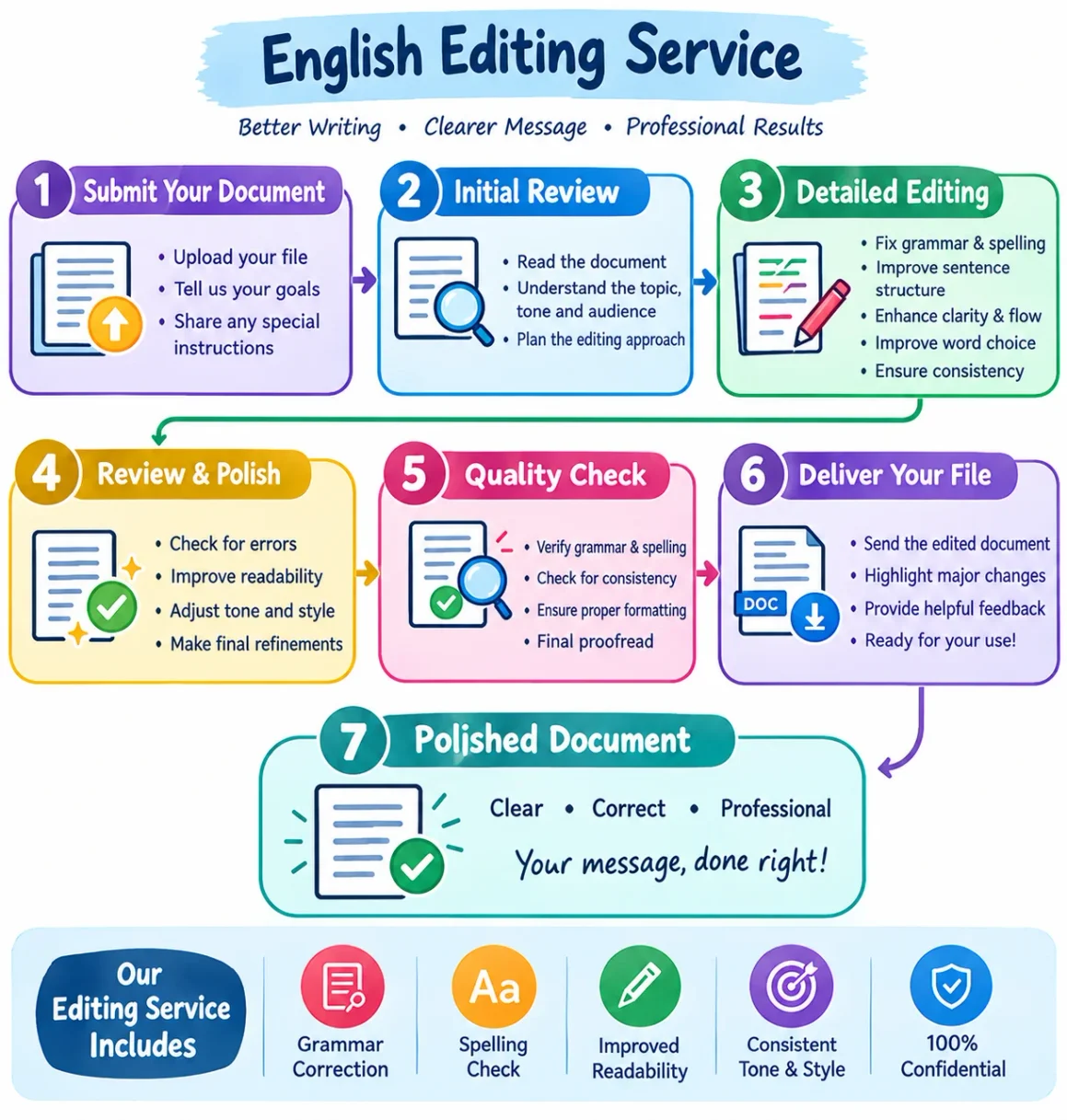
What Does an English Editor Do?
An English editor reviews written content and makes or suggests changes that improve its quality and effectiveness.
Depending on the type of editing, an editor may:
- Read the entire document to understand its purpose and context.
- Identify grammar, spelling, and punctuation problems.
- Improve unclear or awkward sentences.
- Check word choice and terminology.
- Improve paragraph and section flow.
- Check consistency in language, capitalization, and formatting.
- Adjust the tone for the intended audience when appropriate.
- Remove unnecessary repetition.
- Check the document against relevant style requirements.
- Review the revised version for remaining issues.
A professional editor should improve the writing without unnecessarily changing the author’s intended meaning or voice.
English Editing vs. Proofreading
Editing and proofreading are related, but they serve different purposes.
Editing generally involves making substantive improvements to language, clarity, structure, style, consistency, and readability.
Proofreading is usually the final quality check performed after editing and focuses primarily on surface-level errors, such as:
- Typographical errors
- Spelling mistakes
- Punctuation errors
- Formatting inconsistencies
- Missing or repeated words
For example, if a sentence is grammatically correct but awkward or unclear, an editor may revise its structure or wording. A proofreader would generally focus on catching remaining errors rather than substantially rewriting the sentence.
A typical publishing workflow may involve developmental editing, copy or line editing, and then proofreading, although the exact process varies by project.
Who Needs English Editing Services?
English editing can be useful for many types of writers and professionals, including:
- Students
- Bloggers
- Authors
- Job seekers
- Business owners
- Researchers
- Teachers
- Freelance writers
- Website owners
- Marketing professionals
- Non-native English speakers
For example, a professional may have an important business proposal edited before submitting it to a client, while a student may seek editing assistance for an academic paper.
The level of editing required depends on the document and its purpose. A short business email may only need light editing, while a book or research document may require more extensive work.
How to Improve Your English Editing Skills
If you want to improve your ability to edit English writing, develop a systematic editing process rather than checking everything at once.
1. Read the Writing Slowly
Read each sentence carefully and look for grammar, clarity, and word-choice problems. Reading aloud can also help you notice awkward or repetitive sentences.
2. Check Sentence Structure
Make sure each sentence communicates one clear idea and that long or complicated sentences are easy to follow. Break a sentence into two or more sentences when necessary.
3. Check Subject-Verb Agreement
Make sure the subject and verb agree.
Incorrect:
She work in a bank.
Correct:
She works in a bank.
4. Remove Unnecessary Words
Look for words and phrases that do not add meaning. Concise writing is often easier to understand.
5. Check Word Choice
Choose words that accurately express your meaning. Avoid using complicated vocabulary simply to make the writing sound formal.
6. Check Punctuation
Review commas, periods, apostrophes, quotation marks, and other punctuation marks. Correct punctuation can make sentences easier to understand.
7. Check Consistency
Use the same terminology, spelling conventions, capitalization, formatting, and style throughout the document.
8. Review the Final Version
After making your edits, read the complete document again. A second review can reveal errors or inconsistencies that were missed during the first pass.
Frequently Asked Questions About English Editing
What is English editing in simple words?
English editing means reviewing and improving written English to make it more accurate, clear, natural, consistent, and easy to understand.
What is the difference between editing and proofreading?
Editing focuses on improving language, clarity, structure, style, consistency, and readability. Proofreading is generally the final review for smaller errors such as spelling, typing, punctuation, and formatting mistakes.
Is English editing only for non-native speakers?
No. Both native and non-native English speakers can benefit from editing. Professional editing can improve the clarity, consistency, and effectiveness of many types of writing.
How much does English editing cost?
The cost of English editing varies depending on factors such as the type of document, word count, complexity, deadline, and level of editing required. Basic proofreading generally involves less work than extensive developmental or academic editing.
Can English editing improve my writing?
Yes. Editing can help you identify recurring problems with grammar, sentence structure, word choice, clarity, and organization. Reviewing the changes can also help you recognize patterns and develop stronger writing skills over time.
Final Thoughts
English editing is an important part of producing clear, accurate, and professional written communication. It can range from correcting grammar and punctuation to improving sentence structure, organization, tone, consistency, and overall readability.
Whether you are writing a blog post, academic paper, business document, book, or website article, careful editing can make your message clearer and easier for readers to understand.
The goal of good English editing is not to change the writer’s voice unnecessarily. It is to help the writer communicate the intended message as clearly and effectively as possible.