Are you dreaming of becoming a doctor, an engineer, or a pilot? Or maybe you want to fly across the ocean to study at a top university in the USA or UK? For many students in India, the biggest roadblock is not the difficult entrance exams—it is the cost of education.
You might have heard that to get a big loan, your family needs to show “collateral,” like a house or land papers. But what if you don’t have those? Does that mean your dreams are over? Absolutely not!
In today’s world, your talent is your biggest asset. Many banks and companies now offer student loans without collateral in India, also known as “unsecured education loans.” This means you can get the money you need based on your hard work and future potential. In this guide, we will break down everything you need to know in very simple steps.
What are Collateral-Free Student Loans?
In simple words, a collateral-free loan is a loan where you do not have to give the bank any “security”. Usually, banks ask for something valuable—like a flat, a piece of land, or a big Fixed Deposit (FD)—to keep as a guarantee. If the borrower cannot pay back the money, the bank takes that asset.
However, with student loans without collateral in India, the bank trusts you based on your academic record, the university you are joining, and a co-applicant (usually your parent or sibling) who helps you. These loans are a blessing for students who have the brains but not the property to show the bank.
Secured Loans vs. Unsecured Loans: The Simple Difference
Choosing between these two can be confusing. Let’s look at them side-by-side:
- Secured Loans: You must give the bank an asset (collateral) like property or an FD. Because the bank feels safe, they often give you a lower interest rate (around 8% to 10%) and higher loan amounts.
- Unsecured Loans (Collateral-Free): You don’t give any assets. The bank takes a higher risk, so the interest rate is usually higher (around 10.5% to 14% or more). These are faster to get because there is no property to check.
Who Can Get These Loans? (Eligibility Criteria)
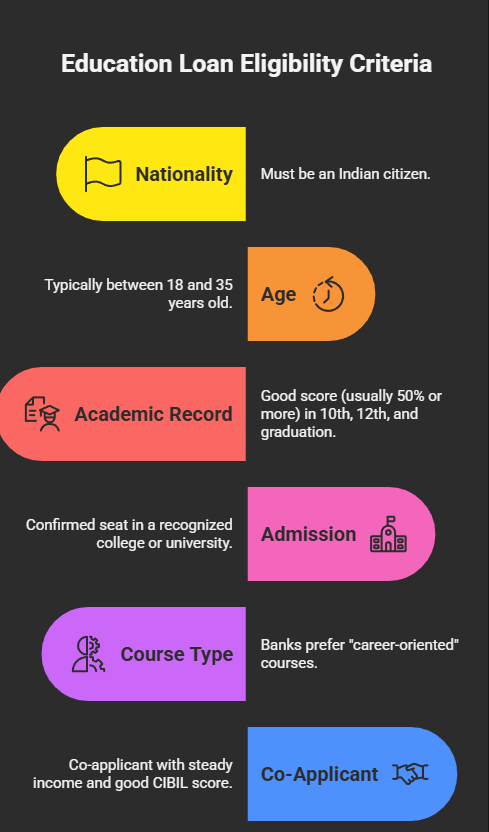
To get a student loan without collateral in India, you usually need to meet these simple requirements:
- Nationality: You must be an Indian citizen.
- Age: Typically, students should be between 18 and 35 years old.
- Academic Record: You should have a good score (usually 50% or more) in your 10th, 12th, and graduation.
- Admission: You must have a confirmed seat in a recognized college or university in India or abroad.
- Course Type: Banks prefer “career-oriented” courses like Engineering, Medicine, Management (MBA), or STEM subjects.
- The Co-Applicant: Since students don’t have jobs yet, banks ask for a co-applicant (parent, spouse, or sibling) who has a steady income and a good CIBIL score
Top Banks and NBFCs Offering Collateral-Free Loans
Many institutions in India are ready to help you. Here are some of the leaders in 2026:
1. Public Sector Banks (Government Banks)
- State Bank of India (SBI): Offers the Scholar Loan Scheme for top Indian colleges and Global Ed-Vantage for abroad. They offer loans without collateral up to ₹7.5 Lakhs for most students and even higher for premier institutes.
- Union Bank of India: Can provide up to ₹40 Lakhs without collateral for studies abroad.
- Bank of Baroda: Very popular for students going to top global universities.
2. Private Sector Banks
- Axis Bank: Offers unsecured loans up to ₹1 Crore for premier courses abroad and up to ₹75 Lakhs for top colleges in India.
- ICICI Bank: Can give up to ₹1 Crore for “Prime” listed universities abroad without asking for property papers.
- IDFC First Bank: Offers up to ₹75 Lakhs for selected universities.
3. NBFCs (Non-Banking Financial Companies)
NBFCs are companies that work like banks but often have faster processes.
- HDFC Credila: Known for giving high amounts (up to ₹80 Lakhs to ₹1 Crore) without collateral for the USA and UK.
- Avanse: They look at your “future potential” and can offer up to ₹1.20 Crores unsecured for eligible students.
Interest Rates and Loan Limits
The “interest rate” is the extra money you pay the bank for letting you use their money.
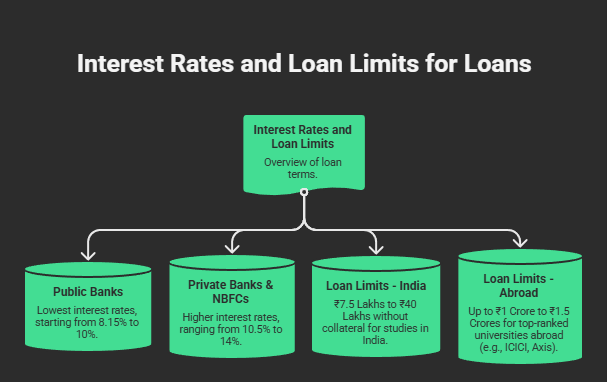
- Public Banks: Usually have the lowest rates, starting from 8.15% to 10%.
- Private Banks & NBFCs: Their rates are a bit higher, ranging from 10.5% to 14%.
- Loan Limits: For studies in India, you can easily get ₹7.5 Lakhs to ₹40 Lakhs without collateral. For studies abroad, some banks like ICICI or Axis go as high as ₹1 Crore to ₹1.5 Crores for top-ranked universities
The Document Checklist
Keep these documents ready to make your application smooth:
For the Student:
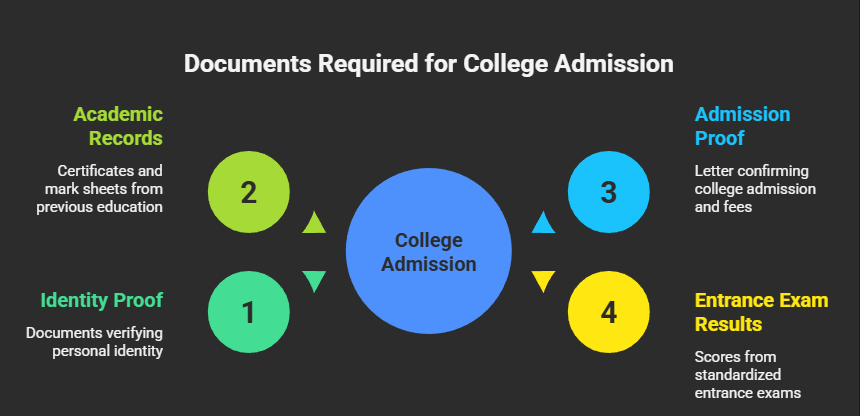
- Identity Proof: Aadhaar Card, PAN Card, or Passport.
- Academic Records: 10th and 12th mark sheets and degree certificates.
- Admission Proof: Admission letter from the college with the fee structure.
- Entrance Exam Results: Scores for exams like JEE, NEET, GRE, or CAT.
For the Co-applicant (Parent/Sibling):
- KYC Docs: Aadhaar and PAN Card.
- Income Proof (Salaried): Last 3 months’ salary slips and 2 years of ITR (Income Tax Returns).
- Income Proof (Self-Employed): 2-3 years of ITR and profit/loss statements.
- Bank Statements: Last 6 months’ statements of their main account.
How to Apply: Step-by-Step
The Online Process (Fastest)
- Visit Portals: Go to official websites like Vidya Lakshmi or Jan Samarth. These are government websites where you can apply to multiple banks at once.
- Fill the Form: Complete the “Common Education Loan Application Form” (CELAF).
- Upload Docs: Scan and upload the documents mentioned above.
- Wait for a call: The bank will review your profile and call you for more details.
The Offline Process
- Visit the Branch: Go to the nearest branch of the bank you like.
- Meet the Manager: Ask for an “Education Loan Officer.”
- Submit Physical Copies: Hand over your application and xerox copies of documents.
- Property Visit (If needed): Even for non-collateral loans, some banks might visit your home just to verify where you live.
Special Section: Abroad Education Loans Without Collateral
Studying in a foreign country is much more expensive. A student loan without collateral in India for abroad doesn’t just cover tuition; it covers your whole “Cost of Attendance”.
- What is covered?
Tuition fees, airfare (passage money), visa fees, health insurance, a laptop, and even your monthly rent and food. - Loan Sanction Letter: Banks can give you a “Pre-admission Sanction Letter” which helps you prove to the embassy that you have enough money for your visa.
- Forex Buffer: Some banks provide extra money in case the value of the Indian Rupee drops compared to the Dollar or Euro.
Understanding Repayment and the “Moratorium Period”
One of the best things about student loans is that you don’t have to start paying them back immediately.
- Moratorium Period: This is a “repayment holiday.” It lasts for your entire course duration plus 6 to 12 months. This gives you time to find a job after you graduate.
- What to pay during college? Some banks ask for Simple Interest (SI) every month. It is smart to pay this if you can, so your loan amount doesn’t grow too much.
- Tenure: You can take up to 15 years to pay back the full loan
Helpful Government Subsidy Schemes
If your family’s income is not very high, the government might pay your interest for you!
- CSIS Scheme: If your family income is up to ₹4.5 Lakhs, the government pays 100% of your interest during the moratorium period for technical/professional courses in India.
- PM-Vidyalaxmi Scheme: A new scheme for 2026. If your family income is up to ₹8 Lakhs, you can get a 3% interest discount on loans up to ₹10 Lakhs
Tips to Increase Your Approval Chances
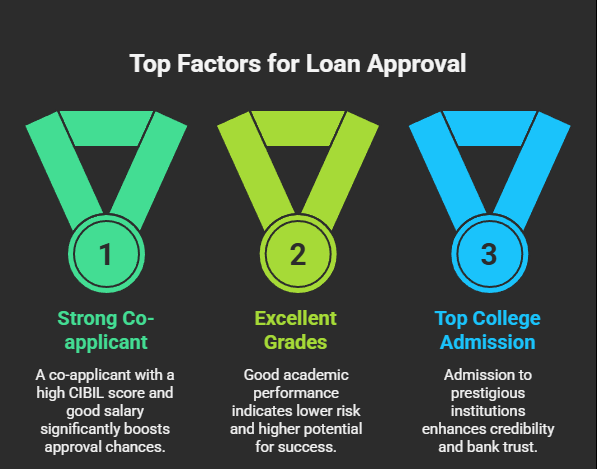
- Pick a Strong Co-applicant: Choose someone with a good salary and a high CIBIL score (above 700).
- Focus on Grades: Better marks mean the bank sees you as a lower “risk”.
- Target Top Colleges: Banks love students who get into famous institutes like IITs, IIMs, or top-ranked global universities.
- Improve CIBIL Score: If your parent has a low score, help them pay off small credit card bills or old loans before applying.
- Apply Early: Don’t wait until the last minute. Start your process at least 2-3 months before your course starts
Frequently Asked Questions (FAQs)
1. Can I get a loan without my parents’ help?
Usually, no. Because you don’t have an income yet, banks need a co-applicant like a parent or guardian to be responsible for the loan.
2. Is there a tax benefit for these loans?
Yes! Under Section 80E, you can save on income tax for the interest you pay on your education loan.
3. Does the loan cover my hostel and books?
Yes, most education loans cover 100% of your expenses, including tuition, hostel, books, laptop, and travel.
4. What is the minimum CIBIL score needed?
Most banks prefer a score of 685 or higher for the co-applicant. Some government banks might accept a lower score for collateral-based loans.
5. Can I pay back the loan early?
Yes! Most education loans in India have zero “pre-closure” charges, meaning you can pay it back as fast as you want without extra fees
Final Advice: Go For Your Dreams!
Getting a student loan without collateral in India is easier now than ever before. Don’t let a lack of property stop you from reaching the stars. Use the tools available—like the Vidya Lakshmi portal—and choose a bank that offers you the best deal.
Remember, an education loan is not just a debt; it is an investment in yourself. Study hard, get a great job, and paying back the loan will feel like a small step in your big success story. Good luck!
Official Government Portals
These websites are essential for applying to multiple banks or accessing government subsidy schemes:
- PM-Vidyalaxmi Portal: This is the primary single-window portal for students to access information and apply for educational loans from various banks.
- Link: www.pmvidyalaxmi.co.in
- Ministry of Education: Provides detailed guidelines on various schemes like PM-USP CSIS and PM-Vidyalaxmi.
- Link: https://www.education.gov.in/en/scholarships-education-loan-4
- CGFSEL (Credit Guarantee Fund Scheme): Offers information on the 75% credit guarantee provided by the government for loans up to ₹7.5 lakhs.
- Link: https://www.ncgtc.in/en/product-details/CGFEL/Credit-Guarantee-Fund-Scheme-for-Education-Loans-(CGFEL)