Animals are fascinating creatures that communicate with each other in various ways, including through vocalizations. Animal sounds are an integral part of the animal kingdom, and each species has its unique way of vocalizing. As humans, we have learned to identify and associate certain sounds with particular animals. For instance, a moo is often associated with a cow and a bark with a dog. In this blog post, we will explore the world of animal sounds, focusing on Animal sounds Name in English. From the roar of the lion to the chirping of the cricket, we will delve into the diverse and intriguing world of Animal sounds Name. So, if you’re curious about the sounds animals make and their names in English, read on!
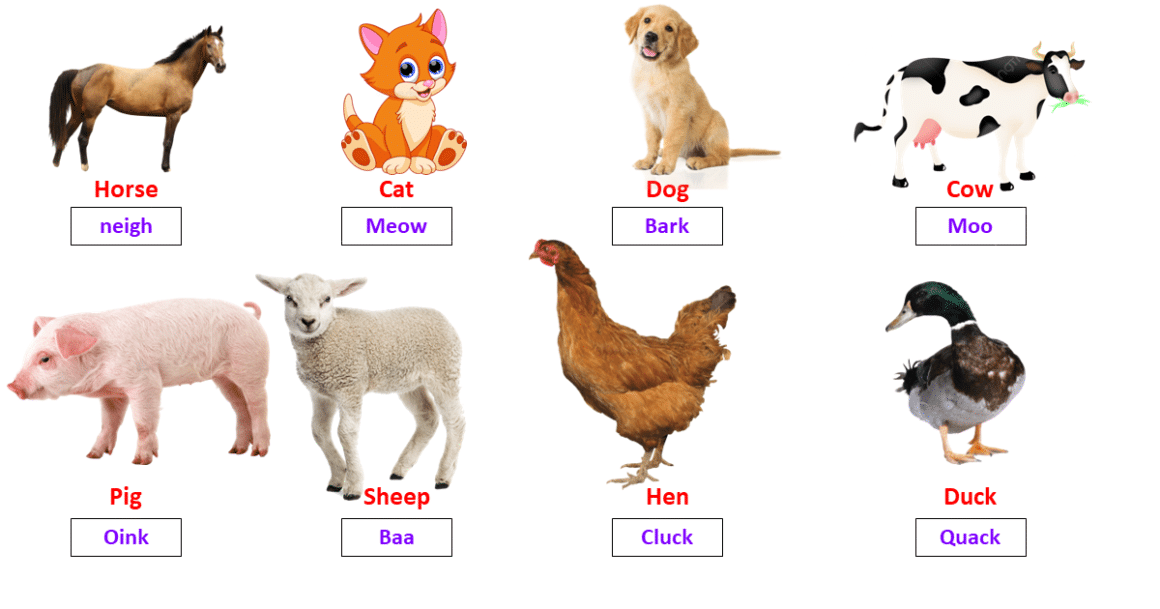
| Animal | Sound |
|---|---|
| Cat | Meow |
| Dog | Bark |
| Cow | Moo |
| Pig | Oink |
| Sheep | Baa |
| Rooster | Cock-a-doodle-doo |
| Hen | Cluck |
| Duck | Quack |
| Goose | Honk |
| Turkey | Gobble |
| Horse | Neigh |
| Donkey | Bray |
| Elephant | Trumpet |
| Lion | Roar |
| Tiger | Growl |
| Bear | Growl |
| Wolf | Howl |
| Fox | Yip |
| Rabbit | Squeak |
| Squirrel | Chatter |
| Chipmunk | Chirp |
| Deer | Bleat |
| Moose | Bell |
| Giraffe | Bleat |
| Kangaroo | Chortle |
| Koala | Grunt |
| Gorilla | Grunt |
| Chimpanzee | Screams, Hoots |
| Monkey | Chatter, Screech |
| Lemur | Scream, Howl |
| Zebra | Neigh |
| Rhino | Grunt |
| Hippopotamus | Grunt |
| Crocodile | Roar, Hiss |
| Alligator | Roar, Hiss |
| Snake | Hiss |
| Turtle | Hiss |
| Frog | Croak |
| Toad | Croak |
| Cricket | Chirp |
| Grasshopper | Chirp |
| Bee | Buzz |
| Fly | Buzz |
| Mosquito | Buzz |
| Cicada | Chirp |
| Owl | Hoot |
| Eagle | Screech |
| Hawk | Screech |
| Seagull | Squawk |
| Pelican | Squawk |
| Penguin | Honk |
| Whale | Sing, Moan |
| Dolphin | Click, Whistle |
Note: Please keep in mind that animals can make different sounds depending on their species and context.
- The cows in the field mooed loudly when they saw the farmer coming.
- The rooster crowed at dawn to wake up the rest of the farm animals.
- The monkey screeched as it swung from tree to tree in the jungle.
- The donkey brayed loudly when it saw its owner coming with a bag of carrots.
- The dog barked incessantly at the mailman as he walked by the house.
- The lion roared ferociously to assert its dominance over the rest of the pride.
- The cat meowed softly as it rubbed against its owner’s leg for attention.
- The bird chirped merrily as it flew from tree to tree in the park.
- The frog croaked loudly in the pond on a warm summer evening.
- The horse neighed loudly when it saw its stablemate being taken out for a ride.
- The wolf howled at the moon in the dead of night.
- The pig oinked contentedly as it rolled in the mud.
- The elephant trumpeted loudly to alert the herd of danger.
- The bee buzzed as it flew from flower to flower collecting nectar.
- The seagull squawked noisily as it fought for a scrap of bread.
- The snake hissed menacingly as it slithered through the grass.
- The turkey gobbled loudly as it strutted around the farmyard.
- The goat bleated plaintively as it searched for its missing kid.
- The owl hooted softly as it perched on a branch in the forest.
- The bear growled warningly as it defended its territory.
- The mouse squeaked in terror as the cat approached.
- The deer bellowed loudly as it ran through the woods.
- The whale sang a haunting melody as it swam through the ocean.
- The dolphin clicked and whistled as it played in the waves.
- The cricket chirped rhythmically on a warm summer night.
- The goose honked loudly as it flew south for the winter.
- The chimpanzee screeched excitedly as it solved a puzzle.
- The sheep bleated softly as it nestled with its lamb.
- The seahorse clicked as it floated in the coral reef.
- The raccoon chattered noisily as it raided a trash can.
- The kangaroo thumped its feet loudly as it hopped away.
- The parrot squawked comically as it imitated its owner’s speech.
- The turtle hissed softly as it retreated into its shell.
- The donkey brayed plaintively as it carried a heavy load.
- The lobster clicked its claws threateningly as it defended its territory.
- The seagulls cried out raucously as they circled above the fishing boat.
- The hyena cackled maniacally as it feasted on a carcass.
- The cowbell tinkled as the herd of cows grazed in the pasture.
- The hummingbird hummed as it hovered in mid-air to drink nectar from a flower.
- The walrus bellowed loudly as it sunned itself on the ice floe.
Recommended | Cow essay in English
I provided a total of 40 sentences using the sounds of various animals. The sentences include examples such as cows mooing, roosters crowing, monkeys screeching, and donkeys braying. I also included sentences with sounds made by other animals, such as whales singing, crickets chirping, and lobsters clicking their claws.
Read Also:
![How to Remove Hesitation While Speaking English Step by Step If you're wondering exactly how to remove hesitation while speaking English, follow these practical steps. 1. Start Speaking Before You Feel Ready Many learners wait until their grammar becomes perfect. That day never comes. Start speaking with the English you already know. Instead of saying: "I will start speaking English after improving my vocabulary." Say: "I will improve my vocabulary by speaking English." 2. Speak in Short Sentences First Long sentences increase mental pressure. Start with simple structures: I work in sales. I live in Lucknow. I enjoy reading books. I am learning English every day. Confidence grows faster when you can complete sentences smoothly. 3. Practice Speaking Out Loud Daily Speaking silently in your mind is not enough. Read articles, stories, or conversations aloud for 10-15 minutes every day. This trains your mouth and brain to work together. [INTERNAL LINK: daily spoken English practice routine for beginners] 4. Record Yourself Speaking Most students avoid recording themselves because it feels uncomfortable. However, it is one of the fastest ways to improve. Choose a simple topic: My job My hometown My daily routine My future goals Record for one minute and listen carefully. You will quickly identify: Frequent pauses Pronunciation issues Repeated words 5. Think in English Instead of translating, start creating simple thoughts directly in English. For example: While drinking tea, think: This tea is hot. I need to finish my work. The weather is pleasant today. Small habits create big improvements. Stop Translating in Your Head One major reason behind hesitation is mental translation. Why Translation Creates Delays Imagine someone asks: "What did you do yesterday?" If your brain follows this path: Hindi → English Translation → Grammar Check → Speak You will hesitate. Instead, train yourself to answer directly: "I visited my friend." "I watched a movie." "I completed a project." A Simple Exercise For 5 minutes daily: Look around your room and describe objects in English. Examples: The fan is running. My laptop is on the table. I need to clean this shelf. This helps your brain create English thoughts naturally. [INTERNAL LINK: how to think in English without translating] Build Speaking Confidence With Daily Practice Confidence does not come before speaking. Confidence comes from speaking repeatedly. Student Story #1 One of my students, a software engineer from Pune, understood English very well but hesitated badly during meetings. Whenever someone asked a question, he would spend several seconds forming the perfect answer. I encouraged him to focus on communicating rather than being perfect. Within six weeks of daily speaking practice, his hesitation reduced dramatically and he became much more active in discussions. Student Story #2 I remember teaching a customer support executive who constantly said "umm..." and "actually..." before every sentence. We practiced one-minute speaking exercises every day for a month. By replacing filler words with brief pauses and improving speaking confidence, she started speaking much more naturally during client calls. In my experience teaching hundreds of Indian learners, hesitation decreases fastest when students practice speaking consistently rather than studying grammar for hours. Common Mistakes That Increase Hesitation Many learners unknowingly make these mistakes. Mistake Result Translating every sentence Slow speech Trying to sound perfect Increased anxiety Memorizing without speaking Low confidence Fear of mistakes Longer pauses Comparing yourself to fluent speakers Reduced motivation Avoiding conversations No real improvement Avoiding these habits can significantly improve your fluency. Useful English Phrases When You Get Stuck Even fluent speakers sometimes need a moment to think. Instead of becoming silent, use these phrases. When You Need Time to Think That's an interesting question. Let me think for a moment. As far as I know... From my experience... When You Don't Understand Instead of saying: "What?" Say: Could you please repeat that? Sorry, I didn't catch that. Could you say that again? When You Forget a Word Try: I'm not sure of the exact word, but... What I mean is... Let me explain differently. These phrases help maintain the flow of conversation. [INTERNAL LINK: useful English phrases for daily conversation] 15 Practical Tips to Remove Hesitation Quickly Here are some practical strategies you can start today: Speak English for at least 15 minutes daily. Stop waiting for perfect grammar. Think in English during routine activities. Record your voice regularly. Read aloud every day. Learn useful speaking phrases. Join English conversation groups. Talk to yourself in English. Practice answering common interview questions. Focus on communication, not perfection. Improve pronunciation gradually. Watch English content actively. Shadow native speakers. Celebrate small improvements. Speak even when you feel nervous. The goal is progress, not perfection. A Simple 15-Minute Daily Routine to Reduce Hesitation If you're busy, follow this routine. Minutes 1-5: Read Aloud Choose any English article or story. Focus on: Clear pronunciation Natural pace Confidence Minutes 6-10: Speak on a Topic Choose one topic: My family My career My favorite movie My goals Speak continuously. Do not stop for mistakes. Minutes 11-15: Think and Describe Describe: Your room Your surroundings Your plans Only in English. Do this consistently for 30 days and you will notice a visible reduction in hesitation. [INTERNAL LINK: best daily English speaking exercises at home] What to Do During Interviews or Meetings Many learners hesitate most during professional situations. Try these strategies: Slow Down Slightly Speaking slowly is better than speaking nervously. A calm pace sounds more confident. Focus on the Message Your goal is communication, not perfection. Interviewers care more about clarity than flawless grammar. Use Familiar Vocabulary Don't force difficult words. Simple English spoken confidently creates a stronger impression. Example: Instead of: "I possess exceptional interpersonal communication capabilities." Say: "I communicate well with people and enjoy teamwork." The second version sounds more natural and confident. How Long Does It Take to Remove Hesitation? The answer depends on your current level and practice consistency. Most learners notice improvement within: 2-4 weeks of daily practice 2-3 months of regular speaking 6 months of consistent conversation practice In over 8 years of teaching spoken English, I've noticed that students who speak daily improve much faster than students who only study grammar and vocabulary. Consistency beats intensity every time. Conclusion Learning how to remove hesitation while speaking English is not about becoming perfect overnight. It is about speaking regularly, making peace with mistakes, and training yourself to think and respond in English naturally. Start with just 15 minutes of daily speaking practice. Over time, your confidence will grow, your pauses will reduce, and speaking English will begin to feel much more natural. If you try any of the techniques from this article, share your experience in the comments and let us know what helped you most. Frequently Asked Questions Can hesitation while speaking English be completely removed? Yes, hesitation can be reduced significantly through regular speaking practice, confidence-building exercises, and thinking in English instead of translating. Even fluent speakers pause occasionally, but frequent hesitation can be overcome with consistency. Why do I hesitate even when I know English? This usually happens because of fear of mistakes, overthinking grammar, lack of speaking practice, or translating from your native language before speaking. How can I remove hesitation while speaking English at home? Practice reading aloud, record yourself speaking, talk to yourself in English, and describe daily activities in English. Just 15 minutes a day can make a noticeable difference. Does grammar cause hesitation? Sometimes, but not always. More often, hesitation comes from fear of making grammar mistakes rather than actual grammar weakness. How long does it take to speak English confidently? Many learners notice improvement within a few weeks of daily practice. Significant confidence usually develops over a few months of regular speaking. Is it okay to make mistakes while speaking English? Absolutely. Mistakes are a natural part of learning. Every fluent speaker made countless mistakes before becoming confident. FAQ Schema-ready Q&A Pairs Question: Can hesitation while speaking English be completely removed? Answer: Yes, hesitation can be reduced significantly through regular speaking practice, confidence-building exercises, and thinking in English instead of translating. Consistent practice helps develop fluency and confidence over time. Question: Why do I hesitate even when I know English? Answer: Most learners hesitate because of fear of making mistakes, overthinking grammar, lack of speaking practice, or translating from their native language before speaking. Question: How can I remove hesitation while speaking English at home? Answer: Practice reading aloud, record your voice, talk to yourself in English, and describe your surroundings in English daily. These exercises help build fluency and confidence. Question: Does grammar cause hesitation while speaking English? Answer: Grammar can contribute to hesitation, but fear of making grammar mistakes is often a bigger issue. Focusing on communication rather than perfection helps reduce hesitation. Question: How long does it take to speak English confidently? Answer: Many learners see improvement within 2-4 weeks of consistent practice. Strong confidence and fluency typically develop over several months of regular speaking. Question: Is it okay to make mistakes while speaking English? Answer: Yes. Making mistakes is a normal part of language learning. Every fluent speaker makes mistakes while learning, and speaking regularly is more important than speaking perfectly.](https://spokenenglishtips.com/wp-content/uploads/2026/06/How-to-Remove-Hesitation-While-Speaking-English-Step-by-Step-800x533.webp)