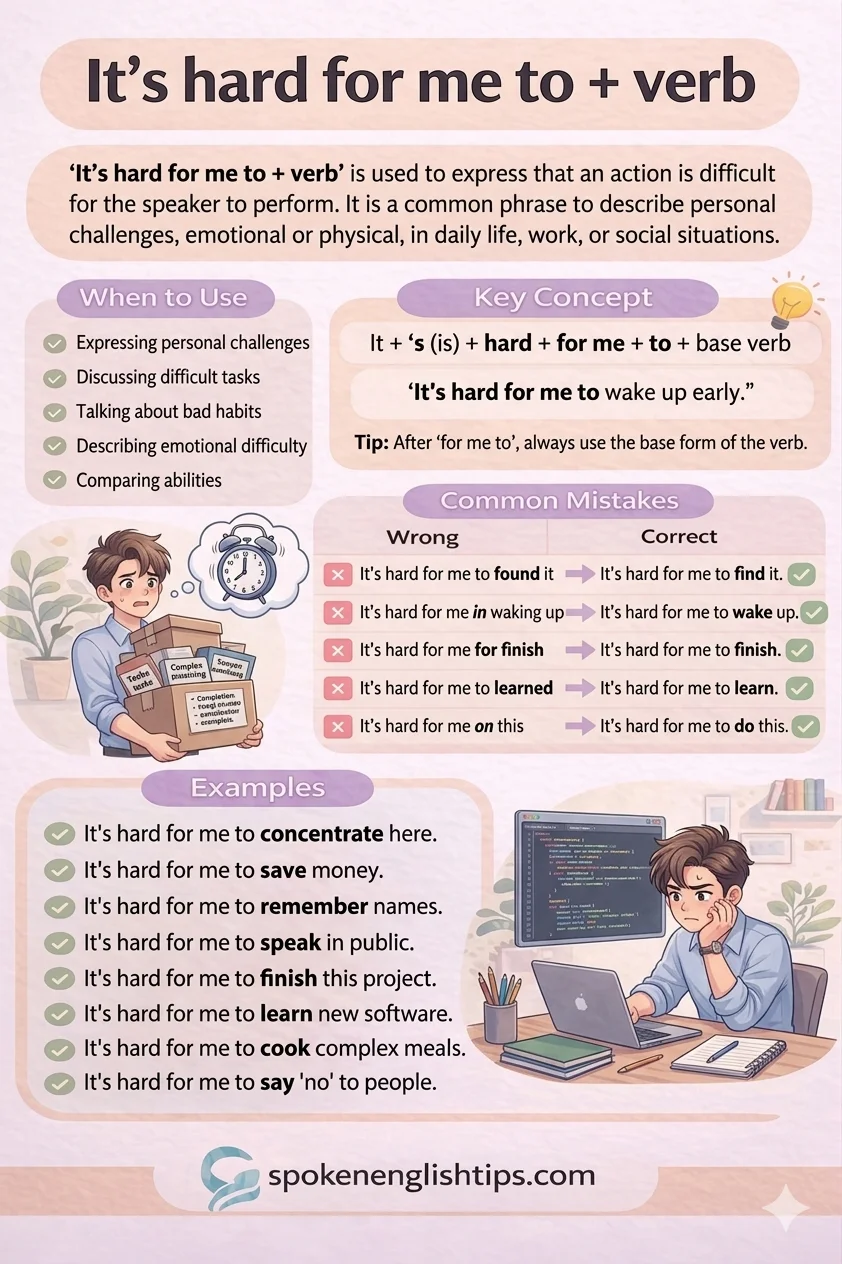
We use “It’s hard for me to + verb” when we want to talk about something that is difficult for us to do. It is very common in daily conversations. For example, you can say, “It’s hard for me to wake up early” or “It’s hard for me to speak in public.” This structure helps you express your feelings, challenges, or struggles clearly. You can use it at home, at work, or with friends. It sounds natural and polite. Learning this pattern will make your English more fluent and help you talk about your problems or difficulties easily.
◎ Important Points
- Use “It’s hard for me to” to talk about personal difficulty
- Always use the base form of the verb (no -ing, no past form)
- “Hard” can be replaced with “easy,” “difficult,” or “important”
- It is commonly used in spoken English
- Use it to express feelings or challenges politely
- Add details to make your sentence clearer
- Very useful in daily conversations
➤Key Concept
Sentence Structure: Subject + is/are + hard for + object + to + base verb
Example: It’s hard for me to understand this lesson.
This structure shows that something is difficult for someone. It helps you speak naturally about your struggles.
Tip: Practice speaking this structure aloud with different verbs daily.
➤ Common Mistakes To Avoid
| Common Mistake | Wrong Example | Correct Example |
|---|---|---|
| Using verb with -ing | It’s hard for me understanding English | It’s hard for me to understand English |
| Missing “to” | It’s hard for me understand English | It’s hard for me to understand English |
| Using past verb form | It’s hard for me to understood | It’s hard for me to understand |
| Wrong word order | It’s hard me for to speak | It’s hard for me to speak |
| Using “very hard” incorrectly | It’s very hard for me speak | It’s very hard for me to speak |
➤ Examples
- It’s hard for me to wake up early in the morning.
- It’s hard for me to remember names.
- It’s hard for me to speak English confidently.
- It’s hard for me to focus on work at home.
- It’s hard for me to say no to people.
- It’s hard for me to learn new words quickly.
- It’s hard for me to manage my time.
- It’s hard for me to understand fast English.
- It’s hard for me to talk in meetings.
- It’s hard for me to stay calm in traffic.
➤ Practice Examples
Fill in the blanks
- It’s hard for me to ______ (wake) up early.
- It’s hard for me to ______ (learn) English grammar.
- It’s hard for me to ______ (speak) in public.
- It’s hard for me to ______ (focus) on studies.
- It’s hard for me to ______ (understand) this topic.
Change incorrect sentence to correct one
- It’s hard for me understanding English.
- It’s hard for me speak loudly.
- It’s hard for me to understood him.
- It’s hard for me talking to strangers.
- It’s hard for me to remembers names.
Speak this sentence aloud
- It’s hard for me to wake up early.
- It’s hard for me to speak English fluently.
- It’s hard for me to manage my time.
- It’s hard for me to learn new skills.
- It’s hard for me to stay focused.