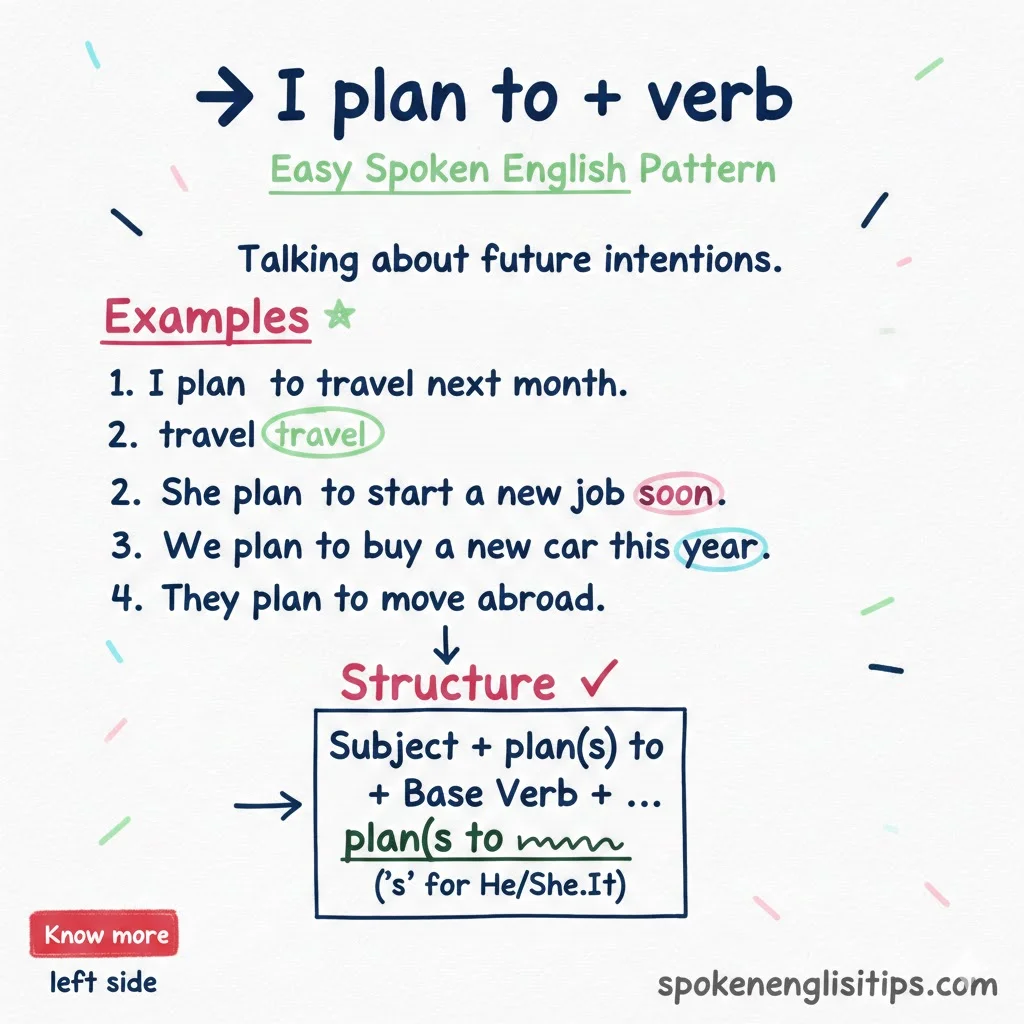
“I’m supposed to + verb” is a common English expression used when talking about duties, expectations, plans, or things that should happen. Native speakers use it in daily conversations at home, work, school, and while traveling. It often means that someone expects you to do something or that it is your responsibility. Using this phrase makes your English sound more natural and fluent. For example, if your boss expects you to submit a report today, you can say, “I’m supposed to send the report today.” Learning this structure will help you talk confidently about responsibilities and expectations in real-life situations.
◎ Important Points
“I’m supposed to” is followed by the base form of a verb.
It shows responsibility, expectation, or duty.
It is commonly used in spoken English.
It can talk about present or future expectations.
Negative form: “I’m not supposed to + verb.”
Question form: “Am I supposed to + verb?”
It sounds more natural than repeatedly saying “I should.”
➤Key Concept
✅ Sentence Structure: Subject + am/is/are + supposed to + base verb + object
Example: I’m supposed to attend the meeting at 10 a.m.
Simple Explanation: Use “supposed to” when something is expected, planned, or required.
💡 Speaking Tip: Use “I’m supposed to” in daily conversations instead of always saying “I should.” It sounds more natural.
➤ Common Mistakes To Avoid
Common Mistake
Wrong Example
Correct Example
Using “to” twice
I’m supposed to to call him.
I’m supposed to call him.
Using verb-ing form
I’m supposed to calling him.
I’m supposed to call him.
Missing “to”
I’m supposed call him.
I’m supposed to call him.
Wrong helping verb
I supposed to finish it.
I’m supposed to finish it.
Wrong negative form
I’m not supposed go there.
I’m not supposed to go there.
➤ Examples
I’m supposed to finish my homework before dinner.
I’m supposed to meet my manager at 3 p.m.
I’m supposed to call my friend tonight.
We’re supposed to arrive early for the event.
She’s supposed to send the email today.
I’m supposed to take this medicine after lunch.
They’re supposed to join the meeting online.
I’m supposed to pick up my brother from school.
He’s supposed to pay the bill today.
I’m supposed to check in two hours before my flight.
➤ Practice Examples
A. Fill in the Blanks (5)
I’m supposed to ________ my teacher today.
We’re supposed to ________ at 9 a.m.
She’s supposed to ________ the documents.
They’re supposed to ________ the project tomorrow.
I’m supposed to ________ my parents this evening.
B. Change the Incorrect Sentence to Correct One (5)
I’m supposed to calling him.
She supposed to attend the class.
We are supposed attend the meeting.
I’m not supposed go there.
They are supposed to arriving early.
C. Speak These Sentences Aloud (5)
I’m supposed to finish my work before lunch.
I’m supposed to call my customer today.
We’re supposed to leave early tomorrow.
I’m not supposed to use my phone during the meeting.
Alok Kumar is an educational content creator, YouTuber, and English speaker dedicated to helping learners grow with clarity and confidence. Through his engaging videos and easy-to-understand teaching style, he simplifies complex topics and makes learning accessible to a wide audience.