1. Strategic Decision-Making: Choosing Your Stream After 12th
I advise students to treat the transition from Class 10 to 12 as a strategic launchpad rather than just a grade jump. Selecting a stream requires a calculated alignment of personal aptitude with industry growth and competitive requirements. In my professional assessment, the following table summarizes the core trajectories for each major stream.
| Criteria | Science | Commerce | Arts |
|---|---|---|---|
| Core Focus | Logical reasoning, technical experimentation, and research. | Business operations, finance, market systems, and taxation. | Society, human behavior, governance, and creative expression. |
| Industry Alignment | Healthcare, Technology, Biotechnology, and IT Research. | Finance, Fintech, International Trade, and Startups. | Governance, Media, Public Policy, and Social Impact. |
| Key Competitive Exams | NEET, JEE, CUET, NEST. | CA, CMA, CLAT, MBA Entrance. | UPSC, SSC, NET, CAT. |
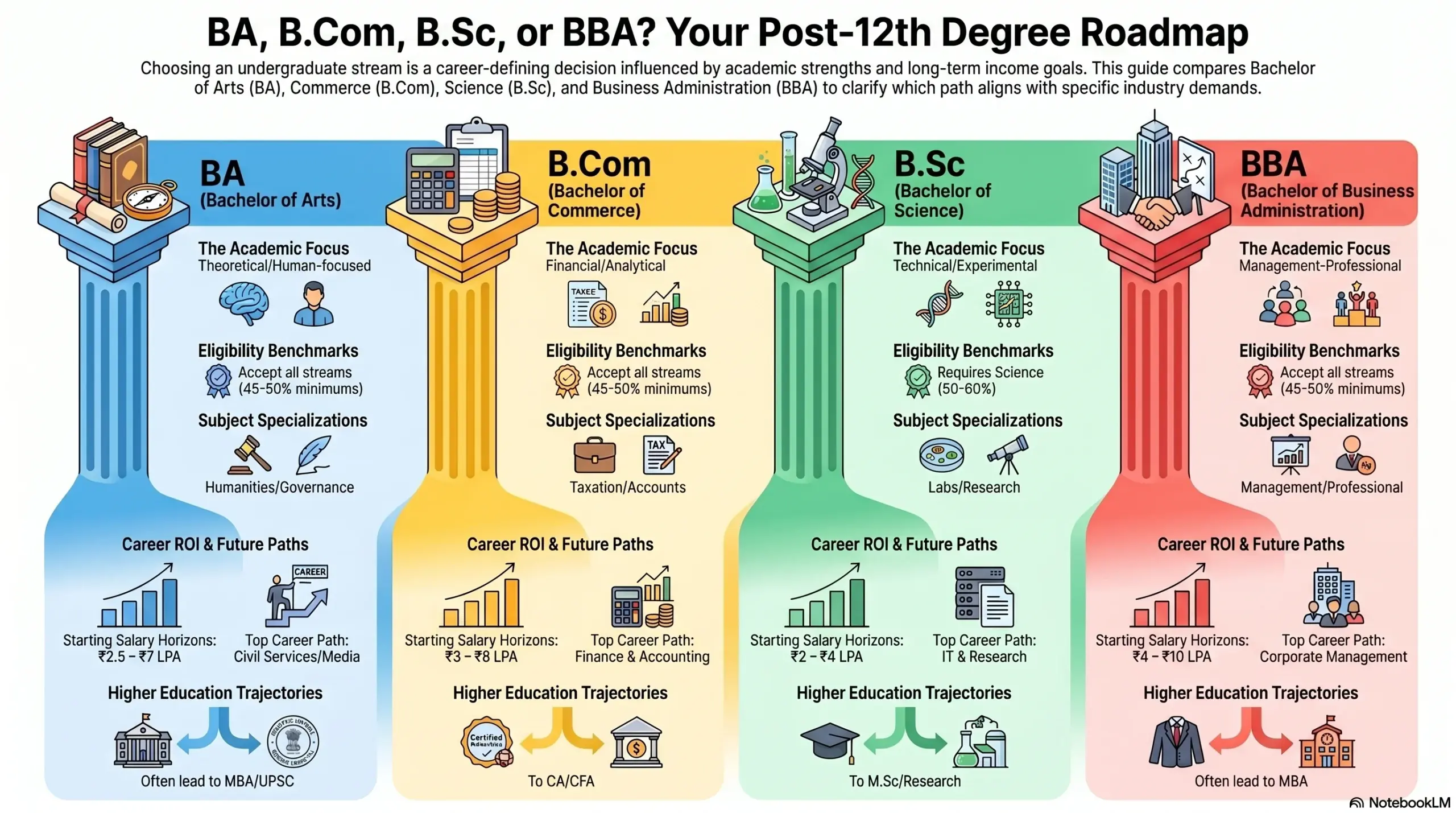
2. The Four Pillars: Comparative Analysis of BA, B.Com, B.Sc, and BBA
Choosing between the primary undergraduate degrees requires understanding their structural differences. While BA and B.Com remain 3-year programs, the B.Sc has evolved into a 4-year, research-intensive degree.
- Bachelor of Arts (BA)
- Level/Duration: UG / 3 Years.
- Minimum Eligibility: 10+2 (Any stream), typically 45% aggregate.
- Who Should Choose This?
- Creative and analytical thinkers who prefer reading, writing, and exploring social issues.
- Aspirants for Civil Services (UPSC) or government exams.
- Students interested in subjects like literature, history, or philosophy.
- Bachelor of Commerce (B.Com)
- Level/Duration: UG / 3 Years.
- Minimum Eligibility: 10+2 (Any stream), 50% aggregate. (Note: Mathematics is compulsory for B.Com Hons.
- Who Should Choose This?
- Individuals with a high aptitude for numbers, logical reasoning, and business concepts.
- Those targeting careers in banking, auditing, or corporate finance.
- Students planning for professional certifications like CA, CS, or CMA.
- Bachelor of Science (B.Sc)
- Level/Duration: UG / 4 Years (Research-oriented).
- Minimum Eligibility: 10+2 (Science stream only), 50%–60% aggregate.
- Who Should Choose This?
- Students are deeply interested in scientific experiments and laboratory research.
- Aspirants aiming for healthcare, biotechnology, or IT roles.
- Those planning to pursue higher academia (M.Sc, PhD).
- Bachelor of Business Administration (BBA)
- Level/Duration: UG / 3 Years.
- Minimum Eligibility: 10+2 (Any stream), competitive entrance, or merit-based.
- Who Should Choose This?
- Future entrepreneurs and corporate leaders are seeking managerial skills.
- Students are looking for a strong professional foundation prior to an MBA.
3. Deep Dive: Integrated Law (BBA + LLB)
For ambitious students, the 5-year integrated BBA + LLB is what I call the ultimate “power move.” This path merges business strategy with legal compliance, saving one full year compared to the traditional 6-year route. It transforms you from a legal technician into a legal strategist who understands the “business why” behind the “legal how.”
Syllabus Progression
- Building the Base: Early semesters balance the “Business” brain (Managerial Economics, Accounting) with the “Legal” brain (Torts, Contracts).
- Diving Deep: Middle years cover Constitutional Law, Criminal Law (IPC/CrPC), and Corporate Law—where the BBA knowledge of company management becomes a distinct advantage.
- Specialization & Practice: The final years focus on Intellectual Property Rights (IPR), Taxation, and International Trade.
Clinical Courses and the ISBR Edge
I recommend looking for institutions that emphasize “Clinical Courses” where you practice drafting and pleading. ISBR Law College in Bangalore offers a significant advantage through:
- Moot Court Experience: Real-life courtroom simulations to build “courtroom presence.”
- Industry Connections: Direct access to C-suite executives and senior advocates in India’s tech hub.
- Placement Powerhouse: An exceptional ROI with a 92% placement rate, recruiters like Amazon and Deloitte, and a highest package reaching INR 16 LPA.
4. The Bachelor of Arts (BA) vs. Bachelor of Science (B.Sc) Distinction
Economics
The difference here is often subtle nomenclature. Both are math-intensive. I strongly caution students: do not choose BA Economics simply to avoid Mathematics; the coursework remains highly quantitative regardless of the degree name. Economics requires rigorous understanding of Statistics and mathematical models to achieve predictive precision.
Psychology
The choice between BA and B.Sc Psychology depends entirely on your preferred approach to the human mind.
| Feature | B.Sc Psychology | BA Psychology |
|---|---|---|
| Focus | Biological, neural, and research-oriented. | Social, cultural, and human interaction. |
| Methodology | Data-driven, experimental, and lab-based. | Theoretical, qualitative, and analytical. |
| Career Path | Healthcare, clinical research, neuroscience. | Counselling, HR, social work, advertising. |
5. High-Salary Careers in Commerce
Many students suffer from “math anxiety” but still wish to pursue high-growth careers. In my assessment, these paths offer excellent professional ROI without requiring advanced calculus or technical math.
| Course Name | Duration | Potential Job Roles |
|---|---|---|
| ACCA | 2–3 Years | Global Accountant, Finance Manager (Global Recognition) |
| BMS (Management) | 3 Years | Management Consultant, Operations Manager |
| BAF (Accounting) | 3 Years | Financial Analyst, Investment Advisor |
| BBI (Banking) | 3 Years | Banking Officer, Risk Management Specialist |
| CS (Company Secretary) | 3–4 Years | Corporate Advisor, Compliance Officer |
6. Medical School Requirements and Offshore Options
Entry into medical school requires a blend of specific academic prerequisites and high-impact extracurricular engagement.
- Academic Requirements: Applicants must complete a four-year degree (BA and B.Sc are equally accepted). Coursework must include one year of English and Biology and two years of Chemistry (including Organic Chemistry).
- MCAT Expectations: While 500 is the average score, competitive matriculants typically average 511.5.
- Essential Extracurricular Categories:
- Shadowing: Observing physicians across diverse care settings and specialties.
- Research: Demonstrating a passion for scientific inquiry and academic medicine.
- Clinical Volunteering: Gaining one-on-one patient experience (e.g., serving as an EMT or Medical Assistant).
- Community Service: Non-clinical volunteering to demonstrate social impact and leadership.
Offshore Alternative: For students who may not meet the domestic GPA/MCAT cutoffs, the Trinity School of Medicine offers a viable alternative with small class sizes and a holistic admissions process that considers the student’s comprehensive potential.
7. Consolidated Guide to Entrance Exams and Top Institutions
| Field / Degree | Key Entrance Exams and Top Colleges |
|---|---|
| Science (B.Sc) | Exams: CUET, NEST, JEE, OUAT. Colleges: St Stephen’s, Miranda House, Hindu College. |
| Arts (BA) | Exams: CUET, TISSNET, IPU CET. Colleges: LSR, Loyola College, Fergusson College. |
| Commerce (B.Com) | Exams: CUET, Merit-based. Colleges: SRCC, St. Xavier’s (Mumbai), Madras Christian College. |
| Law / Business | Exams: CLAT, SET, LSAT India. Colleges: ISBR Law College, NLUs. |
| Management (BBA) | Exams: CUET, NPAT, IPMAT. Colleges: ISBR, Christ University, School of Business-UPES. |
8. Salary Trends and Professional ROI
Based on current market data, I recommend focusing on specializations with high technological or regulatory demand.
| Degree / Specialization | Average Salary Range (LPA) | High-Growth Industry |
|---|---|---|
| BBA (Management) | ₹4 – ₹10 LPA | Startups, Corporate Leadership |
| ACCA / CA | ₹6 – ₹25 LPA | International Finance, Auditing |
| B.Com (Finance) | ₹3 – ₹8 LPA | Banking, Fintech, Taxation |
| Psychology (B.Sc/BA) | ₹3 – ₹10 LPA | Corporate Wellness, Healthcare, HR |
| BA (Humanities) | ₹2.5 – ₹7 LPA | Media, Public Policy, Civil Services |
9. Final Recommendations for Students and Parents
I recommend that you do not choose a path simply because it is “trendy” or because peers are enrolling. Use the following framework to ensure your choice is sustainable.
The Three-Step Career Evaluation Checklist:
- Evaluate Interests: Identify the subjects that stimulate your curiosity. Do you prefer solving technical puzzles, or are you drawn to social and behavioral discussions?
- Identify Strengths: Be honest about your skill sets. Determine if you excel in numerical logic, creative communication, or scientific research and experimentation.
- Define Long-Term Goals: Visualize your daily life ten years from now. Do you see yourself in a high-stakes boardroom, a clinical laboratory, or shaping public policy in a government office?