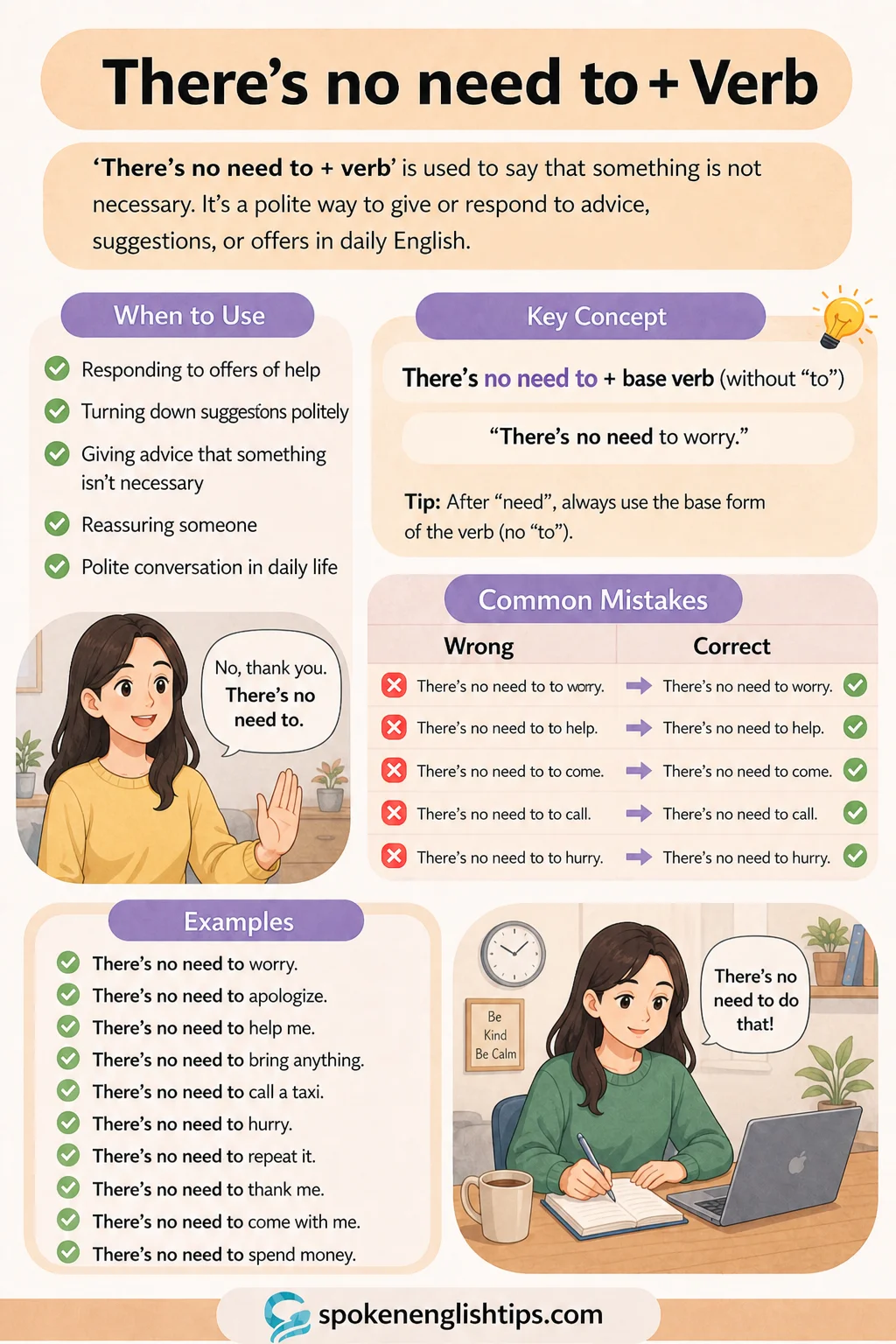
“There’s no need to + verb” is a very useful English phrase. We use it when something is not necessary or not required. It helps you sound polite and natural in conversations. For example, if a friend wants to rush but it’s not important, you can say, “There’s no need to hurry.” This phrase is common in daily life—at home, in the office, or while talking to friends. Instead of saying “Don’t do this,” which may sound rude, this structure sounds softer and more friendly. Learning this will help you speak English more confidently and politely.
◎ Important Points
- Use this phrase when something is unnecessary
- Always use the base form of the verb after “to”
- It is polite and softer than giving direct commands
- Common in daily conversations
- Can be used with subjects like “there is” or “there’s”
- Often used to calm or relax someone
- Works well in both formal and informal speaking
➤Key Concept
✅ Sentence Structure: There’s no need to + base verb
Example: There’s no need to worry.
This structure shows that an action is not required. It makes your speech polite and natural.
Tip: Use this phrase instead of “Don’t…” to sound more friendly in conversations.
➤ Common Mistakes To Avoid
| Common Mistake | Wrong Example | Correct Example |
|---|---|---|
| Using “to” with -ing form | There’s no need to worrying | There’s no need to worry |
| Adding extra subject | There’s no need you to go | There’s no need to go |
| Using past verb form | There’s no need to went | There’s no need to go |
| Missing “to” | There’s no need worry | There’s no need to worry |
| Using “is no need” incorrectly | There no need to hurry | There’s no need to hurry |
➤ Examples
- There’s no need to shout, I can hear you.
- There’s no need to come early tomorrow.
- There’s no need to worry about the meeting.
- There’s no need to spend so much money.
- There’s no need to explain everything.
- There’s no need to rush, we have time.
- There’s no need to call him again.
- There’s no need to be nervous.
- There’s no need to bring food, I already cooked.
- There’s no need to argue over small things.
➤ Practice Examples
A. Fill in the blanks
- There’s no need to ______ (worry).
- There’s no need to ______ (run).
- There’s no need to ______ (call) me now.
- There’s no need to ______ (buy) extra items.
- There’s no need to ______ (wait) here.
B. Change incorrect sentence to correct one
- There’s no need to worrying.
- There’s no need go there.
- There’s no need to went home.
- There’s no need you to study now.
- There no need to hurry.
C. Speak this sentence aloud
- There’s no need to panic.
- There’s no need to argue.
- There’s no need to explain again.
- There’s no need to feel stressed.
- There’s no need to wake up early today.