
A strong Letter of Recommendation for Preschool Teacher should do more than say that someone is kind, patient, or good with children. It should explain how the writer knows the teacher, describe two or three qualities that matter in preschool education, and support those qualities with specific observations.
For most job applications, a focused one-page letter is enough. The strongest recommendation usually comes from someone who has directly observed the teacher’s professional work and can explain why that teacher would be a good fit for the new position.
This guide gives you an editable sample, shorter versions for different recommenders, and a practical method for making the letter sound personal rather than copied.
Quick Answer
A preschool teacher recommendation letter should normally include:
- Who the writer is and how they know the teacher.
- How long they have worked with or observed the teacher.
- Two or three job-relevant strengths.
- At least one specific example showing those strengths.
- A clear recommendation for the new position.
- The writer’s name, title, and contact information.
MIT’s Writing and Communication Center similarly recommends starting by explaining the relationship with the applicant, discussing skills relevant to the position, and using specific examples. Its guidance says recommendation letters are usually three or four paragraphs and should generally stay within one page.
Letter of Recommendation for Preschool Teacher: Editable Sample
The following example is intentionally written with placeholders so it can be adapted without inventing facts.
[Your Name]
[Your Job Title]
[School or Organization]
[Email Address]
[Phone Number]
[Date]Dear [Hiring Manager/Director/Principal Name],
I am pleased to recommend [Teacher Name] for the preschool teacher position at [School or Center Name]. I have worked with [Teacher Name] for [length of time] as [your relationship, such as director, principal, or lead teacher] at [current or former school]. During that time, I have had regular opportunities to observe [his/her/their] work with young children, families, and other staff members.
[Teacher Name] is especially effective at creating a classroom that is organized, welcoming, and appropriate for young learners. [He/She/They] plans engaging activities, maintains clear routines, and responds calmly when children need additional support. One example I remember well was [brief, nonconfidential example]. Instead of simply [describing the challenge], [Teacher Name] [describe the specific action taken]. This showed [his/her/their] patience, preparation, and ability to adjust teaching to the needs of the group.
[Teacher Name] also communicates professionally with families and colleagues. [He/She/They] shares useful observations about children’s progress, contributes ideas during planning, and follows through on classroom responsibilities. These habits make [him/her/them] a dependable educator as well as a supportive member of a teaching team.
Based on my experience working with [Teacher Name], I recommend [him/her/them] for the preschool teacher position at [School or Center Name]. I believe [his/her/their] classroom skills, professionalism, and ability to build positive relationships would make a valuable contribution to your program. Please feel free to contact me at [email address] or [phone number] if additional information would be helpful.
Sincerely,
[Your Name]
[Your Title]
[School or Organization]
Do not keep every sentence simply because it appears in the template. Replace general wording with details the recommender can personally verify.
What Makes a Preschool Teacher Recommendation Effective
A hiring manager can already see qualifications, previous positions, and education on a resume. A recommendation letter adds value by showing what the teacher is actually like to work with.
That is why specific evidence matters.
Compare these two statements:
Weak:
“Maria is an excellent teacher who is wonderful with children.”
Stronger:
“Maria keeps classroom routines predictable without making them rigid. During transitions, she uses visual cues and simple classroom jobs so children know what to do next.”
The second version gives the reader something observable.
MIT’s recommendation-writing guidance specifically advises writers to explain how they know the candidate and support important qualities with detailed examples.
For preschool positions, those examples should connect to actual responsibilities of the job. The U.S. Bureau of Labor Statistics describes preschool teachers as educators who work with children younger than age five who have not yet entered kindergarten. Their duties may include planning curriculum, organizing activities, observing development, keeping records, and communicating with parents.
What to Gather Before Writing
Before drafting the recommendation, collect a few pieces of information.
The job description:
Look at what the new school or center is asking for. If it emphasizes family communication, curriculum planning, or classroom organization, use examples relevant to those responsibilities.
The teacher’s current resume:
Use it to confirm job titles, dates, education, and credentials. Do not guess.
The correct recipient:
Addressing a known director or principal by name feels more purposeful than using a generic greeting.
Two or three real examples:
Think about moments that demonstrate the teacher’s classroom judgment, communication, reliability, creativity, or professionalism.
Any required submission instructions:
Some employers want the letter uploaded through a system, emailed directly by the recommender, or submitted on organizational letterhead.
Best Qualities to Mention in the Letter
The best qualities are not simply the most flattering ones. They are the ones that matter to preschool teaching and that the writer has actually observed.
| Quality | What useful evidence might look like |
|---|---|
| Communication | Explains children’s progress clearly to families and collaborates well with coworkers |
| Creativity | Designs engaging activities and adapts lessons for different learners |
| Interpersonal skill | Builds respectful relationships with children, families, and staff |
| Organization | Maintains routines, prepares materials, documents progress, and follows through |
| Patience | Responds calmly and constructively during difficult moments |
| Adaptability | Adjusts activities or support to meet different children’s needs |
| Professionalism | Communicates respectfully, follows responsibilities, and contributes to the program |
| Observation | Notices children’s interests, progress, and support needs and uses those observations thoughtfully |
The first five qualities above are directly reflected in the BLS description of important preschool-teacher qualities.
NAEYC’s Developmentally Appropriate Practice guidance adds useful professional context. It emphasizes caring learning communities, partnerships with families, observation and assessment, teaching that supports each child’s development, meaningful curriculum, and professionalism.
You do not need to mention all of these areas. Choose the two or three that best match what you have genuinely observed.
How to Structure the Recommendation Letter
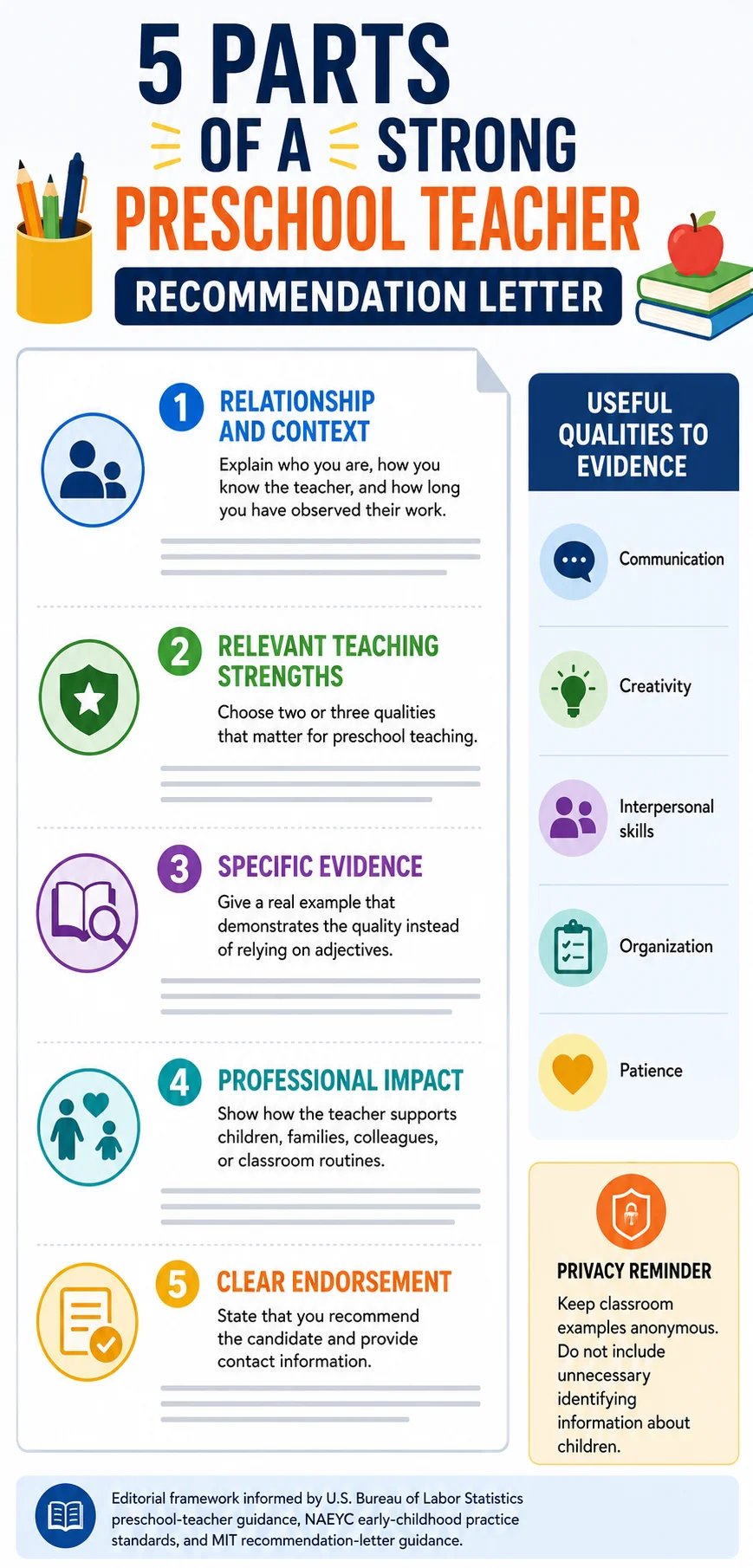
A practical structure has five parts.
1. Establish your relationship.
State your name or role, how you know the teacher, and how long you have known or supervised them.
2. Name the strongest relevant qualities.
Choose skills connected to the position instead of listing generic adjectives.
3. Provide evidence.
Describe one or two examples showing how those qualities appear in real work.
4. Explain the teacher’s broader value.
Mention collaboration, reliability, communication with families, contribution to the school, or another relevant impact you can personally support.
5. Give a clear endorsement.
Say that you recommend the candidate and provide a way for the recipient to contact you.
This approach keeps the letter persuasive without making it unnecessarily long.
Preschool Teacher Recommendation Letter From a Principal or Director
A director or principal can usually comment on performance across several areas, including teaching, reliability, collaboration, and communication.
Dear [Recipient Name],
I am writing to recommend [Teacher Name] for the preschool teacher position at [School Name]. I supervised [Teacher Name] for [time period] at [Program Name], where [he/she/they] worked with [age group or classroom, if relevant].
What consistently impressed me was [Teacher Name]’s ability to combine clear classroom routines with a warm approach to children. [He/She/They] came prepared, adapted activities when children needed additional support, and communicated thoughtfully with families. I also saw [Teacher Name] contribute constructively during staff planning and follow through on responsibilities without needing repeated reminders.
I recommend [Teacher Name] for this position and believe [he/she/they] would bring sound judgment, patience, and professionalism to your early-learning program. I would be happy to provide additional information if needed.
Sincerely,
[Name and Title]
Preschool Teacher Recommendation Letter From a Colleague
A colleague should focus on things they directly observed rather than making claims about formal evaluations or employment decisions.
Dear [Recipient Name],
I have worked alongside [Teacher Name] at [School/Center] for [time period], and I am glad to recommend [him/her/them] for your preschool teaching position.
As a colleague, I have seen [Teacher Name] prepare engaging activities, maintain calm classroom routines, and communicate respectfully with both children and staff. [Specific example]. [He/She/They] is also dependable during shared planning and willingly contributes ideas or support when the teaching team needs it.
Based on our work together, I believe [Teacher Name] would be a strong addition to an early-childhood team. Please contact me if I can provide further information.
Sincerely,
[Name and Position]
Preschool Teacher Recommendation Letter From a Parent
A parent can provide valuable observations about communication, trust, responsiveness, and the child’s experience, but should avoid pretending to have observed responsibilities that occur behind the scenes.
Dear [Recipient Name],
I am pleased to recommend [Teacher Name], who taught my child at [Preschool Name] during [school year or time period].
From a parent’s perspective, one of [Teacher Name]’s strongest qualities is communication. [He/She/They] consistently explained classroom activities clearly, shared useful observations about my child’s progress, and responded thoughtfully when I had questions. My child also spoke positively about [specific classroom activity or appropriate observation].
Based on our family’s experience, I would confidently recommend [Teacher Name] to a preschool seeking an educator who communicates well with families and creates a welcoming environment for young children.
Sincerely,
[Parent Name]
If an employer specifically requests a professional reference, follow that requirement instead of substituting a parent letter.
How to Make the Letter Specific and Credible
Specificity is the biggest difference between a convincing recommendation and a generic one.
Try replacing adjectives with evidence.
Instead of:
“She is very patient.”
Write:
“When children become frustrated during transitions, she stays calm, gives simple directions, and allows enough time for them to regain focus.”
Instead of:
“He is creative.”
Write:
“He regularly turns children’s interests into simple classroom activities, such as using a discussion about neighborhood vehicles for counting, drawing, and storytelling.”
Instead of:
“She communicates well with parents.”
Write:
“She gives families concise updates that explain both what the class is learning and how an individual child is participating.”
You do not need dramatic achievements. Ordinary, well-observed details are often more believable than exaggerated praise.
Common Mistakes to Avoid
Using a template without personalizing it.
Hiring managers can recognize a letter made entirely from generic praise.
Listing too many adjectives.
Three documented strengths are more convincing than ten unsupported ones.
Inventing numbers or outcomes.
Do not claim that learning scores improved by a certain percentage unless there is reliable documentation and the information is appropriate to disclose.
Claiming credentials you have not verified.
Confirm degrees, licenses, certificates, and job titles before mentioning them.
Writing about qualities unrelated to the job.
Focus on evidence relevant to early-childhood education and professional work.
Making the letter about the recommender.
A short explanation of the writer’s role is enough. The candidate should remain the focus.
Repeating the resume.
The recommendation should interpret the candidate’s performance, not copy their employment history.
Being excessively long.
A concise letter with real evidence usually communicates more effectively than several pages of general praise.
Protect Children’s Privacy When Using Examples
Specific classroom examples make recommendation letters stronger, but they do not require identifying a child.
For example, write:
“One child in the group was having difficulty joining morning activities…”
rather than including a child’s full name, diagnosis, family circumstances, or other unnecessary identifying details.
The 2025 NAEYC Code of Ethics says early childhood educators should maintain the confidentiality of a child’s information, images, and data and share them only when there is a legitimate need.
That makes anonymized examples a safer and more professional choice for recommendation letters.
Frequently Asked Questions
How long should a preschool teacher recommendation letter be?
About one page is a useful target for most employment recommendations. MIT’s Writing and Communication Center says recommendation letters are usually three or four paragraphs and should generally not exceed one page.
Who is the best person to write a preschool teacher recommendation letter?
Someone who knows the teacher’s work well and can give specific examples is usually more useful than someone with an impressive title who barely knows the candidate. A director, principal, lead teacher, supervisor, or experienced colleague may be appropriate depending on the application.
Can a parent write a recommendation for a preschool teacher?
Yes, if the employer accepts that type of reference. A parent can credibly discuss communication, responsiveness, trust, and the family’s experience. They should avoid making claims about professional duties they did not observe.
Can a colleague write the recommendation?
Yes. A colleague can describe teamwork, classroom practices, reliability, communication, and other behavior they directly observed.
Should I write “To Whom It May Concern”?
Use the recipient’s name when you know it. If the letter will be reused for several applications or the recipient is unknown, “To Whom It May Concern” or “Dear Hiring Committee” can be appropriate.
What are the best qualities to mention?
Choose qualities you can support with evidence. Useful areas include communication, creativity, patience, organization, interpersonal skills, adaptability, family relationships, observation, classroom routines, and professionalism. BLS specifically identifies communication, creativity, interpersonal skills, organization, and patience among important qualities for preschool teachers.
Should I mention the teacher’s degree or certification?
Only when you have verified it and it is relevant to the application. Preschool education and licensing requirements vary by state and employment setting, so avoid making assumptions.
Should a recommendation letter include weaknesses?
An employment recommendation normally exists to explain why you support the candidate. If you cannot write an accurate and genuinely supportive letter, it may be better to decline rather than produce a vague endorsement. Never hide serious information that you are legally or professionally required to disclose.
Final Takeaway
A strong recommendation letter for a preschool teacher is built on relationship + relevant qualities + specific evidence + clear endorsement.
Keep it concise. Describe what you actually observed. Connect your examples to the requirements of preschool teaching. Verify credentials instead of guessing. Protect children’s privacy. Most importantly, make the letter sound like it could only have been written about that particular teacher.