
Good customer service is not only about solving a customer’s problem. It is also about how you speak, how you listen, and how you make the customer feel during the conversation.
If you work in a call center, BPO, hotel, restaurant, retail store, online support team, or any customer-facing job, the right English expressions can help you sound more polite, confident, and professional.
In this guide, you will learn 100+ customer service expressions in English for real workplace situations. You will also find examples, short dialogues, useful vocabulary, and practical tips for improving your customer service English.
What Are Customer Service Expressions?
Customer service expressions are polite and professional English phrases used when communicating with customers.
You can use them to:
- Greet customers
- Offer assistance
- Ask questions
- Understand a problem
- Apologize for an issue
- Show empathy
- Handle complaints
- Explain solutions
- Ask customers to wait
- Transfer calls
- Give updates
- End conversations professionally
For example, instead of saying:
“Wait.”
A professional customer service agent can say:
“Could you please give me a moment while I check that for you?”
The second expression sounds more polite and helpful.
What Are Customer Service Expressions?
Customer service expressions are common phrases that help employees communicate with customers clearly and respectfully.
They are especially useful when you need to deal with difficult situations.
For example, a customer may be angry because an order is late. Saying:
“That’s not my fault.”
can make the situation worse.
Instead, you could say:
“I understand your frustration. Let me see what I can do to help.”
The goal is not to use complicated English. The goal is to use simple, polite, and professional English.
100+ Customer Service Expressions in English
Here are useful expressions organized according to real customer service situations.
1. Greeting Customers
The first few seconds of a conversation can create a strong impression. Use a friendly greeting and offer assistance.
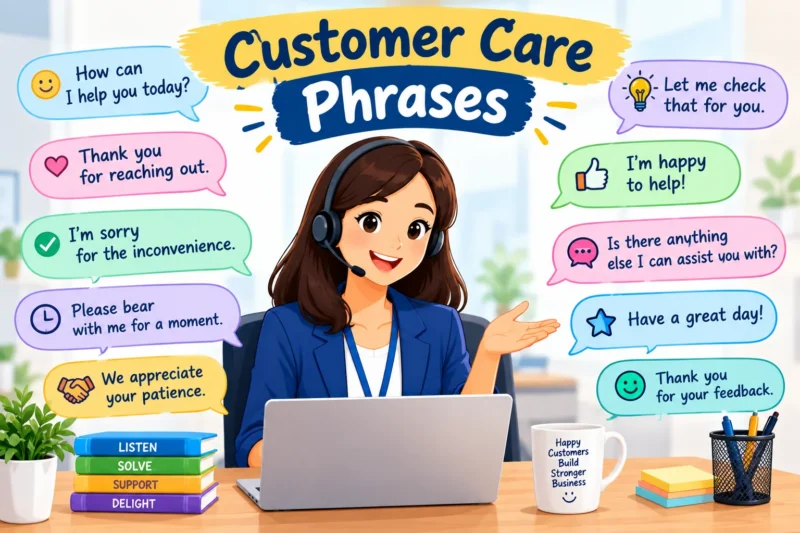
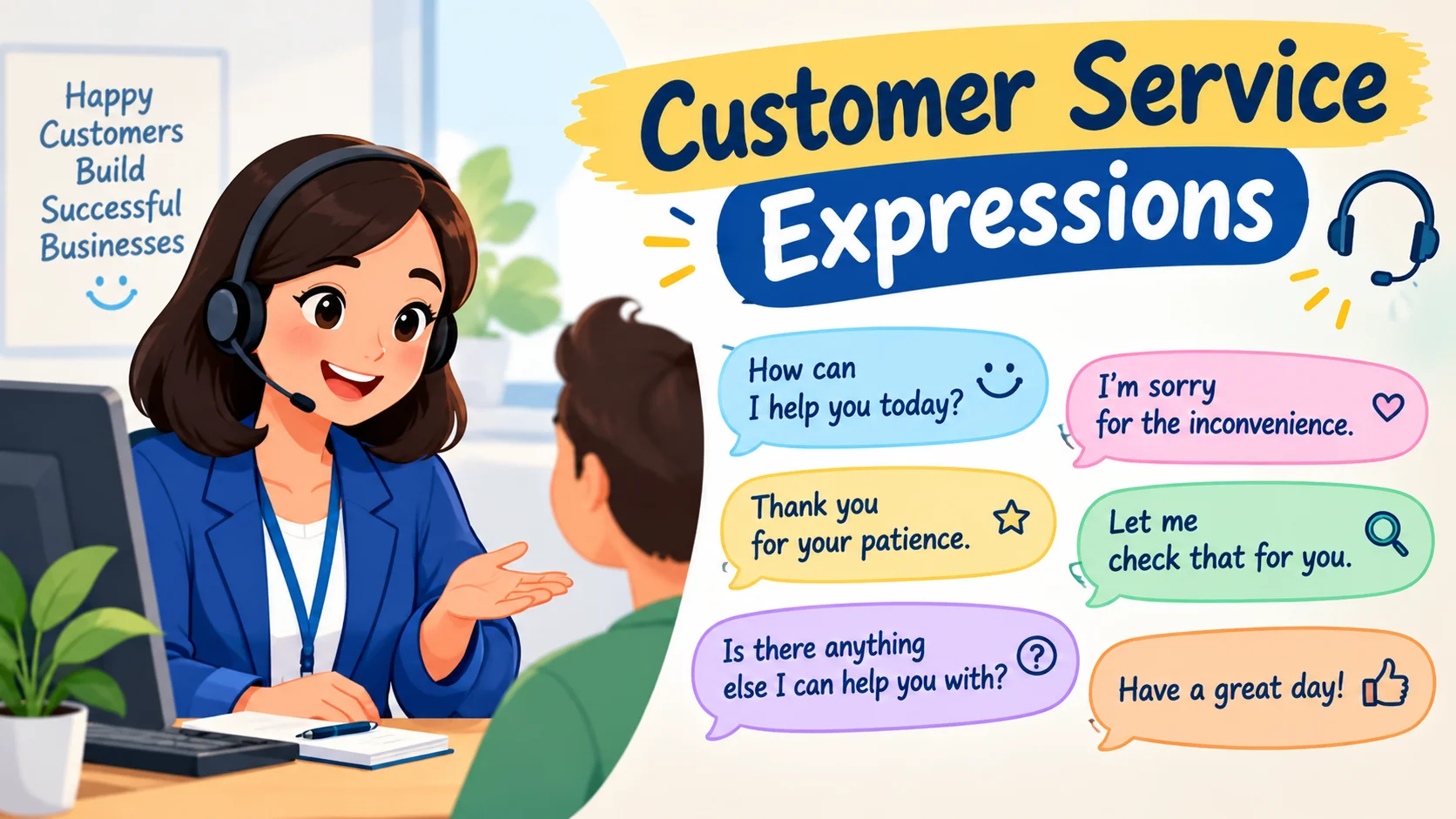
- How can I help you today?
- How may I assist you?
- How can I assist you today?
- What can I help you with?
- How may I be of assistance?
- Thank you for contacting us.
- Welcome! How can I help you?
- It’s a pleasure to assist you.
- Thank you for reaching out to us.
- How may I help you with your request?
Example
Customer: I’d like to check the status of my order.
Agent: Certainly. I’d be happy to help. Could you please provide your order number?
2. Offering Help
Once you have greeted the customer, make it clear that you are ready to help.
- I’d be happy to help you.
- I’ll be happy to look into that for you.
- Certainly, let me check that for you.
- I’ll see what I can do for you.
- Let me help you with that.
- I’d be glad to assist you.
- Let me take a look at that.
- I’ll do my best to help you.
- Let’s see how we can resolve this.
- I’ll be happy to find out more information for you.
Example
Customer: I’m having trouble logging into my account.
Agent: I’m sorry you’re having trouble. I’d be happy to help you with that.
3. Asking for Information
Customer service employees often need specific information before they can solve a problem.
- Could you please provide your order number?
- May I have your name, please?
- Could you please confirm your email address?
- May I have your account number?
- Could you provide a few more details?
- Could you tell me what happened?
- When did you first notice the problem?
- Could you please describe the issue?
- Can you provide the reference number?
- Could you please confirm those details?
Example
“Could you please provide your booking reference so I can check the details for you?”
4. Clarifying Customer Problems
Sometimes customers explain their problems quickly or unclearly. Before offering a solution, make sure you understand what they mean.
- Let me make sure I understand correctly.
- If I understand you correctly…
- Could you clarify that for me?
- Could you explain that in a little more detail?
- Do you mean that the payment was declined?
- Just to confirm, you haven’t received the package yet, correct?
- Let me confirm what happened.
- Could you tell me exactly what you see on the screen?
- When you say the service isn’t working, what happens?
- Let me make sure I have understood the issue correctly.
Useful expression
“Just to make sure we’re on the same page…”
This is useful when you want to confirm that both people understand the situation in the same way.
5. Asking Customers to Wait
Sometimes you need time to check an account, contact another department, or find information.
Avoid simply saying:
“Wait.”
Use a more professional expression.
- Could you please give me a moment?
- Please allow me a moment to check that.
- Would you mind waiting for a moment?
- Let me check that for you.
- I’ll just take a moment to look into this.
- Please bear with me while I check the information.
- Could you give me a few moments, please?
- I’ll be with you shortly.
- Thank you for giving me a moment to check.
- I appreciate your patience while I look into this.
6. Showing Empathy
Empathy is an important part of customer service.
You don’t always need to agree with the customer. You can simply show that you understand why they are concerned.
- I understand your concern.
- I understand how frustrating this must be.
- I can see why you’re concerned.
- I understand why this is important to you.
- I can appreciate how frustrating this situation is.
- I understand where you’re coming from.
- Thank you for explaining the situation.
- I understand that this has been inconvenient for you.
- I can see why you would be disappointed.
- I appreciate you bringing this to our attention.
Example
Customer: I’ve been waiting for my order for two weeks!
Agent: I understand how frustrating that must be. Let me check the latest delivery information for you.
7. Apologizing Professionally
A sincere apology can help calm a difficult conversation.
- I’m sorry for the inconvenience.
- I sincerely apologize for the delay.
- I’m sorry this happened.
- We apologize for the inconvenience caused.
- I’m sorry for the misunderstanding.
- Please accept our apologies for the delay.
- I apologize for any confusion this may have caused.
- I’m sorry you’ve had this experience.
- We regret the inconvenience caused.
- Thank you for your understanding.
Important tip
An apology is stronger when you also explain what you can do next.
Instead of:
“Sorry about that.”
Try:
“I’m sorry about the delay. Let me check the status of your order and see how we can resolve this.”
8. Handling Angry Customers
Dealing with an angry customer can be challenging. The best approach is usually to stay calm, listen carefully, acknowledge the concern, and focus on a possible solution.
- I understand that you’re frustrated.
- I understand your concern, and I’ll do my best to help.
- Let’s see what we can do to resolve this.
- I’d like to help you find a solution.
- Let me look into this for you.
- I understand why you’re upset.
- Thank you for bringing this to our attention.
- I’ll do everything I can within my ability to help.
- Let’s work together to find a solution.
- I appreciate your patience while we work through this.
Avoid saying:
- “Calm down.”
- “That’s not my problem.”
- “You are wrong.”
- “I can’t do anything.”
- “You’ll have to wait.”
These statements can make a difficult conversation even more difficult.
9. Offering Solutions
After understanding the problem, explain what you can do.
- Here’s what I can do for you.
- Let me see what options are available.
- I can arrange that for you.
- We have a couple of options available.
- One option would be to…
- What I can do is…
- I’d recommend trying this first.
- We can arrange a replacement.
- I can help you with that right away.
- Let me find the best available solution for you.
Example
“Here’s what I can do for you. I can arrange a replacement and have it shipped to you as soon as possible.”
10. Saying No Politely
Customer service employees cannot always say yes.
The important thing is to explain the limitation without sounding rude.
- I’m afraid that’s not possible at the moment.
- Unfortunately, we don’t offer that service.
- I’m sorry, but we’re unable to do that.
- I’m afraid we don’t have that option available.
- Unfortunately, that isn’t available right now.
- However, we may have another option for you.
- Let me explain what we can offer instead.
- Although we can’t do that, we can offer you this alternative.
- I’ll see if there is another way we can help.
- Let me check whether there are any other options available.
Better customer service approach
Don’t stop at:
“We can’t do that.”
Try:
“Unfortunately, we’re unable to offer that option, but let me explain what we can do instead.”
11. Transferring Calls
When a customer’s problem needs another department, explain the transfer clearly.
- I’ll transfer you to the appropriate department.
- Let me connect you with our billing team.
- I’ll put you through to a specialist.
- The best person to help you with this is our support team.
- I’ll connect you with someone who can assist you further.
- Please hold while I transfer your call.
- I’ll transfer you to the right department.
- Let me connect you with our technical support team.
12. Putting Customers on Hold
If you need to place someone on hold, ask first when appropriate.
- May I place you on hold for a moment?
- Would you mind holding for a moment?
- Could I put you on hold while I check that information?
- Please hold for a moment while I look into this.
- Thank you for holding.
- I appreciate you waiting.
- Thank you for your patience.
Natural conversation
Agent: May I place you on hold for a moment while I check your account?
Customer: Sure.
Agent: Thank you. I’ll be right back.
13. Giving Updates
Customers appreciate being informed instead of being left wondering what is happening.
- I’m currently looking into this.
- I’ll keep you updated.
- I’ll let you know as soon as I have more information.
- We’re currently working on the issue.
- I’ll check with the relevant team.
- I’ll update you once I receive a response.
- We’re working to resolve the issue as quickly as possible.
- I’ll make sure you receive an update.
14. Confirming Information
Before completing a request, make sure the information is correct.
- Let me confirm that for you.
- Could you please confirm your address?
- Let me make sure I have the correct information.
- Can I confirm your order number?
- Just to confirm, you’d like to change the delivery address, correct?
- Let me read that back to you.
- Could you please confirm those details?
15. Ending a Customer Service Call
A professional ending leaves the customer with a positive impression.
- Is there anything else I can help you with?
- Do you have any other questions?
- Is there anything else you’d like me to check?
- I’m glad I could help.
- Thank you for contacting us.
- Thank you for your patience.
- Thank you for choosing our service.
- We appreciate your business.
- Have a great day!
- Please don’t hesitate to contact us again if you need any further assistance.
Customer Service Expressions for Call Centers
Call center employees often communicate with customers by phone, so their English needs to be clear, polite, and easy to understand.
Here are some useful expressions:
- Thank you for calling. How may I assist you today?
- May I have your name, please?
- Could you please verify your account details?
- Could you explain the issue you’re experiencing?
- Let me check that information for you.
- May I place you on hold for a moment?
- Thank you for holding.
- I’ll transfer you to the appropriate department.
- Is there anything else I can help you with today?
- Thank you for calling. Have a wonderful day.
Call center tip
Don’t speak too quickly.
A customer should be able to understand:
- What you are asking
- Why you are asking
- What you are going to do next
Clear English is more useful than complicated English.
Customer Service Expressions for BPO Jobs
BPO employees may communicate with customers from different countries and backgrounds.
Some useful BPO expressions include:
Starting the call
“Thank you for calling customer support. My name is Alex. How may I assist you today?”
Understanding the problem
“I understand. Could you please explain what happened?”
Checking information
“Please give me a moment while I check your account.”
Showing empathy
“I understand how frustrating this situation must be.”
Offering a solution
“Here’s what I can do for you.”
Ending the call
“Is there anything else I can assist you with today?”
These expressions are especially useful when preparing for a BPO or customer service interview, because they help you demonstrate professional communication.
Customer Service Expressions for Retail
Retail employees communicate face-to-face with customers.
Useful expressions include:
- May I help you find something?
- Are you looking for anything in particular?
- Would you like to see another option?
- We have this product in another size.
- Would you like to try this one?
- Let me check if we have it in stock.
- The fitting rooms are over there.
- Would you like a receipt?
- Would you like a bag?
- Thank you for shopping with us.
Example
Customer: Do you have this shirt in a larger size?
Employee: Let me check that for you. I’ll be right back.
Customer Service Expressions for Hotels
Hotel employees need to sound welcoming and professional.
Useful expressions include:
- Welcome to our hotel.
- How may I assist you?
- Do you have a reservation?
- May I have your name, please?
- Let me check your reservation details.
- Your room is ready.
- I’ll arrange that for you.
- Would you like any assistance with your luggage?
- Please let us know if you need anything.
- We hope you enjoy your stay.
Customer Service Expressions for Restaurants
Restaurant staff often need to greet customers, take orders, answer questions, and deal with complaints.
Useful expressions include:
- Welcome! How many people are in your party?
- Would you like to see the menu?
- Are you ready to order?
- May I take your order?
- Would you like anything to drink?
- Do you have any dietary requirements?
- I’ll check with the kitchen for you.
- I’m sorry about the delay.
- I’ll ask the kitchen to check on your order.
- Would you like anything else?
Customer Service Expressions for Online Chat
Online customer support requires short and clear messages.
Useful expressions include:
- Hello! How can I help you today?
- Thanks for contacting us.
- I’ll be happy to check that for you.
- Could you please provide your order number?
- Please give me a moment while I check this.
- Thank you for waiting.
- I’ve checked your account.
- Here’s what I can do for you.
- Is there anything else I can help you with?
- Thank you for chatting with us.
Keep chat messages short. Customers usually don’t want to read long paragraphs when they are trying to solve a problem.
Customer Service Dialogues in English
Learning individual expressions is useful, but practicing complete conversations can help you use them naturally.
Dialogue 1: A Late Delivery
Customer: My order hasn’t arrived yet. It was supposed to arrive yesterday.
Agent: I’m sorry about the delay. I understand how frustrating that can be.
Customer: Can you tell me where my order is?
Agent: Certainly. Could you please provide your order number?
Customer: It’s 45892.
Agent: Thank you. Please give me a moment while I check the delivery status.
Customer: Okay.
Agent: Thank you for waiting. I can see that your order is currently out for delivery.
Customer: When should I receive it?
Agent: It should arrive today. I’ll also make a note of your concern.
Dialogue 2: An Angry Customer
Customer: I’ve already called twice about this problem, and nobody has helped me!
Agent: I’m sorry you’ve had to contact us more than once. I understand your frustration.
Customer: I just want this problem fixed.
Agent: Of course. Let me look into the issue personally and see what I can do for you.
Customer: Fine.
Agent: Thank you. Could you please confirm your account number?
Customer: It’s 78214.
Agent: Thank you. Please give me a moment while I check the details.
Dialogue 3: Saying No Politely
Customer: Can you refund the full amount?
Agent: I’m sorry, but I’m afraid a full refund isn’t available under our current policy.
Customer: That’s disappointing.
Agent: I understand. However, let me explain the other option available to you.
Customer: Okay.
Agent: We can provide a partial refund or arrange a replacement.
Customer: I’ll take the replacement.
Agent: Certainly. I’ll arrange that for you.
Dialogue 4: Transferring a Customer
Customer: I have a problem with my payment.
Agent: I’d be happy to help. May I have your order number, please?
Customer: It’s 67231.
Agent: Thank you. This issue needs to be handled by our billing team. I’ll connect you with them.
Customer: Okay.
Agent: Please hold for a moment while I transfer your call.
What Not to Say in Customer Service
Knowing what not to say can be just as important as learning professional expressions.
| Avoid saying | Say instead |
|---|---|
| I don’t know. | Let me find out for you. |
| Wait. | Could you please give me a moment? |
| That’s not my job. | Let me connect you with the appropriate team. |
| You are wrong. | Let me clarify that for you. |
| Calm down. | I understand that you’re frustrated. |
| That’s impossible. | Let me see what options are available. |
| You have to wait. | Thank you for your patience while we check this. |
| I can’t help you. | Let me see how I can assist you. |
| That’s our policy. | Let me explain our policy and the options available. |
| You need to call someone else. | I’ll connect you with the appropriate department. |
The goal is not to use artificial or overly formal English. Good customer service language should sound natural, respectful, and helpful.
How to Practice Customer Service English
Memorizing 100 expressions is not enough. You need to practice using them in realistic situations.
1. Learn expressions by situation
Don’t try to memorize everything at once.
Start with five situations:
- Greeting
- Asking questions
- Showing empathy
- Solving problems
- Ending calls
Learn five expressions from each category.
2. Practice with substitutions
Take one sentence and change the important words.
For example:
“Could you please provide your order number?”
Now practice:
Could you please provide your account number?
Could you please provide your booking reference?
Could you please provide your customer ID?
This helps you create sentences naturally instead of memorizing them word for word.
3. Practice both sides of the conversation
Pretend you are the customer first.
Say:
“My order hasn’t arrived.”
Then become the customer service agent:
“I’m sorry about the delay. Let me check that for you.”
This is an excellent way to prepare for real conversations.
4. Record your voice
Choose five expressions and record yourself saying them.
Listen again and check:
- Is your pronunciation clear?
- Are you speaking too quickly?
- Does your voice sound friendly?
- Are you pausing naturally?
You don’t need a perfect accent. You need clear and confident communication.
5. Practice difficult situations
Don’t practice only easy conversations.
Practice situations such as:
- A customer is angry.
- An order is late.
- A payment has failed.
- A customer wants a refund.
- You don’t have the requested product.
- You need to transfer the call.
- You need to ask the customer to wait.
These situations prepare you for real customer service work.
Customer Service Vocabulary
Here are some common words you may hear in customer service jobs.
| Word | Meaning |
|---|---|
| Customer | A person who buys or uses a service |
| Complaint | A statement that something is wrong |
| Refund | Money returned to a customer |
| Replacement | A new product given instead of a faulty one |
| Inquiry | A question or request for information |
| Issue | A problem |
| Resolve | To solve a problem |
| Assistance | Help |
| Representative | A person who communicates with customers |
| Escalate | To send a difficult issue to someone with more authority |
| Account | A customer’s record with a company |
| Order | A request to buy a product or service |
| Cancellation | The act of stopping an order or service |
| Feedback | Comments about a product or service |
| Support | Help provided to a customer |
Frequently Asked Questions
What are customer service expressions?
Customer service expressions are polite and professional phrases used when communicating with customers. They help employees greet customers, ask questions, understand problems, show empathy, provide solutions, and end conversations.
What are some common customer service phrases?
Common phrases include “How can I help you today?”, “I understand your concern,”, “Let me check that for you,” and “Is there anything else I can help you with?”
How do you politely handle an angry customer?
First, listen without interrupting. Then acknowledge the customer’s concern, show empathy, apologize when appropriate, and explain what you can do to help.
For example:
“I understand your frustration. I’m sorry about the inconvenience. Let me see what I can do to resolve this for you.”
How do you ask a customer to wait politely?
You can say:
“Could you please give me a moment while I check that for you?”
You can also say:
“May I place you on hold for a moment?”
How can I improve my customer service English?
Practice useful expressions by situation, read customer service dialogues aloud, record your voice, learn workplace vocabulary, and practice common difficult situations.
What English expressions are useful for call center jobs?
Call center employees should learn expressions for greeting customers, verifying information, asking questions, putting customers on hold, transferring calls, handling complaints, explaining solutions, and ending calls.
can make a big difference in a customer conversation.
If you are preparing for a call center, BPO, retail, hotel, restaurant, or customer support job, don’t try to memorize all 100+ expressions in one day. Choose a few phrases, practice them aloud, and use them in short conversations.
With regular practice, these expressions will become natural parts of your everyday professional English.