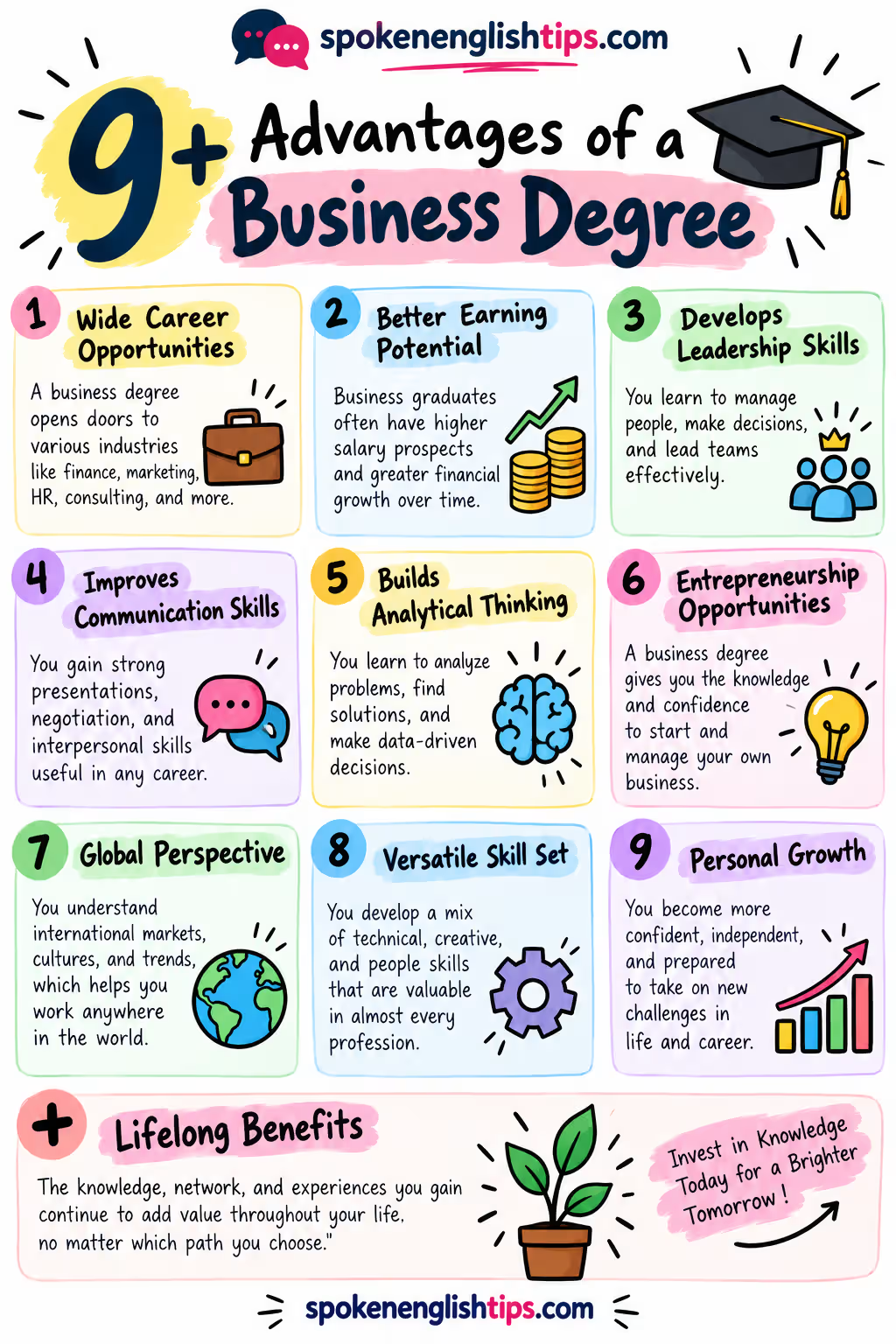
A business degree can be useful for one simple reason: business exists almost everywhere!
Banks need managers. Hospitals need administrators. Technology companies need marketers, analysts, sales teams, finance professionals, and project managers. Even charities, universities, construction companies, government organizations, and small local businesses need people who understand how organizations work.
That doesn’t mean a business degree automatically gives you a great job—or a huge salary. It doesn’t.
What it can give you is something different: a broad foundation that can be used across many roles, industries, and even your own business.
In the United States, Bureau of Labor Statistics data show that people with business degrees work across management, business and financial operations, sales, administration, technology, and other occupational groups. That variety is one of the biggest advantages of studying business.
So, what exactly can you gain from the degree? Let’s look at the practical advantages.
Advantages of a Business Degree
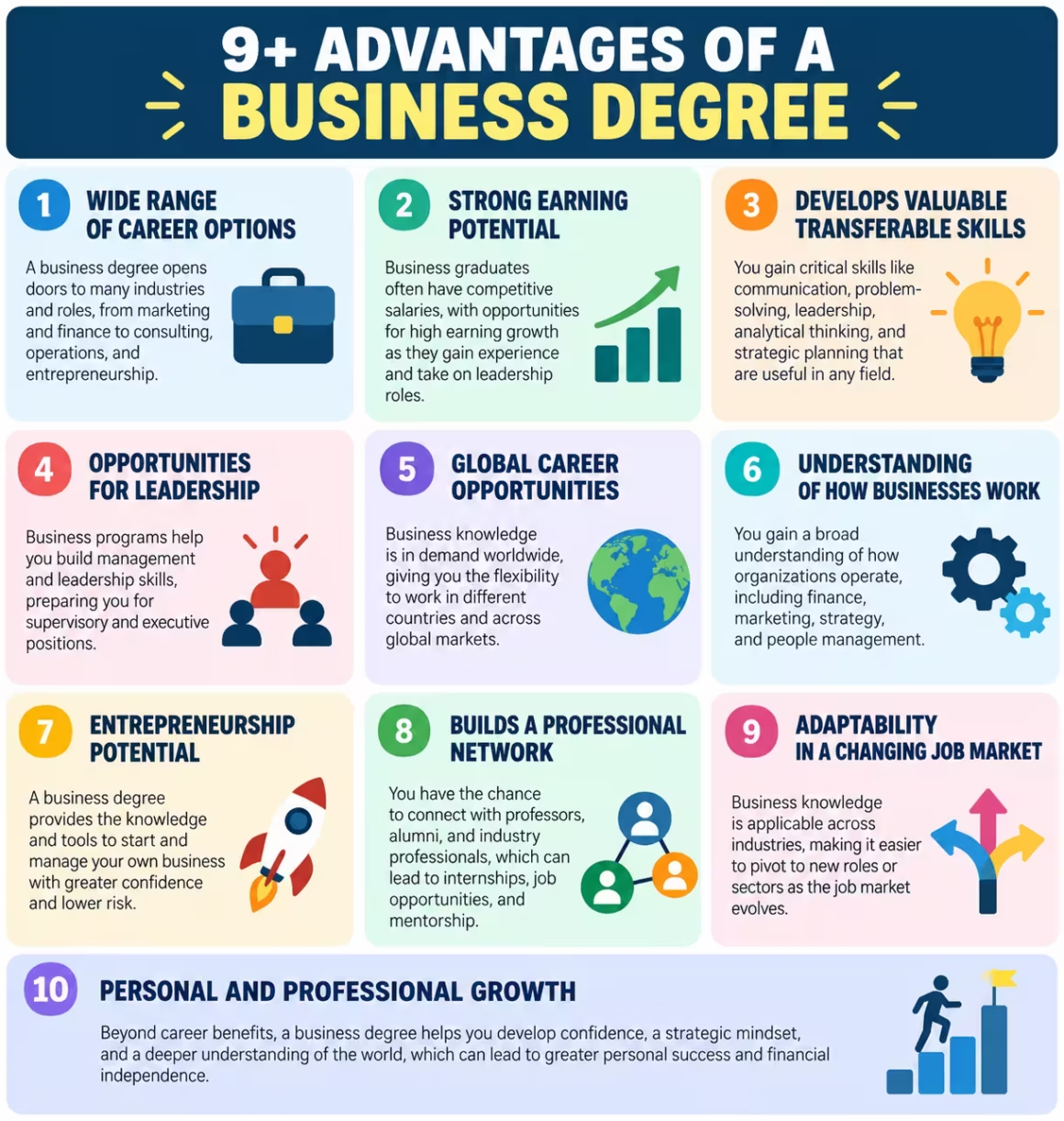
1. You aren’t locked into one career
This is probably one of the biggest advantages of a business degree.
You don’t study business and suddenly have only one job option waiting for you.
Depending on your major, skills, internships, and experience, you may explore areas such as:
- Marketing
- Finance
- Accounting
- Human resources
- Sales
- Operations
- Project management
- Business analysis
- Supply chain
- Consulting
- Entrepreneurship
And here’s where things get interesting: those functions exist in almost every industry.
You could work for a bank today, move into a technology company later, and eventually work in healthcare, manufacturing, retail, education, or another sector.
BLS data make this flexibility visible. In 2023, people with business degrees were distributed across management, business and financial operations, sales, office and administrative support, computer and mathematical occupations, and many other fields.
That’s useful if you’re still figuring out exactly where you want your career to go.
2. You learn how businesses actually work
Have you ever wondered why a company can have millions of customers—and still lose money?
Or why one company grows quickly while another, selling something similar, struggles?
Business education helps connect those pieces.
A general business program may introduce you to:
- Accounting
- Finance
- Economics
- Marketing
- Management
- Operations
- Business strategy
- Analytics
Instead of seeing each department separately, you begin to understand how they affect one another.
Marketing may bring customers in—but pricing affects revenue, operations affect delivery, finance affects investment, and management affects the people doing the work.
That’s an extremely useful way of thinking, even if you eventually specialize in only one area.
3. You develop skills that travel with you
A good business program doesn’t teach only business vocabulary.
It can help you develop skills that are useful in many kinds of jobs.
The U.S. Bureau of Labor Statistics identifies communication, adaptability, leadership, problem-solving, decision-making, critical and analytical thinking, mathematics, and computer and information-technology skills as important across many business occupations.
Think about how transferable those skills are.
If you know how to:
- Explain an idea clearly
- Analyze a problem
- Read basic financial information
- Work with a team
- Make decisions using data
- Present a recommendation
- Manage a project
…you can carry those abilities from one employer to another.
Software changes. Companies change. Job titles change.
Useful thinking and communication skills stay with you.
4. You can choose a specialization that matches you
“Business degree” is actually a very broad term.
You don’t necessarily have to study only general business administration.
Depending on the university, you may find degrees or concentrations in areas such as:
- Accounting
- Finance
- Marketing
- Human resources
- Business analytics
- Entrepreneurship
- Supply chain management
- Leadership
- International business
- Project management
For example, Penn State’s current overview of undergraduate business education includes accounting, business administration, data analytics, economics, finance, human resources, leadership, marketing, supply chain, and project-management-related areas.
That means you can start with an interest in business, then move toward an area that better fits your strengths.
Love numbers? Finance or accounting might interest you.
Enjoy understanding customers? Marketing could make more sense.
Like systems and problem-solving? Operations, analytics, or supply chain may suit you better.
The degree doesn’t have to be one-size-fits-all.
5. It can prepare you for entry-level opportunities
You don’t graduate and immediately become a CEO—that’s not how careers work!
But a business degree can provide academic preparation for several occupations where a bachelor’s degree is a common entry-level qualification.
BLS currently lists examples such as:
- Accountants and auditors
- Market research analysts
- Human resources specialists
- Project management specialists
- Logisticians
- Financial and investment analysts
Many of these occupations typically do not require previous related work experience for entry, although individual employers can still set their own requirements.
This is where internships, projects, software knowledge, communication skills, and practical experience can make your degree much more valuable.
The degree can open a door—but you still have to walk through it.
6. There is room to grow into management
A business degree can also provide a foundation for longer-term progression.
You might begin as:
Marketing Coordinator
and later become:
Marketing Manager
Or start as:
HR Specialist
and eventually move toward:
HR Manager
But experience matters here.
BLS notes that many management occupations typically require related professional experience before entry. In other words, a business degree can support the journey, but it does not instantly turn a new graduate into a manager.
That’s actually an important distinction.
Degree + skills + experience + results
is usually much more powerful than the degree alone.
7. You learn skills that can help if you want to start a business
Maybe you don’t want to work for a company forever.
Maybe you want to build one.
A business degree is certainly not required to become an entrepreneur. Plenty of successful businesses are created by people who never studied business formally.
Still, business education can give you useful foundations.
You may learn about:
- Pricing
- Costs
- Cash flow
- Marketing
- Customers
- Business planning
- Operations
- Hiring
- Strategy
- Financial statements
Imagine launching a small online business.
Making the product is only one part of the job.
You also need to ask:
Who is going to buy it?
How much should I charge?
What does it cost me to deliver?
How will customers discover it?
Am I actually making a profit?
That’s business thinking.
And it can be useful whether you’re running a startup, freelancing, building an agency, selling online, or operating a family business.
8. Business skills are useful across many industries
A finance professional doesn’t have to work only in a bank.
A marketing graduate doesn’t have to work only for an advertising agency.
A human-resources professional doesn’t belong to one specific industry.
Businesses in very different sectors need similar functions.
Think about a hospital.
It still needs:
- Finance
- HR
- Operations
- Procurement
- Marketing
- Administration
- Management
Now think about a software company.
It needs many of the same functions.
A hotel? Same story.
A construction company? Again—finance, procurement, HR, management, sales, project coordination, and administration all matter.
This cross-industry usefulness is one reason business education can remain flexible over a long career.
9. You can build communication and teamwork skills
Business is rarely a solo activity.
You may have to:
- Present an idea
- Work in a group
- Negotiate
- Write reports
- Explain numbers
- Speak with customers
- Coordinate with another department
- Defend a recommendation
Business courses often use presentations, group assignments, discussions, case studies, reports, and projects.
Yes, group projects can sometimes be frustrating!
But there’s a reason they exist: real workplaces involve people with different opinions, personalities, priorities, and responsibilities.
Learning how to communicate clearly—and how to work with other people—isn’t a small advantage. It’s something you’ll use again and again.
10. It can help you become more comfortable with numbers and decisions
You don’t have to become an accountant.
Still, understanding basic business numbers can be incredibly useful.
For example:
If a product sells for $100, that doesn’t mean the company earns $100.
There might be:
- $35 production cost
- $10 shipping
- $8 advertising
- $5 payment fees
- $12 overhead
Suddenly, that $100 sale looks very different.
Business education can help you become more comfortable with concepts such as:
- Revenue
- Costs
- Profit
- Cash flow
- Budgets
- Interest
- Investment
- Forecasting
- Return on investment
That knowledge is useful not only for finance jobs; managers, marketers, entrepreneurs, and project leaders also make decisions involving money.
11. It can provide a foundation for further study
A bachelor’s degree in business doesn’t have to be the end of your education.
Later, you may decide to pursue:
- MBA
- Master in Management
- Master’s in Finance
- Master’s in Marketing
- Business Analytics
- Accounting qualifications
- Professional certifications
You might also discover during your undergraduate studies that you enjoy one particular subject much more than the others.
That’s useful!
A general business background can help you identify where you want to specialize later, instead of making that decision without ever studying the subjects.
What Career Opportunities Can a Business Degree Lead To?
1. Business and financial roles
Depending on your specialization and qualifications, possible career directions can include:
- Accountant
- Financial analyst
- Market research analyst
- HR specialist
- Project management specialist
- Management analyst
- Logistician
BLS projects business and financial operations occupations, along with management occupations, to grow faster than the average for all U.S. occupations over its current projection period.
That does not mean every business graduate will get one of these jobs.
Occupation-specific education, experience, licensing, certifications, and employer requirements still matter.
2. Management opportunities later in your career
After gaining experience, business graduates may eventually move toward areas such as:
- Operations management
- Financial management
- Marketing management
- Sales management
- Human resources management
- General management
Again, experience matters.
BLS specifically shows that many management roles usually require prior related experience rather than being true entry-level positions.
3. Opportunities outside traditional business departments
Business graduates also appear in:
- Technology
- Healthcare
- Education
- Government
- Nonprofits
- Retail
- Manufacturing
- Construction
The skills don’t suddenly stop being useful because the company doesn’t have the word “business” in its name.
Is a Business Degree Worth It?
1. It depends on what you do with it
A business degree can be valuable—but simply earning one doesn’t guarantee success.
Your result will depend on things such as:
- Your specialization
- University
- Location
- Internships
- Work experience
- Technical skills
- Communication ability
- Professional network
- Industry
- Career decisions
That means two people can earn very similar degrees and have completely different career outcomes.
2. Combine the degree with practical skills
Suppose you’re studying marketing.
Don’t stop with theory.
Learn:
- Analytics
- Advertising platforms
- Excel
- CRM tools
- Content strategy
- Presentation skills
Studying finance?
Add:
- Excel
- Financial modeling
- Data analysis
- Industry knowledge
Interested in business analytics?
Build skills in:
- Excel
- SQL
- Visualization
- Statistics
- Data interpretation
The strongest combination is usually:
Business knowledge + practical skills + experience
That’s much more useful than relying on the qualification alone.
3. Consider the cost before enrolling
A degree is an investment of both money and time.
Before choosing a program, compare:
- Tuition
- Living expenses
- Scholarships
- Course quality
- Internship opportunities
- Career services
- Graduate outcomes
- Program recognition
- Total debt
Don’t choose a degree simply because someone says, “Business is a good field.”
Ask whether that specific program, at that specific cost, supports the career you actually want.
Are There Any Disadvantages?
1. A general business degree can be broad
Breadth is an advantage—but it can also become a weakness.
If you learn a little about everything but develop no deeper skill, you may struggle to stand out.
That’s why choosing useful electives, gaining experience, and developing practical skills matters.
2. Competition can be high
Business is a popular area of study.
BLS notes that U.S. institutions have awarded more bachelor’s degrees in business than in any other field since at least the 1980–81 academic year.
So having the degree alone may not differentiate you.
Internships, projects, certifications, technical skills, communication, and real work experience can help.
3. It is not required for every business career
You don’t necessarily need a business degree to:
- Start a company
- Work in sales
- Enter digital marketing
- Become a manager later in your career
- Learn business skills
People enter business careers through many routes.
So the question shouldn’t be:
“Is a business degree good?”
A better question is:
“Is a business degree the right way for me to reach the career I want?”