Business is a huge field! You can study money, people, marketing, technology, data, operations—or even learn how to start and manage your own company. So, when someone says, “I want a business degree,” that still leaves an important question: which one?
The good thing is that you have plenty of options. Business degrees can prepare students for careers in accounting, finance, management, marketing, human resources, analytics, supply chain, information systems, healthcare, entrepreneurship, and many other areas. In U.S. data, business management and administration, general business, accounting, marketing, and finance are among the largest business-major groups.
One small thing to understand before we start: universities don’t always use exactly the same degree names. A university might offer Business Analytics as a BS, while another offers it as a concentration inside a Business Administration degree. So, focus on the subject, curriculum, and career direction—not only the name printed on the degree.
Quick Comparison of Business Degrees
| Business Degree | Main Focus | Good Fit If You Like |
|---|---|---|
| Business Administration | Overall business operations | A little of everything |
| Accounting | Financial records and reporting | Numbers and accuracy |
| Finance | Money, investments and financial decisions | Money and analysis |
| Marketing | Customers, brands and promotion | Creativity + business |
| Human Resource Management | Employees and workplace management | Working with people |
| International Business | Business across countries | Global business |
| Entrepreneurship | Creating and growing businesses | Building new ideas |
| Business Analytics | Using data for business decisions | Data and problem-solving |
| Economics | Markets, incentives and economic decisions | Analysis and research |
| Supply Chain Management | Moving products and materials | Logistics and planning |
| Operations Management | Improving business processes | Systems and efficiency |
| Management Information Systems | Business + technology | Tech and management |
| Project Management | Planning and completing projects | Organization and leadership |
| Healthcare Administration | Business side of healthcare | Healthcare + management |
| Hospitality Management | Hotels, tourism and guest services | Service industries |
| Sport Management | Business side of sports | Sports + business |
| Real Estate | Property, investment and development | Property and finance |
| Risk Management and Insurance | Business risks and protection | Analysis and uncertainty |
| Organizational Leadership | Teams, leadership and organizations | Leading people |
| Master of Business Administration | Advanced general management | Leadership and career growth |
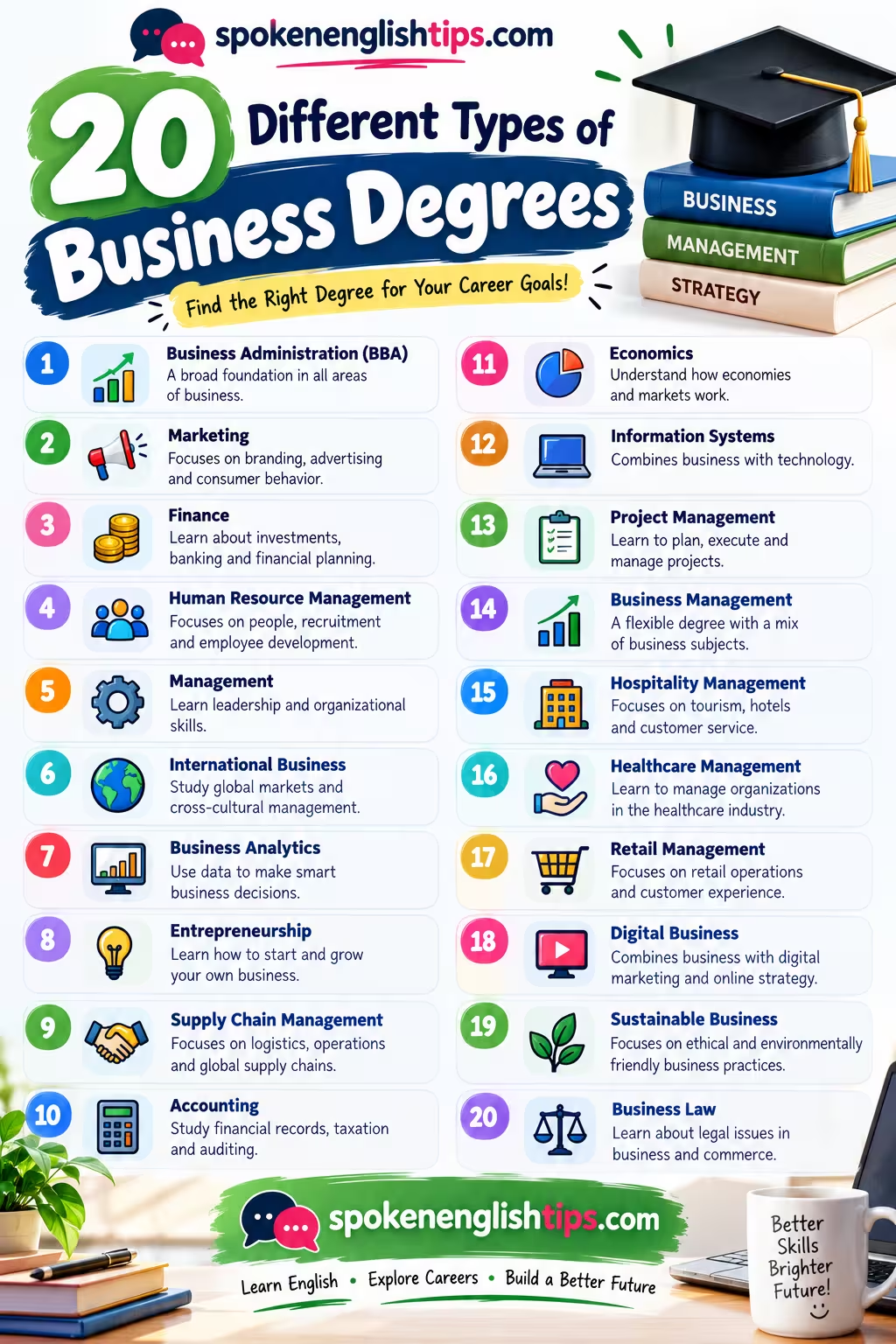
20 Different Types of Business Degrees
1. Business Administration
A Business Administration degree is one of the broadest choices you can make. Instead of concentrating on just one area, you usually study a mix of management, finance, accounting, marketing, economics, operations, and business strategy. That’s why it can work well if you’re interested in business but don’t want to narrow yourself down too early. Many programs also let you add a concentration later—finance, marketing, entrepreneurship, analytics, or another area.
2. Accounting
Love working with numbers, details, records, and rules? Accounting may be worth considering. You’ll typically learn how businesses record financial transactions, prepare financial statements, understand costs, handle taxation, and examine financial information. Accounting isn’t simply “doing calculations,” either—it helps organizations understand where their money is going and whether their financial information is accurate. Accounting is also one of the largest traditional business-major categories.
3. Finance
A Finance degree focuses on how money is raised, invested, managed, and used. You may study corporate finance, investments, financial markets, financial analysis, risk, and portfolio management. If you enjoy looking at numbers and asking questions such as, “Is this investment worth it?” or “How should this company use its money?” finance could be a natural fit. It’s different from accounting—finance generally looks more toward financial decisions, while accounting focuses heavily on recording and reporting financial activity.
4. Marketing
Marketing is about understanding customers—and then connecting the right product, message, price, and experience with them. A Marketing degree can cover consumer behavior, branding, advertising, digital marketing, market research, social media, sales, and marketing strategy. So, yes, there’s creativity involved! But modern marketing also involves plenty of data, testing, measurement, and customer analysis. Marketing and marketing research account for a significant share of business majors in U.S. degree data.
5. Human Resource Management
Businesses don’t operate without people, and that’s exactly where Human Resource Management comes in. This degree focuses on recruiting, employee development, compensation, workplace policies, performance management, organizational behavior, and labor relations. It’s a good option if you enjoy communicating, solving workplace problems, helping teams function effectively, and understanding how organizations manage their employees. Universities currently offer HR management as both undergraduate and graduate business programs.
6. International Business
Want to understand how companies operate beyond one country? An International Business degree explores business across different markets, cultures, economies, and regulatory environments. Courses may cover international trade, global marketing, multinational management, international finance, and cross-cultural communication. It’s especially relevant for students interested in multinational companies, global supply chains, importing and exporting, or international business development. But remember—“international” doesn’t automatically mean you’ll spend the whole degree traveling abroad!
7. Entrepreneurship
An Entrepreneurship degree focuses on creating, developing, and growing businesses. You may learn how to identify opportunities, test business ideas, create business models, understand customers, develop products, find funding, and manage a young company. And no—you don’t necessarily have to become a startup founder! Entrepreneurship skills can also be useful inside established companies where employees develop new products, services, or business units. Universities such as SNHU currently offer entrepreneurship within their business programs.
8. Business Analytics
Businesses collect enormous amounts of data—but data isn’t very useful if nobody knows what to do with it! Business Analytics focuses on using data, statistics, visualization, and analytical methods to support business decisions. Depending on the program, students may work with spreadsheets, databases, dashboards, forecasting, and analytical software. This degree can suit someone who enjoys numbers and technology but also wants to understand how analysis affects real business decisions. Business analytics is now offered as a dedicated undergraduate and graduate study area at many schools.
9. Economics
Economics asks some big questions: Why do prices change? Why do consumers behave differently? What happens when interest rates rise? How do governments, businesses, and markets influence one another? An Economics degree studies topics such as microeconomics, macroeconomics, incentives, markets, forecasting, and economic policy. It can be more theoretical and quantitative than a general business degree, but it’s useful for students who enjoy analysis and want to understand the forces shaping business and financial decisions.
10. Supply Chain Management
Ever wondered how a product travels from raw material… to factory… to warehouse… to your doorstep? That’s supply chain management. A Supply Chain Management degree explores sourcing, procurement, logistics, inventory, transportation, distribution, and supply networks. It’s a practical business field because companies constantly need to get the right products to the right places—on time, at the right cost. Current university programs combine supply chain with areas such as operations and logistics.
11. Operations Management
Operations Management focuses on how organizations actually get work done. Students learn how to improve processes, use resources efficiently, manage quality, plan capacity, control inventory, and solve operational problems. Think of it this way: strategy may decide what a company wants to accomplish; operations helps determine how it can accomplish it efficiently. It’s particularly useful for people who enjoy processes, systems, planning, and finding better ways of doing things.
12. Management Information Systems
Can’t decide between business and technology? Management Information Systems, or MIS, sits right between them. It examines how organizations use information systems, databases, software, technology, and data to support business operations and decisions. Students may study both technical and management subjects, making it different from a pure computer science degree. This field can be useful for careers connecting business teams with technology teams—something almost every modern organization needs.
13. Project Management
A good idea isn’t worth much if nobody can actually deliver it! Project Management focuses on planning projects, organizing teams, managing budgets, handling risks, tracking deadlines, and completing work within defined goals. You’ll learn how different pieces of a project fit together—and what to do when things don’t go according to plan. It can be useful across technology, construction, healthcare, consulting, manufacturing, marketing, and many other industries because projects happen almost everywhere.
14. Healthcare Administration
Healthcare isn’t only doctors, nurses, and clinical care—hospitals and healthcare organizations also need people who understand finance, operations, staffing, policy, technology, and management. A Healthcare Administration degree applies business and management principles specifically to healthcare organizations. It can suit someone interested in healthcare but more attracted to its administrative and management side than to providing clinical treatment. Universities currently offer healthcare administration at undergraduate and graduate levels.
15. Hospitality Management
Hotels, resorts, restaurants, events, tourism businesses—these organizations all need management, too! A Hospitality Management degree combines core business knowledge with topics related to guest experience and service operations. Students may study hotel operations, food and beverage management, tourism, events, marketing, revenue management, and customer service. It’s a more industry-focused business degree, making it particularly suitable if you already know that hospitality or tourism interests you.
16. Sport Management
Love sports—but don’t necessarily want to become an athlete? Sport Management examines the business behind teams, leagues, events, facilities, sponsorships, marketing, ticketing, and sports organizations. Students typically combine general business concepts with subjects specific to the sports industry. It’s worth remembering, though, that loving football or basketball isn’t enough by itself! This is still a business field, so you’ll deal with budgets, marketing, operations, contracts, management, and organizational decisions. Sport management is currently offered as a business-related degree at universities such as SNHU.
17. Real Estate
A Real Estate degree examines property from a business and investment perspective. Depending on the university, the curriculum may include real estate finance, property markets, valuation, development, investment, law, and asset management. It can be useful for people interested in commercial property, development, investment analysis, property management, or related areas. And, importantly, studying real estate is broader than simply learning how to sell houses—the industry includes financing, investing, development, valuation, and large-scale commercial projects.
18. Risk Management and Insurance
Every company faces uncertainty—accidents, financial losses, cyber incidents, legal problems, supply interruptions, natural disasters, and much more. Risk Management and Insurance teaches students how organizations identify, evaluate, reduce, transfer, and finance these risks. You’ll commonly encounter insurance, financial risk, business continuity, risk analysis, and related topics. It’s a more specialized business field, but that’s exactly what may make it appealing if you enjoy analytical thinking and planning for situations that may—or may not—happen.
19. Organizational Leadership
A company can have money, technology, and a fantastic product… but poor leadership can still cause serious problems. Organizational Leadership focuses on how people lead teams, communicate, make decisions, manage change, resolve conflict, and shape organizational culture. Compared with a broad business administration program, it generally places more emphasis on people and leadership. It may suit someone aiming for supervisory, management, team-leadership, or organizational-development roles.
20. Master of Business Administration (MBA)
The Master of Business Administration, or MBA, is different from most entries above because it’s a postgraduate business degree rather than simply a subject major. MBA programs typically bring several business areas together—finance, marketing, accounting, strategy, leadership, operations, and analytics—and are often designed for people who want broader management knowledge or career progression. Some MBAs also let you specialize in finance, marketing, technology, healthcare, entrepreneurship, or other areas.
Which Business Degree Should You Choose?
Don’t ask, “Which business degree is the best?” There isn’t one answer.
Instead, ask yourself:
1. What subjects do I genuinely enjoy?
Numbers may point you toward accounting, finance, economics, or analytics. People and communication may lead toward HR, marketing, or leadership. Technology could point toward MIS or analytics.
2. What kind of work do I want to do?
Start with the career—not just the degree name. Then check which qualification employers commonly expect for that career.
3. Do I want a broad or specialized degree?
Business Administration gives you broad exposure; Accounting, Finance, Supply Chain, Analytics, and similar programs take you deeper into a particular area.
4. What does the actual curriculum contain?
Two universities can offer degrees with almost identical names but very different courses. Read the modules before choosing!
There’s plenty of room to move between business careers, too. U.S. Bureau of Labor Statistics data shows business degree holders working across management, business and financial operations, sales, technology, administration, and other occupational groups—another reminder that your degree does not lock you into one job forever.