Finding a good English tuition centre in Singapore is not just about choosing a famous name. Your child might need help with grammar, composition writing, reading comprehension, or speaking confidently. Different tuition centres focus on different skills, and their fees can vary quite a lot.
For example, published upper-primary English tuition fees among the centres reviewed here range from S$85 to S$158.60 for a weekday lesson at selected providers. Other centres use different billing methods, and some charge extra fees when you enrol.
This guide compares seven established English tuition providers in Singapore, explains their published fees, and helps you decide which learning approach might suit your child.
Last researched: 30 October 2026. Fees and programmes can change. Always confirm the latest quotation, GST treatment, class timetable and available places before enrolling.
Best English Tuition Centres in Singapore at a Glance
The following seven providers are worth comparing, depending on your child’s learning needs.
| Tuition centre | Suitable for | Main learning focus |
|---|---|---|
| Write Edge | Primary and secondary students | English enrichment and structured writing |
| The Write Connection | Primary and secondary students | Composition, comprehension and critical writing |
| Lil’ but Mighty | Primary and secondary students | Small-group English tuition and exam skills |
| Thinking Factory | Primary 3–6 | PSLE English, writing and oral preparation |
| Mind Stretcher | Primary and secondary students | School-based English and exam preparation |
| The Learning Lab | Preschool to junior college | Structured academic enrichment |
| British Council | Children and teenagers | English communication, reading and writing |
How were these centres selected?
We reviewed publicly available programme descriptions, official fee pages, supported school levels, class formats and practical information.
These are examples of established providers with useful published information. They are not ranked by independently tested teaching quality, and inclusion does not guarantee that every centre will suit every student.
A centre with smaller classes may appeal to a child who needs more attention. Another child might respond better to structured worksheets, guided discussions, or focused writing practice.
English Tuition Fees in Singapore: 2026 Comparison
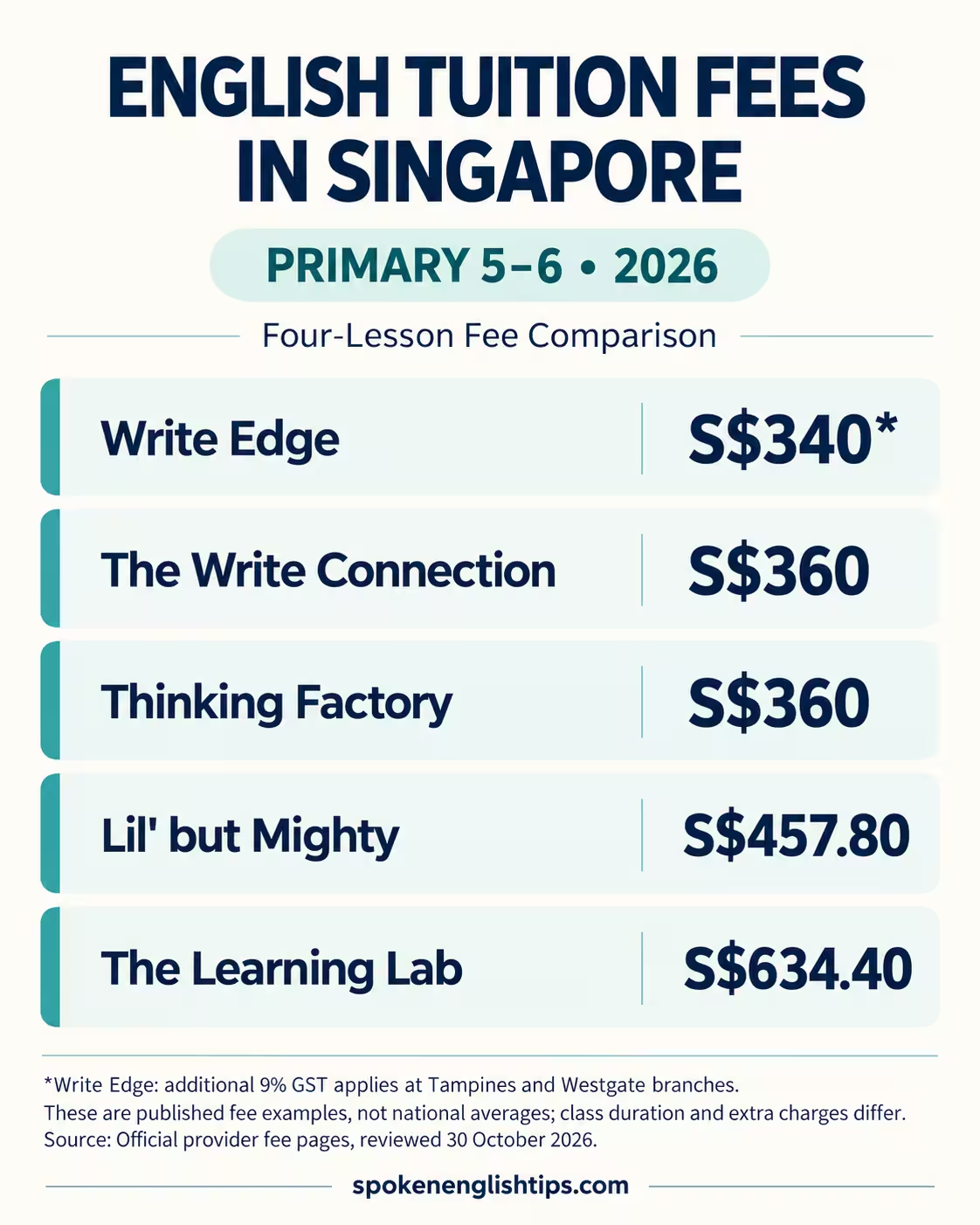
English tuition fees depend on the student’s school level, programme, lesson duration, location and payment schedule.
To make the comparison clearer, the table below uses Primary 5–6 English tuition wherever possible.
| Tuition centre | Published P5–6 fee | Four-lesson comparison |
|---|---|---|
| Write Edge | S$85 per 2-hour lesson | S$340 before any applicable branch GST |
| The Write Connection | S$90 per 2-hour weekday lesson | S$360 |
| Thinking Factory | S$90 per lesson | S$360 |
| Lil’ but Mighty | S$114.45 per 2-hour lesson | S$457.80 |
| The Learning Lab | S$158.60 per weekday lesson | S$634.40 |
| Mind Stretcher | S$272.50 per four academic weeks, weekday | S$272.50 (academic year 2027) |
| British Council | From S$2,184 per semester | Different billing basis; not directly comparable |
Important pricing notes: These are published examples, not a Singapore-wide average. Four-lesson figures are the stated fee multiplied by four or the provider’s published four-week rate. They do not represent every calendar month or the full initial payment.
Write Edge’s listed rates attract an additional 9% GST at its Tampines and Westgate branches. The Write Connection, Lil’ but Mighty, The Learning Lab and Mind Stretcher state that their quoted fees include GST. Thinking Factory lists no applicable GST.
Mind Stretcher’s figure is for its 2027 academic year, which starts on 2 November 2026 for most levels. British Council bills by term or semester, so its semester figure should not be treated as a four-week price.
Sources: Write Edge, The Write Connection, Thinking Factory, Lil’ but Mighty, The Learning Lab, Mind Stretcher, and British Council.
[INSERT INFOGRAPHIC 1 HERE — English Tuition Fees Comparison]
1. Write Edge — English and Creative Writing Tuition
Write Edge offers English enrichment and creative writing programmes for primary school students, along with secondary-level English courses.
Its approach may interest parents whose children have ideas but struggle to turn them into clear sentences and well-organised compositions.
What does Write Edge teach?
Its programmes cover areas such as composition planning, vocabulary, grammar, comprehension and writing techniques. Students can practise organising ideas before writing and learn ways to make their explanations clearer.
The centre also offers broader English enrichment programmes, so parents should ask how much lesson time goes toward writing compared with other English skills.
Write Edge tuition fees
Its published 2026 schedule states:
| School level | Fee per lesson | Duration |
|---|---|---|
| Primary 1–2 | S$70 | 2 hours |
| Primary 3–4 | S$80 | 2 hours |
| Primary 5–6 | S$85 | 2 hours |
| Secondary 1–4 | S$95 | 2 hours |
There is also an S$80 registration fee and S$100 refundable deposit. The centre lists no separate materials fee.
Remember that 9% GST applies at its Tampines and Westgate branches.
Locations: Its published branch list includes Tampines, Bedok, Punggol, Sengkang, Beauty World, Westgate and several other locations, as well as online classes.
Who should consider it? Parents seeking regular writing practice and a structured English enrichment programme.
Official information: Fees and branch locations.
2. The Write Connection — English Tuition and Writing Development
The Write Connection provides primary English tuition, writing enrichment, and secondary critical reading and writing programmes.
One useful distinction is its separation between general English tuition and writing enrichment. These programmes may address different needs.
For example, a Primary 5 student who struggles mainly with composition may need more guided writing practice. Another student who loses marks across grammar and comprehension may benefit from broader tuition.
The centre’s primary English tuition programme covers examination-related components, while its secondary programme focuses on more advanced reading and writing skills.
The Write Connection fees
| School level | Weekday lesson | Weekend lesson |
|---|---|---|
| Primary 1–2 | S$80 | S$85 |
| Primary 3–4 | S$87 | S$92 |
| Primary 5–6 | S$90 | S$95 |
| Secondary 1–4 | S$100 | S$105 |
Primary and secondary lessons listed above are two hours long.
The centre also publishes an S$85 registration fee, S$100 refundable deposit and S$12.50 termly materials fee. Its published rates include GST, and fees are collected by the term.
Who should consider it? Families who want to choose between comprehensive English tuition and a more focused writing programme.
Official information: Course fees and programme FAQs.
3. Lil’ but Mighty — Small-Group English Tuition
Some children feel nervous asking questions in a large classroom. They may understand a lesson but stay silent when they need help.
Lil’ but Mighty focuses on English tuition for primary and secondary students and publishes a maximum class size of six students.
Its programmes use structured learning activities to help children practise English skills and explain what they have learned.
That smaller class limit may appeal to parents who want their child to have more chances to participate, although a small group does not automatically guarantee individual attention.
Lil’ but Mighty tuition fees
Its published 2026 rates are:
| School level | Fee per lesson | Four lessons |
|---|---|---|
| Primary 1–2 | S$103.55 | S$414.20 |
| Primary 3–4 | S$109.00 | S$436.00 |
| Primary 5–6 | S$114.45 | S$457.80 |
| Secondary 1–2 | S$119.90 | S$479.60 |
| Secondary 3–4 | S$125.35 | S$501.40 |
Lessons last two hours and the listed prices include GST.
The centre bills monthly, which may mean four or five lessons depending on its lesson calendar. A deposit equal to four weeks of course fees is required upon registration.
It offers on-site primary classes and online options for eligible levels.
Who should consider it? Students who may benefit from small-group discussion, regular participation and structured examination practice.
Official information: 2026 course fees.
4. Thinking Factory — PSLE English Preparation
Thinking Factory specialises in English support for primary school students.
Its programmes focus on important skills such as composition writing, grammar, comprehension, vocabulary and oral communication.
Consider a Primary 5 student who writes interesting stories but frequently makes grammar mistakes. The child may need a different improvement plan from someone who understands grammar but struggles to explain answers in comprehension exercises.
Thinking Factory’s Primary 3 programme, for example, describes weekly writing and Paper 2 practice, along with periods of oral preparation.
Thinking Factory fees
Its published 2026/2027 lesson rates are:
| Level | Fee per lesson |
|---|---|
| Primary 3 | S$75 |
| Primary 4 | S$80 |
| Primary 5 | S$90 |
| Primary 6 | S$90 |
The provider states that GST is not applicable.
The published Primary 3 programme describes two-hour lessons and online or on-site attendance. Parents should confirm the duration and timetable for the specific upper-primary class they choose.
Who should consider it? Primary school students needing focused English improvement, particularly before the PSLE.
Official information: Pricing and Primary 3 programme details.
5. Mind Stretcher — English Tuition Across School Levels
Mind Stretcher is another option for parents comparing English tuition across multiple primary and secondary levels.
Its offerings include English, other academic subjects and separate writing-related programmes. This can be useful when a family wants to organise several subjects through the same provider.
The centre has published fees and registration details for academic year 2027, which begins in November 2026 for most levels.
Mind Stretcher published 2027 fees
| School level | Weekday, four academic weeks | Weekend, four academic weeks |
|---|---|---|
| Primary 1–3 | S$250.70 | S$272.50 |
| Primary 4–6 | S$272.50 | S$294.30 |
| Secondary 1–4 | S$294.30 | S$316.10 |
The stated fees include GST and cover relevant subjects including English.
The standard registration fee is S$76.30, and the provider requires a deposit equal to five academic weeks of fees per subject. Promotions may change the amount payable.
Mind Stretcher lists locations across the north, south, east and west of Singapore, with online options.
Who should consider it? Families who prefer a multi-subject tuition provider with published fee schedules and several centre locations.
Official information: Academic year 2027 registration and fees.
6. The Learning Lab — Structured Academic English Programmes
The Learning Lab provides educational programmes from preschool through junior college.
Its English programmes are suitable for parents who want to examine a structured curriculum with regular academic learning activities.
However, a more expensive programme is not automatically a better programme.
Before enrolling, ask how the centre handles students who are behind in grammar, reading or writing. A child who needs to rebuild basic skills may require a different lesson pace from a child who is already confident and wants more challenging work.
The Learning Lab English fees
Its published 2026–2027 schedule includes these weekday fees for four lessons:
| School level | Published weekday fee |
|---|---|
| Primary 1–4 | S$575.52 |
| Primary 5–6 | S$634.40 |
| Secondary 1–4 | S$667.08 |
| Junior College | S$701.96 |
These prices apply to the listed subject programmes at the relevant level. The junior college fee covers programmes including General Paper, which is different from primary or secondary English tuition.
The centre also states a one-time registration fee of S$98.10 and a refundable deposit of S$150 per subject.
Its listed fees include GST.
Who should consider it? Families looking for a structured academic programme and comfortable with the higher published fees.
Official information: Course fees 2026–2027.
7. British Council Singapore — English Communication and Language Development
English learning is not only about examination marks.
Some students also need help expressing ideas, reading confidently and speaking naturally in different situations.
British Council Singapore offers English courses for children and teenagers, including programmes aligned with Singapore’s Ministry of Education syllabus.
Its primary courses use discussions, reading activities, group work and writing tasks to develop language skills.
The centre may also be relevant to families who have recently moved to Singapore and want to explore English language support. However, parents should choose the particular programme carefully rather than assume every course has the same examination focus.
British Council English course fees
The provider lists primary English courses starting from S$2,184 per semester.
Its published 2026 lower-primary course schedules show fees of S$2,184 for several semester classes, although exact prices can vary by programme and timetable.
Primary classes in the published timetable generally last one hour and 45 minutes.
Locations: Napier Road and Toa Payoh.
Who should consider it? Families interested in broader English language development, communication and reading confidence alongside school learning.
Official information: Primary English courses and 2026 course dates and fees.
Which English Tuition Centre Is Best for Your Child?
There is no single answer for every student.
Instead of asking which centre has the most impressive advertisement, begin with the problem your child needs to solve.
| Your child’s main need | What to look for |
|---|---|
| Weak grammar | Regular correction, explanations and focused practice |
| Difficulty writing compositions | Guided planning, writing practice and detailed marking |
| Poor comprehension | Practice explaining answers using evidence from passages |
| Low speaking confidence | Small-group discussions and structured oral practice |
| PSLE preparation | Coverage of examination components and timed practice |
| Secondary English | More advanced reading, writing and examination skills |
| Limited family budget | Transparent fees, suitable lesson length and manageable commitments |
For example, a student who writes weak compositions may benefit from weekly marked writing exercises.
A student who reads slowly may first need more suitable reading material and help understanding paragraphs.
A student who understands English but struggles to speak may need regular conversation practice.
These are different learning problems. They should not all receive the same solution.
What Should PSLE English Tuition Cover?
For Primary 5 and Primary 6 students, it is especially important to understand what the Primary School Leaving Examination assesses.
The Singapore Examinations and Assessment Board lists four areas in the English Language examination:
- Writing: Developing and organising ideas in written English.
- Language Use and Comprehension: Understanding passages, grammar and vocabulary.
- Listening Comprehension: Understanding spoken information.
- Oral Communication: Reading aloud and discussing ideas clearly.
The official 2026 PSLE examination format page provides the current examination documents.
A useful question to ask a centre is: “How much time will my child spend on each of these skills?”
A programme that focuses strongly on composition might be valuable, but it may not be enough for a student who also needs intensive comprehension support.
Important Change for Secondary English Students in 2027
Parents of secondary school students should know about Singapore’s upcoming national examination change.
According to the Singapore Examinations and Assessment Board, 2026 is the final year of the existing GCE N-Level and O-Level qualifications.
From 2027, students will sit the Singapore-Cambridge Secondary Education Certificate (SEC) examinations at their relevant subject levels: G1, G2 or G3.
The examination standards are maintained, but students should make sure their tuition programme matches the correct subject level and examination year.
A parent enquiring about Secondary 3 or Secondary 4 English should therefore ask whether the course materials and revision schedule are suitable for the student’s upcoming examination.
Source: SEAB — Secondary Education Certificate.
English Tuition Centre vs Private English Tutor: Which Is Better?
Some students prefer learning with classmates. Others need a teacher who can spend the entire lesson addressing their individual mistakes.
Both options have benefits.
| Factor | Tuition centre | Private tutor |
|---|---|---|
| Teaching format | Usually group classes | Usually one-to-one |
| Lesson pace | Based on a class programme | Can be adjusted for one student |
| Discussion opportunities | Students can learn with peers | More direct tutor-student discussion |
| Writing feedback | Depends on class size and teaching approach | More time may be available for individual feedback |
| Scheduling | Set timetable | Can sometimes be negotiated |
| Fees | Published by some centres | Depends on the individual tutor |
A tuition centre may work well for a child who enjoys structured lessons and learning alongside others.
Private tutoring may be worth considering if a student needs intensive help with specific areas.
For instance, a Secondary 2 student who repeatedly makes the same grammar mistakes might benefit from individual diagnosis and correction.
However, parents should not assume that private tuition always produces better results. The teacher’s ability, lesson plan and relationship with the student matter more than the format alone.
How Much Should You Budget for English Tuition?
The lesson fee is only one part of the cost.
Some centres collect tuition for a full term. Others use monthly billing. Registration fees, deposits and materials may also affect the initial amount.
Example: Write Edge Primary 5 tuition
Using its published 2026 fee schedule at a branch where additional GST does not apply:
| Item | Calculation | Amount |
|---|---|---|
| 12 English lessons | S$85 × 12 | S$1,020 |
| One-time registration | Published charge | S$80 |
| Refundable deposit | Published charge | S$100 |
| Illustrative initial amount | S$1,200 |
This example assumes enrolment for one complete 12-lesson term, with no promotion or extra charges. The S$100 deposit is refundable subject to the centre’s conditions.
The actual initial bill can differ depending on the branch, enrolment date and term-payment rules.
For longer-term budgeting, parents should also consider transport, school holidays, missed lessons, extra workshops and the child’s available study time.
Common Mistakes Parents Should Avoid
Choosing only by price
An affordable class can be a good choice. But a low price is not helpful if the lessons do not address the child’s learning needs.
Compare the actual teaching offered, not just the amount on the fee page.
Paying for several programmes without a clear reason
A student may already have school homework, reading assignments and other tuition subjects.
Adding more classes can reduce the time available for independent practice.
Begin with the areas that genuinely need attention.
Expecting immediate grade improvements
Learning to write clearly or understand difficult passages takes repeated practice.
Do not judge a programme only by one examination result. Look for changes in the quality of answers, error patterns, confidence and independence over time.
Ignoring your child’s opinion
Ask whether the child understands the explanations, feels comfortable asking questions and knows what to practise after class.
A programme that looks impressive to a parent may not be the best learning environment for the student.
How to Measure Whether English Tuition Is Working
You do not need to wait for an important examination to check progress.
Try a simple four-week review.
Week 1: Keep one school composition or comprehension exercise as a starting sample.
Week 2: Identify two or three repeated errors and ask the child to explain the teacher’s corrections.
Week 3: Give the child a similar task without immediate help.
Week 4: Compare the new work with the starting sample.
Look for clearer sentences, more complete answers, stronger vocabulary choices or fewer repeated errors.
This is not a formal measure of teaching quality, but it can help you discuss progress with the tutor.
Parents can also support learning through regular reading and simple English conversations at home.
Are English Tuition Classes Necessary for Every Student?
No. Not every child needs extra tuition.
If your child is learning comfortably, enjoying English and making steady progress, regular reading and school activities may provide enough practice.
Before enrolling, speak with your child’s school teacher and identify whether there is a particular difficulty.
Some children need professional learning support. Others may improve through consistent reading, writing and speaking practice.
If the child has persistent difficulties that tuition alone is not addressing, discuss the concern with the school rather than simply adding more classes.
Frequently Asked Questions
1. What is the best English tuition centre in Singapore?
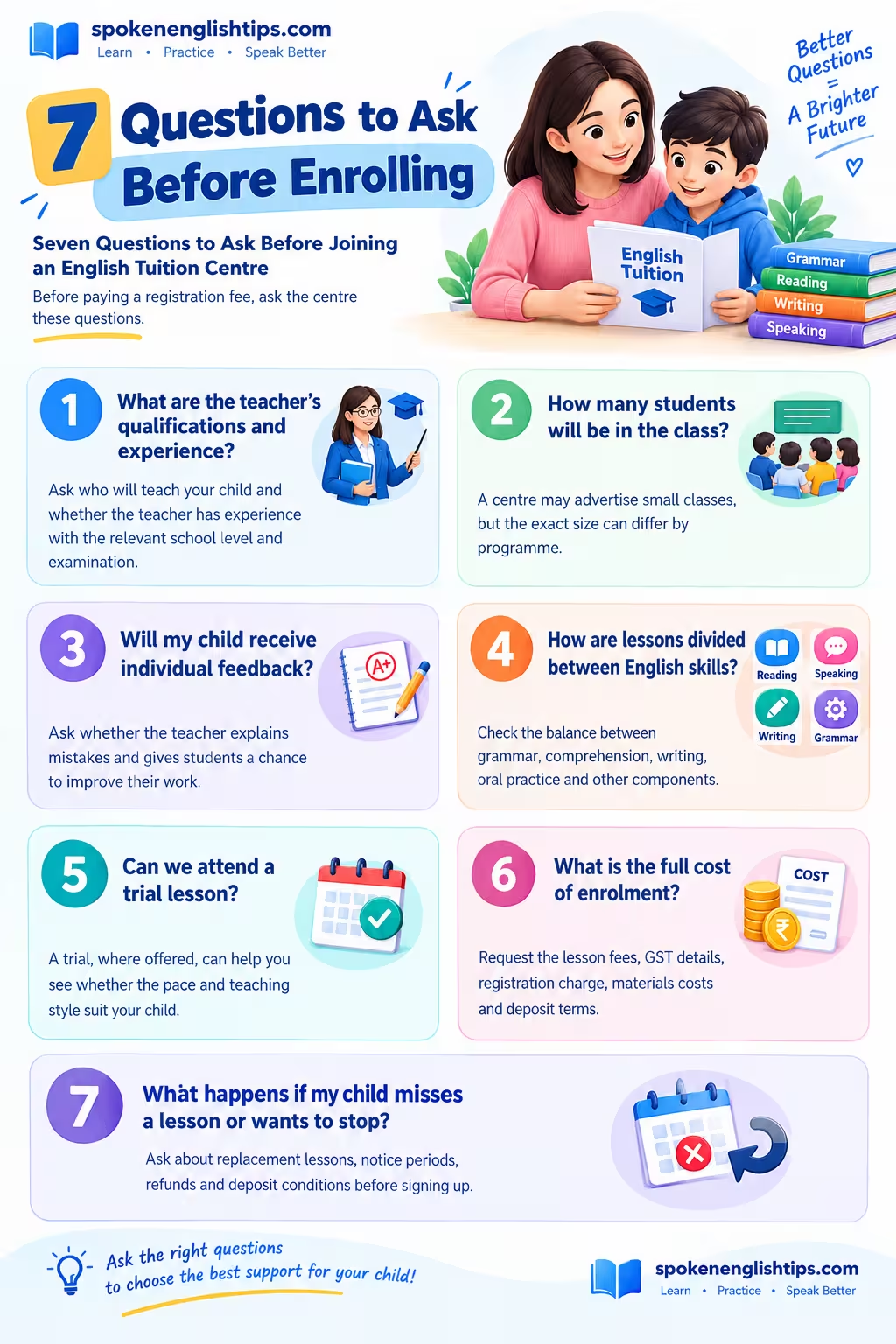
The best choice depends on the child’s school level, weaknesses, learning style, location and budget. Compare programmes and ask for a trial lesson where available rather than relying on a single ranking.
2. How much does English tuition cost in Singapore?
Fees vary considerably. Among the published P5–P6 weekday lesson prices reviewed here, examples include S$85 at Write Edge before applicable branch GST, S$90 at The Write Connection and Thinking Factory, S$114.45 at Lil’ but Mighty, and S$158.60 at The Learning Lab. Other providers use four-week or semester billing.
3. Is English tuition useful for PSLE preparation?
It can be useful when a child needs targeted help with writing, comprehension, listening or oral communication. The programme should address the child’s actual difficulties and the relevant examination format.
4. Are small English tuition classes better?
Small classes can provide more opportunities to ask questions. However, lesson quality, teaching methods and feedback remain important. Ask what happens during a typical lesson.
5. When should a child start English tuition?
There is no single correct age. Tuition may be helpful when schoolwork reveals a persistent problem that needs extra attention. Parents should first consider the child’s needs, workload and motivation.
6. Are online English tuition classes effective?
Online lessons can be convenient and may suit students who are comfortable learning through a screen. Ask whether the programme includes live interaction, feedback and opportunities to practise speaking and writing.
7. Can adults attend these English tuition centres?
Most of the school-level courses in this comparison are designed for children and teenagers. Adult learners should look for adult English language programmes, communication classes or private tutors instead. British Council Singapore also offers separate adult English courses.
Final Thoughts
Choosing an English tuition centre in Singapore should begin with understanding your child’s learning needs.
Write Edge and The Write Connection are worth examining for writing-focused programmes. Lil’ but Mighty offers published small-group classes. Thinking Factory concentrates on primary English skills. Mind Stretcher provides multi-subject tuition options, while The Learning Lab and British Council offer broader structured programmes at different price points and with different teaching approaches.
Before enrolling, compare the exact class, request the full fee breakdown and ask how progress will be measured.
A suitable English tuition programme should help your child understand mistakes, practise independently and become more confident using the language.