Ever had that moment where your brain just goes blank? You’re trying to order a coffee or talk to a new friend in English, but the words stay stuck in your throat.
It feels like everyone else got a secret manual that you missed.
Here’s the deal: You don’t need a manual. You just need the right tool.
With so many choices, finding the best apps to learn English can feel like trying to pick a movie on Netflix—you spend so much time scrolling that you never actually start watching.
I’ve seen students spend months on the wrong app English learning path, only to feel frustrated and quit.
But don’t worry. I’ve got your back.
In this guide, we’re going to find the perfect learn english app for your specific goals so you can start speaking with confidence today.
Why Your Choice Matters More Than You Think
Think about it: Why are you doing this?
Maybe you want to travel the world without feeling lost.
Maybe you’re looking to land a dream job and need to write a perfect message for a hiring manager.
Or maybe you just want to understand the memes your friends are sharing online.
In 2026, English isn’t just a school subject; it’s a global “key” that opens doors to better jobs and bigger adventures.
The problem is that most people think every English learning app is the same.
But they aren’t.
Some apps are great for games, while others are built for serious career growth.
If you use the wrong one, you might learn 500 words but still not be able to hold a five-minute conversation.
We want you to learn fast, but we also want you to learn the right things.
The “Big Three” Paths to Fluency
Before you hit download, you need to know which “lane” you’re in.
Most apps to learn English fall into one of these three categories:
1. The Habit Builders (For Beginners)
If you’re just starting out, you need something that makes you want to come back every day.
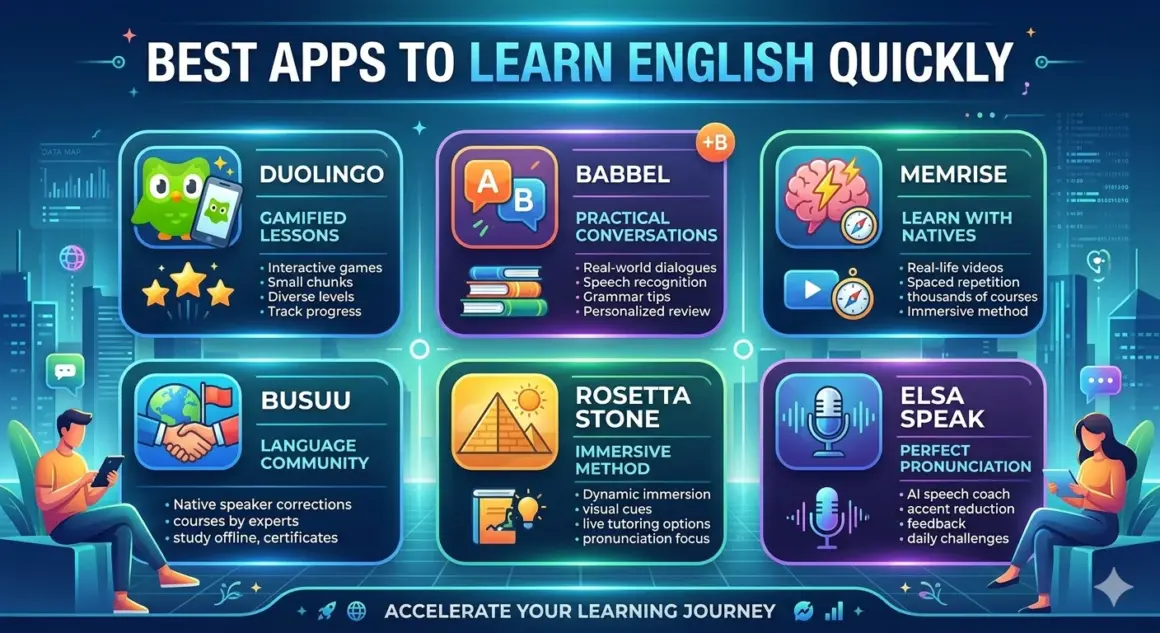
Duolingo is the king of this lane.
It uses games, points, and a very persistent green owl to keep you moving.
It’s perfect for learning the basics without feeling like you’re studying.
Mondly is another solid choice here for building a basic foundation with bite-sized lessons.
2. The Conversation Coaches (For Speaking)
Once you know the basics, you have to start talking.
This is where most students get stuck.
Italki is fantastic because it connects you with real humans for 1-on-1 lessons.
There’s no substitute for a real person correcting your mistakes in real-time.
If you’re not ready for a human yet, Hallo AI or MySivi AI lets you practice with an AI partner.
It’s less scary than a real person, but still gives you that vital speaking practice.
3. The Specialist Tools (For Skills)
Sometimes you just need to fix one specific thing.
Struggling with your accent? ELSA Speak uses AI to listen to your voice and tell you exactly how to sound more natural.
Need to remember 50 new words for an exam? Anki or Memrise uses “spaced repetition” to make those words stick in your brain forever.
A Step-By-Step Guide to Learning Quickly
You can’t just open an app to learn English and hope for the best.
You need a plan. Here is how I recommend my students do it:
Step 1: Set a “Why” Goal
Don’t just say “I want to learn English.”
Be specific.
Tell yourself: “I want to be able to write an email or a message for a hiring manager by next month”.
Or, “I want to learn how to write an apology letter in printable styles for my host family”.
When your goal is real, your brain works harder.
Step 2: The 20-Minute Rule
Consistency beats intensity every single time.
It is much better to practice for 20 minutes a day than for five hours once a week.
Set a timer. Put your phone on “Do Not Disturb.”
Make those 20 minutes your sacred time.
Step 3: Mix Your Tools
Here’s a secret: No single app will make you fluent.
The best students use a “combo”.
Use Duolingo for your morning coffee habit.
Use ELSA Speak for 10 minutes of accent practice after school.
And once a week, book a session on italki to actually use what you’ve learned.
Imagine If This Was You…
Imagine it’s six months from now.
You’re sitting in an interview for a job that could change your life.
The hiring manager asks you a tough question in English.
Instead of panic, you feel a calm wave of confidence.
You find the words easily because you practiced these exact scenarios on your app.
You’ve already sent a professional message for hiring manager that got you in the door.
You aren’t translating in your head anymore.
You’re just… speaking.
That version of you is waiting. You just have to start.
Common Mistakes Beginners Make
I’ve seen these mistakes a thousand times. Don’t let them happen to you.
Mistake #1: Thinking “Free” Means “Enough.” Free apps are amazing to start and learning English. But they usually have limits on speaking and grammar. Don’t be afraid to invest a little in a tutor if you’re serious.
Mistake #2: Avoiding the “Scary” Parts. It’s easy to do the vocabulary matching games because they feel safe. But you won’t grow unless you practice speaking out loud. Even if you’re just talking to an AI, make some noise!.
Mistake #3: Chasing “Perfect” You will make mistakes. That’s the point. I’d rather you speak “broken” English with confidence than stay silent trying to be perfect.
FAQ: Your Top Questions Answered
How long does it take to see results?
If you practice 20-30 minutes daily, you can reach a basic conversation level in 3 to 6 months. True fluency usually takes 6 to 12 months of steady work.
Do I have to pay for a subscription?
Most apps have a free version, but they often include ads or limit how many lessons you can do. If you can afford it, a premium often unlocks the best speaking features.
Can an app help me with the IELTS exam?
Yes, but you’ll need a specific one. Look for the Official Cambridge Guide IELTS app or the IELTS Prep App by British Council. They focus on the exact skills you need for the test.
Are there apps I can use without internet?
Definitely. Busuu and Rosetta Stone allow you to download lessons to use while you’re offline.
Which app is actually the “best” one?
There is no single “best” for everyone.
For fun/habits: Duolingo.
For speaking/tutors: italki.
For serious career study: Babbel or Speechify