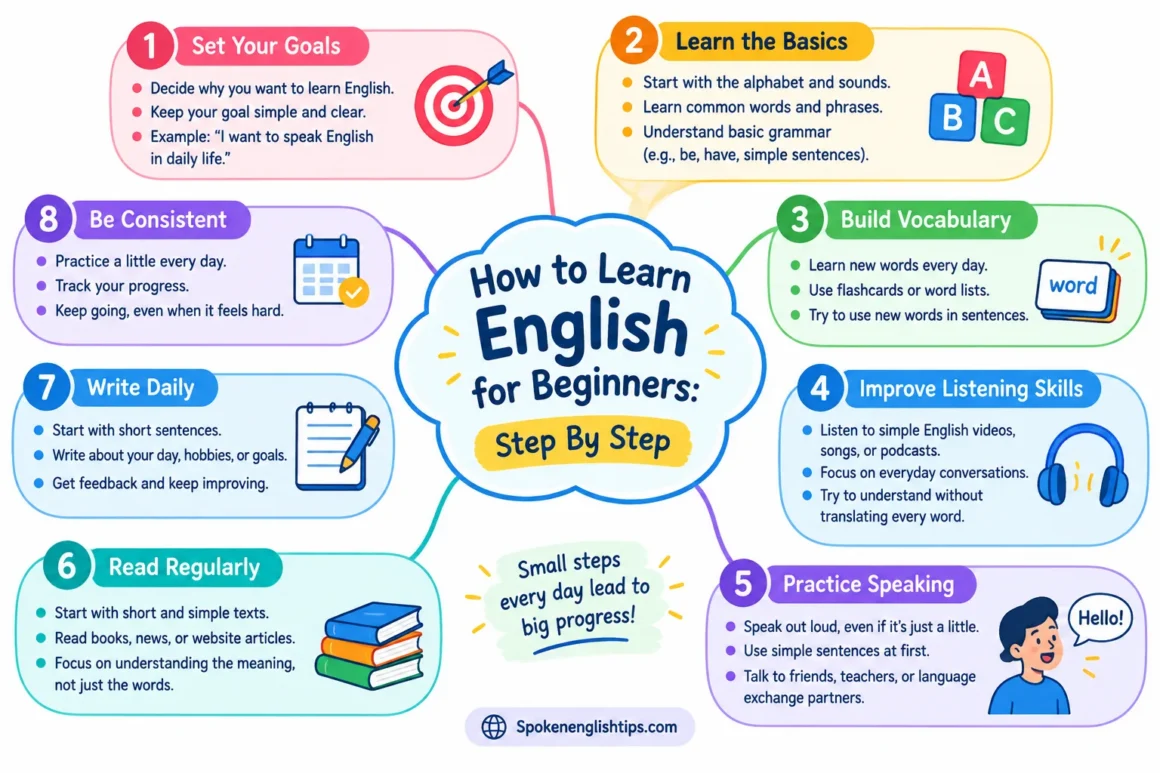
Learning English can feel difficult when you do not know where to start. You may learn new words every day, watch English videos, study grammar, and still feel nervous when it is time to speak.
This is completely normal.
The good news is that you do not need to learn everything at once. You do not need perfect grammar, thousands of words, or a perfect accent before you can speak English.
You need three things:
- A clear learning path
- Regular practice
- The confidence to use English even when you make mistakes
If you are a complete beginner, start small. Learn useful words, understand simple sentence patterns, listen to English every day, and gradually start speaking.
The most important rule: Use English, not just study English.
1. Start With Everyday English Vocabulary
As a beginner, do not try to memorize hundreds or thousands of difficult words.
Start with words that you are most likely to use in your daily life.
Focus on vocabulary related to:
- Family
- Home
- Food
- Work
- School
- Clothes
- Shopping
- Travel
- Time
- Weather
- Feelings
- Common actions
Start With Simple Words
For example:
eat, drink, go, come, work, study, sleep, walk, talk, read, write, buy, need, want, like, help, open, close, good, bad, happy, tired, today, tomorrow, morning, evening
But do not learn words in isolation.
Learn Words in Sentences
Instead of learning only: eat
Learn:
| I eat breakfast at 8 o’clock. |
Learn:
Instead of learning only: work
| I work in an office. |
Instead of learning only: happy
Learn:
| I am happy today. |
This makes your vocabulary much more useful because you are learning how to actually use the words.
2. Learn Common English Phrases
Learning common phrases is especially useful for beginners because you can use them immediately in real conversations.
Here are some useful phrases:
- How are you?
- What is your name?
- Where are you from?
- What do you do?
- Can you help me?
- Could you say that again?
- I don’t understand.
- What does this word mean?
- How much is this?
- I would like some water, please.
Practice these phrases regularly until they start to feel natural.
When you already know useful expressions, speaking becomes easier because you do not have to create every sentence from scratch.
3. Learn How to Make Simple Sentences
After learning basic words and phrases, start making your own sentences.
You do not need complicated grammar at this stage.
One useful sentence pattern is:
Subject + Verb + Object
For example:
- I drink tea.
- She reads books.
- We watch movies.
- They play football.
Once you understand the pattern, change the words and create new sentences.
Example
Start with:
| I drink tea. |
Then create:
- I drink coffee.
- I drink water.
- I drink milk.
Now make the sentence longer:
- I drink tea every morning.
- I drink tea with my breakfast.
- I usually drink tea at home.
This is a simple way to build your English step by step.
Do not worry if your first sentences sound basic. Basic English is still English.
4. Learn Basic Grammar First
Grammar is important, but beginners often make the mistake of trying to learn too much grammar too quickly.
You do not need to memorize every grammar rule before you start speaking.
Start with grammar that helps you communicate.
Learn These Basics First
Begin with:
- Personal pronouns — I, you, he, she, it, we, they
- Forms of be — am, is, are
- Articles — a, an, the
- Common verbs
- Prepositions
- Questions
- Negative sentences
- Basic tenses
Start With Simple Sentences
- I am tired.
- She is happy.
- They are busy.
Then learn how to talk about regular activities:
- I work every day.
- She goes to school.
- They play football on Sundays.
Next, learn how to talk about the past:
- I watched a movie yesterday.
- She visited her friend.
Then learn how to talk about the future:
- I will call you tomorrow.
You do not need to master every tense in one week.
| Learn one useful structure → understand it → create your own sentences → use it in conversation. |
5. Make Listening Part of Your Daily Routine
Listening should become part of your English practice from the beginning.
Many learners spend a lot of time studying English words but very little time actually listening to English.
As a result, they may know many words but still struggle to understand people when they speak.
Your ears need practice too.
What Should Beginners Listen To?
Start with:
- Simple conversations
- Beginner English stories
- Short videos
- Easy podcasts
- Simple English lessons
- Content designed for your level
If something is too difficult, choose easier material.
Use Subtitles When Necessary
You can use subtitles when you need them.
Try this three-step method:
- Listen once to understand the general meaning.
- Listen again and notice individual words and phrases.
- Listen again without subtitles and test your understanding.
You do not need to understand every word.
Focus on the main idea first. With regular practice, your ability to recognize words and sentence patterns will improve.
6. Use the Listen-and-Repeat Method
One of the most useful listening exercises is repetition.
How It Works
- Listen to one sentence.
- Pause the audio.
- Say the sentence yourself.
- Try to copy the speaker’s rhythm and natural flow.
- Listen again.
- Repeat the sentence.
This connects listening and speaking.
You are training your brain to recognize English while also training your mouth to produce it.
7. Start Speaking English From Day One
Do not wait until your English is perfect before you start speaking.
If you wait for perfect grammar, perfect vocabulary, and perfect pronunciation, you may wait for a very long time.
Instead, start with the English you already know.
Talk About Yourself
For example:
| My name is Rahul. I live in India. I work from home. I like watching movies. I enjoy listening to music. I am learning English because I want to communicate confidently. |
That is enough for a beginner.
The next day, talk about your morning:
| I woke up at seven o’clock. I brushed my teeth. I had breakfast. Then I started working. |
8. Practice Speaking to Yourself
You do not always need another person to practice speaking.
You can speak to yourself when nobody else is around.
Describe what you are doing:
- I am making tea.
- I am opening my laptop.
- I need to clean my room.
- I am going to the market.
It may feel strange at first, but it is a simple way to turn ordinary activities into English practice.
Try a 5-Minute Speaking Practice
Choose one topic every day and speak about it for five minutes.
You can talk about:
- Your family
- Your job
- Your hometown
- Your favorite food
- Your hobbies
- Your weekend
- A movie you watched
Do not stop every few seconds to correct yourself.
First, communicate your idea. You can improve your accuracy gradually.
| Making mistakes is not a sign that you are bad at English. Mistakes are part of learning. |
9. Improve Your English Through Reading
Reading exposes you to:
- New vocabulary
- Sentence structures
- Grammar
- Natural expressions
- Common phrases
However, beginners should choose reading material carefully.
If you open an advanced newspaper article and understand only a few words, reading can quickly become frustrating.
Choose Easy Reading Material
Good options include:
- Short stories
- Simple conversations
- Graded reading materials
- Beginner articles
- Easy English books
Choose material that is close to your current level.
Learn Words From Context
When you see a new word, do not immediately stop and look up its meaning.
First, try to understand it from the sentence.
For example:
Sarah was exhausted after working all day, so she went to bed early.
Even if you do not know exhausted, the rest of the sentence gives you a clue.
Sarah worked all day and went to bed early.
So you can guess that exhausted means very tired.
Then check the meaning if the word is important.
10. Read the Same Text More Than Once
Reading the same short text several times can be very useful.
First Reading
Focus on the overall meaning.
Second Reading
Pay attention to new vocabulary.
Third Reading
Try to read more smoothly and naturally.
You can also read some sentences aloud. This gives you additional speaking and pronunciation practice.
11. Start Writing in Simple English
You do not need to start by writing long essays.
Begin with just three sentences about your day.
For example:
I woke up at 7 a.m. I had breakfast with my family. Then I went to work.
After a few days, try writing five sentences.
Later, write a short paragraph.
Write About Topics Such As:
- What you did today
- What you plan to do tomorrow
- A place you visited
- Your favorite food
- Your family
- Something interesting you learned
You can also keep a small English journal.
Write a few sentences every day.
Do not worry about making every sentence perfect. If you repeatedly make the same mistake, learn the correct form and try to use it the next time.
12. Bring English Into Your Everyday Life
One of the best ways to improve your English is to make it part of your daily life.
You do not need to sit at a desk with an English textbook all day.
Instead, change some of the activities you already enjoy.
For example:
- Watch videos in English.
- Listen to English songs.
- Read simple English content.
- Read short English posts.
- Change some phone settings to English.
- Listen to English while traveling to work.
The idea is simple:
Give your brain more opportunities to see, hear, read, and use English.
13. Create Small English Habits Throughout the Day
You can practice English during normal daily activities.
In the Morning
Say a few sentences in English.
During Breakfast
Describe what you are eating.
While Traveling
Listen to a short English lesson.
During Free Time
Read a short English story.
Before Bed
Write three sentences about your day.
These small moments can add up over time.
14. Create a Simple Daily English Routine
Even if you have only 30 minutes a day, you can make meaningful progress.
For example:
- 5 minutes: Review vocabulary
- 5 minutes: Study one small grammar point
- 10 minutes: Listen and repeat
- 5 minutes: Read
- 5 minutes: Write
If you have more time, consider increasing your speaking and listening practice rather than simply adding more grammar exercises.
Example of a 60-Minute Routine
| Activity | Time |
|---|---|
| Vocabulary | 10 minutes |
| Grammar | 10 minutes |
| Listening | 15 minutes |
| Speaking | 15 minutes |
| Reading | 5 minutes |
| Writing | 5 minutes |
You do not have to follow this exact schedule every day.
The important thing is to create a routine that you can actually maintain.
A short routine you follow consistently is better than a complicated routine you abandon after a few days.
15. Learn English Through Your Interests
Learning becomes easier when you enjoy the subject.
Choose English content related to things you already like.
For example:
- Love cooking? Watch simple English cooking videos.
- Enjoy football? Read about football in English.
- Like technology? Follow beginner-friendly technology content.
- Enjoy stories? Listen to English stories.
When the subject interests you, learning feels less like a chore.
You are also more likely to continue practicing.
16. Start Thinking in Simple English
Many beginners struggle because they translate everything from their first language into English.
Translation can be useful sometimes, but gradually try to build the habit of thinking in simple English.
You do not need to think about complicated ideas.
Start with simple thoughts.
Look around you and think:
- The door is open.
- My phone is on the table.
- I am hungry.
- It is raining.
- I need some water.
- I have to go to work.
These simple thoughts help you connect ideas directly with English.
17. Learn Vocabulary in Groups
Instead of learning every word separately, learn vocabulary in groups based on situations.
For example, if you are learning English for shopping, learn words such as:
price, money, cheap, expensive, buy, sell, shop, size, cash, card
Then practice useful sentences:
- How much is this?
- Do you have a larger size?
- Can I pay by card?
- This is too expensive.
Now the vocabulary has a purpose.
You can imagine yourself actually using these words in a real situation.
Match Vocabulary to Your Goal
If you are learning English for travel, practice:
- Airport vocabulary
- Hotel vocabulary
- Restaurant vocabulary
- Transportation
- Directions
If you are learning English for work, practice:
- Meetings
- Emails
- Introductions
- Questions
- Workplace conversations
Your English goals should influence what you practice.
18. Set Small, Achievable Goals
You may wonder:
How long will it take to learn English?
There is no single answer.
Your progress depends on factors such as:
- Your starting level
- How often you practice
- How much English you hear
- Your speaking opportunities
- Your learning habits
- Your personal goals
Instead of asking, “How many months will it take me to become fluent?”, set smaller goals that you can control.
Examples
- This week, I will learn 30 useful words.
- I will speak English for 10 minutes every day.
- I will listen to English for 15 minutes each day.
- I will write five sentences every night.
Small goals make your progress easier to see.
19. Check Your Progress Every Month
At the end of each month, ask yourself:
- Can I introduce myself comfortably?
- Can I talk about my family?
- Can I describe my daily routine?
- Can I understand a simple conversation?
- Can I read a short English text?
- Can I write a short paragraph?
- Can I ask and answer basic questions?
If the answer to some questions is still no, that is okay.
It simply tells you what you need to practice next.
20. Do Not Get Discouraged
There will be days when you feel that your English is improving quickly.
There will also be days when you feel stuck.
That is normal.
Do not assume that you are making no progress simply because improvement is not obvious every day.
Language learning takes time. You may learn something today but not feel confident using it until next week.
Sometimes, you may suddenly understand a sentence that seemed impossible a few weeks earlier.
Keep going.
21. Avoid Trying to Learn Too Much at Once
One common problem among beginners is trying to learn everything at the same time.
They may:
- Study 20 grammar rules
- Memorize 100 words
- Watch difficult videos
- Try to speak for an hour
After a few days, they feel tired and stop.
You do not need to do this.
Instead:
- Learn a small amount.
- Use it.
- Review it.
- Practice it.
- Add something new.
Small steps are easier to maintain.
22. Do Not Just Study English — Use It
Another common problem is studying English without actually using it.
You can read grammar books for months, but if you never create your own sentences or speak with another person, your active English may remain weak.
Think of it this way:
Learning gives you the tools. Practice teaches you how to use them.
You also do not need to speak only with native English speakers.
You can practice with:
- A teacher
- A language partner
- A friend
- A classmate
- Another English learner
The important thing is to have opportunities to communicate.
23. Practice English With a Speaking Partner
If you have someone to practice with, start with simple topics.
Ask questions, answer questions, and take turns speaking.
Try Questions Like:
- What did you do today?
- What do you usually do on weekends?
- What is your favorite food?
- Where would you like to travel?
- What do you like doing in your free time?
As you become more comfortable, gradually make the conversations longer and more challenging.
24. Practice Speaking Alone
If you do not have a speaking partner, you can still practice.
Record yourself speaking for one or two minutes.
Then listen to your recording.
Pay attention to:
- Words you repeat too often
- Sentences that are difficult to create
- Pronunciation problems
- Speaking too quickly
- Grammar mistakes
This information can help you understand what you need to practice.
25. Improve Your Pronunciation
Pronunciation is important, but good pronunciation does not mean copying a particular accent.
Your main goal should be to speak clearly enough that other people can understand you.
Pay attention to:
- Difficult individual sounds
- Word stress
- Sentence rhythm
- Connected speech
- Natural speaking patterns
Listening and repeating are excellent ways to improve these areas.
English is spoken with many different accents around the world. You do not need to sound exactly like someone else.
Clear communication is more important than copying a particular accent.
26. Do Not Wait for Perfect Grammar
You should aim for accuracy, but you do not need perfect grammar before you communicate.
For example, if you say:
Yesterday I go to the market.
A listener can probably understand you.
Later, you can learn to say:
Yesterday I went to the market.
The mistake is useful because it shows you what you need to learn.
The best approach is not to choose between grammar and speaking.
Use Both Together
- Learn a grammar point.
- Create your own sentences.
- Listen for the structure in real conversations.
- Use it when you speak.
- Write a few examples.
That is how grammar becomes practical.