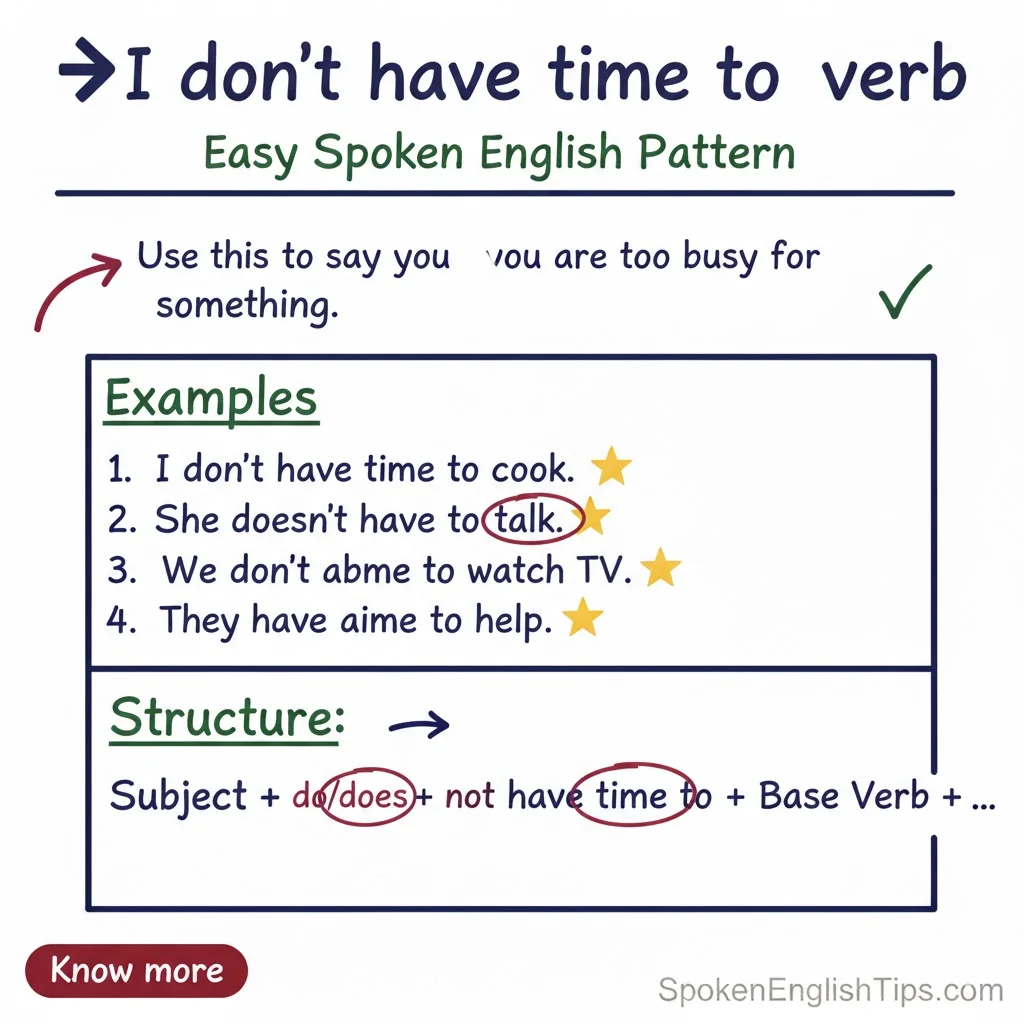
We use “I don’t have time to + verb” when we want to say we are busy. It is very common in daily English speaking.
For example, you may say:
- “I don’t have time to cook.”
- “I don’t have time to talk right now.”
This expression is useful at home, at work, with friends, or on the phone. It sounds natural and polite when you say it correctly. After “to”, we always use the base form of the verb (no -ing, no -ed).
It helps you explain your situation clearly without sounding rude.
◎ Important Points
- Use “to + base verb” (to eat, to go, to call).
- Do not use -ing form after “to”.
- Use it when you are busy or unavailable.
- You can add “right now” for urgency.
- You can make it more polite: “I don’t have time to talk right now, sorry.”
- It is common in both formal and informal conversations.
- Stress the word “time” slightly when speaking for clarity.
➤Key Concept
✅ Sentence Structure: Subject + do/does not have + time + to + base verb
Example:
I don’t have time to finish this report.
Main Concept:
After “to”, always use the base form of the verb.
Speaking Tip:
Do not speak too fast. Pause slightly after “time”:
“I don’t have time… to explain.”
This makes your speech clearer and more confident.
➤ Common Mistakes To Avoid
| Common Mistake | Wrong Example | Correct Example |
|---|---|---|
| Using -ing form | I don’t have time to cooking. | I don’t have time to cook. |
| Missing “to” | I don’t have time finish this. | I don’t have time to finish this. |
| Wrong verb form | I don’t have time to finished it. | I don’t have time to finish it. |
| Using wrong helping verb | I am not have time to go. | I don’t have time to go. |
| Forgetting subject | Don’t have time to talk. | I don’t have time to talk. |
➤ Examples
- I don’t have time to watch TV today.
- I don’t have time to meet you this evening.
- Sorry, I don’t have time to explain everything.
- She doesn’t have time to cook dinner.
- We don’t have time to miss the train.
- I don’t have time to clean my room right now.
- He doesn’t have time to answer all the emails.
- I don’t have time to argue about this.
- They don’t have time to prepare properly.
- I don’t have time to talk. I’m in a meeting.
➤ Practice Examples
A. Fill in the Blanks
- I don’t have time to ______ (study).
- She doesn’t have time to ______ (call) you.
- We don’t have time to ______ (wait).
- He doesn’t have time to ______ (drive).
- I don’t have time to ______ (cook) today.
B. Correct the Sentence
- I don’t have time to cooking dinner.
- She not have time to finish it.
- I don’t have time finish this work.
- Don’t have time to meet you.
- He doesn’t have time to finished the task.
C. Speak Aloud Practice
Say these sentences clearly and slowly:
- I don’t have time to talk right now.
- I don’t have time to deal with this.
- I don’t have time to waste.
- I don’t have time to argue.
- I don’t have time to think about it.