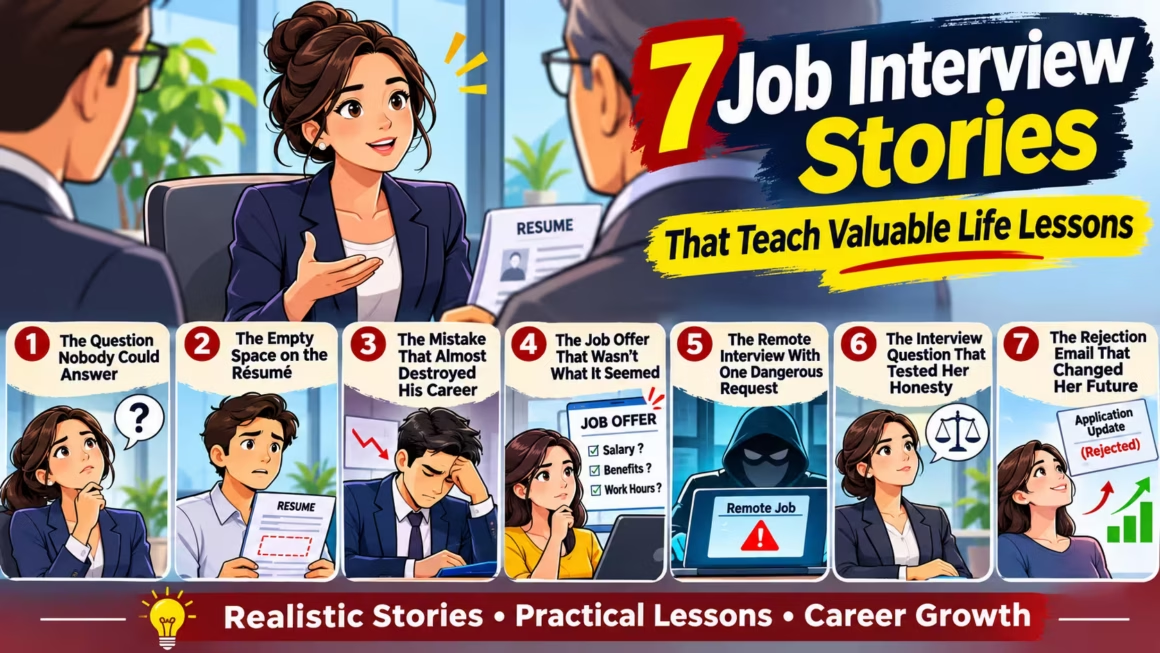
Sometimes, One Interview Changes Everything
The interviewer looked at the young woman sitting across the table and asked one final question.
“Why should we hire you when the other candidates have more experience?”
She had prepared for almost every question. But not this one.
For a moment, she could hear nothing except the ticking clock.
She could pretend to be confident. She could repeat the same impressive words she had memorized the night before. Or she could tell the truth.
What she said next changed the direction of the interview.
Job interviews are not always about having perfect answers. Sometimes, they reveal something much deeper: our honesty, courage, confidence, and ability to make difficult decisions.
In these seven job interview stories, you will meet people who face uncomfortable questions, unexpected problems, and decisions that could change their careers. Each story offers a valuable lesson you can apply to your own professional life.
These are original fictional stories created to illustrate realistic job interview experiences and practical career lessons.
1. The Question Nobody Could Answer

Life lesson: Confidence is not knowing everything. It is knowing how to respond when you don’t.
Maya entered the interview room carrying a folder of certificates and three years of experience as a junior business analyst.
She had spent four evenings preparing. She knew the company’s history, its products, and even the names of its senior managers.
Two interviewers smiled as she sat down.
For the first twenty minutes, everything went perfectly.
Then the senior manager closed Maya’s résumé.
“Imagine our company’s sales suddenly drop by 30% tomorrow. What exactly would you do?”
Maya’s confidence disappeared.
She had studied financial reports, but she had never managed an entire company’s sales performance.
She remembered a video that suggested giving an immediate, confident answer.
So she started speaking.
“I would increase marketing, improve customer service, and introduce a new promotional strategy.”
The manager interrupted.
“How do you know marketing is the problem?”
Maya stopped.
He continued.
“What if our website has stopped processing payments? What if one major customer has simply delayed an order?”
The room became silent.
Maya realized that she had made a dangerous mistake: she was recommending solutions before understanding the problem.
For several uncomfortable seconds, she stared at her notes.
Then she closed her folder.
“May I start again?” she asked.
The valuable lesson
A strong job interview answer does not always begin with a solution. Sometimes it begins with the right question.
When an interviewer presents an unfamiliar business problem, the goal may be to understand how you think rather than whether you already know the answer.
Instead of guessing, clarify the situation, identify missing information, and explain how you would investigate before acting.
What happened next?
The manager leaned forward.
“Go ahead.”
Maya took a moment.
“First, I would check whether the 30% decline is across every product or limited to certain regions. Then I would compare the data with previous weeks and investigate technical issues, customer complaints, and recent business changes.”
She paused.
“Only after identifying the likely cause would I recommend a solution.”
The senior manager wrote something on his notepad.
He didn’t smile.
Maya left believing she had failed.
Three days later, an email arrived.
She had been invited to the final interview.
During that meeting, the manager explained that her willingness to correct her initial answer had stood out.
She hadn’t impressed them by knowing everything.
She had impressed them by recognizing what she didn’t know.
Final lesson: Prepare thoroughly, but don’t memorize confidence. Build it through clear thinking, honest answers, and the courage to correct yourself.
Deep thought: The most dangerous person in a room is not the one who admits uncertainty. It is the one who mistakes an unsupported guess for knowledge.
2. The Empty Space on the Résumé
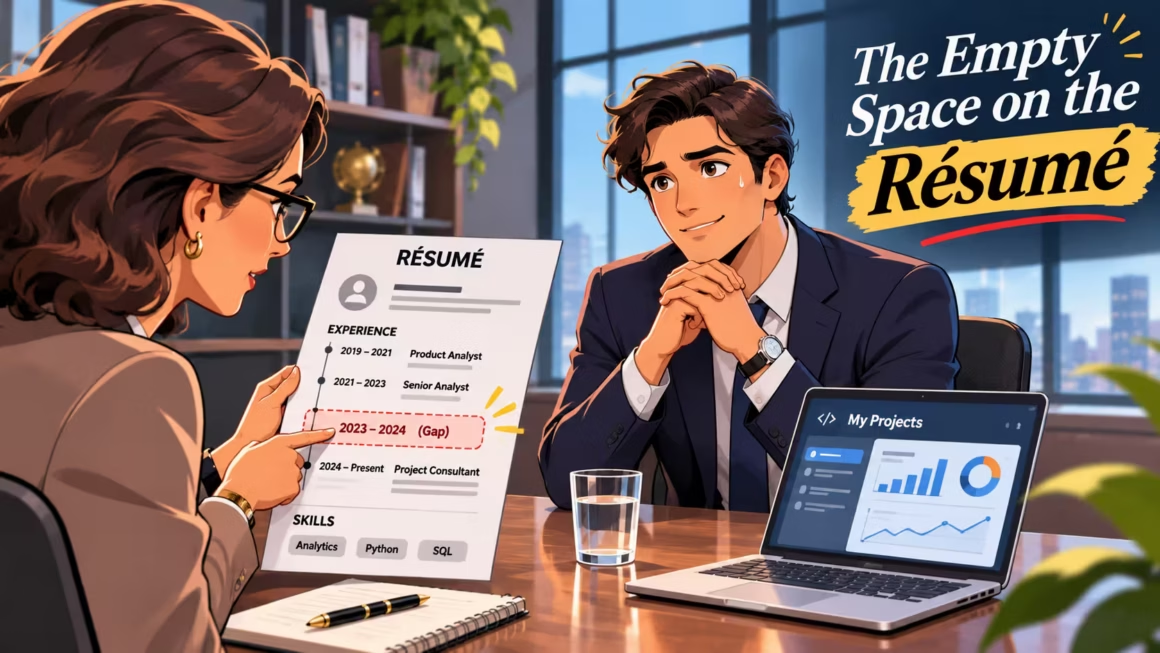
Life lesson: A career gap doesn’t erase your experience, abilities, or potential.
Arjun had been unemployed for fourteen months.
During that time, he had applied for dozens of jobs. A few companies had called him, but most never responded.
Now, sitting inside a bright office, he was closer than ever to getting another opportunity.
The interview was going well.
He answered questions about spreadsheets, customer reports, and project deadlines.
Then the HR manager pointed to his résumé.
“I see you left your previous position over a year ago. What happened during that time?”
Arjun felt his stomach tighten.
He had been expecting this question, yet he still feared the answer.
His mother had needed help recovering from a serious illness. As the eldest son, he had stepped away from full-time work to support his family.
He worried the interviewer would see him as unreliable.
For a second, he considered saying he had been freelancing throughout the entire period.
It sounded more professional.
But it wasn’t true.
“I took time away from full-time employment because of family responsibilities,” he finally said.
The HR manager listened without interrupting.
Arjun continued.
“During that period, I also completed an advanced Excel course and created a small reporting project to keep my skills active.”
The manager looked at his résumé again.
“Can you show me the project?”
Arjun hadn’t expected that question.
Luckily, the project was real.
The valuable lesson
You do not have to invent a perfect employment history to explain a career gap.
Give a brief, truthful explanation, then shift the discussion toward the skills you can demonstrate today.
You can maintain appropriate privacy about personal or family matters. Employers do not need every detail of your personal life.
Courses, portfolio projects, volunteering, or relevant practical work can help you demonstrate readiness—but only mention activities you genuinely completed.
What happened next?
Arjun opened his laptop.
He showed the manager a dashboard he had built using publicly available sample sales data.
It wasn’t perfect.
Some charts were simple. A few formulas could have been improved.
But he explained every decision confidently.
The manager asked how he had cleaned the data, calculated monthly changes, and checked errors.
For the first time during the interview, Arjun stopped worrying about the empty space on his résumé.
He was talking about work he understood.
A week later, the company offered him a reporting assistant position.
His career gap had not disappeared.
It simply hadn’t prevented him from demonstrating his value.
Final lesson: When preparing for an interview after a break, focus on explaining your experience honestly, showing evidence of current skills, and communicating why you’re ready for the role.
Deep thought: A résumé can show the months when you weren’t employed. It cannot measure everything you learned, carried, or overcame during those months.
3. The Mistake That Almost Destroyed His Career

Life lesson: Taking responsibility for failure can reveal more about your character than describing success.
Daniel had one rule for job interviews.
Never talk about failure.
He believed employers wanted confident people with impressive achievements, not candidates who had made embarrassing mistakes.
That belief worked until his final interview for a project coordinator position.
Three people sat across from him.
The hiring manager asked him about his greatest professional achievement. Daniel described a successful project, explained his responsibilities, and shared the results.
Everyone seemed satisfied.
Then the operations director asked a different question.
“Tell us about a time you made a serious mistake at work.”
Daniel froze.
Two years earlier, he had forgotten to confirm an important supplier delivery.
Because of his oversight, his team had missed a customer deadline.
The company had lost money, and his manager had been furious.
Daniel had tried hard to forget that day.
He could choose a minor mistake and make it sound harmless.
Or he could explain what had really happened.
“I once made a mistake that delayed an important customer order,” he admitted.
The director put down his pen.
“How serious was the delay?”
“Three days.”
“And who was responsible?”
Daniel took a slow breath.
“I was.”
The director stared at him.
“Then why should we trust you with our projects?”
The valuable lesson
An interviewer may learn more from how you handled a mistake than from the mistake itself.
When answering behavioral interview questions, the STAR method can help you organize your response:
- Situation: Explain the background.
- Task: Describe your responsibility.
- Action: Explain what you did to address the problem.
- Result: Share the outcome and what you learned.
Do not blame others or pretend a mistake was actually a hidden strength. Explain your accountability and the specific improvements you made afterward.
What happened next?
Daniel could feel his face becoming warm.
But instead of defending himself, he explained.
“After the delay, I contacted the supplier and helped coordinate a revised delivery. I also informed the customer about the problem rather than letting them discover it themselves.”
He paused.
“Then I created a confirmation checklist with clear deadlines and backup contacts. My manager reviewed it, and our team started using it for future orders.”
The director asked another question.
“Did the customer stay with your company?”
“Yes, although we had to work hard to rebuild their confidence.”
For the first time, the director smiled.
“That tells me more than your successful project.”
Daniel didn’t know whether he would receive the job.
But when he walked outside, something had changed.
For years, he had treated his mistake as evidence that he was not good enough.
Now he understood that his response to the mistake was also part of his professional history.
Final lesson: You cannot always control whether something goes wrong. You can control whether you accept responsibility, help repair the damage, and prevent the same mistake from happening again.
Deep thought: Success shows what you are capable of when things go well. Responsibility reveals who you are when they don’t.
4. The Job Offer That Wasn’t What It Seemed
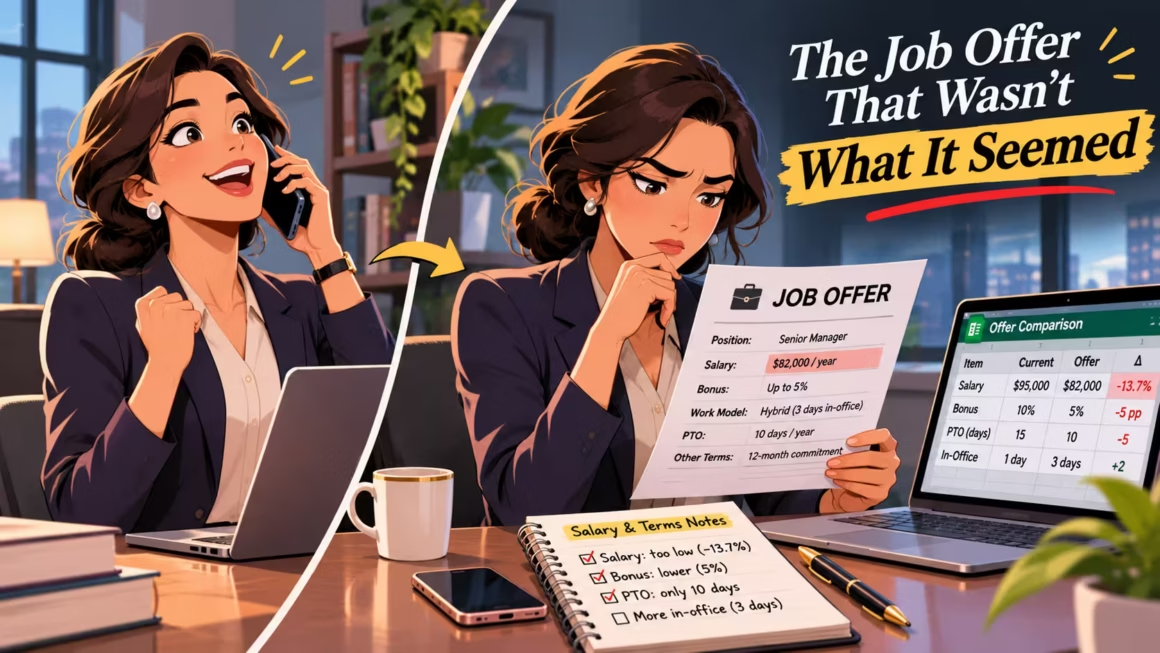
Life lesson: Getting a job offer is exciting, but understanding its terms is essential.
Sophia had been looking for a better job for six months.
Her current salary barely covered rent, transportation, and household expenses.
When a large marketing company invited her for an interview, she believed it might be the opportunity she needed.
The first interview went well.
The second was even better.
By Friday evening, the recruiter called.
“Congratulations, Sophia. We’d like to offer you the marketing manager position.”
Sophia almost shouted with happiness.
Then the recruiter mentioned the salary.
It was higher than her current pay, but noticeably lower than the range Sophia had expected.
She felt disappointed.
Still, she was afraid to say anything.
What if they withdrew the offer?
What if another candidate accepted immediately?
She thanked the recruiter and asked when she would receive the written offer.
“Tomorrow morning,” the recruiter replied.
That night, Sophia opened a spreadsheet.
She calculated her expected monthly income, taxes, commuting costs, and other expenses.
Then she compared the offer with several similar marketing positions she had researched.
Something didn’t add up.
The new job required longer travel, occasional weekend work, and more management responsibilities.
Financially, the improvement was much smaller than it first appeared.
The following morning, she received the offer letter.
At the bottom was one sentence she hadn’t expected:
Please confirm your acceptance by Monday.
The valuable lesson
Salary negotiation is not simply about asking for more money. It is about understanding the full value and expectations of a position.
Before accepting an offer, evaluate the base salary, bonuses, benefits, working hours, leave policies, location, and opportunities for growth.
Research compensation ranges for comparable roles in your location and industry.
If the offer is below your expectations, you can respectfully discuss it with the employer. A professional negotiation should be based on relevant experience, responsibilities, and market information—not pressure or threats.
What happened next?
On Monday morning, Sophia called the recruiter.
“Thank you for the offer. I’m excited about the opportunity,” she began.
Then she explained that the responsibilities and market range suggested a higher compensation level.
“Would there be flexibility in the base salary?” she asked.
The recruiter didn’t answer immediately.
Sophia waited.
Finally, the recruiter said, “I’ll discuss that with the hiring manager.”
Two days passed.
Sophia checked her email repeatedly.
On Wednesday afternoon, a revised offer arrived.
The company couldn’t meet her original target, but it increased the salary and clarified the annual bonus terms.
Sophia reviewed the complete offer before accepting.
The conversation had been uncomfortable, but it had also helped her make a more informed decision.
She realized that asking a reasonable question hadn’t made her ungrateful.
It had made her an active participant in her own career.
Final lesson: Never feel pressured to accept an offer you do not fully understand. Ask questions, verify important terms in writing, and make decisions based on your financial needs and career goals.
Deep thought: Sometimes, the most valuable thing you bring to an interview is not the ability to convince someone to hire you. It is the confidence to recognize what your work is worth.
5. The Remote Interview With One Dangerous Request
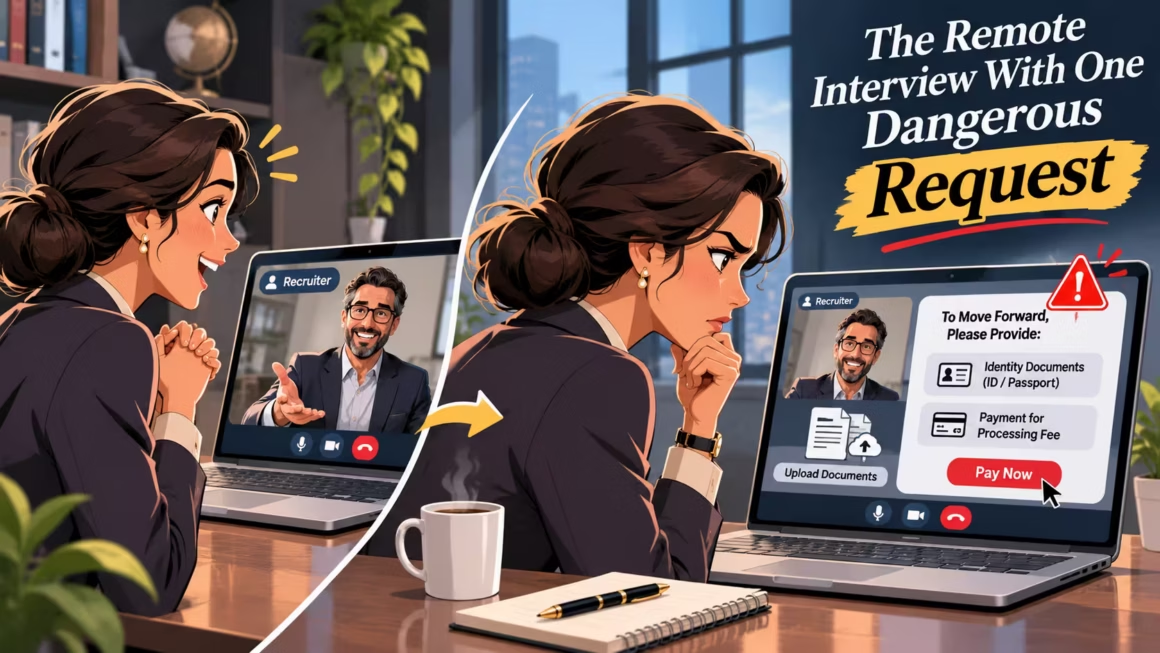
Life lesson: A professional-looking job opportunity is not proof that it is genuine.
Priya had dreamed of working remotely.
She wanted a job that would allow her to avoid a long daily commute while continuing to develop her digital marketing skills.
One afternoon, she received an email.
Subject: Congratulations! Selected for Remote Digital Marketing Interview
The company name sounded familiar.
The email contained a professional logo, a detailed job description, and an attractive salary.
Priya was excited.
The interview was scheduled for the following morning.
At exactly 10 a.m., she joined an online meeting.
The person interviewing her introduced himself as a hiring coordinator.
He asked about her experience with social media campaigns, content planning, and analytics.
Priya answered confidently.
After twenty minutes, he smiled.
“You have the skills we’re looking for.”
Then came the news she had been hoping to hear.
“We’d like to move forward with your employment.”
Priya could hardly believe it.
She asked about the next steps.
The coordinator explained that she needed to complete an employee verification process.
He sent her a link and said she should enter her personal details, upload identity documents, and pay a refundable onboarding charge.
Priya hesitated.
“Why do I need to pay a fee to start working?” she asked.
The coordinator’s expression changed.
“It’s company policy. If you don’t complete it today, we’ll offer the position to someone else.”
Priya’s excitement turned into suspicion.
The valuable lesson
Legitimate job interviews should not require applicants to pay an upfront fee to secure employment.
Job scammers sometimes use familiar company names, realistic email templates, and unusually attractive offers to gain trust.
Before sharing sensitive documents or personal information, verify the employer through its independently located official website and contact channels.
Be especially cautious when someone demands money, pressures you to act immediately, or refuses to provide verifiable company details.
What happened next?
Priya told the coordinator she would review the instructions before proceeding.
Then she ended the call.
She opened the company’s official website by typing its address herself.
The careers page showed no listing for the position.
Next, she contacted the company using its published contact information.
The real HR department confirmed that the message had not come from them.
Someone had been impersonating the company.
Priya stared at the fraudulent email.
Only an hour earlier, she had been imagining her first day at work.
Now she understood how easily excitement could have pushed her into sharing sensitive information.
She reported the suspicious message and continued her job search.
A week later, she attended another remote interview—this time with an employer she had independently verified.
She approached the process with more questions, but also with greater confidence.
Final lesson: Research employers, verify recruiters, protect sensitive information, and resist pressure to make immediate decisions. A genuine opportunity should withstand reasonable verification.
Deep thought: Hope can open wonderful doors. But when hope becomes urgency, it can also make us overlook the warning signs standing in front of them.
6. The Interview Question That Tested Her Honesty
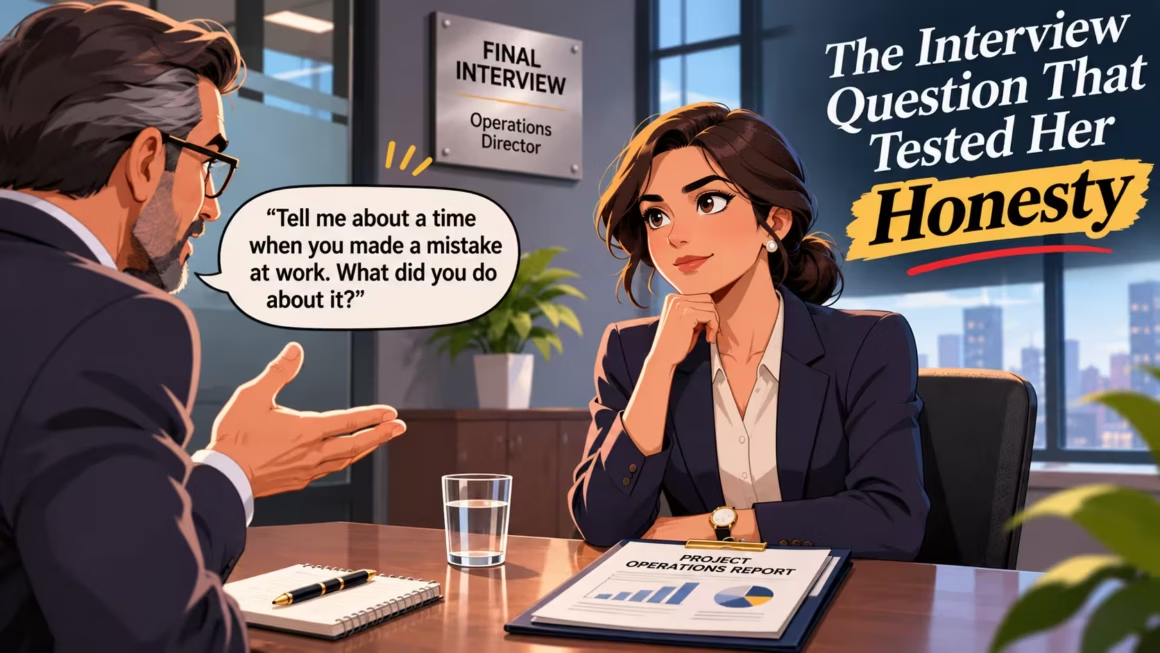
Life lesson: Professional integrity matters most when doing the right thing is uncomfortable.
Aisha was interviewing for an operations supervisor position.
She had passed an online assessment, completed a telephone interview, and impressed the hiring manager with her experience.
Only one final interview remained.
The operations director entered the room carrying a thin folder.
He greeted her politely and sat down.
“We’ve discussed your technical experience,” he said. “Now I’d like to understand how you make decisions under pressure.”
Aisha nodded.
The director gave her a hypothetical situation.
“Imagine your team has made an expensive mistake. Your manager asks you to change the internal report so senior leadership won’t notice the problem. What would you do?”
Aisha was surprised.
She had expected questions about leadership, scheduling, and employee performance.
Not this.
She considered the situation carefully.
If she said she would immediately report her manager, perhaps the interviewer would see her as difficult.
If she agreed to change the report, she would be supporting dishonest behavior.
“Would the requested change make the report inaccurate?” Aisha asked.
“Yes,” the director replied.
“And the mistake could affect future business decisions?”
“Possibly.”
Aisha understood what mattered now.
“I wouldn’t knowingly submit false information,” she said.
The director folded his arms.
“Even if refusing could damage your relationship with your manager?”
The valuable lesson
Ethical interview questions often test whether you can balance professionalism, sound judgment, and accountability.
When responding to an ethical dilemma, explain the principles guiding your decision and the practical steps you would take.
You can remain respectful toward colleagues while refusing to falsify records or conceal important information.
The goal is not to deliver a dramatic speech. It is to demonstrate that you understand the consequences of your actions.
What happened next?
Aisha considered her answer before continuing.
“I would first confirm the facts and make sure the report was accurate. Then I’d explain my concerns to the manager and suggest documenting the mistake along with a corrective action plan.”
The director listened.
“And if the manager still insisted?”
“I would follow the company’s escalation procedures and seek guidance through the appropriate reporting channel.”
The room became quiet.
The director wrote something in the folder.
Then he asked his final question.
“Why would you take that risk?”
Aisha looked directly at him.
“Because an inaccurate report doesn’t solve the original problem. It can create a bigger one.”
The director thanked her.
As she left, Aisha still had no idea whether she would get the job.
But she felt comfortable with her answer.
She had described the kind of supervisor she wanted to be, not simply the kind of candidate she thought someone else wanted.
Final lesson: Employers can teach procedures, software, and technical methods. Integrity requires a personal commitment to honest decisions, especially when pressure makes dishonesty seem easier.
Deep thought: Your professional reputation is built through hundreds of ordinary decisions. One difficult choice may reveal whether those decisions were guided by principle or convenience.
7. The Rejection Email That Changed Her Future
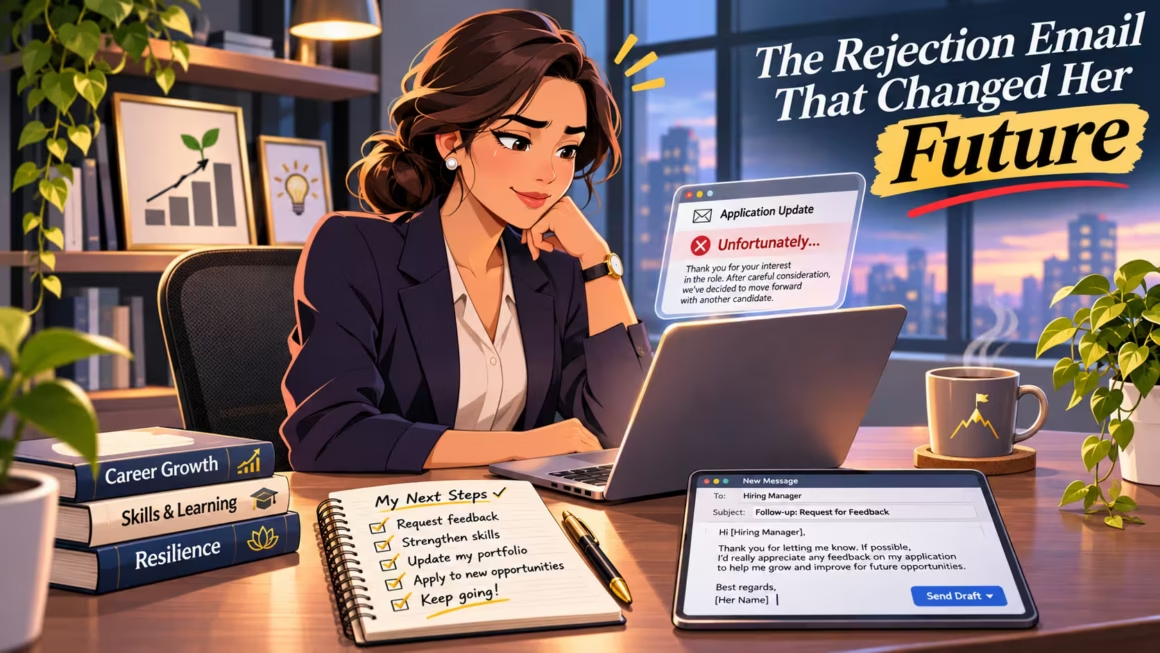
Life lesson: Rejection is painful, but it can also reveal where your next opportunity begins.
Emma had never felt so prepared for an interview.
She had researched the company, practiced common interview questions, and rewritten her résumé several times.
The position was exactly what she wanted: a junior project manager role at a respected technology company.
Her first interview lasted forty minutes.
The second lasted an hour.
After the final interview, the hiring manager shook her hand.
“We’ve really enjoyed speaking with you, Emma. We’ll contact you soon.”
Emma left the building smiling.
For the first time in months, she allowed herself to imagine having the job.
She imagined the office, her new colleagues, and the projects she might manage.
Then, three days later, an email appeared.
Subject: Update on Your Application
She opened it immediately.
Thank you for your time and interest. After careful consideration, we have decided to move forward with another candidate.
Emma read the sentence twice.
She felt embarrassed, disappointed, and exhausted.
She had invested so much energy in preparing.
How could she have come so close and still failed?
That evening, she considered deleting every email connected to the company.
Instead, she opened a blank message.
She wrote a short thank-you note to the hiring manager and politely asked whether they could share any feedback.
She pressed Send.
She expected nothing.
The valuable lesson
A job rejection is a hiring decision, not a complete judgment of your ability or future potential.
Companies compare candidates against specific requirements, experience levels, budgets, and team needs.
A rejection does not always mean you performed badly.
When appropriate, request feedback respectfully. Not every employer will respond, but useful feedback can help identify opportunities to improve.
After an interview, review your answers, examples, communication, and questions while the experience is still fresh.
What happened next?
Five days later, Emma received a response.
The hiring manager thanked her for her professionalism.
Then came the sentence that made Emma stop reading for a moment.
Your communication skills were strong, but the selected candidate had more direct experience managing project budgets.
Emma opened her notebook.
During the interview, she had confidently described her scheduling and teamwork experience.
But when asked about budgets, her answer had been vague.
She had treated that weakness as something to hide.
Now she decided to address it.
Over the following weeks, Emma studied basic project budgeting, practiced using spreadsheets, and developed a sample project plan with estimated costs and expense tracking.
She also revisited projects she had supported in her previous role, looking for truthful examples of resource planning she could discuss.
Two months later, she interviewed with a smaller company.
This time, when the interviewer asked about project budgets, Emma explained her existing experience, acknowledged its limits, and confidently demonstrated her sample plan.
She received an offer for a junior project coordinator position.
It wasn’t the original job.
And it wasn’t the same title.
But it offered meaningful responsibilities, training, and a realistic path toward becoming a project manager.
Emma accepted.
On her first day, she opened the notebook she had used after the rejection.
At the top of one page, she had written:
Learn what you don’t know yet.
She smiled.
Final lesson: Rejection can provide useful direction when you separate your emotions from the information available. Identify specific skill gaps, develop relevant evidence of your abilities, and continue pursuing opportunities that fit your goals.
Deep thought: Some doors stay closed no matter how hard you knock. Growth begins when you stop measuring your worth by that door and start preparing for the opportunities still ahead.
What These 7 Job Interview Stories Teach Us
Every character in these stories faces a different challenge. Yet their experiences reveal several practical lessons that can make real job interviews easier to approach.
| Interview challenge | Most useful lesson |
|---|---|
| An unexpected question | Think clearly and ask for relevant information before answering |
| An employment gap | Be truthful and demonstrate current skills |
| A past workplace failure | Accept responsibility and explain your improvements |
| A disappointing salary offer | Research compensation and negotiate professionally |
| A suspicious remote opportunity | Verify the employer and protect personal information |
| An ethical dilemma | Demonstrate integrity and sound judgment |
| Rejection after a final interview | Seek useful feedback and improve your preparation |
How to prepare for your next job interview
Knowing these lessons is one thing. Applying them is another.
Before your next interview, review the job description and identify the skills the employer needs most. Prepare several genuine examples from your experience, including successful projects, difficult decisions, mistakes, and teamwork challenges.
Practice answering common questions aloud. Research appropriate salary ranges. Prepare thoughtful questions about the job’s responsibilities, performance expectations, and working environment.
Most importantly, remember that a good interview is a two-way conversation. The employer is evaluating your suitability, but you are also deciding whether the position is right for you.
Frequently Asked Questions About Job Interviews
1. What is the biggest lesson from job interview stories?
One of the most important lessons is that honesty, preparation, communication, and adaptability often matter more than memorizing perfect answers. Strong candidates explain their reasoning and support their claims with genuine examples.
2. How can I answer difficult job interview questions?
Listen carefully, take a moment to think, and organize your answer. For behavioral questions, use the STAR method to explain the situation, your responsibility, your actions, and the results. If something is unclear, ask a relevant question.
3. What should I do if I fail a job interview?
Review the experience without judging yourself too harshly. Identify questions that were difficult, improve your answers, and practice relevant skills. You can also politely request feedback, although employers may not always provide it.
4. Should I negotiate salary during a job interview?
It can be appropriate to discuss compensation when the employer raises the topic or when an offer is being considered. Research comparable roles and communicate your expectations respectfully, using your experience and the responsibilities of the position as supporting reasons.
5. Can I get hired even if I have an employment gap?
Yes. Employment gaps do not automatically disqualify a candidate. Be ready to give a brief, truthful explanation and show that your experience, skills, and current readiness match the job requirements.