SST stands for social studies, which is a subject. According to the Indian Education system, this subject is taught in junior classes in which all field of social science and information is added.
If you have ever looked at a school timetable, you have seen it. Three simple letters: SST. It appears on report cards, textbook covers, and exam schedules. But have you ever stopped to ask what it really means?
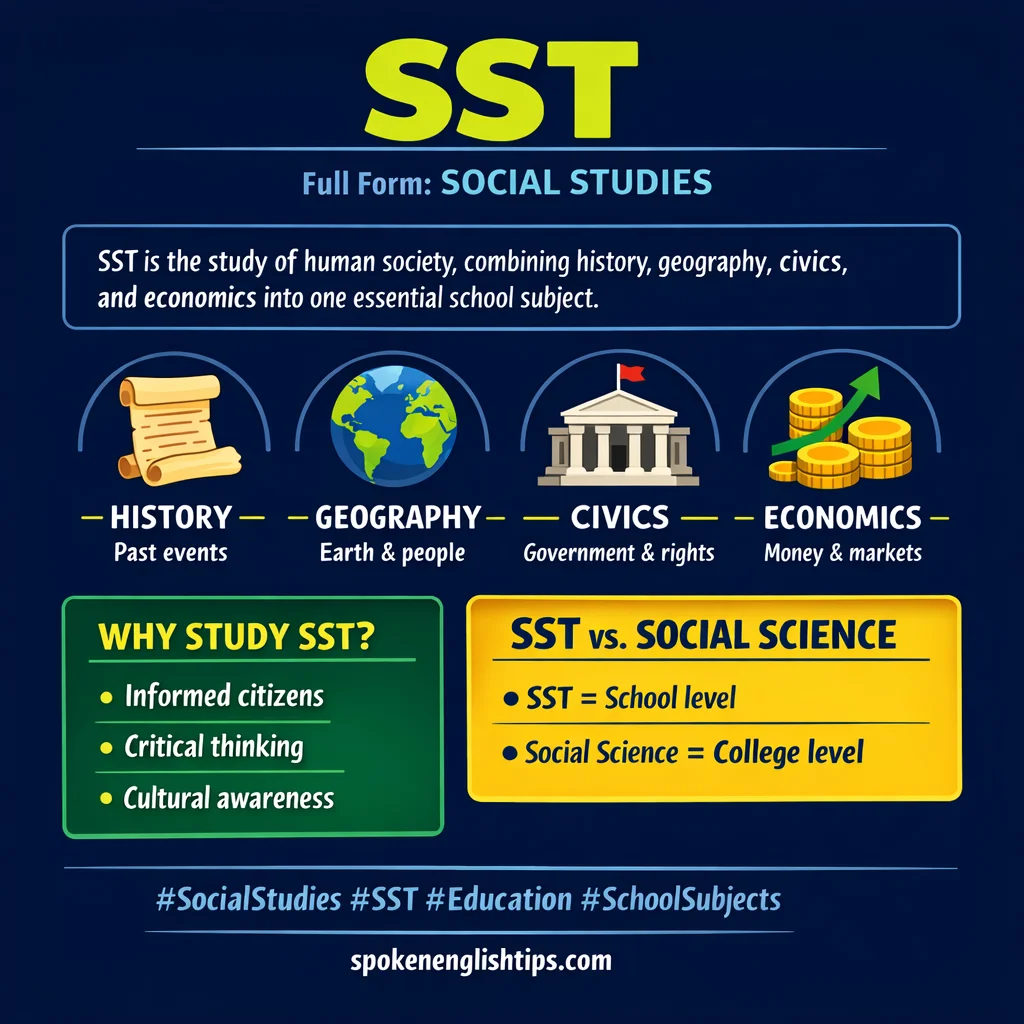
The full form of SST is Social Studies.
But Social Studies is much more than a subject name. It is the study of how human societies work. It looks at our past, our present, and how we organize ourselves. It combines history, geography, civics, and economics into one powerful field of knowledge.
For students in India and many other countries, SST is a core subject. It shapes young minds into informed citizens. It helps us understand the world beyond our own neighborhoods.
In this guide, we will explore everything about SST. We will break down its meaning, its subjects, and why it matters. Whether you are a student preparing for exams or a parent helping your child, this article is for you.
What is the Full Form of SST?
Let us start with the basics. SST stands for Social Studies.
| Aspect | Details |
|---|---|
| Full Form | Social Studies |
| Subject Category | Humanities / Social Sciences |
| Commonly Taught In | Schools (Classes 1 to 10) |
| Main Focus | Human society, history, geography, civics, economics |
| Alternative Name | Social Science (in higher classes) |
“Social Studies is not just about memorizing dates and names. It is about understanding how people live, why societies change, and how we can build a better future.”
The term “Social Studies” emerged in the early 20th century. Educators wanted a subject that combined multiple social sciences. The goal was to prepare students for active citizenship. Today, SST remains a cornerstone of school education worldwide.
The Core Subjects Under SST
Social Studies is not a single subject. It is a collection of subjects woven together. Think of it as a tree with four main branches.
The Four Pillars of SST
Here is a breakdown of what each branch covers:
| Subject | What It Studies | Key Topics |
|---|---|---|
| History | Past events and human experiences | Ancient civilizations, medieval empires, modern independence movements, world wars |
| Geography | Earth’s physical features and human interaction | Mountains, rivers, climate, population, resources, maps |
| Civics | Government, rights, and duties of citizens | Constitution, democracy, laws, elections, fundamental rights |
| Economics | Production, distribution, and consumption of goods | Money, markets, poverty, development, trade |
Each branch connects to the others. You cannot understand a country’s geography without knowing its history. You cannot understand its government without knowing its economy. This is the beauty of SST.
Why is SST Important in Education?
Some students think SST is just about memorizing facts. That is a mistake. SST builds skills that last a lifetime.
1. It Creates Informed Citizens
Democracy depends on informed citizens. SST teaches students about their rights and responsibilities. They learn how government works. They understand the Constitution. This knowledge helps them vote wisely and participate in society.
2. It Develops Critical Thinking
History is not just a list of dates. It is a series of causes and effects. Students learn to ask: Why did this happen? What led to that outcome? These questions build analytical skills.
3. It Builds Cultural Awareness
India is a diverse country. SST introduces students to different cultures, religions, and traditions. This fosters respect and understanding. It helps reduce prejudice.
4. It Connects the Past to the Present
Why do we celebrate certain holidays? Why are some regions wealthy and others poor? SST answers these questions. It shows how past decisions shape our current reality.
“A people without the knowledge of their past history, origin, and culture is like a tree without roots.” — Marcus Garvey
SST Syllabus Overview by Grade
The SST syllabus evolves as students grow. Younger students learn about their immediate surroundings. Older students explore national and global issues.
Here is a general overview of what students study at different levels:
| Grade Level | Focus Area | Example Topics |
|---|---|---|
| Classes 1-3 | Family, neighborhood, community | My family, my school, local festivals, and maps of the classroom |
| Classes 4-5 | State, country, basic history | Our country, India, has major landforms and freedom fighters |
| Classes 6-8 | Ancient to medieval history, geography basics, civics fundamentals | Early humans, Ashoka, the Mughals, earth’s structure, and rural and urban life |
| Classes 9-10 | French Revolution, Indian independence, democracy, poverty, and sustainable development | Our country, India, has major landforms and freedom fighters |
Key Differences: SST vs. Social Science
Many people use “Social Studies” and “Social Science” interchangeably. But there is a subtle difference.
| Feature | Social Studies (SST) | Social Science |
|---|---|---|
| Level | School education (Classes 1-10) | Higher education (College and university) |
| Approach | Integrated, simplified, interdisciplinary | Specialized, in-depth, discipline-specific |
| Goal | Prepare informed citizens | Conduct research, develop theories, produce experts |
| Subjects | Combined into one textbook | Separate disciplines: History, Economics, Sociology, etc. |
In simple terms, SST is the foundation. Social Science is an advanced specialization.
A student who enjoys SST in school may choose to study History or Economics in college. That is when it becomes “Social Science.”
Tips to Score High in SST Exams
SST is often seen as a subject that requires heavy memorization. But smart study techniques make a huge difference.
1. Understand, Do Not Just Memorize
Memorizing dates without context is difficult. Instead, understand the story behind the date. Why was 1857 important? What led to the revolt? When you understand the cause, the date becomes easier to remember.
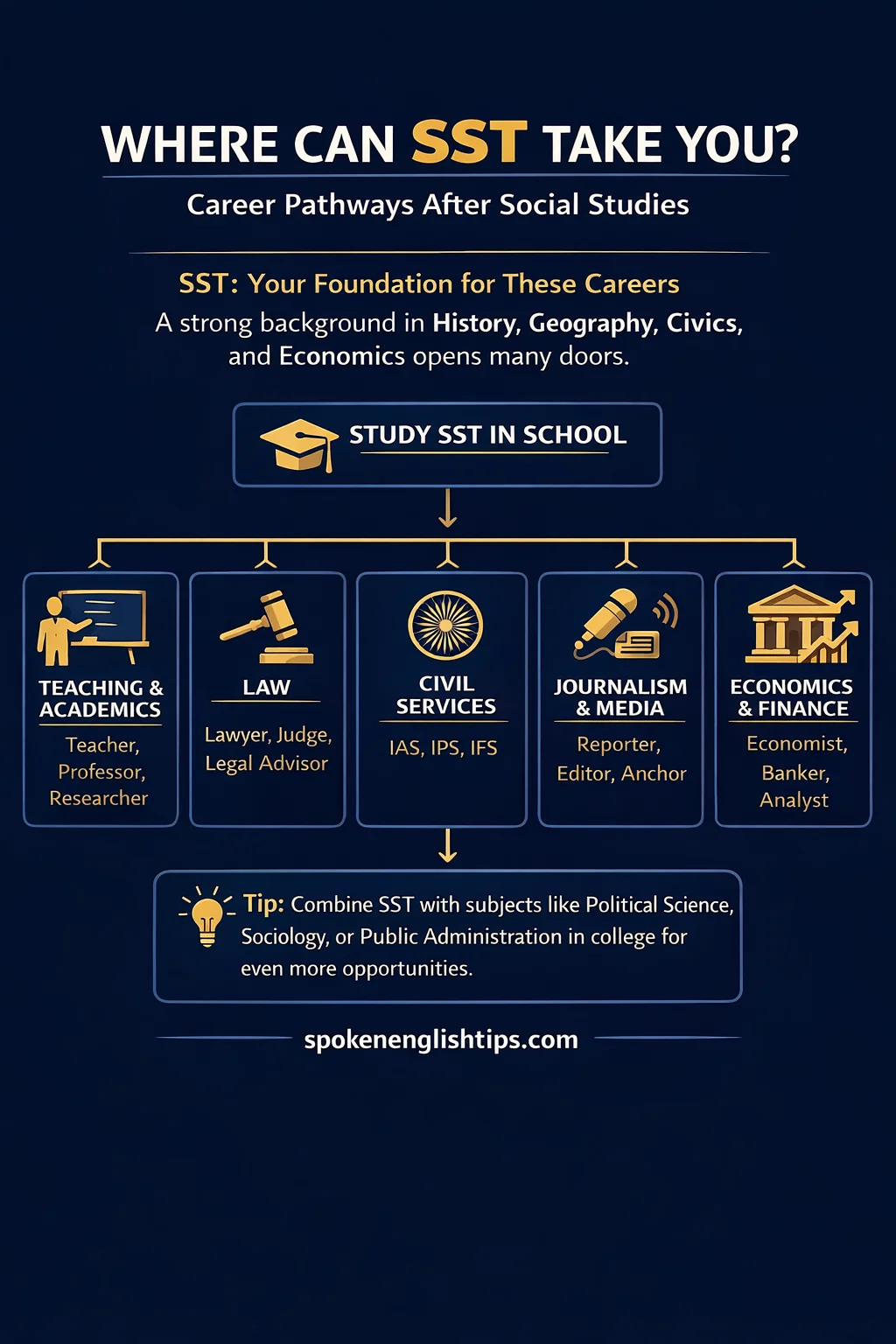
2. Use Mind Maps and Timelines
History has many events. Geography has many terms. Organize them visually.
| Tool | How to Use |
|---|---|
| Timelines | Place historical events in chronological order on a line. |
| Mind Maps | Start with a central topic and branch out to subtopics. |
| Flashcards | Write a term on one side and its definition on the other. |
3. Practice Map Work
Geography and history often include map-based questions. Practice labeling maps. Mark rivers, mountain ranges, historical sites, and cities. This can earn you easy marks in exams.
4. Write Answers in Points
Examiners appreciate clear, structured answers. Instead of writing one long paragraph, break your answer into bullet points or numbered sections. Use headings like “Causes,” “Effects,” and “Solutions.”
5. Connect to Current Events
SST becomes interesting when you connect it to today’s news. When studying the constitution, read about recent court judgments. When studying economics, follow the news about inflation or unemployment. This makes learning relevant.
“The more you read about history, geography, and civics, the more you understand the newspaper you hold every morning.”
Career Options After Studying SST
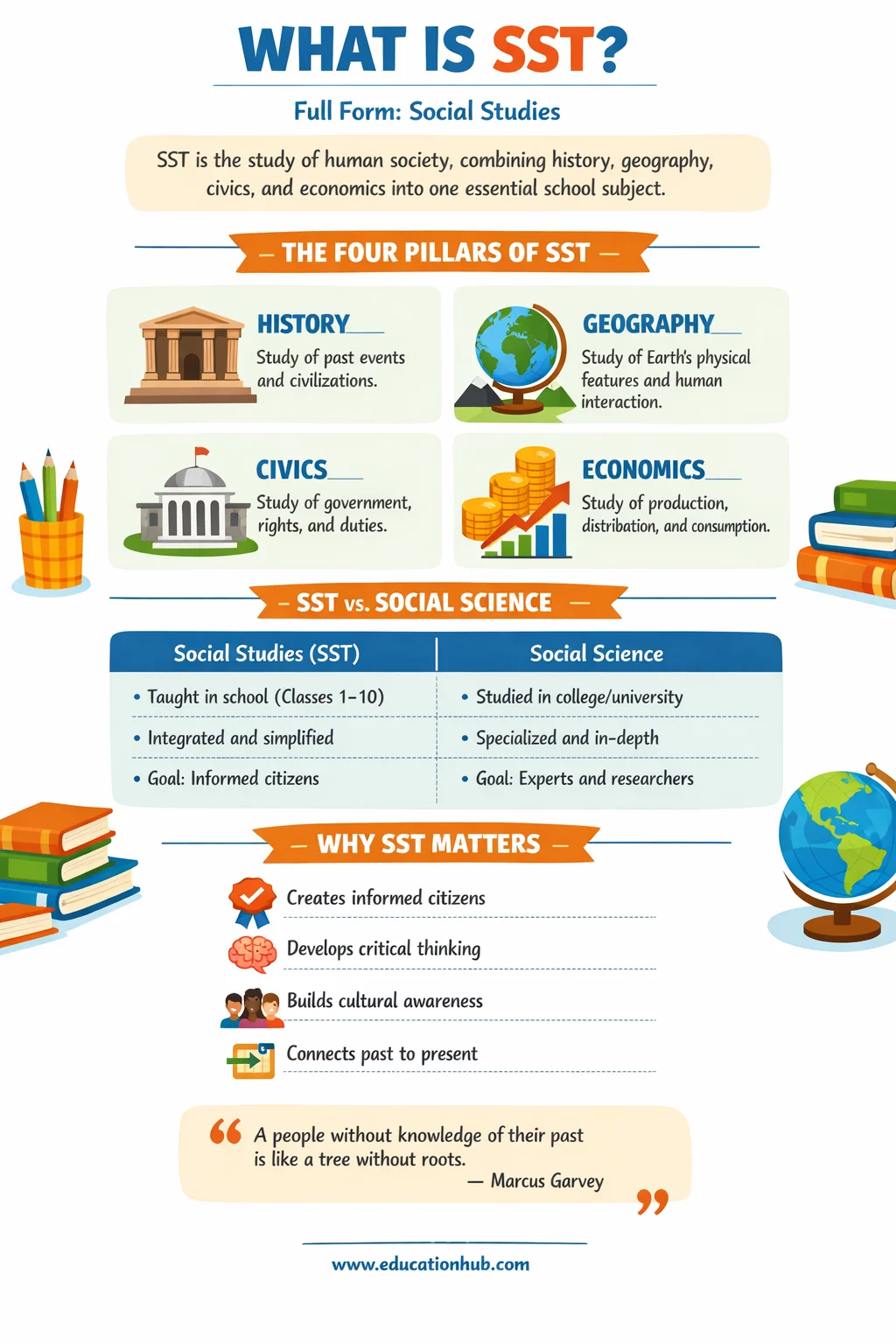
A strong foundation in SST opens many career doors. Here are some popular career paths:
| Career Field | Job Roles | Required Education |
|---|---|---|
| Teaching & Academics | School teacher, college professor, researcher | B.Ed., M.A., Ph.D. |
| Law | Lawyer, judge, legal advisor | LL.B., LL.M. |
| Civil Services | IAS, IPS, IFS officer | UPSC examination |
| Journalism & Media | Reporter, editor, news anchor | Degree in Mass Communication |
| Economics & Finance | Economist, banker, financial analyst | B.A./M.A. Economics, MBA |
| Archaeology & Museums | Archaeologist, curator, historian | M.A. in Archaeology or History |
| Public Administration | Government officer, policy analyst | MPA, MPP |
Even careers in business, marketing, or public relations benefit from SST knowledge. Understanding human behavior and society is valuable in almost any profession.
Frequently Asked Questions
Here are common questions students and parents ask about SST.
Q1: Is SST the same as Social Science?
No. SST (Social Studies) is taught in school and combines subjects. Social Science is a broader academic field studied in college.
Q2: Which subjects are included in SST?
SST typically includes History, Geography, Civics, and Economics. Some boards also include Sociology or Political Science in higher classes.
Q3: Is SST a compulsory subject?
In most Indian schools, SST is compulsory from Class 1 to Class 10. In Class 11 and 12, students can choose Humanities (which includes Social Science subjects) or other streams.
Q4: How can I make SST interesting for my child?
Use stories, documentaries, and field trips. Visit historical sites. Discuss news events. Show how textbook topics connect to real life.
Q5: What is the full form of SST in Hindi?
In Hindi, SST is called सामाजिक अध्ययन (Saamajik Adhyayan). The full form remains Social Studies.
Q6: Which board has the most detailed SST syllabus?
CBSE, ICSE, and state boards all have detailed SST syllabi. CBSE is known for its structured approach. ICSE includes more depth in history and geography.
✅Basic Tips for English Grammar
Basics of grammar, which is essential for Spoken English. Study all the lessons below to improve your speaking, writing..
✅Basics Of Speaking English Structures
1000+ Basics of English Speaking Structures in this course, which is used to improve your Spoken English.
✅Additional English Speaking Structures
Regular English-speaking structures at least 1000 here. It can be used during Fluent English Speaking.
✅Daily English Speaking conversation topics
Learn above 100 topics about what to say and how to say things in daily conversations.
✅10000+ Vocabulary for Spoken English
10000+ above Most Common Words in English which enhance your vocabulary power.
✅Business Speaking Tips
Improve your English Fluency dealing with Business, Learn How to deal with business communication.
✅Interview Speaking Tips
Crack any kind of interview by improving communication skills Prepare for any kind of interview conducted in English
✅Communication – Soft Skills
Learn Soft skills for your personality development, improving yourself, body language tips, and ideas.