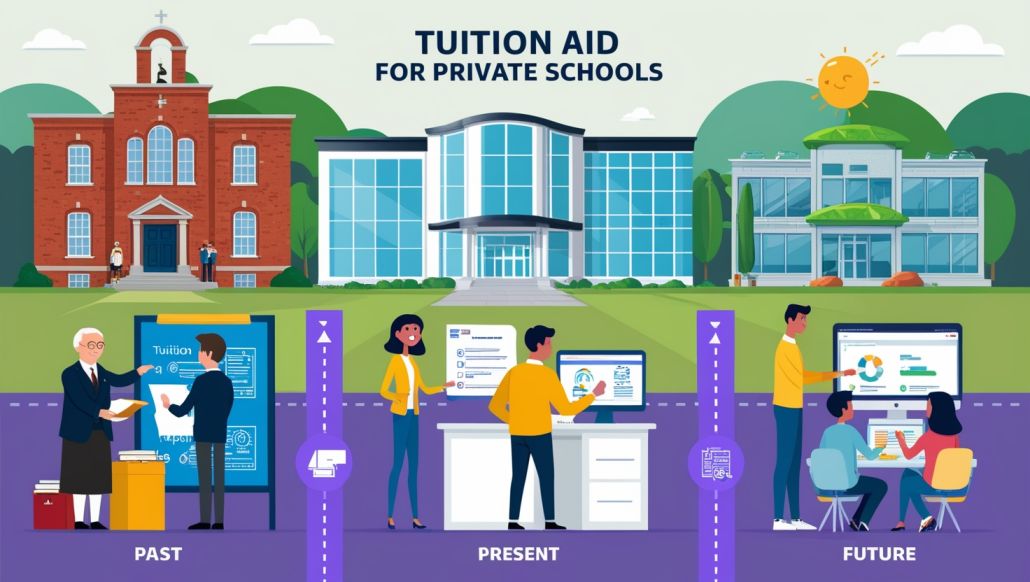
Discover the origins and evolution of tuition aid for private schools, including its impact on the availability of schooling, and learn how institutions like Olney Friends School provide necessary financial support.
Origins and Relevance of Tuition Aid for Private Schools
For decades, private schools were seen as bastions of exclusivity, accessible only to the privileged few.
Today, tuition aid has transformed this perception, enabling thousands of students from diverse backgrounds to access private education.
Thanks to the provision of this kind of support, which has been a vital and always-changing element of the educational environment, students from a range of socioeconomic situations are given possibilities that might otherwise be out of their grasp.Â
As we see, tuition aid has played a pivotal role in shaping the landscape of private education, evolving from an exclusive privilege to a key tool for promoting accessibility.
This article explores the history, impact, and future of tuition aid.
An Examination of Financial Aid for Private Schools Early Years
To understand the transformative impact of tuition aid, it’s essential to trace its early beginnings and the societal changes that prompted its evolution.
While early programs were limited, they laid the groundwork for a broader system that would eventually revolutionize access to private education.
As we know, these institutions have been often associated with wealth and exclusiveness throughout history, but this trend first began to shift in the 19th and early 20th centuries,
when social groups and humanitarian activities started to value the need to ensure that education could be accessed by more people.
Groups such as Quakers and Catholic organizations funded scholarship programs to extend education to underserved communities.
At the same time, in the United States, private educational institutions—including religious schools and residential schools—were sometimes seen as a substitute for public ones.
This was particularly true in areas devoid of public schools with appropriate caliber. Conversely, the cost associated with private education meant that only a tiny fraction of the population could afford to attend these institutions.
The spread of tuition aid schemes at the start of the 20th century signaled a major turning point in the degree of accessibility private institutions provided.
Originally, most tuition aid for private schools came in the form of scholarships, which rich families, religious organizations, and private donors provided.
Early initiatives often had limited scope, and each year they could only help a small number of youngsters.
Conversely, growing knowledge of education as a means of social mobility led to the creation of more orderly schemes meant to help lower the cost of tuition for a greater range of students.
The Expansion of Financial Aid for Private Schools Programs
Tuition aid began to show a significant increase only in the middle of the 20th century.
Many institutions started to see the benefits of a more varied student body and the financial challenges experienced by those from lower-income families started to lessen.
Educational organizations, including Ivy League universities and wealthy preparatory schools, started creating endowments.
These endowments funded scholarships, making private education more accessible change made it feasible for students who could achieve academic excellence but lacked the means to keep on their study at these universities.
Driven by government actions as well as private charity over the course of the 1960s and 1970s, these kinds of programs experienced even more expansion during those years.
By means of initiatives like Pell Grants and subsidized loans, the United States of America government has helped to increase the range of educational possibilities open to private school attendees.
These programs allowed families experiencing financial difficulties to get help, therefore enabling them to afford private education that they would not have been able to afford otherwise.
Particularly among elite private institutions, the concept of “need-blind” admissions—in which schools offer support to students without considering their financial situation during the application process—started to gather steam in the latter half of the 20th century.
Many educational institutions began building strong financial aid departments to help students negotiate the complexity of many types of financial assistance, from low-interest loans to scholarship possibilities.
Private Schools Financial Aid in the Modern Era
From elite preparatory schools to smaller independent schools, it is a standard practice for many different kinds of educational institutions to offer financial aid to students registered in private schools.
Some of these organizations have created specialized departments recently that work directly with families to create customized plans.
Often these packages combine loans, scholarships, and grants. These packages, meant to make the expense of tuition more accessible, can help families of different economic levels.
One of the most significant features of modern tuition aid for private colleges is the shift toward support grounded on a student’s need.
Need-based financial help fills in for the difference between what the school charges for tuition and what a family can afford.
Unlike merit-based scholarships, which are given for academic or athletic performance, this is not so in line with Schools sometimes demanding families to supply thorough financial information,
which could include tax records, thus determining whether or not a family qualifies for this program.
For students attending private institutions, scholarships and grants now allow for a wide range of expenses beyond tuition.
These costs cover extracurricular activities, textbooks, and even lodging for students living in boarding houses.
By means of this all-encompassing approach, it is guaranteed that students are not burdened by extra expenses that can forbid their attendance.
Indeed, the process of promoting inclusivity and diversity in private institutions depends critically on financial support for these institutions.
Because they offer financial aid, private schools can draw students from a variety of socioeconomic levels.
For the kids who go to these schools, this offers a more varied and exciting classroom.
A Success Case
Programs like those run at Olney Friends School help to illustrate this approach, as it brings financial help to make sure students from all walks of life may benefit from a private education.
As shown by the material on their website dedicated to financial support, Olney Friends School boasts a thorough help scheme for financially strapped families.
The institution provides financial support to families based on the proof they have shown a need for, therefore guaranteeing that no student is denied admission because of lack of financial means.
By using this approach, students can seize the unique learning environment and great educational possibilities this school offers.
Using a case study, an analysis of the impacts of aid for students at Olney Friends School
Long ago, Olney Friends School—a Quaker institution with a long history of supporting social justice and diversity—was aware of the need to provide financial support for children attending private education institutes.
By means of all-encompassing financial aid packages, Olney Friends ensures that students are free to actively engage in the academic and extracurricular activities presented to them free from financial constraints.
Apart from helping to make education more accessible, the school’s program helps to foster a community that welcomes people of many faiths and backgrounds.
Families from various financial backgrounds should apply for financial aid; the school closely monitors every family to make sure the tuition fits their means.
Olney Friends School has been able to draw pupils from a variety of financial, cultural, and geographical backgrounds as a result, therefore improving the educational experience for every one of the children.
The Future of Tuition Aid for Private Schools
As we look ahead, we examine how inclusion projects for private schools have changed.
Tuition support for private schools is expected to become increasingly more important as tuition costs keep rising, while demand for education at private institutions keeps high.
To guarantee its ongoing success, the procedure of giving help to families must be made more transparent, easily available, and environmentally friendly.
Sliding-scale tuition, in which the tuition cost is computed depending on family income, is one innovative approach to offering financial aid that is probably going to get more and more common in the future.
Moreover, educational institutions could progressively create alliances with non-governmental organizations and government projects in order to extend the range of financial assistance accessible.
The path tuition aid for private schools has followed over its existence has been helping to remove financial obstacles and provide private education to a greater spectrum of students.
This road has been one from exclusivity to inclusiveness. Programs like the one given at Olney Friends School illustrate how financial assistance may transform a student’s life. These initiatives help students to seize the opportunities presented by private institutions.
As private education becomes more inclusive through evolving tuition aid programs, we move closer to a future where every child, regardless of their financial background, has the opportunity to thrive in an environment that nurtures their potential.
![How to Remove Hesitation While Speaking English Step by Step If you're wondering exactly how to remove hesitation while speaking English, follow these practical steps. 1. Start Speaking Before You Feel Ready Many learners wait until their grammar becomes perfect. That day never comes. Start speaking with the English you already know. Instead of saying: "I will start speaking English after improving my vocabulary." Say: "I will improve my vocabulary by speaking English." 2. Speak in Short Sentences First Long sentences increase mental pressure. Start with simple structures: I work in sales. I live in Lucknow. I enjoy reading books. I am learning English every day. Confidence grows faster when you can complete sentences smoothly. 3. Practice Speaking Out Loud Daily Speaking silently in your mind is not enough. Read articles, stories, or conversations aloud for 10-15 minutes every day. This trains your mouth and brain to work together. [INTERNAL LINK: daily spoken English practice routine for beginners] 4. Record Yourself Speaking Most students avoid recording themselves because it feels uncomfortable. However, it is one of the fastest ways to improve. Choose a simple topic: My job My hometown My daily routine My future goals Record for one minute and listen carefully. You will quickly identify: Frequent pauses Pronunciation issues Repeated words 5. Think in English Instead of translating, start creating simple thoughts directly in English. For example: While drinking tea, think: This tea is hot. I need to finish my work. The weather is pleasant today. Small habits create big improvements. Stop Translating in Your Head One major reason behind hesitation is mental translation. Why Translation Creates Delays Imagine someone asks: "What did you do yesterday?" If your brain follows this path: Hindi → English Translation → Grammar Check → Speak You will hesitate. Instead, train yourself to answer directly: "I visited my friend." "I watched a movie." "I completed a project." A Simple Exercise For 5 minutes daily: Look around your room and describe objects in English. Examples: The fan is running. My laptop is on the table. I need to clean this shelf. This helps your brain create English thoughts naturally. [INTERNAL LINK: how to think in English without translating] Build Speaking Confidence With Daily Practice Confidence does not come before speaking. Confidence comes from speaking repeatedly. Student Story #1 One of my students, a software engineer from Pune, understood English very well but hesitated badly during meetings. Whenever someone asked a question, he would spend several seconds forming the perfect answer. I encouraged him to focus on communicating rather than being perfect. Within six weeks of daily speaking practice, his hesitation reduced dramatically and he became much more active in discussions. Student Story #2 I remember teaching a customer support executive who constantly said "umm..." and "actually..." before every sentence. We practiced one-minute speaking exercises every day for a month. By replacing filler words with brief pauses and improving speaking confidence, she started speaking much more naturally during client calls. In my experience teaching hundreds of Indian learners, hesitation decreases fastest when students practice speaking consistently rather than studying grammar for hours. Common Mistakes That Increase Hesitation Many learners unknowingly make these mistakes. Mistake Result Translating every sentence Slow speech Trying to sound perfect Increased anxiety Memorizing without speaking Low confidence Fear of mistakes Longer pauses Comparing yourself to fluent speakers Reduced motivation Avoiding conversations No real improvement Avoiding these habits can significantly improve your fluency. Useful English Phrases When You Get Stuck Even fluent speakers sometimes need a moment to think. Instead of becoming silent, use these phrases. When You Need Time to Think That's an interesting question. Let me think for a moment. As far as I know... From my experience... When You Don't Understand Instead of saying: "What?" Say: Could you please repeat that? Sorry, I didn't catch that. Could you say that again? When You Forget a Word Try: I'm not sure of the exact word, but... What I mean is... Let me explain differently. These phrases help maintain the flow of conversation. [INTERNAL LINK: useful English phrases for daily conversation] 15 Practical Tips to Remove Hesitation Quickly Here are some practical strategies you can start today: Speak English for at least 15 minutes daily. Stop waiting for perfect grammar. Think in English during routine activities. Record your voice regularly. Read aloud every day. Learn useful speaking phrases. Join English conversation groups. Talk to yourself in English. Practice answering common interview questions. Focus on communication, not perfection. Improve pronunciation gradually. Watch English content actively. Shadow native speakers. Celebrate small improvements. Speak even when you feel nervous. The goal is progress, not perfection. A Simple 15-Minute Daily Routine to Reduce Hesitation If you're busy, follow this routine. Minutes 1-5: Read Aloud Choose any English article or story. Focus on: Clear pronunciation Natural pace Confidence Minutes 6-10: Speak on a Topic Choose one topic: My family My career My favorite movie My goals Speak continuously. Do not stop for mistakes. Minutes 11-15: Think and Describe Describe: Your room Your surroundings Your plans Only in English. Do this consistently for 30 days and you will notice a visible reduction in hesitation. [INTERNAL LINK: best daily English speaking exercises at home] What to Do During Interviews or Meetings Many learners hesitate most during professional situations. Try these strategies: Slow Down Slightly Speaking slowly is better than speaking nervously. A calm pace sounds more confident. Focus on the Message Your goal is communication, not perfection. Interviewers care more about clarity than flawless grammar. Use Familiar Vocabulary Don't force difficult words. Simple English spoken confidently creates a stronger impression. Example: Instead of: "I possess exceptional interpersonal communication capabilities." Say: "I communicate well with people and enjoy teamwork." The second version sounds more natural and confident. How Long Does It Take to Remove Hesitation? The answer depends on your current level and practice consistency. Most learners notice improvement within: 2-4 weeks of daily practice 2-3 months of regular speaking 6 months of consistent conversation practice In over 8 years of teaching spoken English, I've noticed that students who speak daily improve much faster than students who only study grammar and vocabulary. Consistency beats intensity every time. Conclusion Learning how to remove hesitation while speaking English is not about becoming perfect overnight. It is about speaking regularly, making peace with mistakes, and training yourself to think and respond in English naturally. Start with just 15 minutes of daily speaking practice. Over time, your confidence will grow, your pauses will reduce, and speaking English will begin to feel much more natural. If you try any of the techniques from this article, share your experience in the comments and let us know what helped you most. Frequently Asked Questions Can hesitation while speaking English be completely removed? Yes, hesitation can be reduced significantly through regular speaking practice, confidence-building exercises, and thinking in English instead of translating. Even fluent speakers pause occasionally, but frequent hesitation can be overcome with consistency. Why do I hesitate even when I know English? This usually happens because of fear of mistakes, overthinking grammar, lack of speaking practice, or translating from your native language before speaking. How can I remove hesitation while speaking English at home? Practice reading aloud, record yourself speaking, talk to yourself in English, and describe daily activities in English. Just 15 minutes a day can make a noticeable difference. Does grammar cause hesitation? Sometimes, but not always. More often, hesitation comes from fear of making grammar mistakes rather than actual grammar weakness. How long does it take to speak English confidently? Many learners notice improvement within a few weeks of daily practice. Significant confidence usually develops over a few months of regular speaking. Is it okay to make mistakes while speaking English? Absolutely. Mistakes are a natural part of learning. Every fluent speaker made countless mistakes before becoming confident. FAQ Schema-ready Q&A Pairs Question: Can hesitation while speaking English be completely removed? Answer: Yes, hesitation can be reduced significantly through regular speaking practice, confidence-building exercises, and thinking in English instead of translating. Consistent practice helps develop fluency and confidence over time. Question: Why do I hesitate even when I know English? Answer: Most learners hesitate because of fear of making mistakes, overthinking grammar, lack of speaking practice, or translating from their native language before speaking. Question: How can I remove hesitation while speaking English at home? Answer: Practice reading aloud, record your voice, talk to yourself in English, and describe your surroundings in English daily. These exercises help build fluency and confidence. Question: Does grammar cause hesitation while speaking English? Answer: Grammar can contribute to hesitation, but fear of making grammar mistakes is often a bigger issue. Focusing on communication rather than perfection helps reduce hesitation. Question: How long does it take to speak English confidently? Answer: Many learners see improvement within 2-4 weeks of consistent practice. Strong confidence and fluency typically develop over several months of regular speaking. Question: Is it okay to make mistakes while speaking English? Answer: Yes. Making mistakes is a normal part of language learning. Every fluent speaker makes mistakes while learning, and speaking regularly is more important than speaking perfectly.](https://spokenenglishtips.com/wp-content/uploads/2026/06/How-to-Remove-Hesitation-While-Speaking-English-Step-by-Step-800x533.webp)