Every successful business needs customers. Whether a company sells software, clothes, insurance, or professional services, it must find people who are interested in its products. But who helps a business discover new customers and build relationships with them?
One person who plays an important role in this process is a Business Development Associate (BDA).
A Business Development Associate helps a company find new business opportunities, connect with potential customers, and increase sales. The job involves communication, research, relationship building, and understanding what customers need.
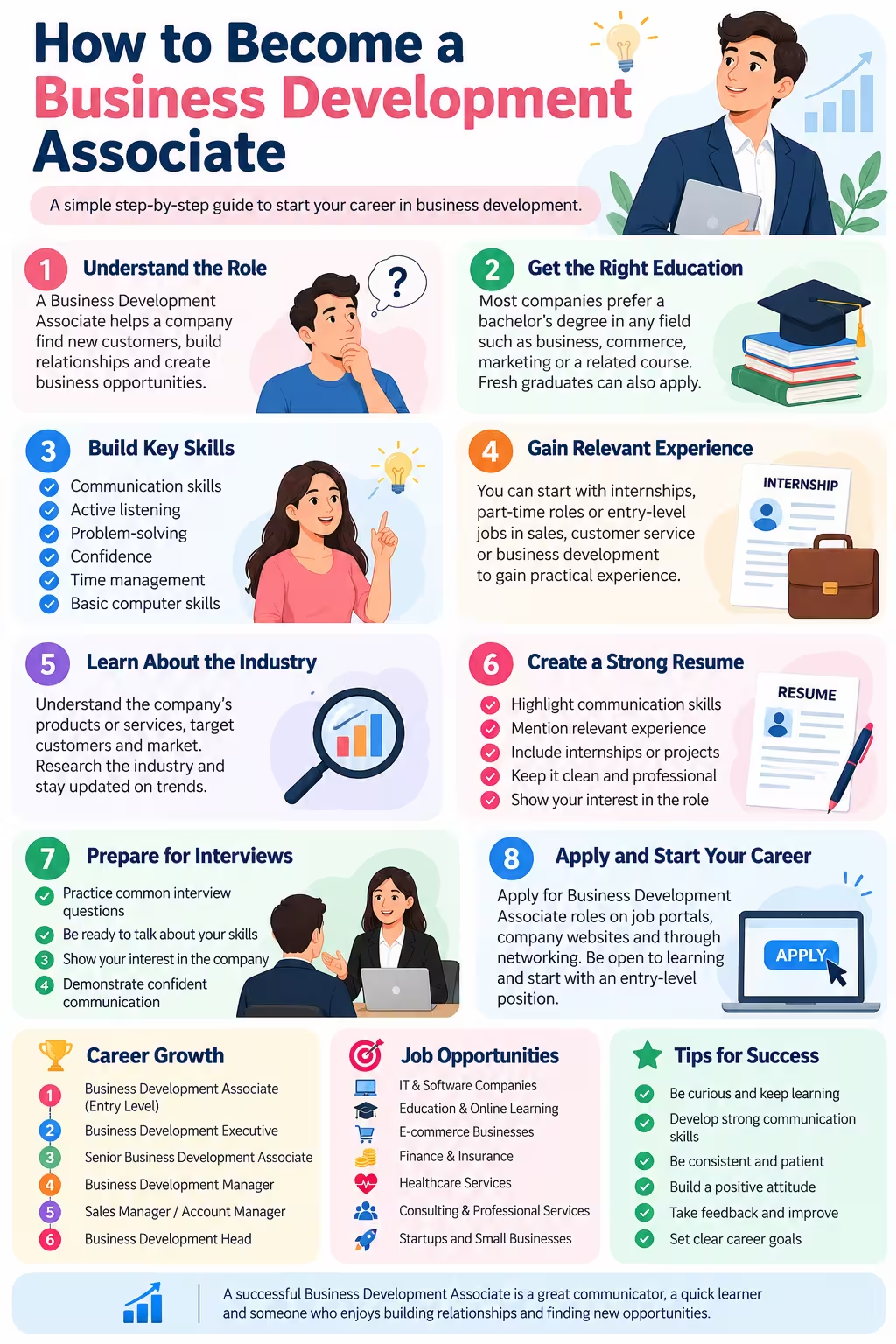
If you are planning to start your career in business development, this guide will help you understand what a Business Development Associate does, their daily responsibilities, required skills, and career opportunities.
Who Is a Business Development Associate?
A Business Development Associate is a professional who helps a company grow by identifying potential customers and creating new business opportunities.
For example, imagine a company that provides online English-speaking courses. The company wants more students to join its programs.
A Business Development Associate may contact interested students, explain the available courses, answer their questions, and help them choose a suitable program.
The associate may also research new markets, follow up with interested customers, and work with the sales team to achieve business goals.
In simple words, a Business Development Associate helps connect a company’s products or services with people who may need them.
The exact responsibilities depend on the company. In some organizations, the role focuses mainly on sales calls. In others, it involves market research, partnerships, and long-term business relationships.
What Does a Business Development Associate Do?
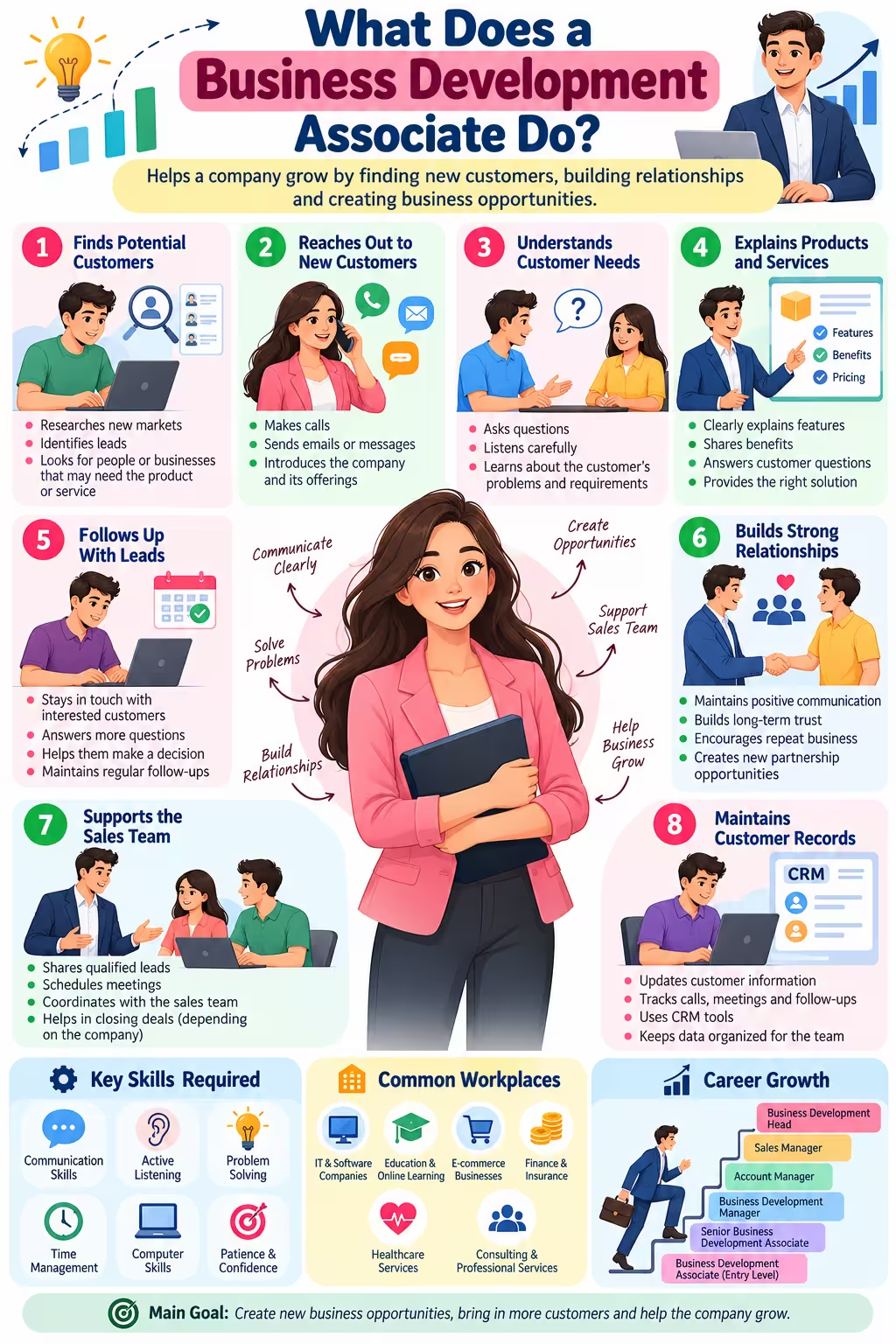
A Business Development Associate performs several tasks that support business growth.
1. Finding Potential Customers
One of the main responsibilities of a Business Development Associate is identifying people or businesses that might be interested in the company’s products.
This process is called lead generation.
For example, if a company sells website development services, the associate may search for small businesses that need a professional website.
They may find potential customers through online research, social media, business directories, referrals, or marketing campaigns.
The goal is to identify people who are likely to benefit from the company’s services.
2. Contacting New Customers
After finding potential customers, the next step is reaching out to them.
A Business Development Associate may communicate with customers through phone calls, emails, messages, or online meetings.
During these conversations, the associate introduces the company and explains how its products or services can help.
Good communication matters because customers usually want to understand a product before making a purchase.
Instead of simply trying to sell something, a good associate listens carefully and tries to understand the customer’s problems.
3. Understanding Customer Needs
Not every customer wants the same thing.
Some people are looking for affordable services, while others care more about quality, features, or long-term support.
A Business Development Associate asks questions to understand what the customer needs.
For example, suppose a customer wants to purchase business management software. The associate may ask about the company’s size, daily operations, and budget.
Based on the answers, the associate can recommend a suitable solution or connect the customer with the right sales specialist.
Understanding customer needs helps build trust and improves the chances of successful business relationships.
4. Explaining Products and Services
A Business Development Associate should understand the company’s offerings.
They must be able to explain product features, pricing, benefits, and important differences in simple language.
For example, an associate working for an education company may explain course duration, learning materials, class schedules, and enrollment procedures.
They should also answer common questions clearly and honestly.
If a customer asks something the associate does not know, it is better to check with the appropriate team than to provide incorrect information.
5. Following Up With Interested Customers
Many customers do not make a decision during the first conversation.
They may need time to compare options, discuss the purchase with family members, or arrange their budget.
Following up with these customers is another important responsibility.
A Business Development Associate may call or email a customer after a few days to answer questions or provide additional information.
For example, someone interested in an online course may request the fee details but decide to enroll the following week.
A polite follow-up can help the customer make an informed decision.
However, good follow-up should be helpful rather than pushy.
6. Building Strong Customer Relationships
Business development is not only about finding new customers. It also involves maintaining positive relationships.
When customers trust a company, they may return for another purchase or recommend its services to others.
A Business Development Associate supports these relationships by communicating professionally, addressing concerns, and coordinating with other departments when necessary.
Even small actions, such as replying on time or remembering a customer’s requirements, can make a difference.
7. Supporting the Sales Team
Business Development Associates often work closely with sales executives and managers.
They may schedule meetings, qualify potential customers, prepare basic proposals, or share important customer information.
In some companies, associates are also responsible for closing sales and meeting revenue targets.
In other companies, they mainly develop opportunities and pass qualified leads to senior salespeople.
These responsibilities depend on how the organization structures its sales process.
8. Maintaining Customer Records
Businesses need organized information to manage customer relationships.
A Business Development Associate may use a Customer Relationship Management (CRM) system to record calls, meetings, customer interests, and follow-up dates.
For example, if a customer requests another call on Friday, the associate records that information to ensure the follow-up happens on time.
Accurate records help team members understand customer progress and avoid unnecessary repeated communication.
What Does a Business Development Associate Do Daily?
A typical working day can involve several different activities.
| Time | Example Daily Activity |
|---|---|
| 9:30 AM | Check emails, messages, and the day’s priorities |
| 10:00 AM | Research new customers and business opportunities |
| 11:00 AM | Make calls or send introductory emails |
| 12:30 PM | Speak with interested customers |
| 2:00 PM | Attend meetings or product training |
| 3:00 PM | Follow up with potential customers |
| 4:00 PM | Update customer information in the CRM |
| 5:00 PM | Review progress and plan the next day’s work |
This is only an example. Some companies have flexible schedules, while others require associates to complete specific calling or sales targets.
The role may involve working from an office, remotely, or occasionally visiting clients.
Skills Required to Become a Business Development Associate
You do not need to be an expert salesperson on your first day. However, certain skills can help you perform the job successfully.
Communication Skills: You should be able to explain ideas clearly, ask useful questions, and speak confidently with different people.
Active Listening: Understanding what customers say is just as important as talking to them. Listening helps you identify their actual needs.
Problem-Solving Skills: Customers may have concerns about prices, features, or services. You should be able to understand these concerns and suggest suitable solutions.
Time Management: Business Development Associates often handle several customers and follow-ups during the day. Good planning helps them complete their work on time.
Basic Computer Skills: Familiarity with email, spreadsheets, video meetings, and CRM software makes daily tasks easier.
Patience and Confidence: Not every customer will be interested. Learning to handle rejection professionally is an important part of the job.
Product Knowledge: Understanding what your company offers helps you provide accurate information and build customer trust.
These skills improve with practice, feedback, and real customer interactions.
What Qualifications Are Needed?
Many companies prefer candidates who have completed a bachelor’s degree.
Graduates from business administration, commerce, marketing, management, and other educational backgrounds may be eligible.
However, requirements vary between employers.
Some companies hire fresh graduates and provide training, while others prefer candidates with previous sales or customer service experience.
You may also find it helpful to learn basic sales techniques, professional email writing, Microsoft Excel, and CRM tools.
Practical communication skills and a willingness to learn can be just as valuable as academic knowledge for many entry-level positions.
Is Business Development Associate a Sales Job?
A Business Development Associate often works closely with sales, but business development and sales are not always exactly the same.
Business development focuses on identifying opportunities, reaching potential customers, and creating relationships that may generate future revenue.
Sales focuses more directly on converting opportunities into purchases.
For example, a Business Development Associate may contact a company interested in buying software and arrange a demonstration.
A sales executive may then discuss detailed pricing and finalize the agreement.
However, in many organizations, especially smaller businesses, one person performs both activities.
That is why it is important to read the job description carefully before applying.
Is Business Development Associate a Good Career?
Business development can be a good career choice for people who enjoy communication, meeting new people, and learning how businesses work.
It offers practical experience in customer relationships, marketing, sales, negotiation, and business operations.
These skills can be useful in many industries.
With experience and strong performance, a Business Development Associate may grow into roles such as:
- Business Development Executive
- Senior Business Development Associate
- Business Development Manager
- Account Manager
- Sales Manager
- Business Development Head
Career progression depends on the company, available opportunities, and individual performance.
The job can also be challenging. Some positions involve frequent calls, demanding sales targets, rejection, and performance pressure.
Before accepting an offer, ask about working hours, training, fixed salary, incentives, and performance expectations.
Business Development Associate Salary
The salary of a Business Development Associate depends on several factors, including location, industry, employer, experience, and job responsibilities.
An entry-level associate may receive a fixed salary along with performance-based incentives.
Some organizations offer additional commissions for successful sales or meeting monthly targets.
For example, a company might provide a basic monthly salary and extra incentives when an associate achieves certain sales goals.
However, incentive structures are different in every organization.
Before joining, make sure you understand how much of the compensation is guaranteed and how much depends on performance.