
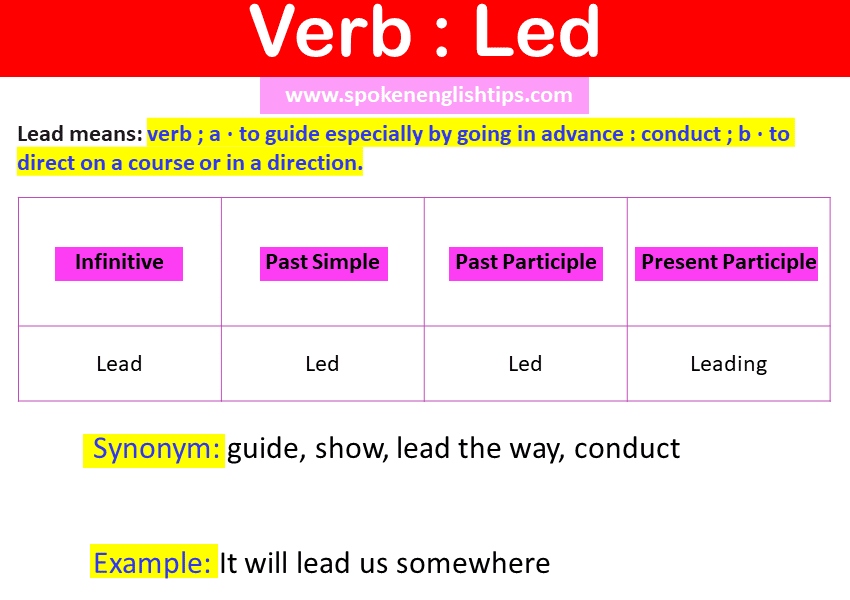
It is a kind of verb. The lead meaning is to control a group of a situation, people, or a country.
- I think we have chosen the right person to lead the target.
- I told Gloria to lead this discussion.
- Who gonna be lead this project? If anyone is not ready to lead this project, I am going to handle this project under me.
- Who will lead this inquiry Commission?
Lead Meaning More Examples:
- There was no strong leader to lead that conversation against him.
- Always men have to be active in their life and they lead to work hard. While for the woman, they have to empower themselves.
- I’m damn sure, he will lead one day to this country.
- Always, Father has to lead the family to encourage them or empower them.
I explained the word LEAD, and how we can use it in our daily life. I don’t explain only the meaning of a word rather I try to explain the essence of the word and try to make you feel the meaning of a word. so, as the situation arises you wouldn’t get confused and directly the words within you. Also, I have provided all queries and situations that come to your mind which are below explained.
Astray Past Tense
The past tense of Astray is as follows:-
- adrift,
- afield,
- awry,
- gone,
- lost,
- off course.
Past tense of go astray is went astray.
Words That Rhyme With Lead
- read
- declared
- depend
- spend
- trend
- embed
- misread
- Freda
- Ged
- Reade
- unread
- Pred
- edd
- abed
- hed
- Tancred
- pled
- Sayed
- Sched
- redd
- red
- instead
- Hist Med
- in the head
- end
- held
- friend
- compared
- prepared
- tend
- send
- eds
- shared
- heads
- extend
- attend
- stared
- defend
- beds
- thread
- shed
- fled
- Ted
- infrared
- dread
- bred
- tread
- sped
- bled
- sled
- shred
- Dred
- unwed
- unsaid
- recommend
- condemned
- alleged
- compelled
- impaired
- bend
- scared
- cared
- intend
- lend
- pretend
- yelled
- led
- dead
- bed
- spread
- ahead
- bread
- fed
- overfed
- Med
- in bed
- Fred
- Ned
- stead
- wed
- misled
- in head
- Zed
- Jed
- Biomed
You Led Me To The Wrong
Co-Lead Synonym
Here is the list of Co-lead synonyms.
- leading
- lead
- co-sponsor
- co-responsible
- co-director
- co-head
- co-management
Lead To Doing
- lead somebody to do structure to show someone how to do something
- lead somebody to doing structure to convince someone to do something
Led Up To This
The meaning of led up to this means immediately precedes or is the cause of something.
Led The Pack
It is the kind of idiom that means If someone is in front of everyone else in a race or competition, you can refer to them as leading the pack or ahead of the pack. The group might still come out on top in the end.
Had Led To
"Had led", answer A, is past perfect, which we use when we're talking about something that came before a particular point in the past. 1. He has a hard working strategies, which has led to a strong result. 2. Instead, there was a different division, which led to in an order that, in my opinion, is merely the first step. The knowledge culture that we have created has led us to reestablish research as the foundation of our society.
Lead Using Queries’
- Lead You To
- Leads Up To Synonym
- Led By Meaning
- Lead The Way Meaning
- Led Or Lead Astray
- What Is Lead Charge
- He Leads Me On
- Led Up To
- People-Led
- Led Me To You
- How To Spell Visit
- L E D
- Led Away Meaning
- Led Similar Words
- Opposite Of Led
- Metal Lead In Spanish
- Being Led On
- Led In A Sentence
- Lead Me To Believe
- I Was Led To Believe
- Lead Up Synonym
- Leading Me To Believe
- Led To Success
- Leading The Way Synonym
- L.E.D.
- Leading Up To Synonym
- Led Leads
- Led Down A Path
- Easily Led Definition
- He Led Me On
- Led The Charge
- Led Somewhere
- Lead Irregular Verb
- Lead A Group
- How Do You Spell Gave
- L. E. D
- Easily Led Synonym
- Leading Me To Believe Synonyms
- Ly Led
- She Led Me Up The Stairs
- Leading Up To Meaning
- Leading Up Synonym
- Leeds Vs Leads
- Conjugation Of Lead
- Lead Me To
- Seem Past Tense
- Led By
- Lead Him To Believe
- Another Word For Led
- Leading The Charge Meaning
- Which Leads To
- Thanks For The Lead Meaning
- This leads Me To Believe
- Lead Up Meaning
- Lead The Effort
- Lead The Group
- Co-Lead Synonym
- Lead The Race
- Led Pronunciation
- Lead Way Meaning
- This Lead Us To
- Led Long Lead
- Rhymes With Bleed
- Lead The Way Synonym
- Synonym For Leading The Way
- Spell Assume

| Unstoppable Self-Confidence: How to Create the indestructible | Visit Site |
| Performance Conversations: How to Use Questions to Coach Employees? | Buy Here |
| The Self-Confidence Workbook | Buy Here |
| 5-Minute Core Exercises for Seniors | Buy Here |
| How to Build a High-Performance Team | Buy Here |


![How to Remove Hesitation While Speaking English Step by Step If you're wondering exactly how to remove hesitation while speaking English, follow these practical steps. 1. Start Speaking Before You Feel Ready Many learners wait until their grammar becomes perfect. That day never comes. Start speaking with the English you already know. Instead of saying: "I will start speaking English after improving my vocabulary." Say: "I will improve my vocabulary by speaking English." 2. Speak in Short Sentences First Long sentences increase mental pressure. Start with simple structures: I work in sales. I live in Lucknow. I enjoy reading books. I am learning English every day. Confidence grows faster when you can complete sentences smoothly. 3. Practice Speaking Out Loud Daily Speaking silently in your mind is not enough. Read articles, stories, or conversations aloud for 10-15 minutes every day. This trains your mouth and brain to work together. [INTERNAL LINK: daily spoken English practice routine for beginners] 4. Record Yourself Speaking Most students avoid recording themselves because it feels uncomfortable. However, it is one of the fastest ways to improve. Choose a simple topic: My job My hometown My daily routine My future goals Record for one minute and listen carefully. You will quickly identify: Frequent pauses Pronunciation issues Repeated words 5. Think in English Instead of translating, start creating simple thoughts directly in English. For example: While drinking tea, think: This tea is hot. I need to finish my work. The weather is pleasant today. Small habits create big improvements. Stop Translating in Your Head One major reason behind hesitation is mental translation. Why Translation Creates Delays Imagine someone asks: "What did you do yesterday?" If your brain follows this path: Hindi → English Translation → Grammar Check → Speak You will hesitate. Instead, train yourself to answer directly: "I visited my friend." "I watched a movie." "I completed a project." A Simple Exercise For 5 minutes daily: Look around your room and describe objects in English. Examples: The fan is running. My laptop is on the table. I need to clean this shelf. This helps your brain create English thoughts naturally. [INTERNAL LINK: how to think in English without translating] Build Speaking Confidence With Daily Practice Confidence does not come before speaking. Confidence comes from speaking repeatedly. Student Story #1 One of my students, a software engineer from Pune, understood English very well but hesitated badly during meetings. Whenever someone asked a question, he would spend several seconds forming the perfect answer. I encouraged him to focus on communicating rather than being perfect. Within six weeks of daily speaking practice, his hesitation reduced dramatically and he became much more active in discussions. Student Story #2 I remember teaching a customer support executive who constantly said "umm..." and "actually..." before every sentence. We practiced one-minute speaking exercises every day for a month. By replacing filler words with brief pauses and improving speaking confidence, she started speaking much more naturally during client calls. In my experience teaching hundreds of Indian learners, hesitation decreases fastest when students practice speaking consistently rather than studying grammar for hours. Common Mistakes That Increase Hesitation Many learners unknowingly make these mistakes. Mistake Result Translating every sentence Slow speech Trying to sound perfect Increased anxiety Memorizing without speaking Low confidence Fear of mistakes Longer pauses Comparing yourself to fluent speakers Reduced motivation Avoiding conversations No real improvement Avoiding these habits can significantly improve your fluency. Useful English Phrases When You Get Stuck Even fluent speakers sometimes need a moment to think. Instead of becoming silent, use these phrases. When You Need Time to Think That's an interesting question. Let me think for a moment. As far as I know... From my experience... When You Don't Understand Instead of saying: "What?" Say: Could you please repeat that? Sorry, I didn't catch that. Could you say that again? When You Forget a Word Try: I'm not sure of the exact word, but... What I mean is... Let me explain differently. These phrases help maintain the flow of conversation. [INTERNAL LINK: useful English phrases for daily conversation] 15 Practical Tips to Remove Hesitation Quickly Here are some practical strategies you can start today: Speak English for at least 15 minutes daily. Stop waiting for perfect grammar. Think in English during routine activities. Record your voice regularly. Read aloud every day. Learn useful speaking phrases. Join English conversation groups. Talk to yourself in English. Practice answering common interview questions. Focus on communication, not perfection. Improve pronunciation gradually. Watch English content actively. Shadow native speakers. Celebrate small improvements. Speak even when you feel nervous. The goal is progress, not perfection. A Simple 15-Minute Daily Routine to Reduce Hesitation If you're busy, follow this routine. Minutes 1-5: Read Aloud Choose any English article or story. Focus on: Clear pronunciation Natural pace Confidence Minutes 6-10: Speak on a Topic Choose one topic: My family My career My favorite movie My goals Speak continuously. Do not stop for mistakes. Minutes 11-15: Think and Describe Describe: Your room Your surroundings Your plans Only in English. Do this consistently for 30 days and you will notice a visible reduction in hesitation. [INTERNAL LINK: best daily English speaking exercises at home] What to Do During Interviews or Meetings Many learners hesitate most during professional situations. Try these strategies: Slow Down Slightly Speaking slowly is better than speaking nervously. A calm pace sounds more confident. Focus on the Message Your goal is communication, not perfection. Interviewers care more about clarity than flawless grammar. Use Familiar Vocabulary Don't force difficult words. Simple English spoken confidently creates a stronger impression. Example: Instead of: "I possess exceptional interpersonal communication capabilities." Say: "I communicate well with people and enjoy teamwork." The second version sounds more natural and confident. How Long Does It Take to Remove Hesitation? The answer depends on your current level and practice consistency. Most learners notice improvement within: 2-4 weeks of daily practice 2-3 months of regular speaking 6 months of consistent conversation practice In over 8 years of teaching spoken English, I've noticed that students who speak daily improve much faster than students who only study grammar and vocabulary. Consistency beats intensity every time. Conclusion Learning how to remove hesitation while speaking English is not about becoming perfect overnight. It is about speaking regularly, making peace with mistakes, and training yourself to think and respond in English naturally. Start with just 15 minutes of daily speaking practice. Over time, your confidence will grow, your pauses will reduce, and speaking English will begin to feel much more natural. If you try any of the techniques from this article, share your experience in the comments and let us know what helped you most. Frequently Asked Questions Can hesitation while speaking English be completely removed? Yes, hesitation can be reduced significantly through regular speaking practice, confidence-building exercises, and thinking in English instead of translating. Even fluent speakers pause occasionally, but frequent hesitation can be overcome with consistency. Why do I hesitate even when I know English? This usually happens because of fear of mistakes, overthinking grammar, lack of speaking practice, or translating from your native language before speaking. How can I remove hesitation while speaking English at home? Practice reading aloud, record yourself speaking, talk to yourself in English, and describe daily activities in English. Just 15 minutes a day can make a noticeable difference. Does grammar cause hesitation? Sometimes, but not always. More often, hesitation comes from fear of making grammar mistakes rather than actual grammar weakness. How long does it take to speak English confidently? Many learners notice improvement within a few weeks of daily practice. Significant confidence usually develops over a few months of regular speaking. Is it okay to make mistakes while speaking English? Absolutely. Mistakes are a natural part of learning. Every fluent speaker made countless mistakes before becoming confident. FAQ Schema-ready Q&A Pairs Question: Can hesitation while speaking English be completely removed? Answer: Yes, hesitation can be reduced significantly through regular speaking practice, confidence-building exercises, and thinking in English instead of translating. Consistent practice helps develop fluency and confidence over time. Question: Why do I hesitate even when I know English? Answer: Most learners hesitate because of fear of making mistakes, overthinking grammar, lack of speaking practice, or translating from their native language before speaking. Question: How can I remove hesitation while speaking English at home? Answer: Practice reading aloud, record your voice, talk to yourself in English, and describe your surroundings in English daily. These exercises help build fluency and confidence. Question: Does grammar cause hesitation while speaking English? Answer: Grammar can contribute to hesitation, but fear of making grammar mistakes is often a bigger issue. Focusing on communication rather than perfection helps reduce hesitation. Question: How long does it take to speak English confidently? Answer: Many learners see improvement within 2-4 weeks of consistent practice. Strong confidence and fluency typically develop over several months of regular speaking. Question: Is it okay to make mistakes while speaking English? Answer: Yes. Making mistakes is a normal part of language learning. Every fluent speaker makes mistakes while learning, and speaking regularly is more important than speaking perfectly.](https://spokenenglishtips.com/wp-content/uploads/2026/06/How-to-Remove-Hesitation-While-Speaking-English-Step-by-Step-800x533.webp)

