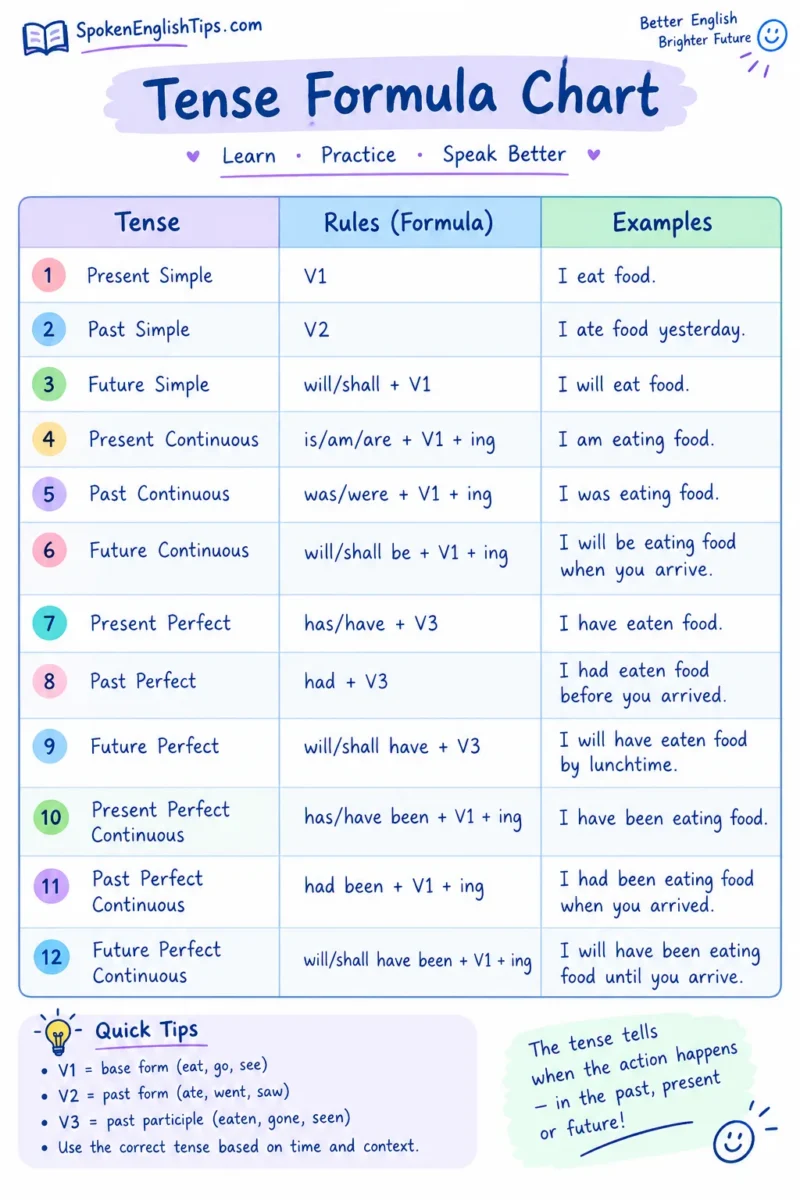
Tenses become confusing when we try to learn them only through formulas. A formula such as Subject + has/have + V3 may tell you how a sentence is formed, but it does not always tell you why a speaker chooses that tense.
Examples make the difference.
When you compare “I work here,” “I am working here,” “I have worked here,” and “I have been working here,” the grammar starts to feel more practical. The subject may stay the same, but the meaning changes because the speaker is looking at the action differently.
This guide brings together 100 tense examples in English and then explains the differences that usually confuse learners: Present Perfect versus Present Perfect Continuous, Simple Past versus Present Perfect, Simple Present versus Present Continuous, Past Simple versus Past Continuous, and Past Perfect versus Simple Past.
You will also learn how to identify tenses, use since and for, understand V1, V2, and V3, talk naturally about the future, and change a sentence from present to past and future.
Understanding the 12 English Tenses Before the Examples
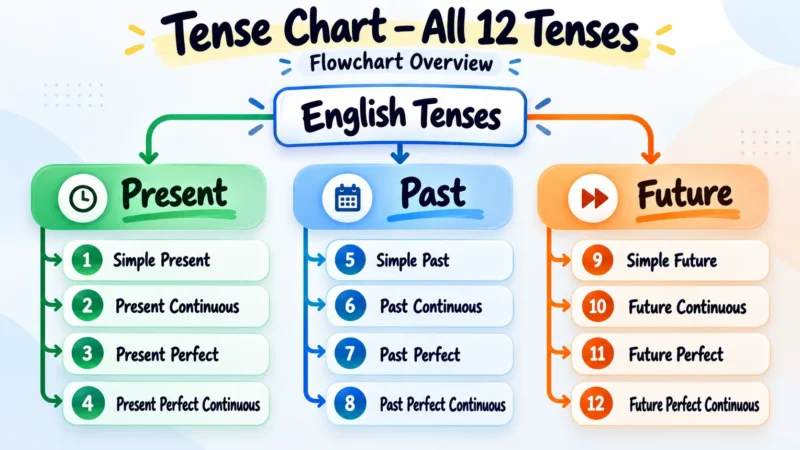
English tenses are commonly taught in three time groups: Present, Past, and Future. Each group is divided into four patterns: Simple, Continuous, Perfect, and Perfect Continuous.
The word simple usually presents an action as a fact, routine, or complete event. Continuous focuses on an action in progress. Perfect connects one time with another, while Perfect Continuous usually emphasizes how long an activity continues.
That distinction becomes easier to understand through real sentences.
Simple Present Tense Examples
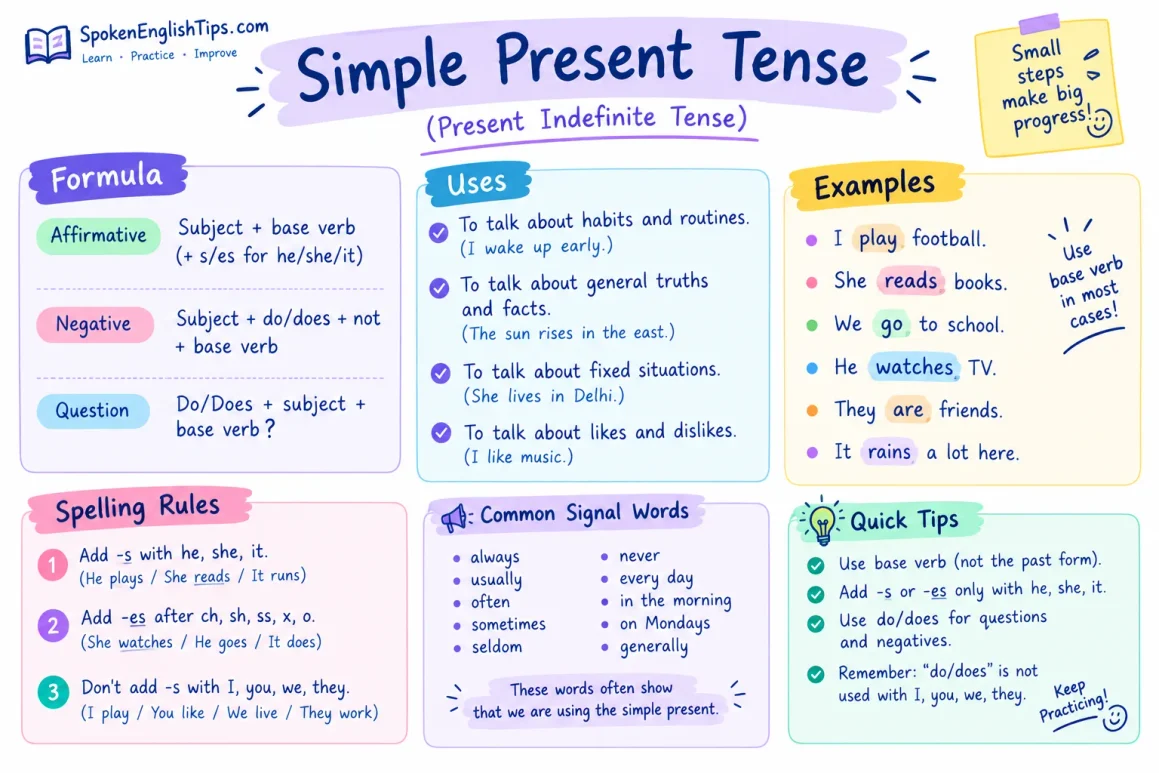
The Simple Present is used for routines, habits, facts, repeated actions, permanent situations, and general truths. It is also common when talking about schedules and things that happen regularly.
| No. | Example | What it expresses |
|---|---|---|
| 1 | I drink tea every morning. | Daily habit |
| 2 | She works in a private bank. | Regular situation |
| 3 | My brother plays football on Sundays. | Repeated activity |
| 4 | The Earth moves around the Sun. | General truth |
| 5 | We usually eat dinner at eight. | Routine |
| 6 | He speaks English very well. | Ability or fact |
| 7 | The shop opens at nine every day. | Schedule |
| 8 | They live near the railway station. | Permanent situation |
| 9 | Riya studies before breakfast. | Regular habit |
Notice how works, plays, speaks, opens, and studies change when the subject is he, she, it, or another singular noun.
Present Continuous Tense Examples
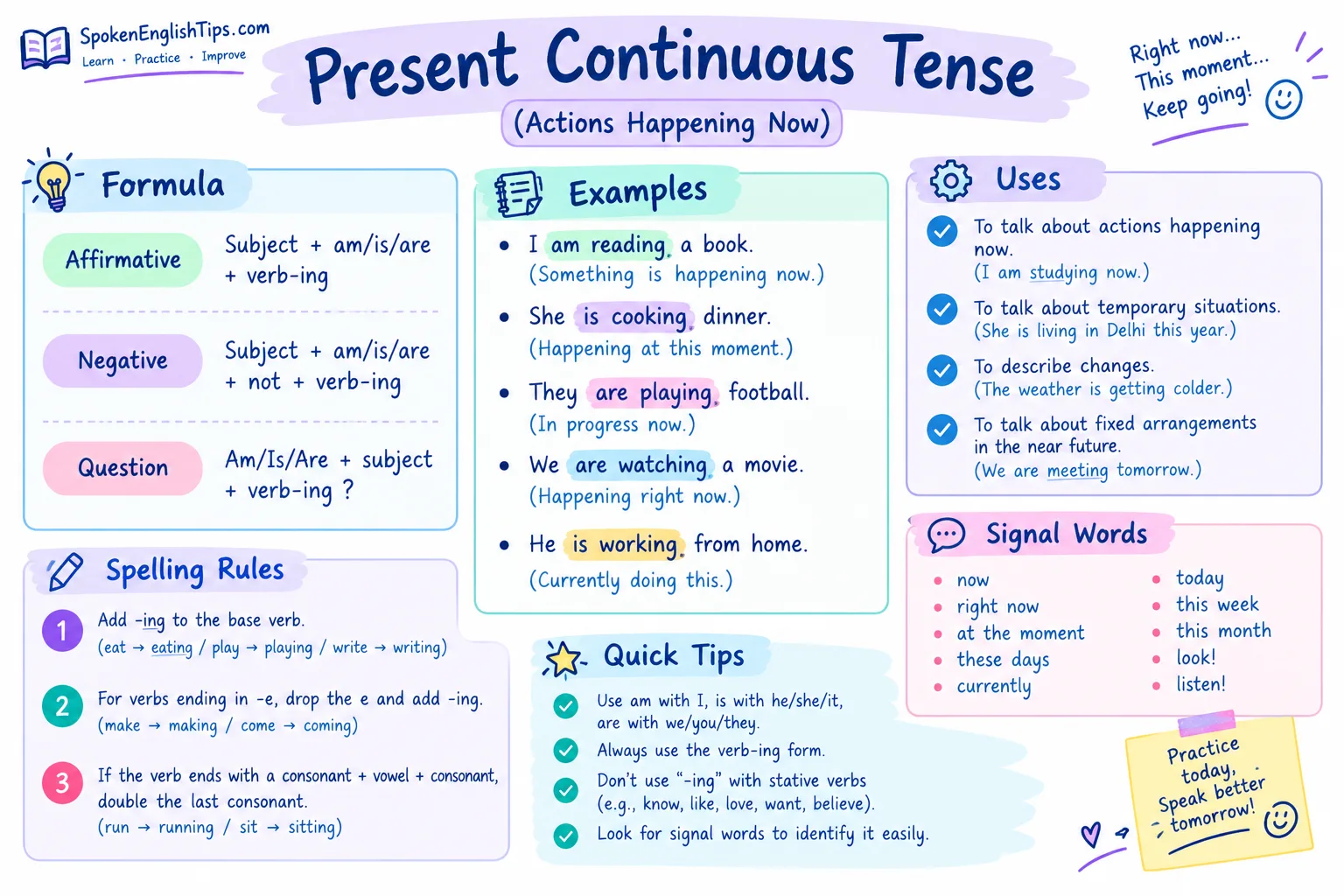
The Present Continuous usually shows that something is happening now, around the present time, or temporarily. It can also describe a changing situation or an arranged future plan.
| No. | Example | What it expresses |
|---|---|---|
| 10 | I am reading an interesting book. | Action happening now |
| 11 | She is talking to her teacher. | Current action |
| 12 | They are waiting outside the office. | Action in progress |
| 13 | We are learning spoken English this month. | Temporary activity |
| 14 | He is staying with his uncle for a few days. | Temporary situation |
| 15 | The weather is getting colder. | Changing situation |
| 16 | My parents are travelling this week. | Temporary activity |
| 17 | I am meeting Rahul tomorrow. | Future arrangement |
| 18 | The children are playing in the garden. | Action happening now |
Compare “He stays with his uncle” with “He is staying with his uncle.” The first can sound like a regular or permanent arrangement. The second clearly suggests that the situation is temporary.
Present Perfect Tense Examples
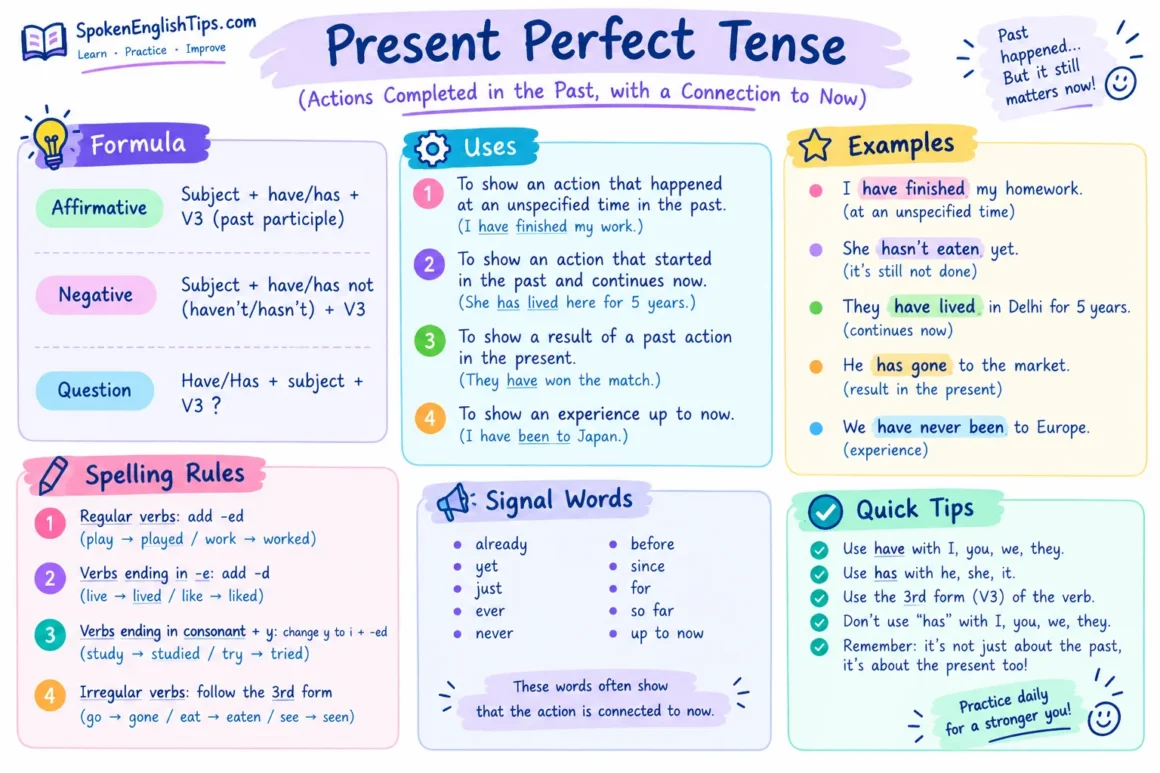
The Present Perfect connects the past with the present. The action happened before now, but its result, experience, or importance still matters.
| No. | Example | What it expresses |
|---|---|---|
| 19 | I have finished my homework. | Present result |
| 20 | She has visited Singapore twice. | Life experience |
| 21 | They have already eaten dinner. | Recently completed action |
| 22 | We have completed the first part of the project. | Present result |
| 23 | He has lost his wallet. | Past event with present effect |
| 24 | I have never travelled by ship. | Experience up to now |
| 25 | Meera has just arrived. | Very recent action |
| 26 | The company has opened a new office. | Recent development |
The Present Perfect normally avoids finished time expressions such as yesterday, last year, or in 2020.
We say:
I visited Jaipur last year.
Not:
I have visited Jaipur last year.
Present Perfect Continuous Tense Examples
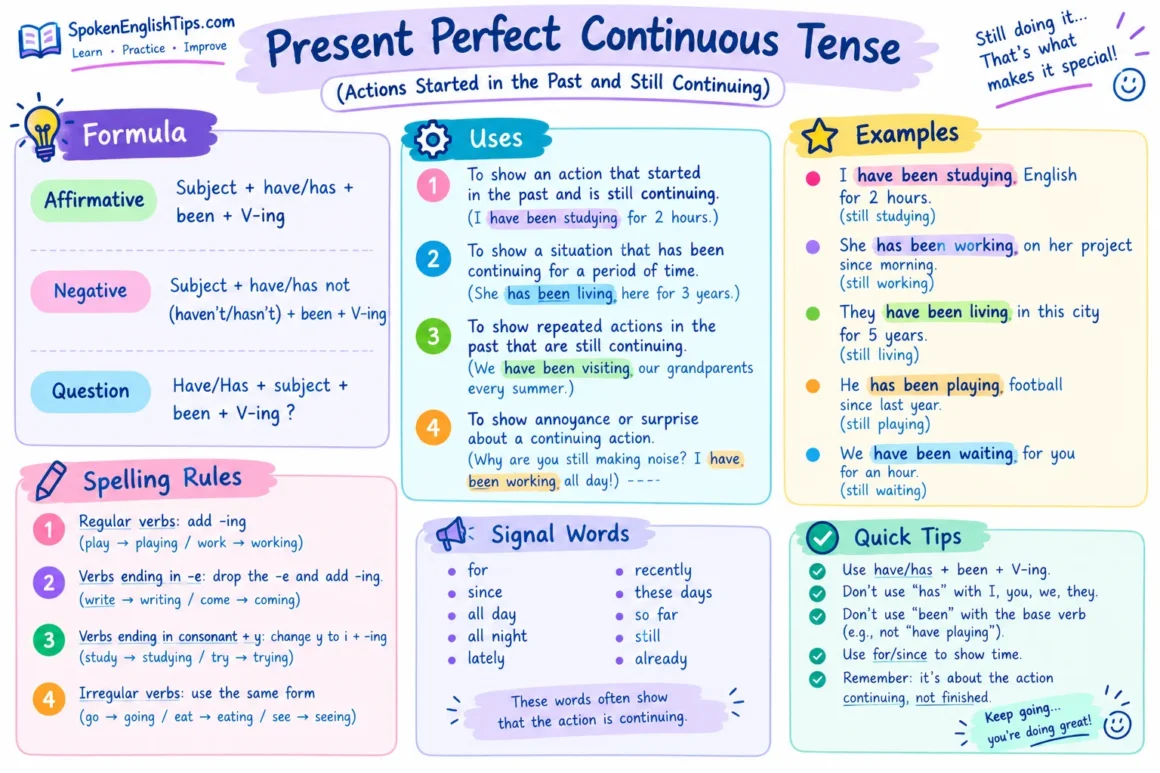
The Present Perfect Continuous looks back to an earlier time and emphasizes an activity that has continued until now or has recently stopped but still has a visible effect.
| No. | Example | What it expresses |
|---|---|---|
| 27 | I have been studying for three hours. | Duration until now |
| 28 | She has been working here since June. | Action continuing from a starting point |
| 29 | They have been waiting for the doctor. | Ongoing activity |
| 30 | We have been practising English every evening. | Repeated continuing activity |
| 31 | It has been raining since morning. | Continuing situation |
| 32 | He has been looking for a new job. | Activity over a period |
| 33 | My eyes hurt because I have been reading for hours. | Recent activity with present effect |
| 34 | The workers have been repairing the road all week. | Continuing work |
Past Tense Examples
Past tenses allow us to describe finished events, actions that were in progress, and events that happened before other past events.
Simple Past Tense Examples
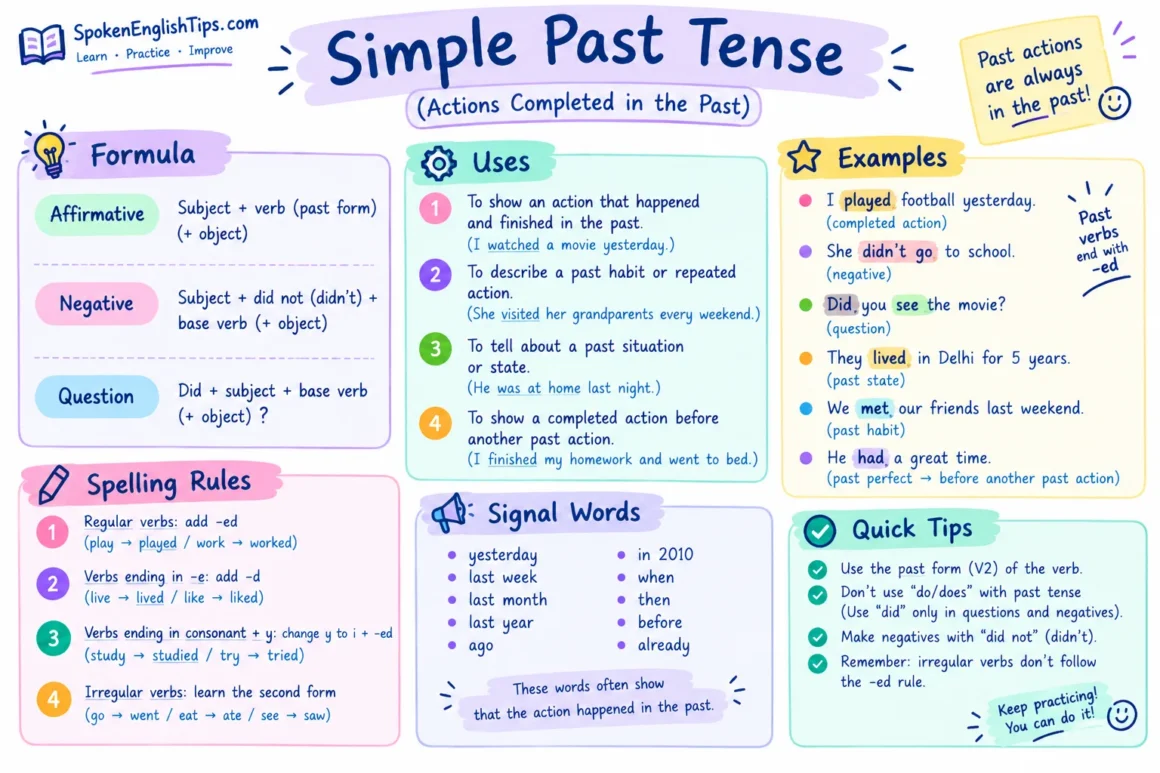
The Simple Past describes a finished action or situation at a definite time in the past.
| No. | Example | What it expresses |
|---|---|---|
| 35 | I called my mother yesterday. | Finished past action |
| 36 | She visited Agra last winter. | Past event |
| 37 | We watched a documentary after dinner. | Completed activity |
| 38 | He bought a new phone last month. | Finished action |
| 39 | They moved to Delhi in 2022. | Completed past change |
| 40 | The meeting started at ten. | Specific past event |
| 41 | I saw her at the market. | Finished event |
| 42 | Rahul forgot his notebook at home. | Past action |
| 43 | My grandparents lived in Lucknow for many years. | Past situation |
Words such as yesterday, last week, two days ago, in 2022, and when I was young often appear with the Simple Past.
Past Continuous Tense Examples
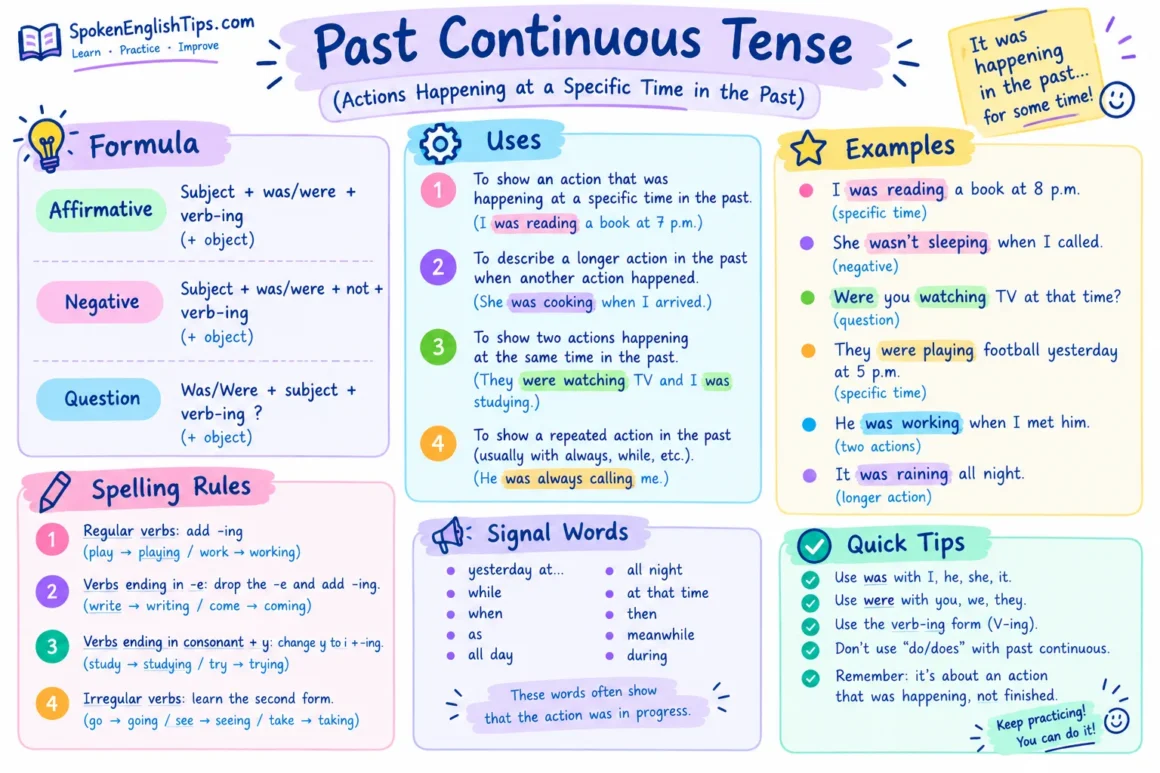
The Past Continuous shows that an action was already in progress at a particular time in the past. It often provides the background for another event.
| No. | Example | What it expresses |
|---|---|---|
| 44 | I was sleeping when you called. | Ongoing action interrupted |
| 45 | She was cooking at seven o’clock. | Activity in progress at a past time |
| 46 | They were playing cricket when it began to rain. | Background action |
| 47 | We were driving home at midnight. | Past action in progress |
| 48 | He was studying while his friends were watching television. | Two simultaneous actions |
| 49 | The students were writing their answers. | Ongoing past activity |
| 50 | I was waiting outside when the office opened. | Longer action and shorter event |
| 51 | The baby was crying when I entered the room. | Background action |
Past Perfect Tense Examples
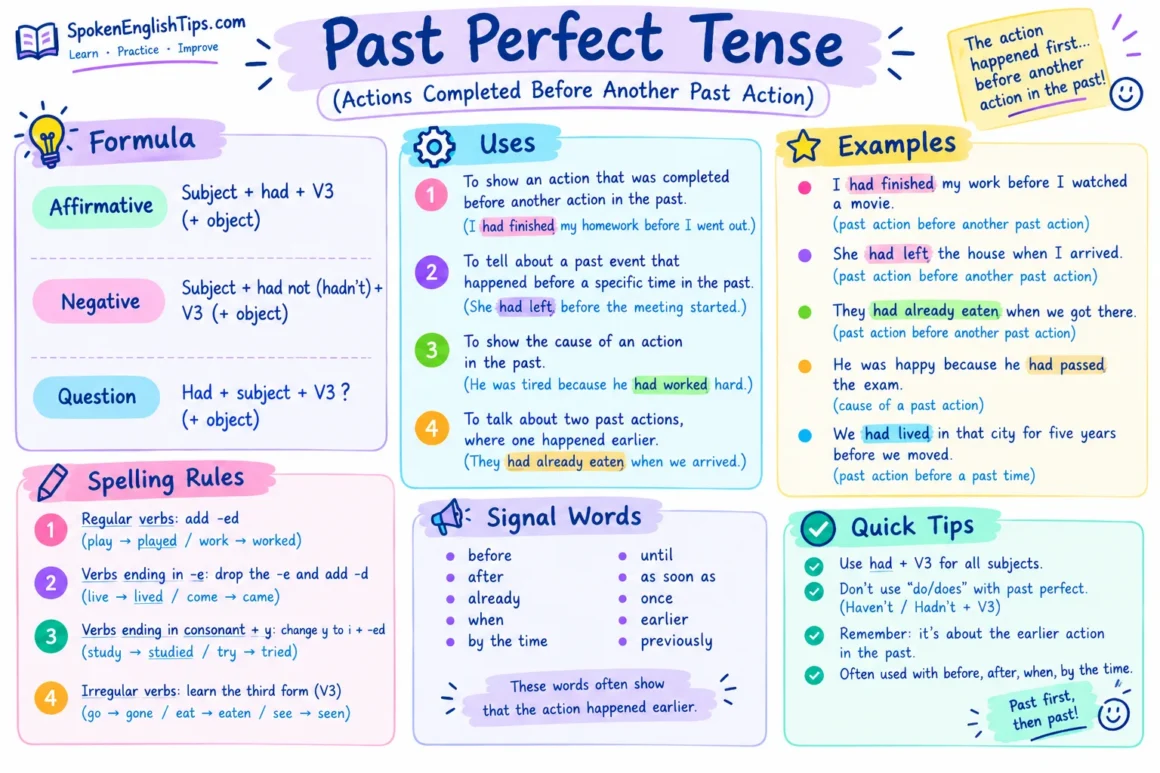
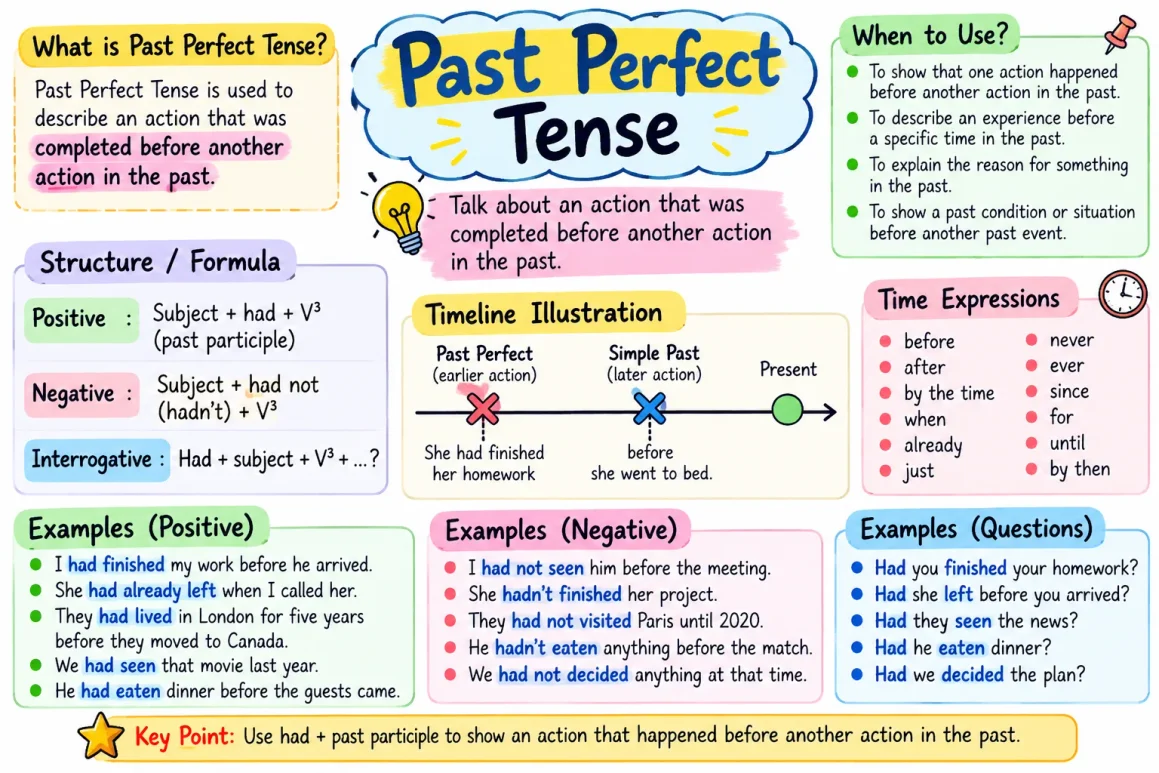
The Past Perfect is useful when two events happened in the past and we need to make the earlier event clear.
| No. | Example | What it expresses |
|---|---|---|
| 52 | The train had left before we reached the station. | Earlier past event |
| 53 | She had finished dinner before I arrived. | Earlier completed action |
| 54 | They had already started the meeting when we entered. | Action completed first |
| 55 | I had never seen snow before that trip. | Experience before another past point |
| 56 | He had forgotten the password, so he could not log in. | Cause before a past result |
| 57 | We had completed the work before the deadline. | Earlier completion |
| 58 | Riya had gone home before the rain started. | First of two past events |
| 59 | The shop had closed by the time we got there. | Completion before another past moment |
Past Perfect Continuous Tense Examples
The Past Perfect Continuous emphasizes how long an activity had been happening before another past moment or event.
| No. | Example | What it expresses |
|---|---|---|
| 60 | I had been studying for two hours before dinner. | Duration before a past point |
| 61 | She had been working there for five years before she resigned. | Long activity before change |
| 62 | They had been waiting for forty minutes when the bus arrived. | Continuing activity before event |
| 63 | It had been raining all night. | Continuing past situation |
| 64 | We had been travelling for hours before we found a hotel. | Duration before another event |
| 65 | He was tired because he had been running. | Earlier activity explaining result |
| 66 | The children had been playing outside before it became dark. | Activity continuing up to past point |
| 67 | Rahul had been preparing for the exam for several weeks. | Extended past activity |
Future Tense Examples
English has several ways of expressing future meaning. The traditional future tense patterns with will are useful, but natural English also uses going to, the Present Continuous, and sometimes the Simple Present for future time.
Simple Future Tense Examples
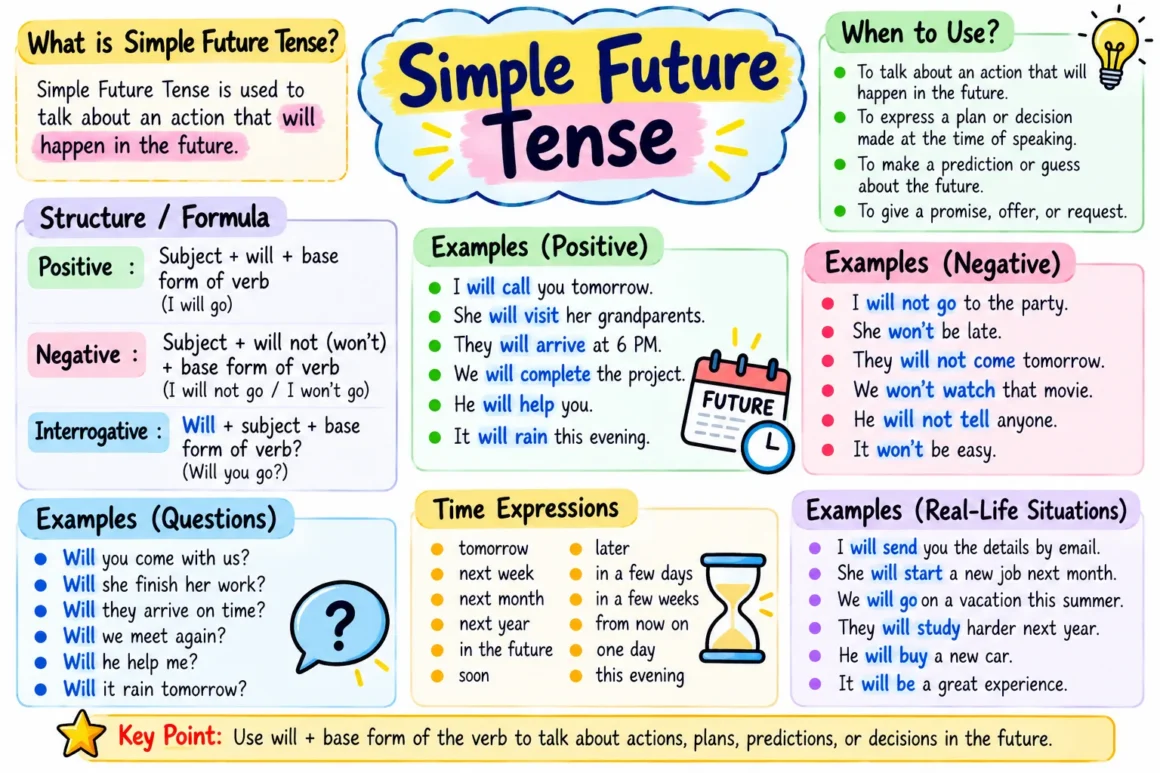
| No. | Example | What it expresses |
|---|---|---|
| 68 | I will call you tonight. | Future action |
| 69 | She will help you with the assignment. | Offer or future action |
| 70 | They will arrive tomorrow morning. | Prediction |
| 71 | We will visit our grandparents next weekend. | Future event |
| 72 | I think India will win the match. | Prediction |
| 73 | Do not worry; I will handle it. | Immediate decision |
| 74 | He will probably come later. | Prediction |
| 75 | The results will be announced on Monday. | Future event |
| 76 | I will never forget your kindness. | Promise or future statement |
Future Continuous Tense Examples
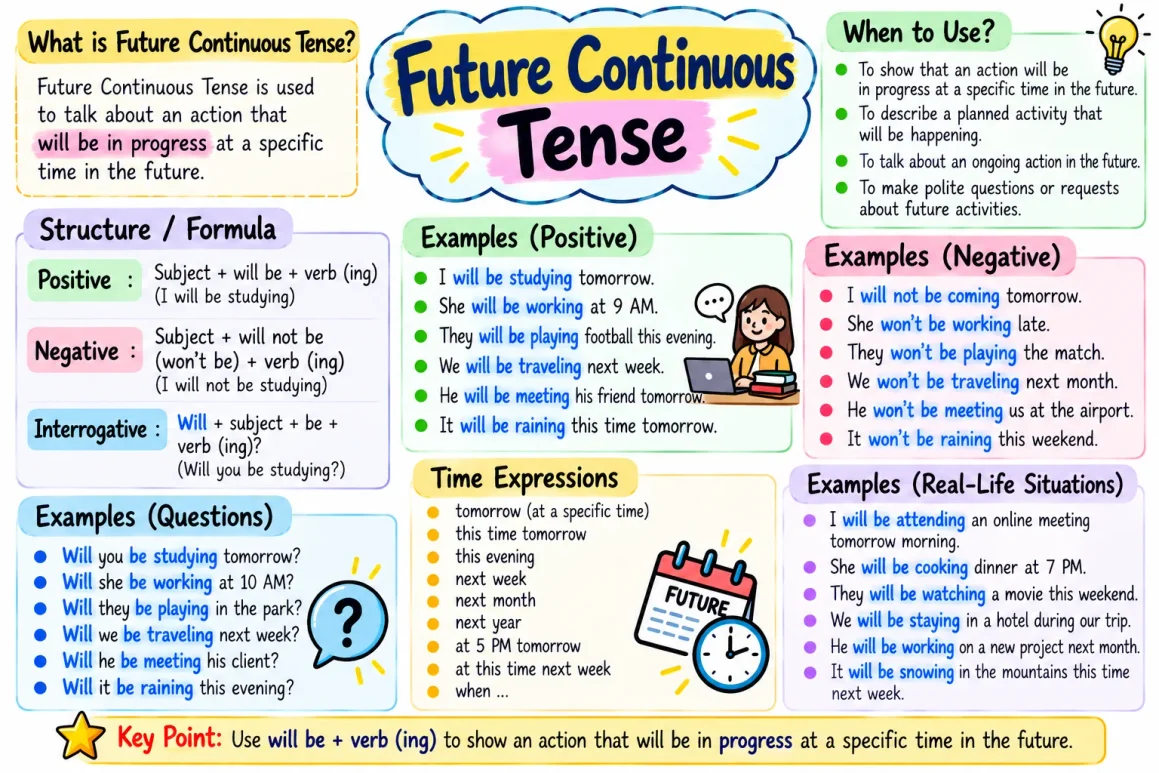
The Future Continuous describes an action that will be in progress at a particular future time.
| No. | Example | What it expresses |
|---|---|---|
| 77 | I will be working at ten tomorrow morning. | Future action in progress |
| 78 | She will be travelling next week. | Ongoing future activity |
| 79 | They will be waiting for us at the airport. | Expected future activity |
| 80 | We will be having dinner at eight. | Activity in progress at future time |
| 81 | He will be studying when you call. | Future background action |
| 82 | This time tomorrow, I will be flying to Mumbai. | Action in progress at a future point |
| 83 | The team will be practising throughout the afternoon. | Extended future activity |
| 84 | My parents will be staying with us this weekend. | Temporary future situation |
Future Perfect Tense Examples
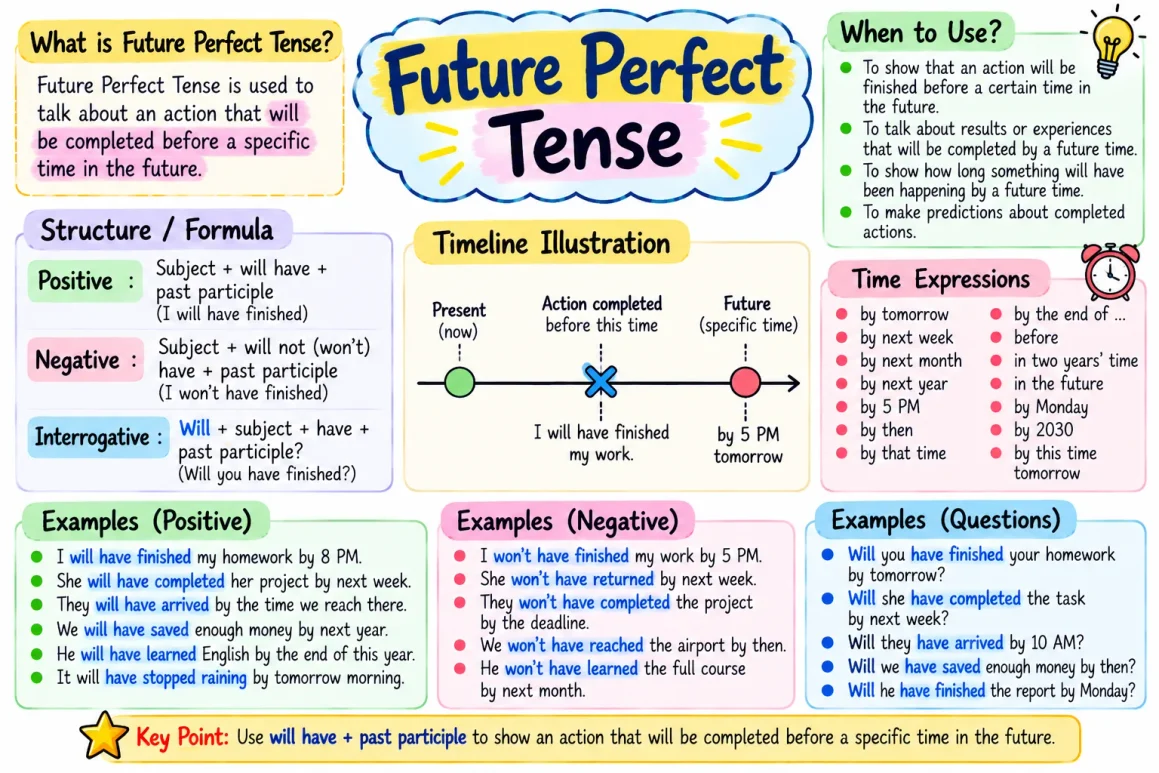
The Future Perfect describes an action that will be completed before a particular future time.
| No. | Example | What it expresses |
|---|---|---|
| 85 | I will have finished the report by Friday. | Completion before future deadline |
| 86 | She will have completed the course by June. | Future completion |
| 87 | They will have reached home by midnight. | Completion before future time |
| 88 | We will have saved enough money by next year. | Future result |
| 89 | He will have left before you arrive. | Earlier future event |
| 90 | The workers will have completed the bridge by December. | Completion by deadline |
| 91 | I will have read the book by tomorrow. | Future completion |
| 92 | The train will have departed by then. | Completed future event |
Future Perfect Continuous Tense Examples
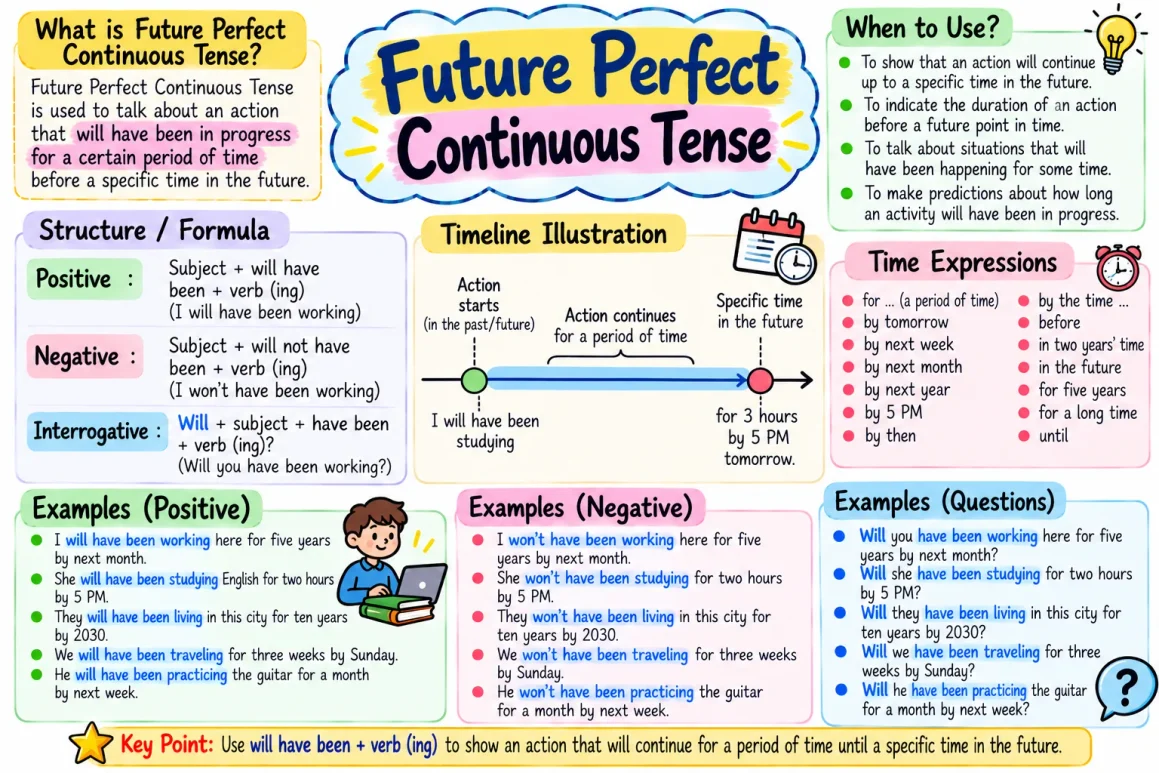
The Future Perfect Continuous focuses on the duration of an activity up to a future point.
| No. | Example | What it expresses |
|---|---|---|
| 93 | I will have been working here for ten years next month. | Duration up to future time |
| 94 | She will have been studying for three hours by noon. | Future duration |
| 95 | They will have been travelling for a week by Friday. | Continuing activity up to future point |
| 96 | We will have been living here for five years in December. | Duration |
| 97 | He will have been teaching for twenty years next year. | Long future duration |
| 98 | It will have been raining for six hours by midnight. | Continuing future situation |
| 99 | The team will have been practising for a month by then. | Duration before future point |
| 100 | By July, Riya will have been working on the project for six months. | Activity continuing up to future deadline |
How to Identify Tenses in a Sentence
Identifying a tense becomes easier when you stop looking only at time words and start looking at the verb structure.
Take this sentence:
She is writing a letter.
The word is is followed by writing, an -ing form. This immediately suggests a Continuous structure. Since the helping verb is is, the sentence is in the Present Continuous.
Now consider:
She had written the letter before lunch.
Here we have had + written. Written is the third form of write, so had + V3 tells us that the sentence is in the Past Perfect.
The following chart gives you a fast way to recognize the major patterns.
| Tense | Main pattern | Example clue |
|---|---|---|
| Simple Present | V1 / V1+s/es | works, goes, reads |
| Present Continuous | am/is/are + V-ing | is reading |
| Present Perfect | has/have + V3 | has finished |
| Present Perfect Continuous | has/have been + V-ing | has been working |
| Simple Past | V2 | worked, went |
| Past Continuous | was/were + V-ing | was reading |
| Past Perfect | had + V3 | had finished |
| Past Perfect Continuous | had been + V-ing | had been working |
| Simple Future | will + V1 | will work |
| Future Continuous | will be + V-ing | will be working |
| Future Perfect | will have + V3 | will have finished |
| Future Perfect Continuous | will have been + V-ing | will have been working |
Time words such as now, yesterday, already, since, tomorrow, and by next week can help, but they should be treated as clues—not as the only way to identify a tense.
Present Perfect vs. Present Perfect Continuous
These two tenses both connect the past with the present, which is why learners often confuse them.
The Present Perfect usually gives more attention to the result, number, completion, or achievement. The Present Perfect Continuous gives more attention to the activity, process, or duration.
Compare:
I have written five pages.
The important information is the result: five pages are complete.
Now compare:
I have been writing for two hours.
Here the important information is the activity and its duration.
| Present Perfect | Present Perfect Continuous |
|---|---|
| Focuses more on result | Focuses more on activity |
| Often shows completion | Often shows continuation |
| Can tell us how many | Often tells us how long |
| has/have + V3 | has/have been + V-ing |
| I have cleaned the kitchen. | I have been cleaning the kitchen. |
| She has read three chapters. | She has been reading for two hours. |
The difference can sometimes be subtle.
She has painted the room.
This suggests that the room is finished.
She has been painting the room.
This tells us about the activity. She may still be painting, or she may have stopped recently.
Simple Past vs. Present Perfect
The Simple Past and Present Perfect both describe actions before now, but they look at past events differently.
The Simple Past normally belongs to a finished past time.
I visited Goa in 2023.
The year 2023 is finished.
The Present Perfect connects an experience or result to the present without placing it inside a finished past time.
I have visited Goa three times.
The speaker is talking about life experience up to now.
| Simple Past | Present Perfect |
|---|---|
| Finished past time | Past connected with present |
| Often says when | Exact past time often not stated |
| Uses V2 | Uses has/have + V3 |
| I saw that film yesterday. | I have seen that film. |
| She finished the work last night. | She has finished the work. |
| We visited Jaipur in 2022. | We have visited Jaipur several times. |
A useful test is to ask: “Is the time completely finished?”
If yes, Simple Past is usually the natural choice.
Simple Present vs. Present Continuous
The difference between these tenses is one of the most important distinctions in everyday English.
The Simple Present usually talks about what is regular, normal, permanent, or generally true.
I work in Delhi.
The Present Continuous talks about what is happening now, around now, changing, or temporary.
I am working in Delhi this month.
| Simple Present | Present Continuous |
|---|---|
| Routine or habit | Action happening now |
| Permanent or regular situation | Temporary situation |
| General fact | Changing situation |
| Subject + V1 | am/is/are + V-ing |
| She teaches English. | She is teaching a class now. |
| I live with my parents. | I am living with my cousin this month. |
This comparison shows why learning only the formula is not enough. Both sentences can be grammatically correct, but they communicate different meanings.
Past Simple vs. Past Continuous
The Past Simple presents an action as a completed event. The Past Continuous presents an action as something that was already happening at a particular moment.
Consider:
I was taking a shower when the phone rang.
The shower was already in progress. The phone call happened during that activity.
| Past Simple | Past Continuous |
|---|---|
| Completed past action | Past action in progress |
| Often shorter event | Often longer background activity |
| Uses V2 | Uses was/were + V-ing |
| The phone rang. | I was taking a shower. |
| She arrived at eight. | We were eating dinner at eight. |
| The lights went out. | I was reading when the lights went out. |
When the two tenses appear together, the Continuous form often provides the background while the Simple Past introduces the event that happened during it.
Past Perfect vs. Simple Past
When several past events are already arranged clearly in chronological order, the Simple Past may be enough. But when you need to emphasize that one event happened before another past event, the Past Perfect becomes especially useful.
Consider:
When I reached the station, the train had left.
First, the train left.
Later, I reached the station.
| Past Perfect | Simple Past |
|---|---|
| Earlier of two past events | Later or ordinary past event |
| had + V3 | V2 |
| She had gone home before I called. | I called at nine. |
| They had eaten before we arrived. | We arrived later. |
| He had saved the file before the computer crashed. | The computer crashed. |
A simple way to remember it is:
Past Perfect = past before past.
Since and For – Rules and Examples
Since and for both talk about time, but they answer different questions.
Since tells us the starting point.
For tells us the duration.
Compare:
I have lived here since 2021.
2021 is the point where the situation started.
I have lived here for five years.
Five years describes the length of time.
| Since | For |
|---|---|
| Starting point | Length of time |
| since Monday | for two days |
| since 2020 | for five years |
| since morning | for three hours |
| since I joined the company | for a long time |
Examples:
She has been working since 8 a.m.
She has been working for four hours.
We have known each other since school.
We have known each other for many years.
A useful question is:
When did it start? → Since
How long? → For
V1 V2 V3 Verb Forms
V1, V2, and V3 are not tenses by themselves. They are names used to describe different forms of a verb.
V1 is the base form.
V2 is the Simple Past form.
V3 is the past participle.
| V1 | V2 | V3 |
|---|---|---|
| go | went | gone |
| write | wrote | written |
| eat | ate | eaten |
| speak | spoke | spoken |
| take | took | taken |
| see | saw | seen |
| begin | began | begun |
| drive | drove | driven |
| choose | chose | chosen |
| break | broke | broken |
| come | came | come |
| buy | bought | bought |
| make | made | made |
| find | found | found |
| teach | taught | taught |
Look at how one verb changes across tenses:
I write every day. — V1
I wrote yesterday. — V2
I have written the email. — V3
This is why knowing common verb forms makes tense learning much easier.
How to Talk About the Future in English
Learners often assume that every future sentence must use will. Natural English is more flexible.
We use different structures depending on whether we are talking about a prediction, plan, arrangement, timetable, or decision.
| Future form | Common use | Example |
|---|---|---|
| will + V1 | Prediction, promise, quick decision | I will help you. |
| be going to + V1 | Intention or clear evidence | I am going to start a course. |
| Present Continuous | Personal arrangement | I am meeting my manager tomorrow. |
| Simple Present | Timetable or schedule | The train leaves at 7:10. |
| Future Continuous | Action in progress later | I will be working at eight. |
| Future Perfect | Completed before future time | I will have finished by Friday. |
Imagine someone asks:
“What are you doing tomorrow?”
A natural answer might be:
“I am meeting a client in the morning.”
You do not need to say “I will meet a client” because the meeting is already arranged.
Now imagine you suddenly decide to answer the phone:
“I’ll get it.”
Here, will is natural because the decision is being made at that moment.
How to Change a Sentence from Present to Past and Future
Changing the tense of a sentence is not simply about replacing one verb. You must think about the helping verb, main verb, and sometimes the time expression.
Take a simple sentence:
I play football every Sunday.
In the past:
I played football last Sunday.
In the future:
I will play football next Sunday.
The main action stays the same, but its grammatical form changes.
Here are some useful comparisons:
| Present | Past | Future |
|---|---|---|
| I work here. | I worked here. | I will work here. |
| She is reading. | She was reading. | She will be reading. |
| They have finished. | They had finished. | They will have finished. |
| I have been studying for two hours. | I had been studying for two hours. | I will have been studying for two hours. |
| He goes to school every day. | He went to school yesterday. | He will go to school tomorrow. |
| We are having dinner now. | We were having dinner at eight. | We will be having dinner at eight tomorrow. |
You should also change time expressions when necessary.
today → yesterday → tomorrow
this week → last week → next week
now → at that time → at this time tomorrow
The goal is not to replace words mechanically. The goal is to keep the meaning logical while moving the action to a different time.
A Better Way to Practise Tenses
Reading 100 examples is useful, but creating your own variations makes the lesson much stronger.
Take:
She works in an office.
Now change the tense:
She is working in an office today.
She worked in an office last year.
She was working in an office when I met her.
She has worked in several offices.
She will work in our new office next month.
By changing one sentence several times, you begin to notice the grammar pattern instead of memorizing isolated rules.
This is also one of the easiest ways to improve both writing and speaking because you are learning how the same idea changes across time.
Final Thoughts
The purpose of these 100 tense examples in English is not to make you memorize 100 sentences. The purpose is to help you notice patterns.
When you see is working, you should gradually recognize a Continuous form. When you see has finished, you should notice a Perfect structure. When you see had been waiting, you should understand that an activity had continued before another past moment.
Tenses become easier when you connect three things: time, structure, and meaning.
Start with simple examples. Compare similar tenses. Change sentences from present to past and future. Pay attention to verb forms. With regular practice, the tense system begins to feel less like a collection of grammar rules and more like a natural way of expressing time in English.