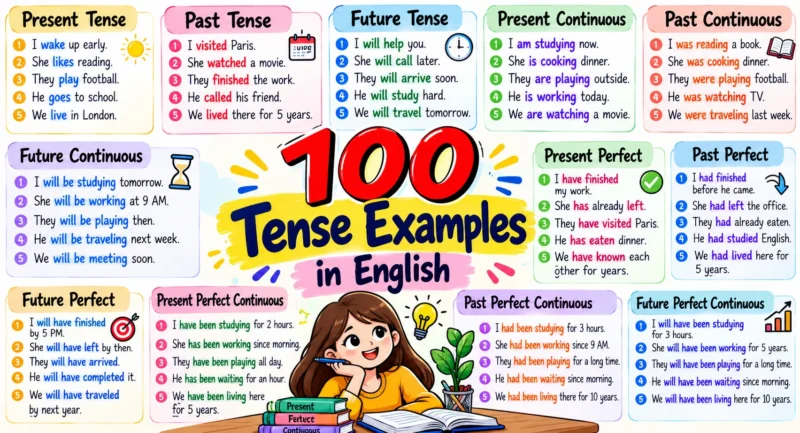
Learning English tenses becomes much easier when you understand their basic sentence patterns. Instead of memorizing many sentences, you can learn the tense formula and use it to create your own sentences.
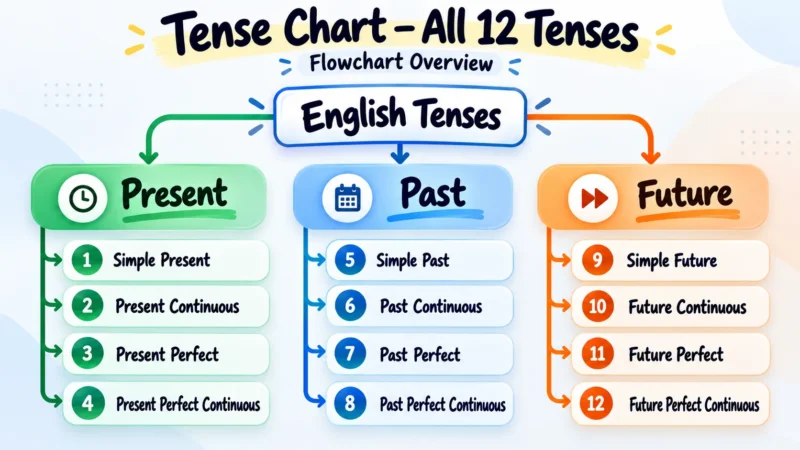
There are 12 main tenses in English—four present tenses, four past tenses, and four future tenses.
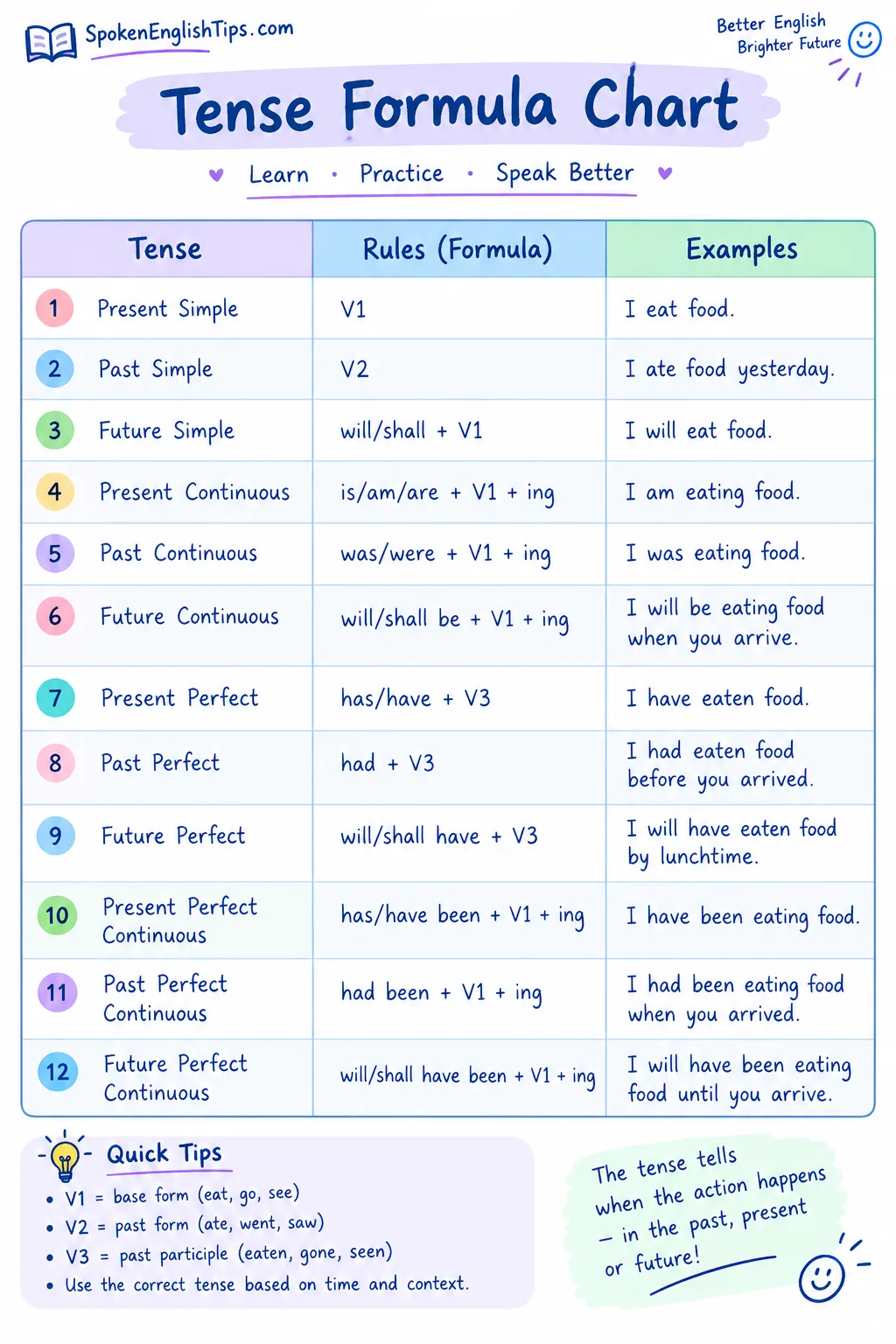
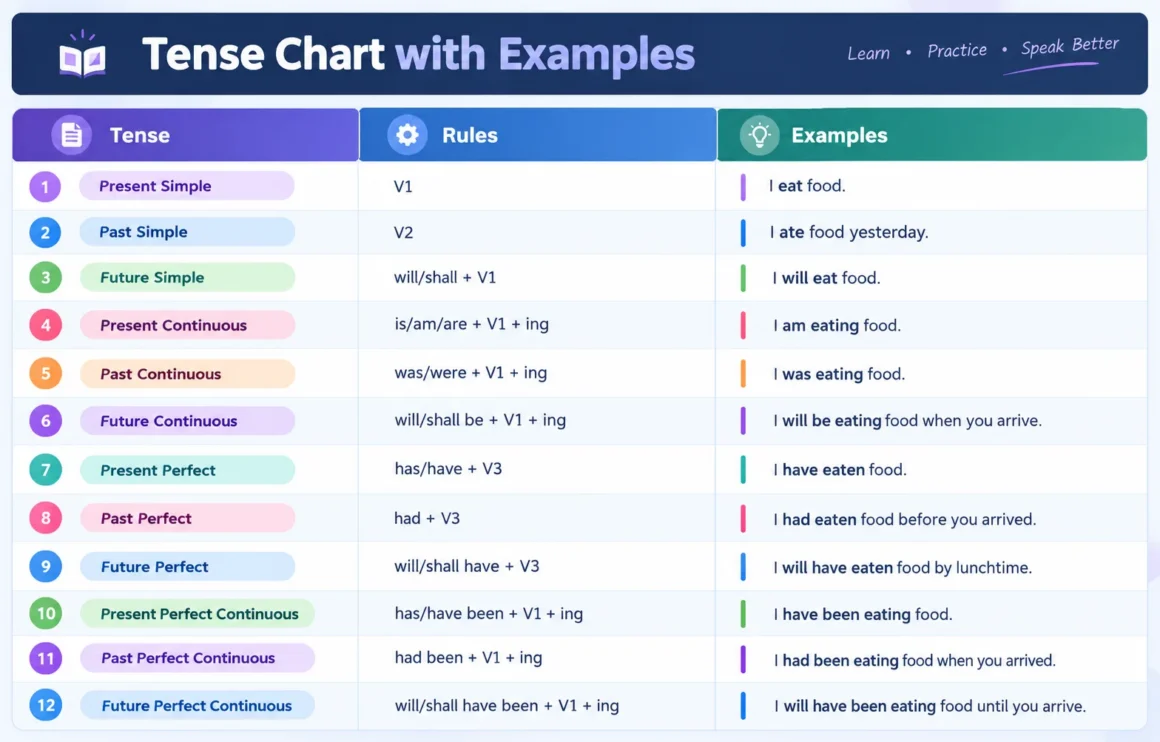
This Tense Formula Chart brings all 12 tense structures together in one place for quick study and revision.
Basic Verb Forms Used in Tense Formulas
Before using the chart, understand these common symbols:
S = Subject
V1 = Base form of verb — go, eat, write
V2 = Past form — went, ate, wrote
V3 = Past participle — gone, eaten, written
V-ing = Verb + ing — going, eating, writing
Helping verbs such as is, are, was, were, have, has, had, and will change according to the tense and subject.
Tense Formula Chart
| Tense | Formula |
|---|---|
| Simple Present | Subject + V1 / V1+s/es |
| Present Continuous | Subject + am/is/are + V-ing |
| Present Perfect | Subject + has/have + V3 |
| Present Perfect Continuous | Subject + has/have been + V-ing |
| Simple Past | Subject + V2 |
| Past Continuous | Subject + was/were + V-ing |
| Past Perfect | Subject + had + V3 |
| Past Perfect Continuous | Subject + had been + V-ing |
| Simple Future | Subject + will + V1 |
| Future Continuous | Subject + will be + V-ing |
| Future Perfect | Subject + will have + V3 |
| Future Perfect Continuous | Subject + will have been + V-ing |
Present Tense Formulas
The present tense group contains four structures.
1. Simple Present
Formula:
Subject + V1 / V1+s/es
Examples:
I work every day.
She works every day.
For he, she, and it, we normally add s or es to the main verb.
2. Present Continuous
Formula:
Subject + am/is/are + V-ing
Example:
She is reading a book.
Use am with I, is with singular subjects, and are with plural subjects and you.
3. Present Perfect
Formula:
Subject + has/have + V3
Example:
She has finished her work.
Use has with he, she, and it. Use have with I, you, we, and they.
4. Present Perfect Continuous
Formula:
Subject + has/have been + V-ing
Example:
She has been studying for two hours.
This structure is often used when an activity started earlier and has continued for a period of time.
Past Tense Formulas
The past tense group also contains four structures.
5. Simple Past
Formula:
Subject + V2
Example:
She visited Delhi yesterday.
The second form of the verb is normally used for affirmative Simple Past sentences.
6. Past Continuous
Formula:
Subject + was/were + V-ing
Example:
She was studying at 8 PM.
Use was with I, he, she, and it. Use were with you, we, and they.
7. Past Perfect
Formula:
Subject + had + V3
Example:
She had finished her work before dinner.
The helping verb had stays the same with all subjects.
8. Past Perfect Continuous
Formula:
Subject + had been + V-ing
Example:
She had been studying for two hours.
The structure had been + V-ing is used for every subject.
Future Tense Formulas
Future structures are often easier to remember because will remains the same with different subjects.
9. Simple Future
Formula:
Subject + will + V1
Example:
She will study tomorrow.
10. Future Continuous
Formula:
Subject + will be + V-ing
Example:
She will be studying tonight.
11. Future Perfect
Formula:
Subject + will have + V3
Example:
She will have finished the work by Friday.
12. Future Perfect Continuous
Formula:
Subject + will have been + V-ing
Example:
She will have been studying for two hours.
Easy Pattern to Remember Tense Formulas
You do not have to treat all 12 formulas as completely different patterns.
Remember these four basic ideas:
Simple → Main verb
Continuous → Be + V-ing
Perfect → Have + V3
Perfect Continuous → Have + Been + V-ing
Then change the helping verb according to the time—present, past, or future.
For example:
Present Continuous: am/is/are + V-ing
Past Continuous: was/were + V-ing
Future Continuous: will be + V-ing
Similarly:
Present Perfect: has/have + V3
Past Perfect: had + V3
Future Perfect: will have + V3
This pattern makes the complete 12 tenses formula chart much easier to understand.
Quick Revision
English has three main time groups:
Present — Past — Future
Each group contains:
Simple — Continuous — Perfect — Perfect Continuous
Together, they form the 12 English tenses.
Use the tense formula chart whenever you need to check which helping verb or verb form belongs in a sentence. With regular practice, these structures become easier to recognize and use naturally.