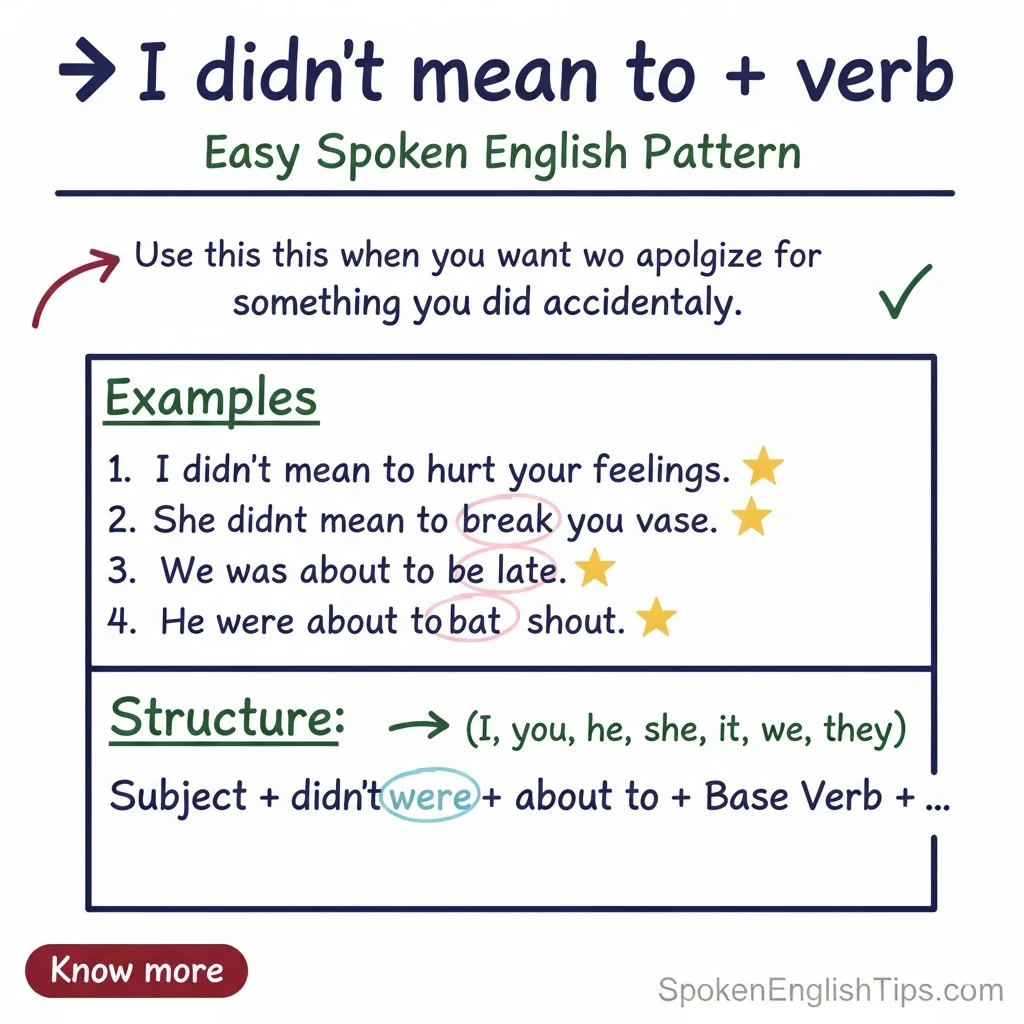
We use “I didn’t mean to + verb” when we want to say sorry or explain that something was not intentional. It shows that we did something by mistake.
For example, if you hurt someone’s feelings, you can say, “I didn’t mean to hurt you.” If you dropped someone’s phone, you can say, “I didn’t mean to drop it.”
This expression is very common in daily English conversations at home, at work, or with friends. It helps you sound polite and responsible. Native speakers use it often when they want to correct a misunderstanding or explain an accident.
◎ Important Points
- Use this structure when something happens by accident.
- Always use the base form of the verb (not past tense).
- It shows apology or explanation.
- It is used for past actions.
- You can add extra details after the verb.
- The tone should sound sincere and calm.
- It is common in both formal and informal situations.
➤Key Concept
✅Subject + didn’t mean to + base verb
Example:
I didn’t mean to break your glass.
Main Concept:
We use this structure to say something was not planned or intentional.
Speaking Tip:
Stress the word “didn’t” slightly when speaking to show sincerity.
➤ Common Mistakes To Avoid
| Common Mistake | Wrong Example | Correct Example |
|---|---|---|
| Using past tense verb | I didn’t mean to broke it. | I didn’t mean to break it. |
| Missing “to” | I didn’t mean hurt you. | I didn’t mean to hurt you. |
| Using “for” instead of “to” | I didn’t mean for hurt you. | I didn’t mean to hurt you. |
| Using present tense | I don’t mean to broke it yesterday. | I didn’t mean to break it yesterday. |
| Adding -ing form | I didn’t mean to hurting you. | I didn’t mean to hurt you. |
➤ Examples
- I didn’t mean to call you so late.
- I didn’t mean to delete the file.
- I didn’t mean to laugh at you.
- I didn’t mean to interrupt your meeting.
- I didn’t mean to send that message to everyone.
- I didn’t mean to step on your foot.
- I didn’t mean to ignore your call.
- I didn’t mean to make you upset.
- I didn’t mean to forget your birthday.
- I didn’t mean to spill coffee on your desk.
➤ Practice Examples
A. Fill in the blanks
- I didn’t mean to ______ (break) your pen.
- She didn’t mean to ______ (say) that.
- We didn’t mean to ______ (arrive) late.
- He didn’t mean to ______ (hurt) your feelings.
- They didn’t mean to ______ (cause) trouble.
B. Change the incorrect sentence to correct one
- I didn’t mean to broke it.
- I didn’t mean hurt you.
- She didn’t mean to hurting him.
- We don’t mean to missed the bus.
- He didn’t mean for shout at you.
C. Speak This Sentence Aloud
Say these sentences slowly and clearly:
- I didn’t mean to upset you.
- I didn’t mean to send that email.
- I didn’t mean to make a mistake.
- I didn’t mean to drop your phone.
- I didn’t mean to offend anyone.