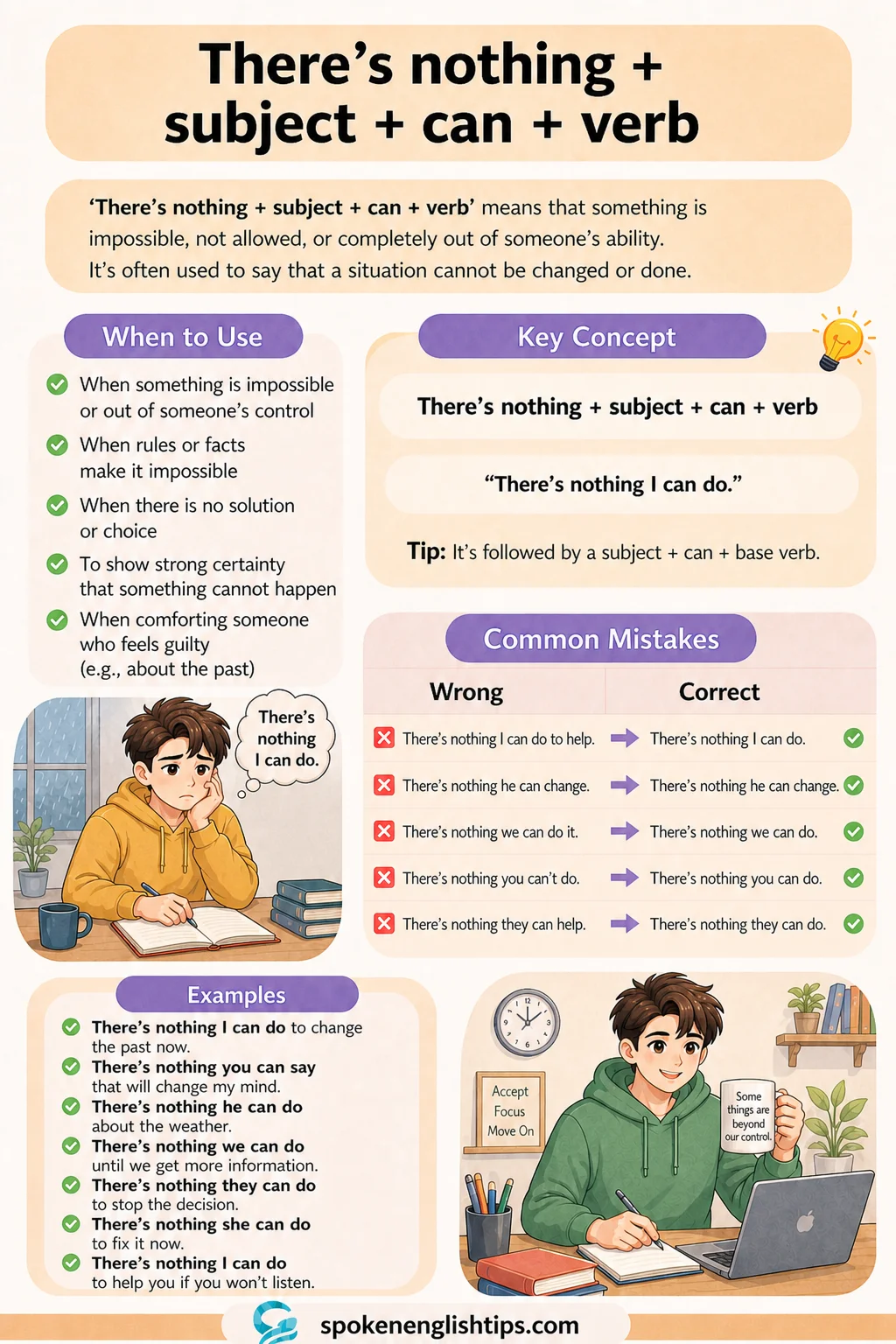
This structure is used when we want to say that something is not possible or cannot be done. It shows a feeling of limitation, helplessness, or certainty. For example, when a situation is out of control, we use this pattern to express that clearly. In daily life, you might say this when giving advice, showing support, or explaining a situation. For example, if a friend is worried about something already finished, you can say, “There’s nothing you can do now.” This makes your English sound natural and confident in real conversations.
◎ Important Points
- Use this structure to show impossibility or no option
- Always start with “There’s nothing”
- Use a subject after “nothing” (you, I, they, we, etc.)
- Add “can” to show ability or possibility
- Use the base form of the verb (do, say, change, help)
- Common in emotional or practical situations
- Sounds very natural in spoken English
➤Key Concept
✅ Sentence Structure: There’s nothing + subject + can + verb
Example: There’s nothing you can do.
This structure means no action is possible in the situation. It is simple and very useful in real conversations.
Tip: Use this pattern when giving honest advice or showing understanding in difficult situations.
➤ Common Mistakes To Avoid
| Common Mistake | Wrong Example | Correct Example |
|---|---|---|
| Missing “can” | There’s nothing you do | There’s nothing you can do |
| Using wrong verb form | There’s nothing you can did | There’s nothing you can do |
| Adding extra words | There’s nothing that you can to do | There’s nothing you can do |
| Wrong subject placement | There’s nothing can you do | There’s nothing you can do |
| Using past tense unnecessarily | There’s nothing you could do now | There’s nothing you can do now |
➤ Examples
- There’s nothing I can say to change your mind.
- There’s nothing we can do about the weather.
- There’s nothing you can buy here; the shop is closed.
- There’s nothing they can fix right now.
- There’s nothing I can eat in this restaurant.
- There’s nothing you can learn without practice.
- There’s nothing we can plan until he arrives.
- There’s nothing she can understand in this lesson.
- There’s nothing I can find in my bag.
- There’s nothing you can change about the past.
➤ Practice Examples
Fill in the blanks
- There’s nothing you ___ do now.
- There’s nothing I ___ say to him.
- There’s nothing we ___ fix today.
- There’s nothing she ___ understand here.
- There’s nothing they ___ change quickly.
Change incorrect sentence to correct one
- There’s nothing you do → __________
- There’s nothing can you do → __________
- There’s nothing you can did → __________
- There’s nothing I say → __________
- There’s nothing we can fixing → __________
Speak this sentence aloud
- There’s nothing I can do about it.
- There’s nothing you can change now.
- There’s nothing we can plan today.
- There’s nothing they can solve quickly.
- There’s nothing she can understand easily.