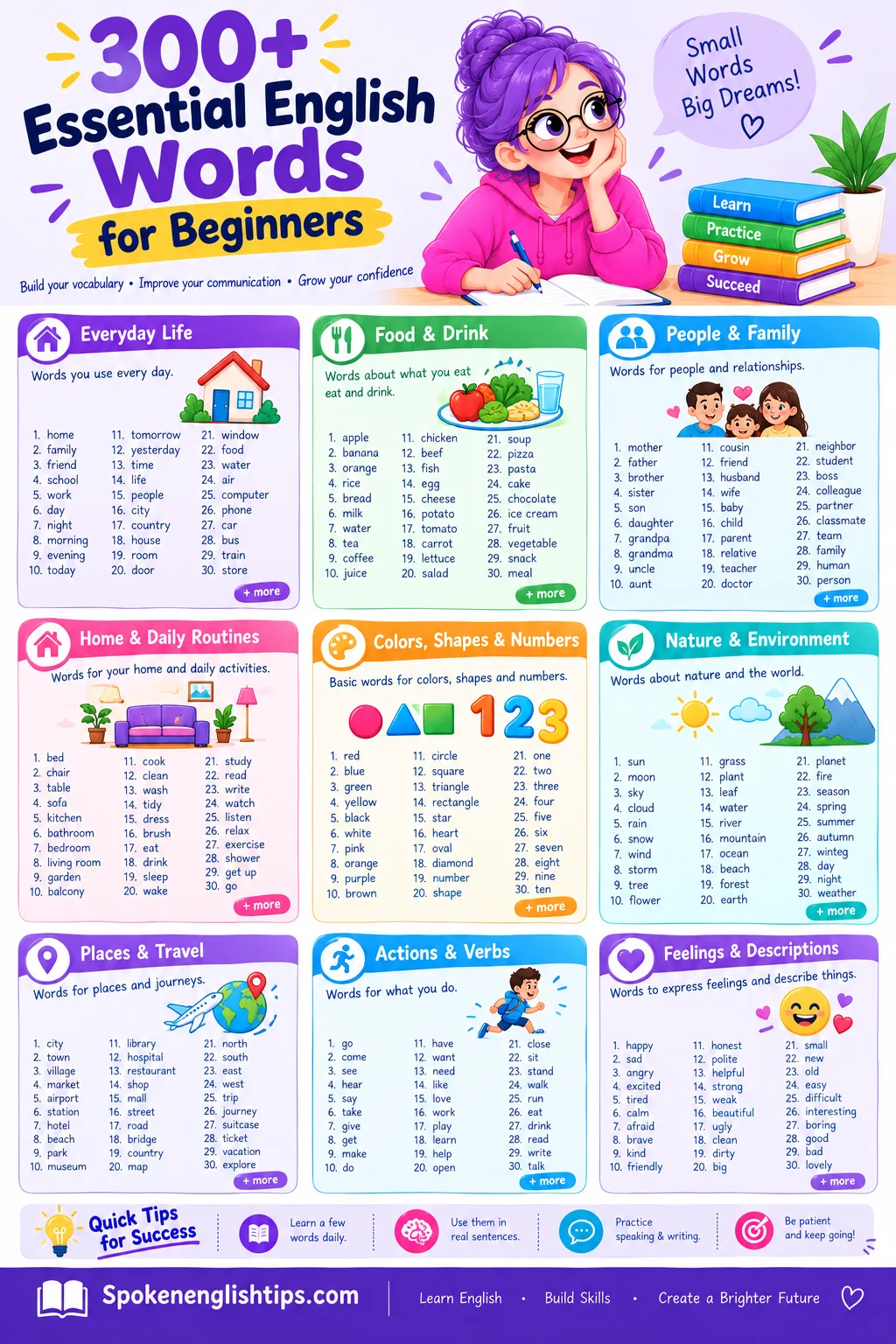
Learning essential English words is one of the easiest ways to build a strong foundation in English. Common words appear again and again in everyday conversations, reading, writing, work, school, travel, and daily activities. When you know these words, it becomes easier to understand simple sentences and express your own ideas.
Learning vocabulary by category can make the process even easier. Instead of memorizing random words, you can learn related words together, such as family words, action verbs, food words, time words, travel words, and describing words. This helps you remember new vocabulary and use it naturally in real situations.
In this guide, you will find Essential English Words for Beginners, organized into useful categories with simple examples. Read the words aloud, learn them in context, and practice making your own sentences. Regular review and daily practice can gradually improve your English vocabulary.
1. Pronouns and Helper Words
Words that help you build basic English sentences
Pronouns
I, you, he, she, it, we, they
Articles
a, an, the
Conjunctions
and, but, or, because, so
Prepositions
in, on, at, to, from, with, for, of
| Word | Example |
|---|---|
| I | I am happy. |
| you | You are my friend. |
| he | He is a teacher. |
| she | She is at home. |
| we | We are ready. |
| they | They live here. |
2. Common Action Verbs
Essential verbs for everyday communication
be, do, have, go, come, get, make, take, give, put
eat, drink, sleep, walk, run, sit, stand, open, close, help
say, tell, ask, answer, speak, talk, listen, read, write
| Word | Example |
|---|---|
| go | I go to school. |
| come | Come with me. |
| eat | I eat breakfast. |
| drink | Drink some water. |
| read | I read a book. |
| write | Write your name. |
450+ Basic English Words for Beginners
Learning English doesn’t have to start with complicated grammar rules or long vocabulary lists. A better way to start is to learn words you can actually use in everyday conversations.
4. Descriptive Words (Adjectives)
Words used to describe people, things, feelings, and situations
| Category | Words |
|---|---|
| Size | big, small, large, long, short |
| Appearance | beautiful, pretty, clean, dirty, new |
| Feelings | happy, sad, angry, tired, excited |
| Quality | good, bad, easy, difficult, useful |
5. Time Words
Common words for talking about time and frequency
6. Numbers and Quantity Words
Basic words for numbers, amounts, and quantities
| Word | Example |
|---|---|
| some | I need some water. |
| many | She has many books. |
| much | I don’t have much time. |
| more | I need more money. |
| few | I have a few questions. |
| enough | We have enough food. |
7. Question Words
Essential words for asking questions in English
| Question Word | Use | Example |
|---|---|---|
| what | Things | What is this? |
| who | People | Who is she? |
| where | Places | Where do you live? |
| when | Time | When will you come? |
| why | Reason | Why are you sad? |
| how | Manner or condition | How are you? |
8. Daily Conversation Words
Common words and expressions used in everyday conversations
9. Food and Drink Words
Useful vocabulary for meals, drinks, cooking, and ordering food
| Category | Words |
|---|---|
| Food | rice, bread, egg, meat, chicken |
| Fruits | apple, banana, orange, mango |
| Drinks | water, milk, tea, coffee, juice |
| Actions | eat, drink, cook, buy, order |
10. Home and Daily Life Words
Essential vocabulary for your home and everyday surroundings
11. School and Work Words
Common vocabulary for learning, jobs, and the workplace
12. Travel and Places
Useful vocabulary for locations, transportation, and travel
13. Body and Health Words
Basic vocabulary for body parts and everyday health conversations
14. Colors and Common Describing Words
Simple words for colors, conditions, speed, weight, and appearance
15. Nature and Weather Words
Common vocabulary for nature, the sky, and everyday weather
| Category | Words |
|---|---|
| Sky | sun, moon, star, cloud, sky |
| Nature | tree, flower, river, mountain, sea |
| Weather | sunny, rainy, cloudy, windy |
| Temperature | hot, cold, warm, cool |
Essential English Words: Quick Reference
Use this quick-reference table to review important English vocabulary by category. It can also be used as a simple checklist for regular vocabulary practice.
| Category | Essential English Words |
|---|---|
| Pronouns | I, you, he, she, it, we, they |
| Articles | a, an, the |
| Verbs | be, do, have, go, come, get, make, take |
| Actions | eat, drink, sleep, walk, run, sit, stand |
| People | man, woman, boy, girl, child, friend |
| Family | mother, father, brother, sister |
| Places | home, school, office, shop, market |
| Objects | book, pen, bag, phone, table, chair |
| Adjectives | good, bad, big, small, new, old |
| Feelings | happy, sad, angry, tired, excited |
| Time | today, tomorrow, yesterday, now, later |
| Questions | what, who, where, when, why, how |
| Food | rice, bread, egg, fruit, chicken |
| Drinks | water, milk, tea, coffee, juice |
| Travel | bus, train, car, taxi, airport |
| Weather | sunny, rainy, cloudy, windy, hot, cold |
| Polite Words | please, sorry, thank you, excuse me |
| Quantity | some, many, much, more, few, enough |
50 Essential English Words With Simple Sentences
Learning a word becomes easier when you see it in a simple sentence. Use these examples to understand how common English words can be used in everyday communication.
| Word | Meaning | Simple Sentence |
|---|---|---|
| go | move to a place | I go to school. |
| come | move toward someone | Come here. |
| eat | have food | I eat rice. |
| drink | have a drink | I drink water. |
| happy | feeling good | I am happy. |
| tired | needing rest | I am tired. |
| home | place where you live | I am at home. |
| friend | person you know well | He is my friend. |
| book | something you read | This is my book. |
| help | make something easier | Please help me. |
How to Learn Essential English Words
You do not need to memorize hundreds of words at once. A simple and regular practice routine can make vocabulary easier to remember and use.
1. Learn Words by Category
Family: mother, father, brother, sister
2. Learn Words in Context
Water: I drink water.
3. Make Simple Sentences
Go: I go to work.
4. Practice Speaking
Say the words and sentences aloud. Try to use them in your daily conversations.
5. Review Regularly
Review yesterday’s words before learning new ones.
Beginner Vocabulary Checklist
Use this checklist to track the English vocabulary categories you have studied. Check each category after you have learned and practiced the words.
| Vocabulary Category | Learned |
|---|---|
| Pronouns | |
| Helper Words | |
| Verbs | |
| Nouns | |
| Adjectives | |
| Time Words | |
| Numbers | |
| Question Words | |
| Conversation Words | |
| Food Words | |
| Home Words | |
| School Words | |
| Work Words | |
| Travel Words | |
| Body Words | |
| Weather Words |