A low undergraduate GPA can feel like a massive roadblock on your journey to a top-tier business school. When you are staring down average admitted GPAs of 3.6 to 3.9 at M7 programs, a 2.8 or 3.1 can induce serious panic.
But here is the reality: MBA admissions committees do not admit numbers; they admit people.
Your GPA is a historical metric. It tells the admissions committee who you were at 19 or 20 years old. Top MBA programs are far more interested in who you are today, what you have achieved since graduation, and where you are going. If you can prove that your undergraduate grades are an outlier in an otherwise stellar profile, the gates to elite business schools are still open.
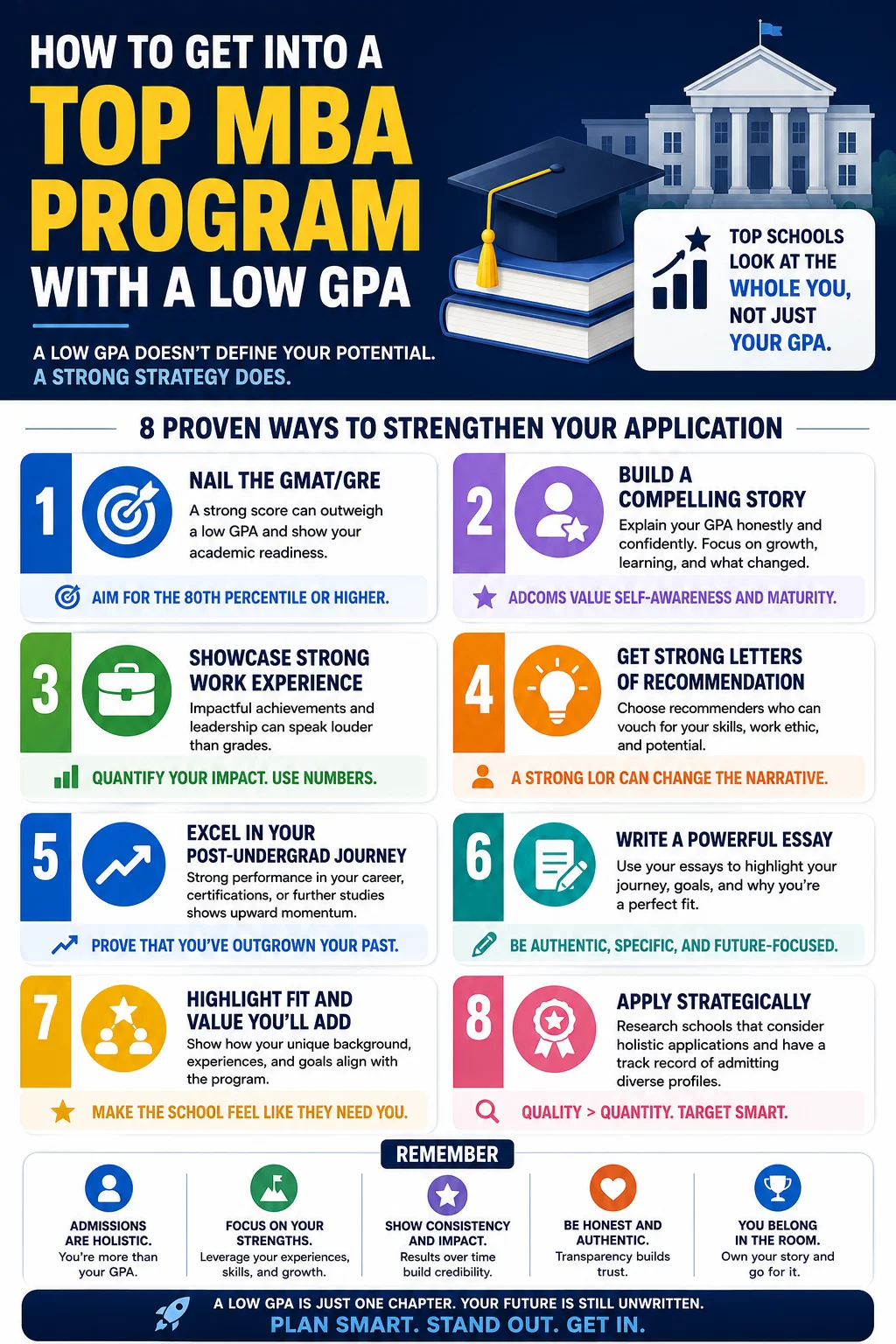
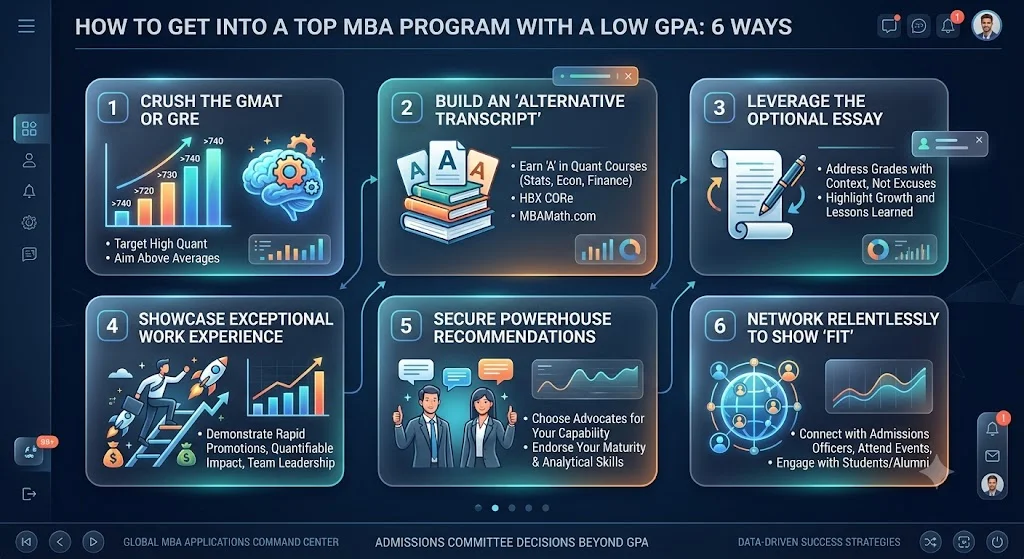
Here are six proven ways to overcome a sub-par GPA and land an acceptance letter from a top MBA program.
- 12 Powerful Reasons Why MBA Worth It in 2026
- 12 MBA Skills Every Student Must Learn
- 25 MBA Interview Questions with Smart Answers
- 7 Best MBA Courses for Working Professionals
- Top 15 MBA Specializations with the Highest Salary in India: 2026 Guide
1. Crush the GMAT or GRE
This is the single most effective way to neutralize a low GPA. Admissions committees use your GPA to answer one primary question: Can this candidate handle the academic rigor of our program?
If your undergraduate transcript fails to answer that with a “yes,” your standardized test score must scream it.
- Aim Above the Average: Do not just aim for the school’s median score. If a school’s average GMAT is 720, you should be targeting a 740 or higher to offset the academic liability of your GPA.
- Focus on the Quant: Business school is heavily quantitative. A low GPA coupled with a low quantitative sub-score is a massive red flag. A top-percentile math score on the GMAT or GRE proves you have the analytical chops to survive core classes like finance and accounting.
2. Build an “Alternative Transcript”
If your academic history is weak, build a new one. An alternative transcript consists of recent, high-quality grades from reputable institutions that prove your current academic maturity.
Instead of taking generic courses, target the specific subjects that MBA adcoms care about most:
- Statistics
- Microeconomics
- Financial Accounting
- Corporate Finance
Where to take them:
You do not need to enroll in a formal degree program. Consider programs specifically designed for MBA prep, such as HBX CORe (Harvard Business School’s credential program) or MBAMath.com. Alternatively, earning an “A” in an evening extension course at a reputable local university works perfectly.
3. Leverage the Optional Essay
Almost every MBA application includes an optional essay, usually explicitly designated for explaining extenuating circumstances. This is your opportunity to address the elephant in the room.
The golden rule of the optional essay is Context, Not Excuses. You must explain the why without shifting the blame.
| Approach | Example | Impression Given |
| Context | Worked 30 hours weekly to fund tuition | Shows grit and resilience |
| Ownership | Lacked focus and maturity in early years | Demonstrates self-awareness |
| Evidence | Achieved a 3.8 GPA in final two years | Proves an upward trajectory |
| Blame | The professor graded unfairly | Looks highly defensive |
Keep it brief, objective, and factual. State what happened, what you learned from it, and point to the evidence (like your GMAT or recent coursework) that proves it is no longer an issue.
4. Showcase Exceptional Work Experience
MBA programs value real-world impact over classroom theory. A candidate with a 3.0 GPA who has spearheaded a $5 million product launch, managed a team of ten, and earned rapid promotions will almost always beat out a 4.0 GPA candidate with a stagnant, uninspired career.
To make your work experience outshine your GPA, focus your resume and essays on:
- Quantifiable Impact: How much money did you save? How much revenue did you generate?
- Trajectory: Have you been promoted faster than your peers?
- Leadership: Have you influenced cross-functional teams or managed direct reports?
5. Secure Powerhouse Recommendations
When your academic foundation is shaky, third-party validation becomes critical. Your recommenders can advocate for your intellectual capacity and work ethic in ways you cannot do yourself without sounding arrogant.
Sit down with your recommenders and explicitly discuss your GPA concern. Ask them to highlight specific instances where you demonstrated:
- Sharp analytical thinking
- The ability to learn complex concepts quickly
- Maturity and professionalism
A letter from a respected director stating, “They are the most analytically gifted associate I have managed in ten years,” goes a long way in erasing doubts about a C- in sophomore year Calculus.
6. Network Relentlessly to Show “Fit”
Admissions officers advocate for candidates they actually like and remember. If you are just a file in a stack, it is easy to reject you based on a low number. If you are the insightful, engaging professional they met at a coffee chat or who asked brilliant questions during a campus visit, they will look for reasons to admit you.
- Attend both virtual and in-person admissions events.
- Reach out to current students and alumni who run clubs you want to join.
- Mention these specific conversations in your essays to show deep, personalized interest in their program.
A low GPA is a hurdle, not a stop sign. Top MBA programs are in the business of identifying future industry leaders, and leadership is rarely defined by perfection on a college transcript. By delivering a stellar GMAT score, proving your current academic discipline, and leading with massive professional impact, you can confidently claim your seat in a top-tier business school.